Myanmar Hiking Gear & Equipment Market Size, Share & Growth Rate
The Myanmar Hiking Gear & Equipment Market was estimated at USD 268 Million in 2025 and is projected to reach USD 375 Million by 2032, growing at a CAGR of 4.9% from 2026 to 2032. This growth trajectory is underpinned by a surge in both local and international interest in adventure tourism, as Myanmar's diverse and picturesque landscapes become increasingly recognized as prime hiking destinations. Additionally, rising disposable incomes are enabling a broader segment of the population to invest in high-quality hiking gear, aligning with the growing trend of health-conscious outdoor recreation.
Myanmar Hiking Gear & Equipment Market Year-wise Growth Rate and Key Drivers
This graph highlights how the Myanmar Hiking Gear & Equipment Market has steadily grown over the years, supported by major growth factors.
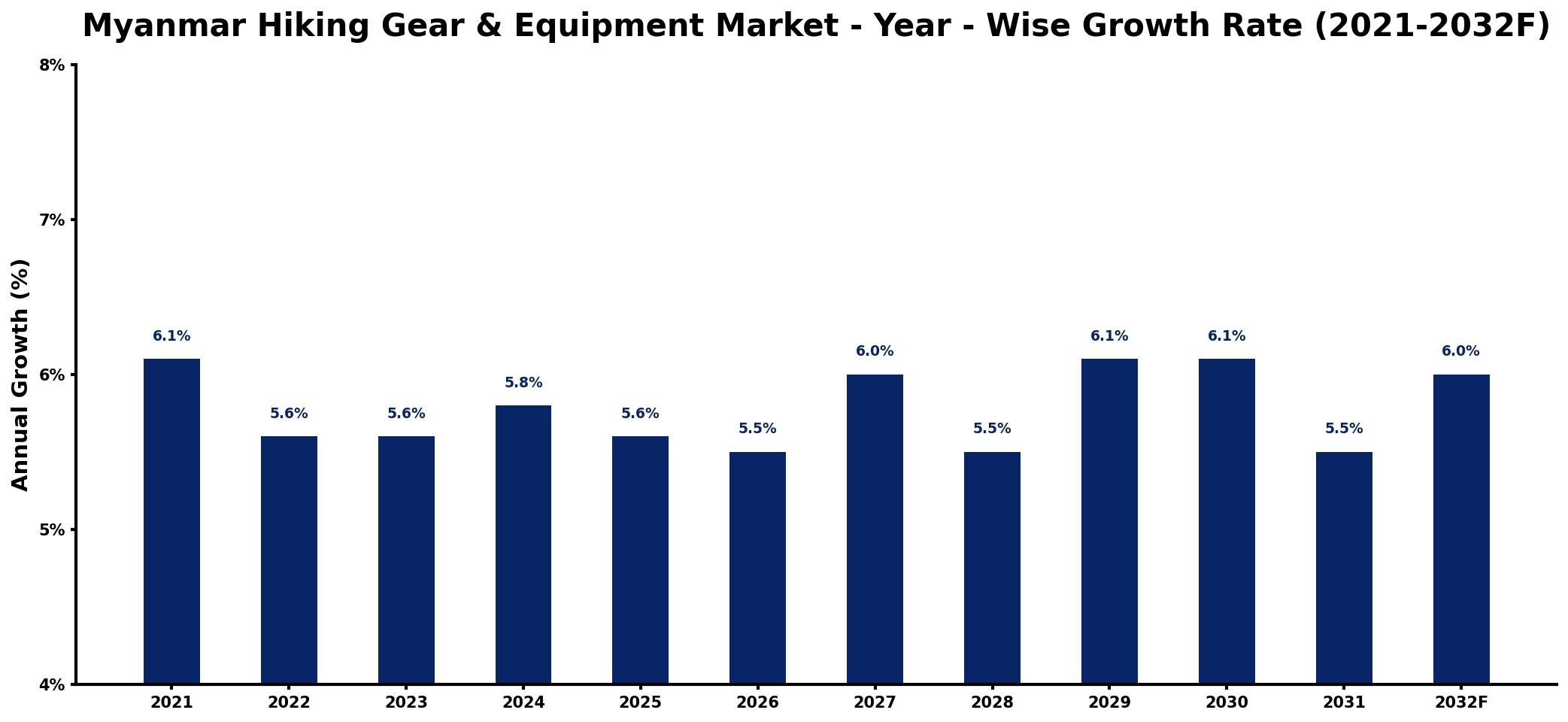
The table below presents the year‑wise growth rates along with the key drivers influencing the market
| Year | Growth Rate | Major Drivers |
| 2021 | 6.1% | Rising interest in outdoor activities |
| 2022 | 5.6% | Growing domestic tourism initiatives |
| 2023 | 5.6% | Increased disposable income trends |
| 2024 | 5.8% | Expansion of eco-tourism programs |
| 2025 | 5.6% | Emergence of adventure travel packages |
| 2026 | 5.5% | Enhanced accessibility to natural parks |
| 2027 | 6.0% | Investment in outdoor recreation infrastructure |
| 2028 | 5.5% | Development of community outdoor events |
| 2029 | 6.1% | Strengthening of online retail platforms |
| 2030 | 6.1% | Collaboration with travel influencers |
| 2031 | 5.5% | Promotion of health wellness lifestyles |
| 2032 | 6.0% | Increased environmental awareness campaigns |
Note: Market size estimations and growth projections presented in this report are based on 6Wresearch's proprietary forecasting methodology, utilizing the latest available industry data, government publications, and primary research inputs.
Myanmar Hiking Gear & Equipment Market Synopsis
In Myanmar, the demand for durable and lightweight hiking gear is climbing, propelled by both locals and tourists eager to explore the countrys stunning trails. The growing interest in eco-friendly options is also influencing purchasing decisions, as consumers become more aware of the environmental impact of outdoor activities.
On the supply side, local retailers and e-commerce platforms are expanding their reach, catering to an increasingly adventurous consumer base. The influx of international brands known for their quality and reliability is enhancing product offerings and driving competition in the market.
- The market is driven by increasing disposable incomes and an interest in health and wellness through outdoor activities.
- Demand for lightweight, durable, and eco-friendly hiking gear is on the rise among consumers.
- International brands are gaining traction due to their superior quality and performance.
- Local retailers are expanding their product range and online presence to meet growing demand.
- Government initiatives focused on promoting sustainable tourism are shaping market dynamics.
Despite the promising growth, the Myanmar Hiking Gear & Equipment Market faces significant obstacles. A considerable portion of the population remains unfamiliar with outdoor activities, leading to a lack of engagement. Additionally, the current infrastructure for hiking trails is often inadequate, hindering potential growth. The market is also plagued by issues of counterfeit goods, which compromise consumer trust in product quality. Fluctuating import regulations and high duties further restrict the availability of a wider variety of international products, making it challenging for consumers to access quality gear.
Several trends are currently shaping the Myanmar Hiking Gear & Equipment Market. There's a notable shift towards the use of advanced technology, with consumers increasingly looking for gear equipped with GPS and solar-powered devices. Moreover, the demand for specialized trekking gear tailored to Myanmars unique landscapes is on the rise, signifying a more focused approach by brands. Additionally, the emphasis on sustainability is prompting consumers to seek out eco-friendly materials, driving brands to innovate and offer responsible products.
The market offers significant investment opportunities, particularly in segments focusing on high-quality hiking apparel, footwear, and camping equipment. There's also a growing niche for eco-friendly products, reflecting consumer preferences for sustainable outdoor recreation. Partnerships with local retailers and leveraging e-commerce platforms can enhance brand presence and distribution. This expansion is crucial for tapping into the lucrative middle-class demographic eager to explore Myanmars natural beauty.
The Myanmar government is actively fostering an environment conducive to sustainable tourism and outdoor recreation. Policies are in place to ensure hiking gear meets safety and environmental standards, promoting the use of eco-friendly materials. Additionally, initiatives encouraging local production of hiking equipment aim to boost domestic industries while minimizing reliance on imports. These government efforts not only protect the environment but also seek to create a supportive framework for the hiking gear market.
Looking ahead to 2026-2032, the Myanmar Hiking Gear & Equipment Market is poised for a sustained period of growth. Increasing participation in outdoor activities, coupled with rising consumer awareness about health benefits, is expected to drive demand. Moreover, government initiatives aimed at promoting tourism will likely contribute to greater interest in adventure sports. As technological innovations continue to develop in hiking gear, the market will attract a broader consumer base, propelling its expansion.
In recent months, the market has seen an influx of new product launches focusing on lightweight and high-performance gear, appealing to both recreational hikers and serious trekkers. Additionally, several e-commerce platforms have reported increased sales as consumers prefer online shopping for convenience and variety. There's also been a growing emphasis on community awareness programs promoting responsible hiking practices, aimed at safeguarding Myanmar's natural landscape for future generations.
- 10 Years of Market Numbers
- Historical Data Starting from 2022 to 2025
- Base Year: 2025
- Forecast Data until 2032
- Key Performance Indicators Impacting the Market
- Major Upcoming Developments and Projects
Key Highlights of the Report:
- Myanmar Hiking Gear & Equipment Market Outlook
- Market Size of Myanmar Hiking Gear & Equipment Market, 2025
- Forecast of Myanmar Hiking Gear & Equipment Market, 2032
- Historical Data and Forecast of Myanmar Hiking Gear & Equipment Revenues & Volume for the Period 2022-2032F
- Myanmar Hiking Gear & Equipment Market Trend Evolution
- Myanmar Hiking Gear & Equipment Market Drivers and Challenges
- Myanmar Hiking Gear & Equipment Price Trends
- Myanmar Hiking Gear & Equipment Porter's Five Forces
- Myanmar Hiking Gear & Equipment Industry Life Cycle
- Historical Data and Forecast of Myanmar Hiking Gear & Equipment Market Revenues & Volume By Product for the Period 2022-2032F
- Historical Data and Forecast of Myanmar Hiking Gear & Equipment Market Revenues & Volume By Clothes for the Period 2022-2032F
- Historical Data and Forecast of Myanmar Hiking Gear & Equipment Market Revenues & Volume By Footwear for the Period 2022-2032F
- Historical Data and Forecast of Myanmar Hiking Gear & Equipment Market Revenues & Volume By Backpack for the Period 2022-2032F
- Historical Data and Forecast of Myanmar Hiking Gear & Equipment Market Revenues & Volume By Equipment for the Period 2022-2032F
- Historical Data and Forecast of Myanmar Hiking Gear & Equipment Market Revenues & Volume By Others for the Period 2022-2032F
- Historical Data and Forecast of Myanmar Hiking Gear & Equipment Market Revenues & Volume By Distribution Channel for the Period 2022-2032F
- Historical Data and Forecast of Myanmar Hiking Gear & Equipment Market Revenues & Volume By Specialty stores for the Period 2022-2032F
- Historical Data and Forecast of Myanmar Hiking Gear & Equipment Market Revenues & Volume By Retail stores for the Period 2022-2032F
- Historical Data and Forecast of Myanmar Hiking Gear & Equipment Market Revenues & Volume By Online for the Period 2022-2032F
- Myanmar Hiking Gear & Equipment Import Export Trade Statistics
- Market Opportunity Assessment By Product
- Market Opportunity Assessment By Distribution Channel
- Myanmar Hiking Gear & Equipment Top Companies Market Share
- Myanmar Hiking Gear & Equipment Competitive Benchmarking By Technical and Operational Parameters
- Myanmar Hiking Gear & Equipment Company Profiles
- Myanmar Hiking Gear & Equipment Key Strategic Recommendations






































