Myanmar Hotel Furniture Market Summary
The myanmar hotel furniture market was estimated at USD 155 Million in 2025 and is projected to reach USD 204 Million by 2032, growing at a CAGR of 5.0% from 2026 to 2032.
Myanmar Hotel Furniture Market Year-wise Growth Rate and Key Drivers
This graph highlights how the Myanmar Hotel Furniture Market has steadily grown over the past five years, supported by major growth factors.
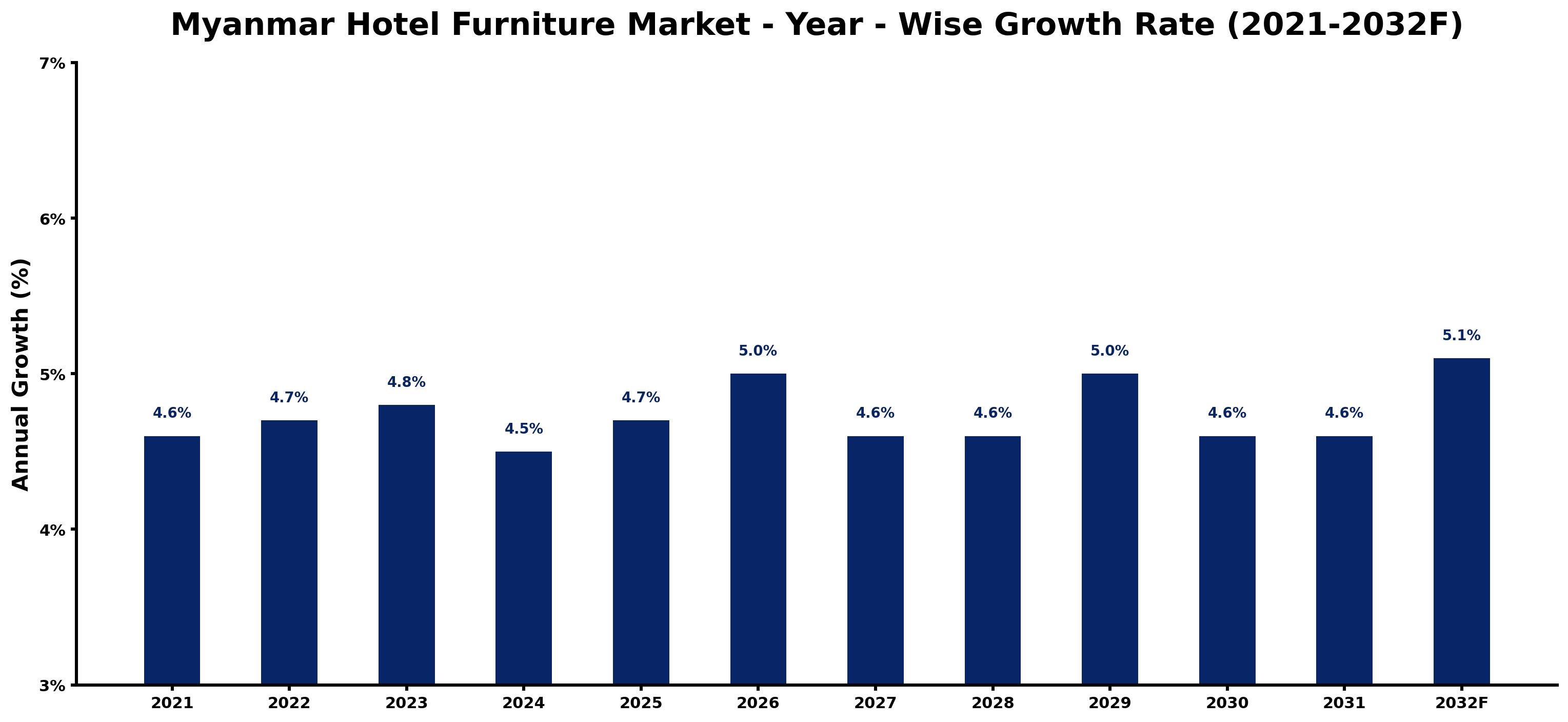
The table below presents the year wise growth rates along with the key drivers influencing the market
| Year | Growth Rate | Major Drivers |
| 2021 | 4.6% | Tourism recovery post-COVID encourages increased investment in hotel infrastructure and furnishings. |
| 2022 | 4.7% | Local manufacturers enhance capabilities, offering customized solutions suited for Myanmar's cultural aesthetics. |
| 2023 | 4.8% | The influx of foreign investments leads to a surge in luxury hotel developments nationwide. |
| 2024 | 4.5% | Sustainability practices gain traction, prompting hotels to seek eco-friendly furniture options. |
| 2025 | 4.7% | Emerging boutique hotels require unique furniture designs, diversifying market offerings significantly. |
| 2026 | 5.0% | Urbanization trends drive demand for compact, multifunctional furniture in city hotels. |
| 2027 | 4.6% | Construction of new resorts along coastal areas attracts premium furniture suppliers to the market. |
| 2028 | 4.6% | Increased domestic tourism fosters local demand for enhanced hotel experiences and quality furnishings. |
| 2029 | 5.0% | Digitalization in the hospitality sector boosts online procurement of hotel furniture solutions. |
| 2030 | 4.6% | Collaborations between designers and local artisans promote traditional craftsmanship in hotel furniture. |
| 2031 | 4.6% | International hospitality brands enter Myanmar, setting higher standards for furniture design and quality. |
| 2032 | 5.1% | Economic stabilization supports long-term investments in luxury accommodations and associated furniture. |
Note - Market size estimations and growth projections presented in this report are based on 6Wresearch's advanced forecasting approach, validated with industry datasets as of June 2026.
Myanmar Hotel Furniture Market Synopsis
The Myanmar Hotel Furniture Market is projected to reach 5.0% and witness significant growth during the forecast period (2026-2032). This growth is primarily fueled by increased investments in Myanmar's burgeoning tourism sector, which has led to a substantial rise in the development of hotels and resorts. As the demand for stylish and high-quality furniture grows, local manufacturers find an opportunity to present their craftsmanship tailored to the unique requirements of the hospitality industry. The focus on durable and sustainable materials, coupled with modern designs that harmoniously blend traditional aesthetics, underscores the evolving dynamics of the market.
Myanmar Hotel Furniture Market Growth Drivers
The expansion of the Myanmar Hotel Furniture Market is driven by several key factors:
- The influx of international tourists is significantly increasing the demand for accommodation, propelling the growth of hotels and resorts that require quality furnishings.
- Investments in tourism-related infrastructure, supported by government initiatives, are boosting the operational capabilities of the hospitality sector.
- A growing preference among hotels for modern, functional, and aesthetically appealing furniture enhances guest experience, which is crucial in a competitive market.
- The trend toward sustainability fosters demand for eco-friendly materials, prompting manufacturers to adopt more responsible sourcing practices.
- Customization in furniture design allows hotels to create unique identities, thus attracting a diverse clientele seeking memorable experiences.
Myanmar Hotel Furniture Market Trends and Opportunities
Current trends in the Myanmar Hotel Furniture Market illustrate a noticeable shift toward contemporary designs. Hotels increasingly prioritize furniture that not only meets functional needs but also enhances the overall guest experience through style and comfort. This trend opens several opportunities:
- The growing emphasis on space-efficient furniture solutions allows for versatile room configurations, essential for maximizing revenue in high-demand periods.
- Demand for sustainable furniture options is likely to lead to innovation in material usage, allowing businesses to highlight their commitment to environmental stewardship.
- Increasing investor interest in the hospitality sector creates avenues for partnerships between local artisans and international suppliers, fostering cultural exchange and enhancing product offerings.
- With a competitive landscape, hotels must differentiate themselves through unique furniture designs, prompting an increase in bespoke manufacturing requests.
- As health and wellness become focal points for travelers, furniture that supports these themes will be increasingly sought after, presenting a niche for specialized product lines.
Myanmar Hotel Furniture Market Challenges and Restraints
Despite the positive outlook, the Myanmar Hotel Furniture Market faces several challenges:
- Limited access to high-quality raw materials necessitates the reliance on imported products, which can escalate costs and affect pricing strategies.
- The lack of standardized regulations and quality control measures complicates the procurement process, leading to potential inconsistencies in furniture quality.
- Economic factors such as currency fluctuations may affect investment and purchasing decisions, creating uncertainty for stakeholders.
- Political instability can deter foreign investment and impact market confidence, posing challenges for long-term planning.
- Intense competition from both local and international entities places pressure on pricing strategies, necessitating differentiation through innovation and quality.
Myanmar Hotel Furniture Market Government Investment and Initiatives
The Myanmar government is actively implementing policies to foster the growth of the hotel furniture market. Key initiatives include:
- Regulations aimed at establishing quality and safety standards in furniture production help to ensure that products meet both domestic and international expectations.
- Programs promoting the use of eco-friendly materials align with global sustainability goals, encouraging manufacturers to adopt more responsible practices.
- Support for local artisans is prioritized, fostering the preservation of traditional crafts and integrating them into modern furniture design.
- Tax incentives are available for businesses that engage in sustainable practices and contribute to the local economy, thus enhancing market appeal.
- Development plans focusing on tourism infrastructure aim to improve connectivity and amenities, creating an attractive environment for both investment and consumer engagement.
Myanmar Hotel Furniture Market Latest Developments (May 2025 - June 2026)
Recent developments in the Myanmar Hotel Furniture Market reflect a proactive approach to meet the evolving demands of the hospitality sector. During this period, there has been a notable increase in partnerships between local manufacturers and international designers, aimed at enhancing product diversity and quality. Additionally, hotels are increasingly seeking customized furniture solutions that reflect their unique identities and brand values. Sustainability initiatives have gained momentum, with more establishments prioritizing eco-friendly furniture options. The government's commitment to improving tourism infrastructure has also led to heightened investments in the hospitality sector, which is expected to underpin robust growth in the hotel furniture market.
Myanmar Hotel Furniture Market Future Outlook
The outlook for the Myanmar Hotel Furniture Market remains positive as the tourism sector continues to expand. With increasing tourist arrivals, the demand for high-quality, stylish furniture is projected to rise. Continuous government efforts to bolster tourism and improve infrastructure further emphasize the potential growth trajectory of the hospitality industry. As hoteliers aim to provide comfortable and visually appealing accommodations, there will be consistent opportunities for suppliers and manufacturers. Overall, steady growth is anticipated in the coming years, indicating a favorable business environment for stakeholders within the Myanmar hotel furniture market.
Myanmar Hotel Furniture Market - Key Attractiveness of the Report
- 10 Years of Market Numbers
- Historical Data Starting from 2022 to 2025
- Base Year: 2025
- Forecast Data until 2032
- Key Performance Indicators Impacting the Market
- Major Upcoming Developments and Projects
Key Highlights of the Report:
- Myanmar Hotel Furniture Market Outlook
- Market Size of Myanmar Hotel Furniture Market, 2025
- Forecast of Myanmar Hotel Furniture Market, 2032F
- Historical Data and Forecast of Myanmar Hotel Furniture Revenues & Volume for the Period 2022-2032F
- Myanmar Hotel Furniture Market Trend Evolution
- Myanmar Hotel Furniture Market Drivers and Challenges
- Myanmar Hotel Furniture Price Trends
- Myanmar Hotel Furniture Porter's Five Forces
- Myanmar Hotel Furniture Industry Life Cycle
- Historical Data and Forecast of Myanmar Hotel Furniture Market Revenues & Volume By Product Types for the Period 2022-2032F
- Historical Data and Forecast of Myanmar Hotel Furniture Market Revenues & Volume By Table and Chairs for the Period 2022-2032F
- Historical Data and Forecast of Myanmar Hotel Furniture Market Revenues & Volume By Hotel Beds for the Period 2022-2032F
- Historical Data and Forecast of Myanmar Hotel Furniture Market Revenues & Volume By Hotel Casegoods for the Period 2022-2032F
- Historical Data and Forecast of Myanmar Hotel Furniture Market Revenues & Volume By Other for the Period 2022-2032F
- Historical Data and Forecast of Myanmar Hotel Furniture Market Revenues & Volume By Applications for the Period 2022-2032F
- Historical Data and Forecast of Myanmar Hotel Furniture Market Revenues & Volume By Business Hotel for the Period 2022-2032F
- Historical Data and Forecast of Myanmar Hotel Furniture Market Revenues & Volume By Luxury Hotel for the Period 2022-2032F
- Historical Data and Forecast of Myanmar Hotel Furniture Market Revenues & Volume By Boutique Hotel for the Period 2022-2032F
- Historical Data and Forecast of Myanmar Hotel Furniture Market Revenues & Volume By Other for the Period 2022-2032F
- Myanmar Hotel Furniture Import Export Trade Statistics
- Market Opportunity Assessment By Product Types
- Market Opportunity Assessment By Applications
- Myanmar Hotel Furniture Top Companies Market Share
- Myanmar Hotel Furniture Competitive Benchmarking By Technical and Operational Parameters
- Myanmar Hotel Furniture Company Profiles
- Myanmar Hotel Furniture Key Strategic Recommendations






































