Myanmar Identity and Access Management Market Size & Growth Rate (2026-2032)
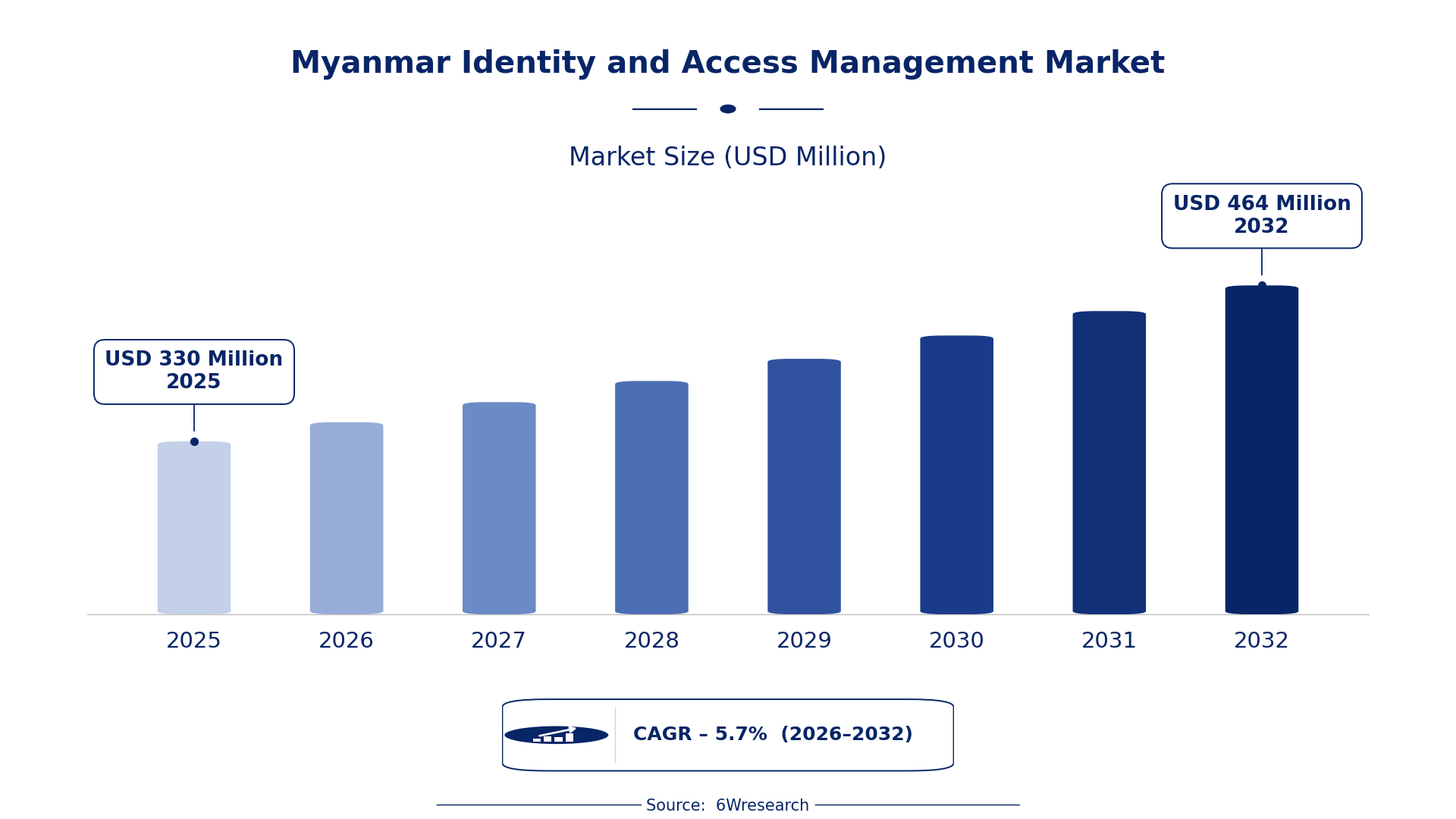
The Myanmar Identity and Access Management Market was estimated at USD 330 Million in 2025 and is projected to reach USD 464 Million by 2032, growing at a CAGR of 5.7% from 2026 to 2032.
Myanmar Identity and Access Management Market Synopsis
The escalating need for enhanced cybersecurity is the primary force shaping the Myanmar Identity and Access Management Market today. Organizations across various sectors are recognizing that protecting sensitive data and ensuring regulatory compliance are non-negotiable as they adopt digital technologies.
In response to a rapidly changing digital environment, businesses are increasingly turning towards sophisticated IAM solutions. Local and international providers are entering the market, offering tailored services that address the unique challenges faced by Myanmar's organizations, driven by a growing awareness of the importance of robust identity management.
Myanmar Identity and Access Management Market Year-wise Growth Rate and Key Drivers
This graph illustrates the annual growth rates of the Myanmar Identity and Access Management Market from 2021 to 2032, highlighting a steady upward trajectory and projected expansion over the forecast period.
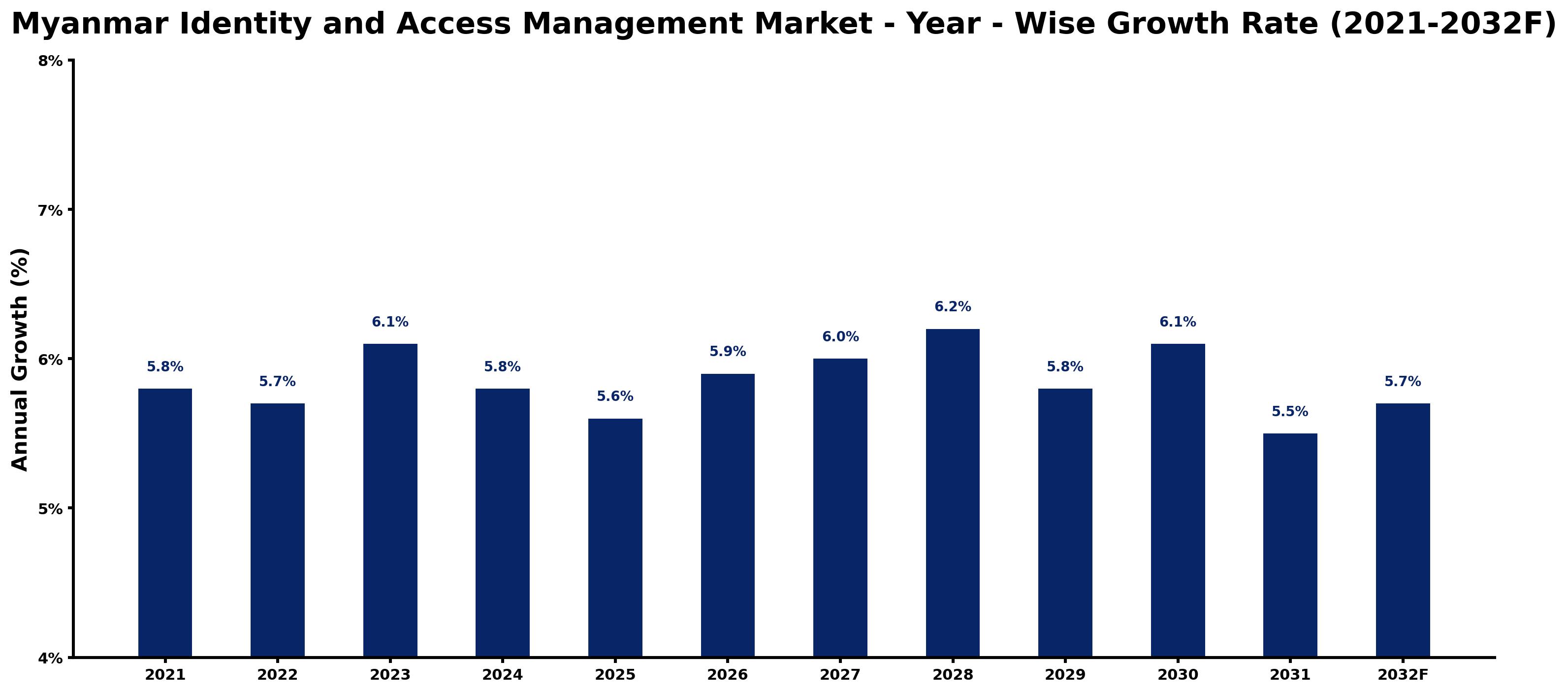
The table below presents the year‑wise growth rates along with the key drivers influencing the market
| Year | Growth Rate | Major Drivers |
| 2021 | 5.8% | Government push for digital identification systems initiatives. |
| 2022 | 5.7% | Increased demand for KYC regulations among financial institutions. |
| 2023 | 6.1% | Rising biometric authentication adoption in government services. |
| 2024 | 5.8% | Expanding mobile network coverage facilitates identity solutions. |
| 2025 | 5.6% | Growing digital fraud concerns drive security technology adoption. |
| 2026 | 5.9% | Local startups enhancing user authentication platforms rapidly. |
| 2027 | 6.0% | Legislative support for cyber security frameworks increases market confidence. |
| 2028 | 6.2% | Increased online transaction volumes necessitate effective identity management. |
| 2029 | 5.8% | Public sector's digitization strategy boosts access management technologies. |
| 2030 | 6.1% | Matured e-commerce sector demands comprehensive identity verification. |
| 2031 | 5.5% | Yearly increase in internet penetration fuels identity solution demand. |
| 2032 | 5.7% | Emergence of local cybersecurity companies strengthens market offerings. |
Note: Market size estimations and growth projections presented in this report are based on 6Wresearch's proprietary forecasting methodology, utilizing the latest available industry data, government publications, and primary research inputs.
Myanmar Identity and Access Management Market Key Takeaways
Below are some of the specific key takeaways from the market, including:
- The increasing prevalence of cyber threats is driving demand for IAM solutions in Myanmar.
- Cloud-based IAM offerings are gaining traction, emphasizing flexibility and scalability for businesses.
- Regulatory compliance, particularly concerning data protection, is a key factor influencing IAM adoption.
- Integrated IAM platforms are becoming the preferred choice for organizations seeking comprehensive identity management.
- Investment opportunities exist in biometric authentication and user-friendly identity verification solutions.
Evaluation of Restraints in Myanmar Identity and Access Management Market
Despite the promising growth prospects, several restraints limit the Myanmar Identity and Access Management Market's potential. A prevalent lack of awareness about IAM solutions persists among businesses, leading to missed opportunities for enhanced security. Coupled with this, the shortage of skilled professionals capable of implementing and managing IAM systems effectively hampers progress. Additionally, ongoing concerns related to data privacy and security create an environment of hesitation, further slowing down market adoption. Traditional identity management processes, often fraught with errors, continue to pose challenges, undermining efforts to secure digital assets. The current political and economic climate adds another layer of uncertainty, making it imperative for vendors to educate the market and provide the necessary training for local talent.
Myanmar Identity and Access Management Market Trends
A few trends are significantly influencing the Myanmar Identity and Access Management Market. The shift towards cloud-based solutions is a notable development, as businesses seek systems that can grow with their needs while ensuring security. Concurrently, organizations are becoming increasingly aware of the importance of compliance with data protection regulations, leading to heightened interest in IAM solutions that assure secure data access. Furthermore, the market is witnessing a transition towards integrated IAM platforms that combine identity governance, access management, and authentication, streamlining processes and enhancing security protocols.
Myanmar Identity and Access Management Market Opportunities
Investment opportunities are thriving within the Myanmar Identity and Access Management Market, driven by the ongoing digitalization of businesses and government services. As entities aim to bolster cybersecurity and simplify user access, the demand for innovative IAM solutions is escalating. Key growth areas include biometric authentication technologies, cloud-based identity management platforms, and specialized solutions tailored for Myanmar's regulatory landscape. The increased use of mobile and online services also highlights the need for secure and user-friendly identity verification mechanisms, opening avenues for investment in this sector.
Government Initiatives in the Myanmar Identity and Access Management Market
The government of Myanmar is increasingly recognizing the importance of a secure identity and access management framework. Recent policy actions reflect a commitment to fostering growth in this sector, with regulations aimed at enhancing cybersecurity and protecting personal data. These initiatives not only encourage businesses to adopt IAM solutions but also create a framework that supports the development of a more secure digital environment.
- A regulatory framework implemented in 2025 mandates businesses to ensure compliance with data protection standards.
- Currently ongoing, a national cybersecurity initiative is underway, aimed at enhancing the overall security posture of critical digital services.
- A planned public-private partnership is expected to launch by 2027, focusing on the development of innovative IAM solutions tailored for local organizations.
- A recently completed training program for local IT professionals was held in early 2025, aimed at building local expertise in IAM technologies.
Future Insights of the Myanmar Identity and Access Management Market
Looking ahead to 2026-2032, the Myanmar Identity and Access Management Market is set to expand significantly, fueled by ongoing digital transformation initiatives across various sectors. The rise in cloud services adoption and a heightened emphasis on data security and privacy will propel organizations to seek IAM solutions that facilitate effective user identity management. The banking, finance, healthcare, and government sectors, in particular, will be pivotal in driving demand, as these industries prioritize compliance with data protection regulations and safeguard sensitive information.
Myanmar Identity and Access Management Market Latest Developments
In the past year, the Myanmar Identity and Access Management Market has witnessed a surge of activity, reflecting a growing recognition of the need for advanced IAM solutions. Companies are ramping up efforts to innovate and improve their service offerings, signaling a more competitive market environment.
- A major technology vendor launched a new cloud-based IAM platform in early 2025, providing businesses with enhanced security and ease of access.
- In mid-2025, a regional operator announced an ongoing partnership aimed at integrating biometric authentication technologies into existing IAM solutions.
- A rollout of a user-friendly identity verification system is planned for Q3 2026, designed to meet the growing demand for secure online services.
- A key service upgrade was initiated in late 2025 to improve the functionality and security features of an existing IAM product, enhancing user experience.
Myanmar Identity and Access Management Market - Key Attractiveness of the Report
- 10 Years of Market Numbers
- Historical Data Starting from 2022 to 2025
- Base Year: 2025
- Forecast Data until 2032
- Key Performance Indicators Impacting the Market
- Major Upcoming Developments and Projects
Key Highlights of the Report:
- Myanmar Identity and Access Management Market Outlook
- Market Size of Myanmar Identity and Access Management Market, 2025
- Forecast of Myanmar Identity and Access Management Market, 2032
- Historical Data and Forecast of Myanmar Identity and Access Management Revenues & Volume for the Period 2022-2032F
- Myanmar Identity and Access Management Market Trend Evolution
- Myanmar Identity and Access Management Market Drivers and Challenges
- Myanmar Identity and Access Management Price Trends
- Myanmar Identity and Access Management Porter's Five Forces
- Myanmar Identity and Access Management Industry Life Cycle
- Historical Data and Forecast of Myanmar Identity and Access Management Market Revenues & Volume By Component for the Period 2022-2032F
- Historical Data and Forecast of Myanmar Identity and Access Management Market Revenues & Volume By Solutions for the Period 2022-2032F
- Historical Data and Forecast of Myanmar Identity and Access Management Market Revenues & Volume By Services for the Period 2022-2032F
- Historical Data and Forecast of Myanmar Identity and Access Management Market Revenues & Volume By Solution for the Period 2022-2032F
- Historical Data and Forecast of Myanmar Identity and Access Management Market Revenues & Volume By Data Directory for the Period 2022-2032F
- Historical Data and Forecast of Myanmar Identity and Access Management Market Revenues & Volume By Identity Lifecycle Management for the Period 2022-2032F
- Historical Data and Forecast of Myanmar Identity and Access Management Market Revenues & Volume By Deployment Mode for the Period 2022-2032F
- Historical Data and Forecast of Myanmar Identity and Access Management Market Revenues & Volume By Cloud for the Period 2022-2032F
- Historical Data and Forecast of Myanmar Identity and Access Management Market Revenues & Volume By On-premises for the Period 2022-2032F
- Historical Data and Forecast of Myanmar Identity and Access Management Market Revenues & Volume By Organization Size for the Period 2022-2032F
- Historical Data and Forecast of Myanmar Identity and Access Management Market Revenues & Volume By SMEs for the Period 2022-2032F
- Historical Data and Forecast of Myanmar Identity and Access Management Market Revenues & Volume By Large Enterprises for the Period 2022-2032F
- Historical Data and Forecast of Myanmar Identity and Access Management Market Revenues & Volume By Vertical for the Period 2022-2032F
- Historical Data and Forecast of Myanmar Identity and Access Management Market Revenues & Volume By BFSI for the Period 2022-2032F
- Historical Data and Forecast of Myanmar Identity and Access Management Market Revenues & Volume By Travel and Hospitality for the Period 2022-2032F
- Historical Data and Forecast of Myanmar Identity and Access Management Market Revenues & Volume By Healthcare for the Period 2022-2032F
- Historical Data and Forecast of Myanmar Identity and Access Management Market Revenues & Volume By Retail and eCommerce for the Period 2022-2032F
- Historical Data and Forecast of Myanmar Identity and Access Management Market Revenues & Volume By IT and ITeS for the Period 2022-2032F
- Historical Data and Forecast of Myanmar Identity and Access Management Market Revenues & Volume By Education for the Period 2022-2032F
- Historical Data and Forecast of Myanmar Identity and Access Management Market Revenues & Volume By Others (Energy and Utilities, Telecommunication, Other Citizen Services) for the Period 2022-2032F
- Myanmar Identity and Access Management Import Export Trade Statistics
- Market Opportunity Assessment By Component
- Market Opportunity Assessment By Solution
- Market Opportunity Assessment By Deployment Mode
- Market Opportunity Assessment By Organization Size
- Market Opportunity Assessment By Vertical
- Myanmar Identity and Access Management Top Companies Market Share
- Myanmar Identity and Access Management Competitive Benchmarking By Technical and Operational Parameters
- Myanmar Identity and Access Management Company Profiles
- Myanmar Identity and Access Management Key Strategic Recommendations






































