Myanmar Industrial Fasteners Market Size Growth Rate
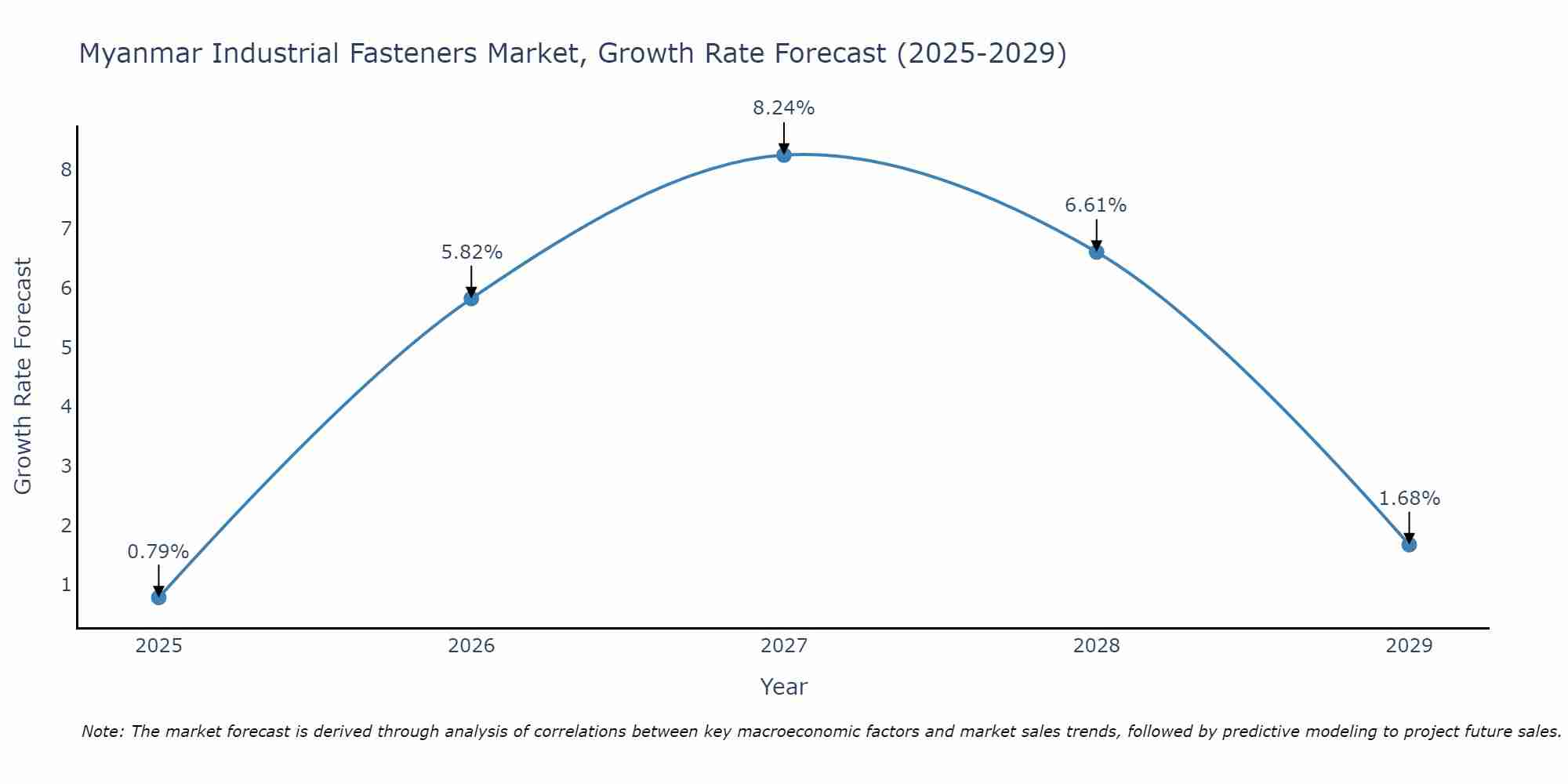
The Myanmar Industrial Fasteners Market is projected to witness mixed growth rate patterns during 2025 to 2029. Starting at 0.79% in 2025, the market peaks at 8.24% in 2027, and settles at 1.68% by 2029.
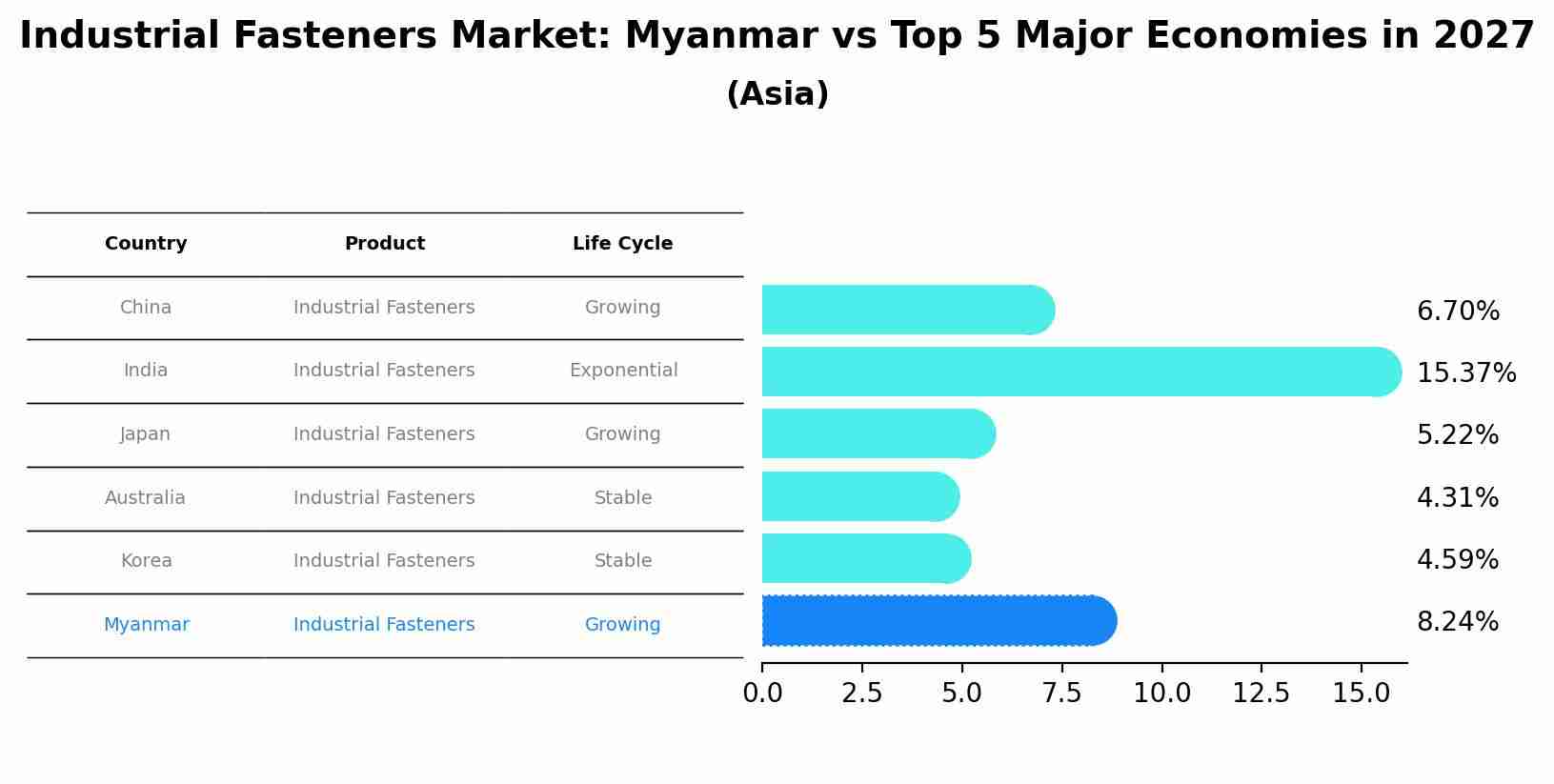
Industrial Fasteners Market: Myanmar vs Top 5 Major Economies in 2027 (Asia)
Myanmar's Industrial Fasteners market is anticipated to experience a growing growth rate of 8.24% by 2027, reflecting trends observed in the largest economy China, followed by India, Japan, Australia and South Korea.
Myanmar Industrial Fasteners Market Overview
The Industrial Fasteners Market in Myanmar supports construction, automotive, and machinery sectors. Fasteners such as bolts, nuts, and screws are essential components that ensure the structural integrity and reliability of assembled products.
Drivers of the market
The growth of the manufacturing sector and the increasing demand for durable and reliable fastening solutions drive the growth of the industrial fasteners market in Myanmar. Industrial fasteners, such as bolts, nuts, screws, and washers, are critical components used in the assembly of machinery, equipment, and structures. Moreover, the expansion of automotive, aerospace, and construction industries fuels the demand for high-quality fasteners. Additionally, the development of innovative fastening technologies and the emphasis on product quality and safety further stimulate market growth in Myanmar.
Challenges of the market
In Myanmar, the industrial fasteners market encounters challenges related to quality control and supply chain management. Inconsistent product quality and reliability pose risks to industrial operations, leading to equipment failures and production delays. Moreover, logistical constraints and supply chain disruptions affect the availability and affordability of fastener products, impacting manufacturing efficiency and competitiveness in the market.
Government Policy of the market
Government policies aim to regulate and support the industrial fasteners market in Myanmar, ensuring product quality, safety, and reliability. These policies include standards for fastener design and performance, as well as measures to promote local manufacturing, reduce dependency on imports, and enhance competitiveness in domestic and international markets.
Key Highlights of the Report:
- Myanmar Industrial Fasteners Market Outlook
- Market Size of Myanmar Industrial Fasteners Market, 2024
- Forecast of Myanmar Industrial Fasteners Market, 2031
- Historical Data and Forecast of Myanmar Industrial Fasteners Revenues & Volume for the Period 2018 - 2031
- Myanmar Industrial Fasteners Market Trend Evolution
- Myanmar Industrial Fasteners Market Drivers and Challenges
- Myanmar Industrial Fasteners Price Trends
- Myanmar Industrial Fasteners Porter's Five Forces
- Myanmar Industrial Fasteners Industry Life Cycle
- Historical Data and Forecast of Myanmar Industrial Fasteners Market Revenues & Volume By Raw Material for the Period 2018 - 2031
- Historical Data and Forecast of Myanmar Industrial Fasteners Market Revenues & Volume By Plastic for the Period 2018 - 2031
- Historical Data and Forecast of Myanmar Industrial Fasteners Market Revenues & Volume By Metal for the Period 2018 - 2031
- Historical Data and Forecast of Myanmar Industrial Fasteners Market Revenues & Volume By Product for the Period 2018 - 2031
- Historical Data and Forecast of Myanmar Industrial Fasteners Market Revenues & Volume By Externally Threaded for the Period 2018 - 2031
- Historical Data and Forecast of Myanmar Industrial Fasteners Market Revenues & Volume By Internally Threaded for the Period 2018 - 2031
- Historical Data and Forecast of Myanmar Industrial Fasteners Market Revenues & Volume By Non-threaded for the Period 2018 - 2031
- Historical Data and Forecast of Myanmar Industrial Fasteners Market Revenues & Volume By Aerospace Grade for the Period 2018 - 2031
- Historical Data and Forecast of Myanmar Industrial Fasteners Market Revenues & Volume By Application for the Period 2018 - 2031
- Historical Data and Forecast of Myanmar Industrial Fasteners Market Revenues & Volume By Automotive for the Period 2018 - 2031
- Historical Data and Forecast of Myanmar Industrial Fasteners Market Revenues & Volume By Aerospace for the Period 2018 - 2031
- Historical Data and Forecast of Myanmar Industrial Fasteners Market Revenues & Volume By Building & Construction for the Period 2018 - 2031
- Historical Data and Forecast of Myanmar Industrial Fasteners Market Revenues & Volume By Industrial Machinery for the Period 2018 - 2031
- Historical Data and Forecast of Myanmar Industrial Fasteners Market Revenues & Volume By Lawn and Garden for the Period 2018 - 2031
- Historical Data and Forecast of Myanmar Industrial Fasteners Market Revenues & Volume By Plumbing Products for the Period 2018 - 2031
- Historical Data and Forecast of Myanmar Industrial Fasteners Market Revenues & Volume By Others for the Period 2018 - 2031
- Myanmar Industrial Fasteners Import Export Trade Statistics
- Market Opportunity Assessment By Raw Material
- Market Opportunity Assessment By Product
- Market Opportunity Assessment By Application
- Myanmar Industrial Fasteners Top Companies Market Share
- Myanmar Industrial Fasteners Competitive Benchmarking By Technical and Operational Parameters
- Myanmar Industrial Fasteners Company Profiles
- Myanmar Industrial Fasteners Key Strategic Recommendations






































