Democratic Republic of the Congo Industrial Fasteners Market Size Growth Rate
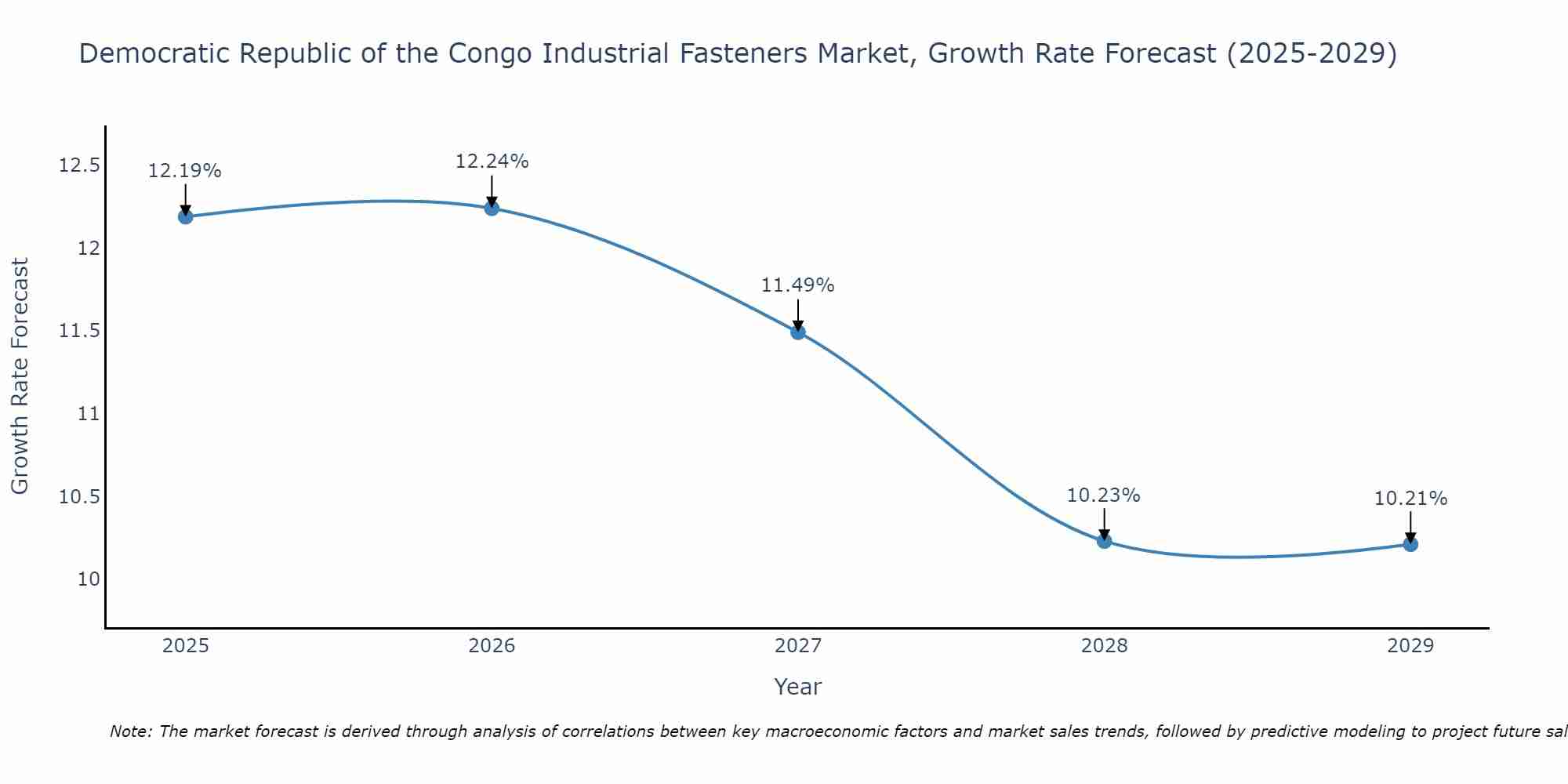
The Democratic Republic of the Congo Industrial Fasteners Market is projected to witness mixed growth rate patterns during 2025 to 2029. The growth rate begins at 12.19% in 2025, climbs to a high of 12.24% in 2026, and moderates to 10.21% by 2029.
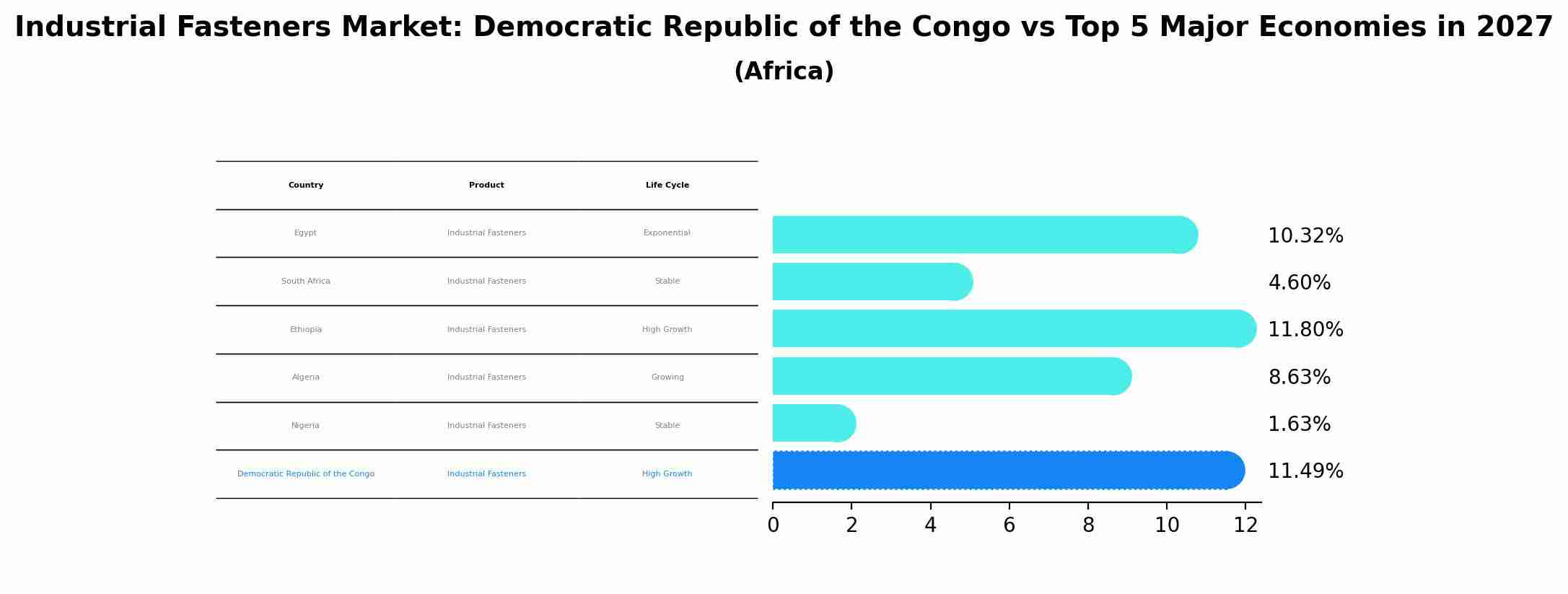
Industrial Fasteners Market: Democratic Republic of the Congo vs Top 5 Major Economies in 2027 (Africa)
By 2027, Democratic Republic of the Congo's Industrial Fasteners market is forecasted to achieve a high growth rate of 11.49%, with Egypt leading the Africa region, followed by South Africa, Ethiopia, Algeria and Nigeria.
Congo Industrial Fasteners Market Overview
The industrial fasteners market in Congo is expanding with the growing need for fastening solutions in manufacturing and construction. Industrial fasteners, including bolts, nuts, and screws, are essential for securing components and structures. The market is driven by industrial growth and advancements in fastener technology. Challenges include the need for high-quality and reliable fasteners and competition from alternative fastening solutions.
Drivers of the market
The growth of the industrial fasteners market is driven by the expansion of construction and automotive industries, along with the demand for high-strength fastening solutions.
Challenges of the market
The industrial fasteners market in Congo is constrained by supply chain and quality control issues. The reliance on imported fasteners can result in inconsistencies in product quality and availability. Additionally, the lack of local manufacturing capabilities for fasteners means that businesses face higher costs and longer lead times. The absence of standardized testing and certification processes for fasteners can also impact the reliability and performance of industrial applications.
Government Policy of the market
Congos government supports the industrial fasteners market through policies that encourage local manufacturing and use in construction, automotive, and machinery sectors. Tax incentives and subsidies are provided, along with reduced import duties on raw materials and components. The government also enforces standards to ensure the strength and reliability of fasteners in various applications.
Key Highlights of the Report:
- Congo Industrial Fasteners Market Outlook
- Market Size of Congo Industrial Fasteners Market, 2024
- Forecast of Congo Industrial Fasteners Market, 2031
- Historical Data and Forecast of Congo Industrial Fasteners Revenues & Volume for the Period 2021-2031
- Congo Industrial Fasteners Market Trend Evolution
- Congo Industrial Fasteners Market Drivers and Challenges
- Congo Industrial Fasteners Price Trends
- Congo Industrial Fasteners Porter`s Five Forces
- Congo Industrial Fasteners Industry Life Cycle
- Historical Data and Forecast of Congo Industrial Fasteners Market Revenues & Volume By Raw Material for the Period 2021-2031
- Historical Data and Forecast of Congo Industrial Fasteners Market Revenues & Volume By Plastic for the Period 2021-2031
- Historical Data and Forecast of Congo Industrial Fasteners Market Revenues & Volume By Metal for the Period 2021-2031
- Historical Data and Forecast of Congo Industrial Fasteners Market Revenues & Volume By Product for the Period 2021-2031
- Historical Data and Forecast of Congo Industrial Fasteners Market Revenues & Volume By Externally Threaded for the Period 2021-2031
- Historical Data and Forecast of Congo Industrial Fasteners Market Revenues & Volume By Internally Threaded for the Period 2021-2031
- Historical Data and Forecast of Congo Industrial Fasteners Market Revenues & Volume By Non-threaded for the Period 2021-2031
- Historical Data and Forecast of Congo Industrial Fasteners Market Revenues & Volume By Aerospace Grade for the Period 2021-2031
- Historical Data and Forecast of Congo Industrial Fasteners Market Revenues & Volume By Application for the Period 2021-2031
- Historical Data and Forecast of Congo Industrial Fasteners Market Revenues & Volume By Automotive for the Period 2021-2031
- Historical Data and Forecast of Congo Industrial Fasteners Market Revenues & Volume By Aerospace for the Period 2021-2031
- Historical Data and Forecast of Congo Industrial Fasteners Market Revenues & Volume By Building & Construction for the Period 2021-2031
- Historical Data and Forecast of Congo Industrial Fasteners Market Revenues & Volume By Industrial Machinery for the Period 2021-2031
- Historical Data and Forecast of Congo Industrial Fasteners Market Revenues & Volume By Lawn and Garden for the Period 2021-2031
- Historical Data and Forecast of Congo Industrial Fasteners Market Revenues & Volume By Plumbing Products for the Period 2021-2031
- Historical Data and Forecast of Congo Industrial Fasteners Market Revenues & Volume By Others for the Period 2021-2031
- Congo Industrial Fasteners Import Export Trade Statistics
- Market Opportunity Assessment By Raw Material
- Market Opportunity Assessment By Product
- Market Opportunity Assessment By Application
- Congo Industrial Fasteners Top Companies Market Share
- Congo Industrial Fasteners Competitive Benchmarking By Technical and Operational Parameters
- Congo Industrial Fasteners Company Profiles
- Congo Industrial Fasteners Key Strategic Recommendations






































