Myanmar IoT Connectivity Market Size & Growth Rate (2026-2032)
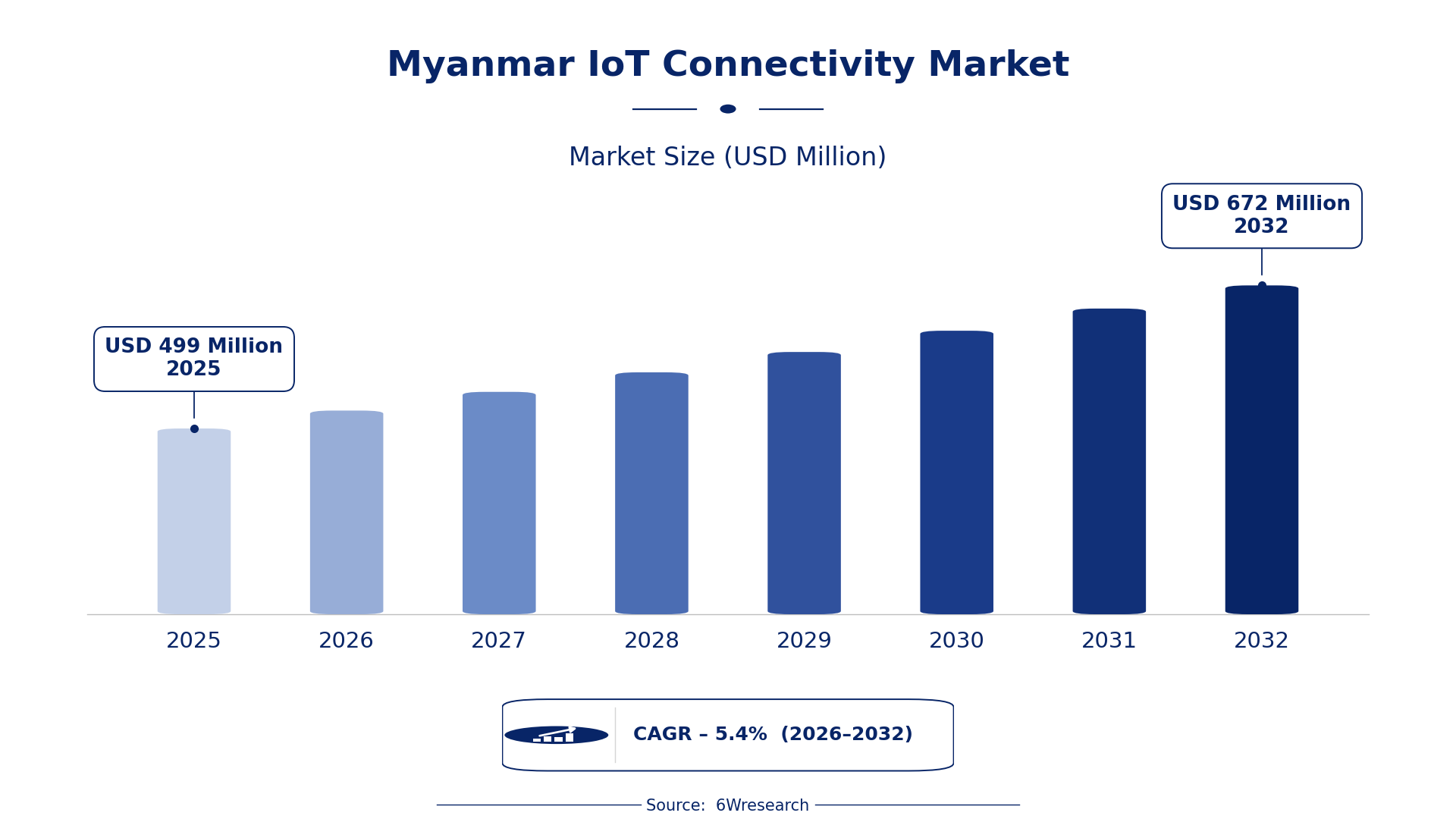
The Myanmar IoT Connectivity Market was estimated at USD 499 Million in 2025 and is projected to reach USD 672 Million by 2032, growing at a CAGR of 5.4% from 2026 to 2032.
Myanmar IoT Connectivity Market Synopsis
The surge in IoT device deployment is the primary catalyst driving the Myanmar IoT Connectivity Market. As urbanization accelerates and businesses seek automation, the demand for reliable connectivity solutions is becoming non-negotiable.
With applications spanning smart homes, industrial automation, and healthcare, connectivity is critical for seamless data exchange. The introduction of advanced wireless technologies like 5G is further enhancing the potential for innovative applications across various sectors.
Myanmar IoT Connectivity Market Year-wise Growth Rate and Key Drivers
This graph illustrates the annual growth rates of the Myanmar IoT Connectivity Market from 2021 to 2032, highlighting a steady upward trajectory and projected expansion over the forecast period.
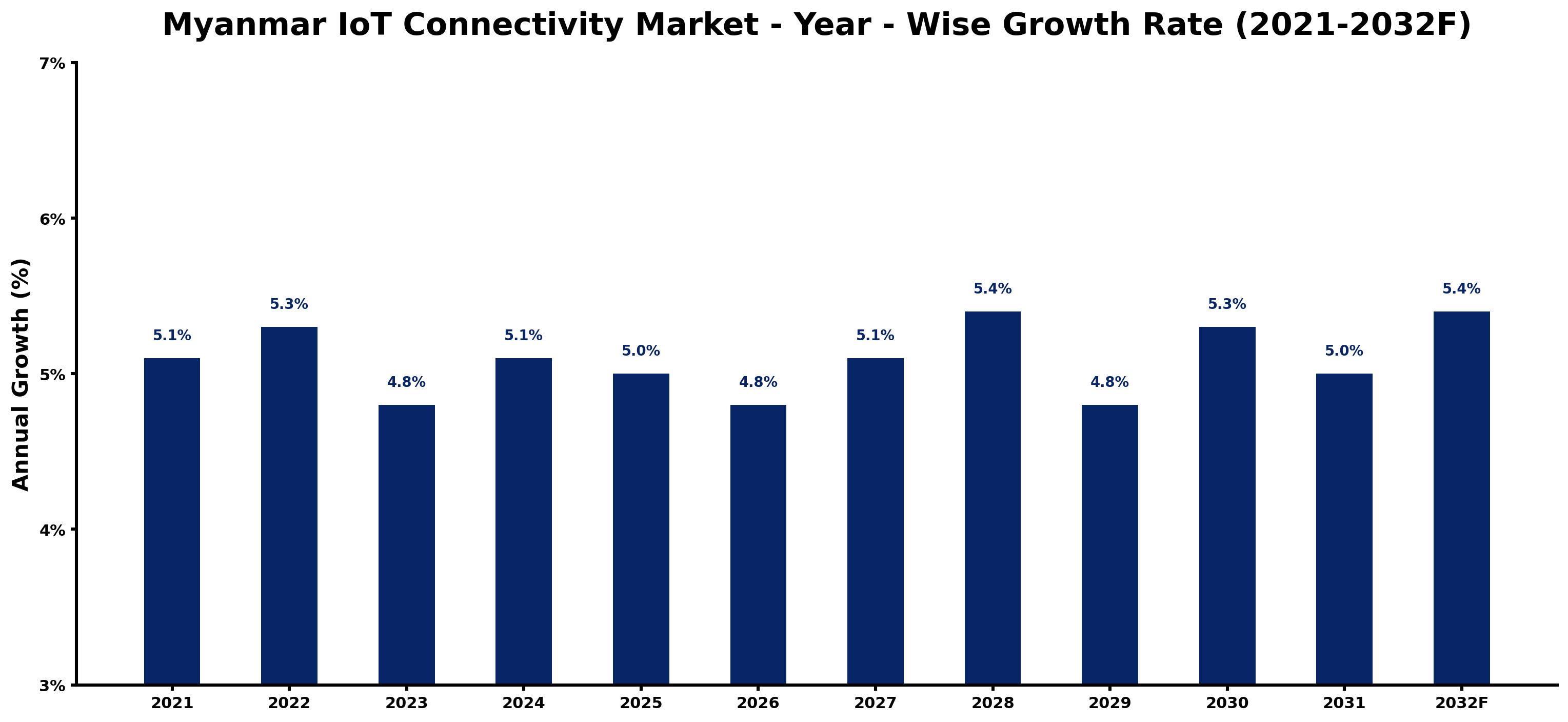
The table below presents the year‑wise growth rates along with the key drivers influencing the market
| Year | Growth Rate | Major Drivers |
| 2021 | 5.1% | Boost in mobile penetration facilitating IoT adoption. |
| 2022 | 5.3% | Government policy promoting smart manufacturing among local industries. |
| 2023 | 4.8% | Rising interest in smart home devices among consumers. |
| 2024 | 5.1% | Local universities initiating IoT training programs for students. |
| 2025 | 5.0% | Increased foreign investment in tech startups enhancing connectivity. |
| 2026 | 4.8% | Surge in logistics companies using IoT for tracking solutions. |
| 2027 | 5.1% | Emergence of health monitoring systems enhancing public health. |
| 2028 | 5.4% | Investment in agricultural IoT solutions improving yield management. |
| 2029 | 4.8% | Increase in climate monitoring initiatives using IoT technology. |
| 2030 | 5.3% | Greater roll-out of renewable energy projects using IoT. |
| 2031 | 5.0% | Companies adopting IoT for supply chain optimization. |
| 2032 | 5.4% | National digitalization strategy fostering IoT ecosystem growth. |
Note: Market size estimations and growth projections presented in this report are based on 6Wresearch's proprietary forecasting methodology, utilizing the latest available industry data, government publications, and primary research inputs.
Myanmar IoT Connectivity Market Key Takeaways
Below are some of the specific key takeaways from the market, including:
- The increasing deployment of IoT devices is fueling demand for connectivity solutions.
- Advanced wireless technologies are critical for enhancing IoT performance.
- Infrastructure limitations are significant barriers to market growth.
- Government policies are increasingly focused on improving connectivity infrastructure.
- Healthcare applications are emerging as a significant driver for IoT connectivity.
Evaluation of Restraints in Myanmar IoT Connectivity Market
Infrastructure limitations present a major challenge for the Myanmar IoT Connectivity Market. Many rural areas lack access to reliable internet and wireless networks, which restricts the deployment of IoT solutions. Additionally, issues related to device compatibility and network coverage create hurdles for both consumers and businesses. The high costs associated with data roaming further complicate matters, making it essential for providers to develop more affordable and widespread connectivity solutions. Regulatory compliance also adds another layer of complexity, as companies must navigate the intricacies of telecommunications regulations and spectrum allocation.
Myanmar IoT Connectivity Market Trends
One key trend is the growing adoption of 5G technology, which promises to significantly enhance connectivity and enable advanced applications. The increasing focus on smart cities is also driving demand, as local governments seek to implement IoT solutions for traffic management, waste management, and energy efficiency. Additionally, the rise of connected healthcare applications is pushing for more secure and reliable data transmission, underscoring the importance of network reliability and security in the market.
Myanmar IoT Connectivity Market Opportunities
Investment opportunities are abundant in the Myanmar IoT Connectivity Market. With the government prioritizing infrastructure development, companies can capitalize on public-private partnerships aimed at expanding network coverage. Additionally, the push for smart city initiatives opens avenues for technology providers to deliver innovative solutions that address urban challenges. The healthcare sector, in particular, presents a lucrative opportunity for IoT applications focused on patient monitoring and telemedicine.
Government Initiatives in the Myanmar IoT Connectivity Market
Government policy plays a crucial role in shaping the Myanmar IoT Connectivity Market. By focusing on enhancing connectivity infrastructure, the government is laying the groundwork for broader IoT adoption. Regulatory measures that ensure fair competition and spectrum availability are vital for attracting investment and fostering innovation within the sector.
- A national digital infrastructure upgrade programme now in its rollout phase aims to expand broadband access across urban and rural areas.
- Current initiatives include incentives for telecom operators to enhance network reliability and coverage.
- A regulatory framework introduced in 2025 mandates increased transparency in pricing for IoT connectivity services.
- Upcoming plans include a public-private initiative expected to bolster telecommunications infrastructure by 2028.
Future Insights of the Myanmar IoT Connectivity Market
Looking ahead to 2026-2032, the Myanmar IoT Connectivity Market is set for substantial growth. As more devices connect to the internet, the necessity for reliable, fast, and secure connectivity will become increasingly urgent. The integration of 5G technology will likely serve as a cornerstone for advancements in various sectors, including healthcare and industrial automation. on top of that, as government initiatives take root, the expansion of infrastructure will further support the development of a thriving IoT ecosystem.
Myanmar IoT Connectivity Market Latest Developments
In the last year, the Myanmar IoT Connectivity Market has seen notable developments aimed at improving connectivity and expanding infrastructure. The focus on advanced technologies and innovative solutions is shaping the direction of the industry.
- A leading regional operator launched a 5G pilot program in early 2025, targeting urban centers to demonstrate enhanced connectivity capabilities.
- An initiative that began in mid-2025 and remains underway involves partnerships with local tech companies to develop IoT solutions for smart agriculture.
- A major technology vendor is currently rolling out a new LPWAN solution designed to improve connectivity in remote areas, expected to be completed by late 2026.
- Plans for an upcoming national awareness campaign are set to kick off in early 2026, aimed at educating businesses on the benefits of IoT connectivity.
Myanmar IoT Connectivity Market - Key Attractiveness of the Report
- 10 Years of Market Numbers
- Historical Data Starting from 2022 to 2025
- Base Year: 2025
- Forecast Data until 2032
- Key Performance Indicators Impacting the Market
- Major Upcoming Developments and Projects
Key Highlights of the Report:
- Myanmar IoT Connectivity Market Outlook
- Market Size of Myanmar IoT Connectivity Market, 2025
- Forecast of Myanmar IoT Connectivity Market, 2032
- Historical Data and Forecast of Myanmar IoT Connectivity Revenues & Volume for the Period 2022-2032F
- Myanmar IoT Connectivity Market Trend Evolution
- Myanmar IoT Connectivity Market Drivers and Challenges
- Myanmar IoT Connectivity Price Trends
- Myanmar IoT Connectivity Porter's Five Forces
- Myanmar IoT Connectivity Industry Life Cycle
- Historical Data and Forecast of Myanmar IoT Connectivity Market Revenues & Volume By Component for the Period 2022-2032F
- Historical Data and Forecast of Myanmar IoT Connectivity Market Revenues & Volume By Platform for the Period 2022-2032F
- Historical Data and Forecast of Myanmar IoT Connectivity Market Revenues & Volume By Services for the Period 2022-2032F
- Historical Data and Forecast of Myanmar IoT Connectivity Market Revenues & Volume By Application Areas for the Period 2022-2032F
- Historical Data and Forecast of Myanmar IoT Connectivity Market Revenues & Volume By Building & Home Automation for the Period 2022-2032F
- Historical Data and Forecast of Myanmar IoT Connectivity Market Revenues & Volume By Smart Energy & Utility for the Period 2022-2032F
- Historical Data and Forecast of Myanmar IoT Connectivity Market Revenues & Volume By Smart Manufacturing for the Period 2022-2032F
- Historical Data and Forecast of Myanmar IoT Connectivity Market Revenues & Volume By Connected Health for the Period 2022-2032F
- Historical Data and Forecast of Myanmar IoT Connectivity Market Revenues & Volume By Smart Retail for the Period 2022-2032F
- Historical Data and Forecast of Myanmar IoT Connectivity Market Revenues & Volume By Smart Transportation for the Period 2022-2032F
- Historical Data and Forecast of Myanmar IoT Connectivity Market Revenues & Volume By Others (Education and Agriculture) for the Period 2022-2032F
- Historical Data and Forecast of Myanmar IoT Connectivity Market Revenues & Volume By Organization Size for the Period 2022-2032F
- Historical Data and Forecast of Myanmar IoT Connectivity Market Revenues & Volume By Large Enterprises for the Period 2022-2032F
- Historical Data and Forecast of Myanmar IoT Connectivity Market Revenues & Volume By SMEs for the Period 2022-2032F
- Myanmar IoT Connectivity Import Export Trade Statistics
- Market Opportunity Assessment By Component
- Market Opportunity Assessment By Application Areas
- Market Opportunity Assessment By Organization Size
- Myanmar IoT Connectivity Top Companies Market Share
- Myanmar IoT Connectivity Competitive Benchmarking By Technical and Operational Parameters
- Myanmar IoT Connectivity Company Profiles
- Myanmar IoT Connectivity Key Strategic Recommendations






































