Myanmar Kaolin Market Size Growth Rate
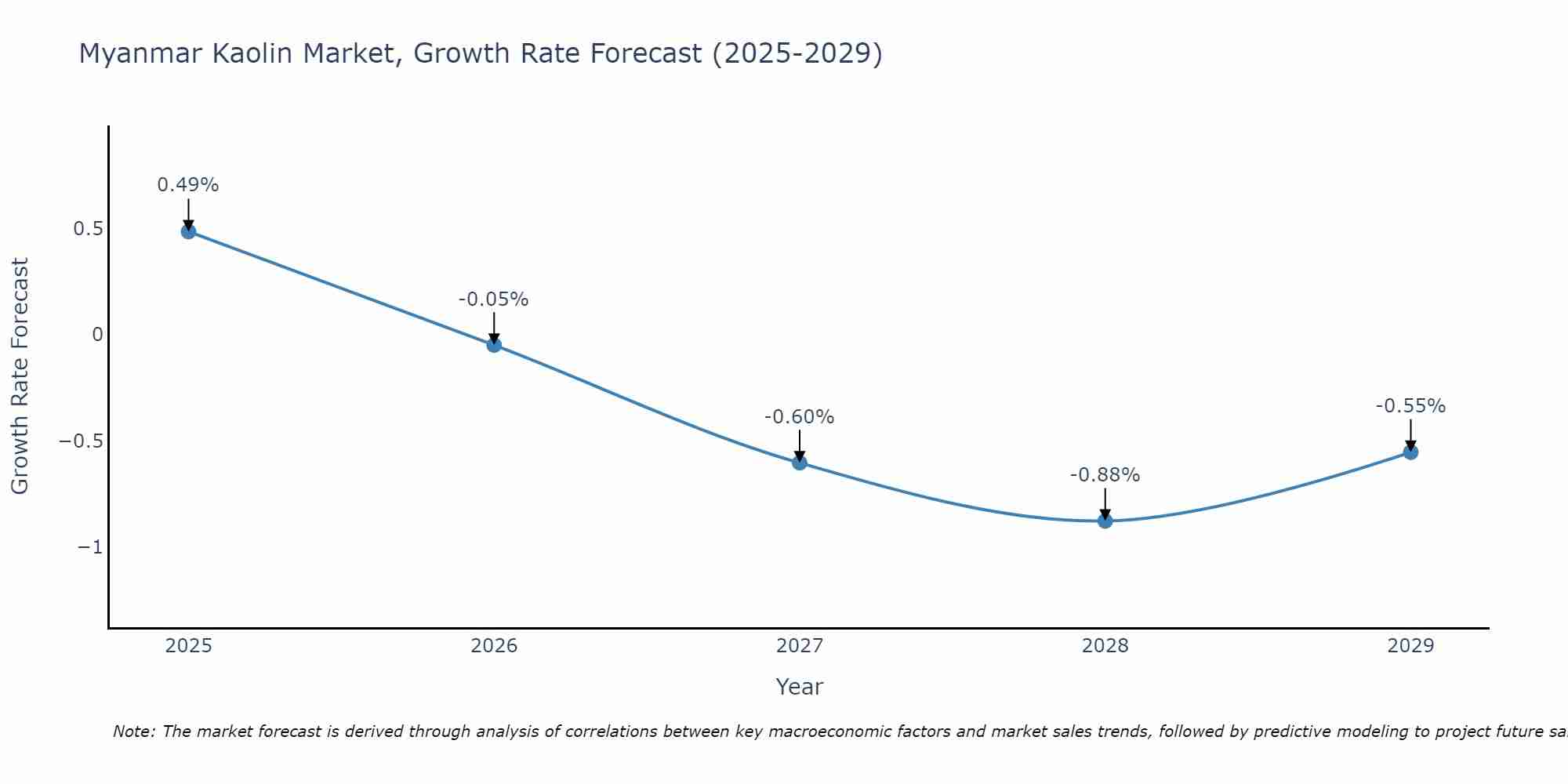
The Myanmar Kaolin Market is projected to witness mixed growth rate patterns during 2025 to 2029. Beginning strongly at 0.49% in 2025, growth softens to -0.55% in 2029.
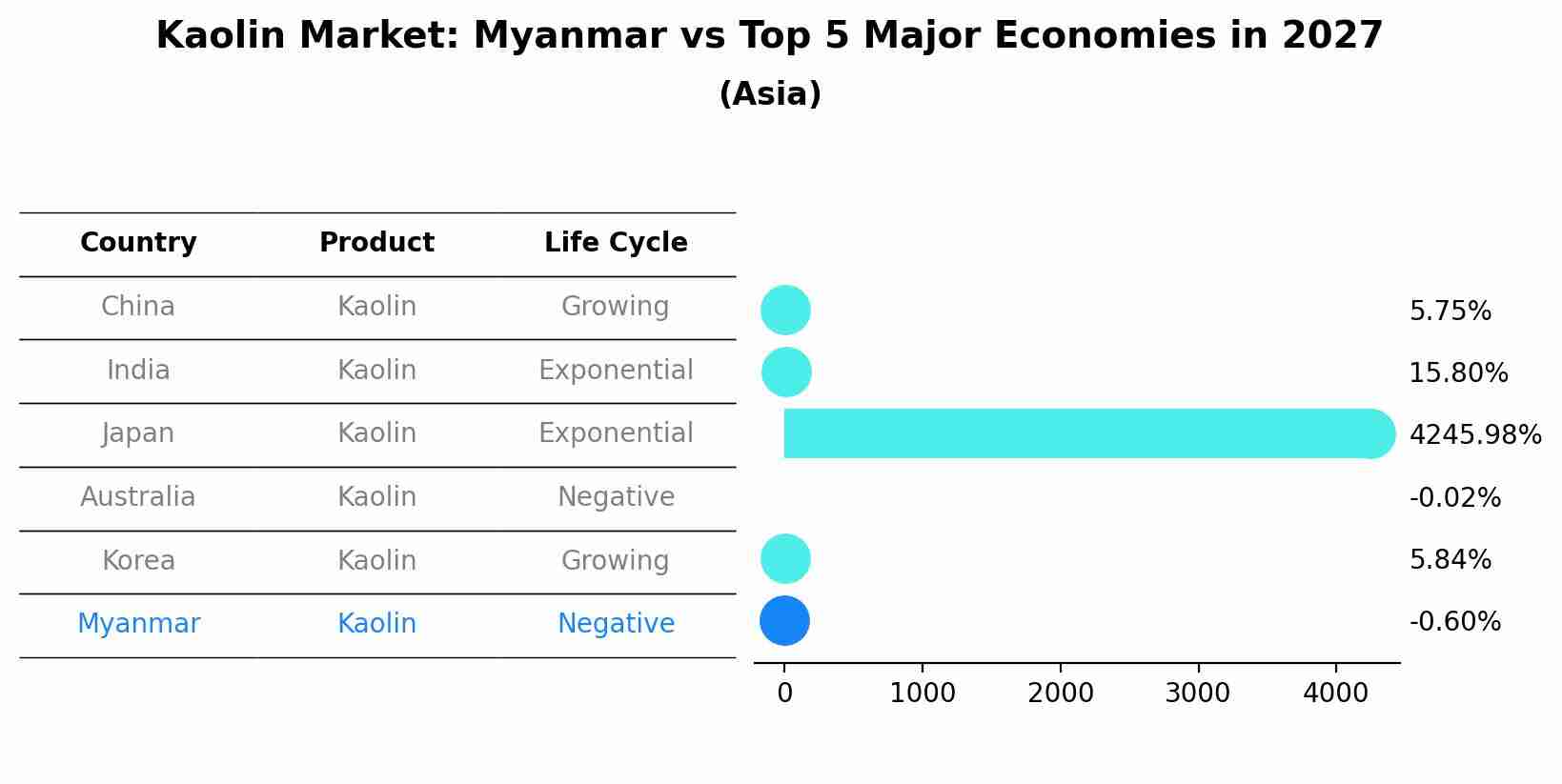
Kaolin Market: Myanmar vs Top 5 Major Economies in 2027 (Asia)
By 2027, Myanmar's Kaolin market is forecasted to achieve a negative growth rate of -0.60%, with China leading the Asia region, followed by India, Japan, Australia and South Korea.
Myanmar Kaolin Market Overview
Myanmar kaolin market is expanding due to its use in various industries, including ceramics, paper, and paints. Kaolin, a type of clay, is valued for its whiteness, fine particle size, and chemical inertness. The construction boom and the demand for high-quality ceramic products are key factors driving the growth of the kaolin market.
Drivers of the market
The kaolin market in Myanmar benefits from the country`s rich reserves of high-quality kaolin deposits, particularly in the central and southern regions. Kaolin, a versatile clay mineral, finds diverse applications in industries such as ceramics, paper, paint, plastics, and pharmaceuticals. The booming construction sector and infrastructure development projects drive the demand for kaolin in the production of ceramics, tiles, and cement. Moreover, the growing use of kaolin as a filler and extender in paper and paint formulations enhances product performance and reduces production costs. Additionally, the increasing investments in mining and processing technologies contribute to the expansion of the kaolin market in Myanmar.
Challenges of the market
The Kaolin market in Myanmar faces challenges such as inconsistent quality of Kaolin deposits, limited infrastructure for processing and transportation, and competition from alternative mineral fillers. Moreover, fluctuations in demand from end-user industries like ceramics and paper add complexity to market dynamics.
Government Policy of the market
To support the development of the ceramics and paper industries, the government has introduced policies to regulate and support the kaolin market in Myanmar. These policies include incentives for responsible mining practices, regulations to ensure environmental sustainability and community engagement in kaolin extraction, and measures to promote value-added processing and utilization of kaolin resources.
Key Highlights of the Report:
- Myanmar Kaolin Market Outlook
- Market Size of Myanmar Kaolin Market, 2024
- Forecast of Myanmar Kaolin Market, 2031
- Historical Data and Forecast of Myanmar Kaolin Revenues & Volume for the Period 2018 - 2031
- Myanmar Kaolin Market Trend Evolution
- Myanmar Kaolin Market Drivers and Challenges
- Myanmar Kaolin Price Trends
- Myanmar Kaolin Porter's Five Forces
- Myanmar Kaolin Industry Life Cycle
- Historical Data and Forecast of Myanmar Kaolin Market Revenues & Volume By Process for the Period 2018 - 2031
- Historical Data and Forecast of Myanmar Kaolin Market Revenues & Volume By Water-washed for the Period 2018 - 2031
- Historical Data and Forecast of Myanmar Kaolin Market Revenues & Volume By Airfloat for the Period 2018 - 2031
- Historical Data and Forecast of Myanmar Kaolin Market Revenues & Volume By Calcined for the Period 2018 - 2031
- Historical Data and Forecast of Myanmar Kaolin Market Revenues & Volume By Delaminated for the Period 2018 - 2031
- Historical Data and Forecast of Myanmar Kaolin Market Revenues & Volume By Surface-modified & Unprocessed for the Period 2018 - 2031
- Historical Data and Forecast of Myanmar Kaolin Market Revenues & Volume By End-users for the Period 2018 - 2031
- Historical Data and Forecast of Myanmar Kaolin Market Revenues & Volume By Ceramics & Sanitarywares for the Period 2018 - 2031
- Historical Data and Forecast of Myanmar Kaolin Market Revenues & Volume By Fiberglass for the Period 2018 - 2031
- Historical Data and Forecast of Myanmar Kaolin Market Revenues & Volume By Paints & Coatings for the Period 2018 - 2031
- Historical Data and Forecast of Myanmar Kaolin Market Revenues & Volume By Rubber for the Period 2018 - 2031
- Historical Data and Forecast of Myanmar Kaolin Market Revenues & Volume By Adhesives & Sealants for the Period 2018 - 2031
- Historical Data and Forecast of Myanmar Kaolin Market Revenues & Volume By Plastics for the Period 2018 - 2031
- Historical Data and Forecast of Myanmar Kaolin Market Revenues & Volume By Others for the Period 2018 - 2031
- Myanmar Kaolin Import Export Trade Statistics
- Market Opportunity Assessment By Process
- Market Opportunity Assessment By End-users
- Myanmar Kaolin Top Companies Market Share
- Myanmar Kaolin Competitive Benchmarking By Technical and Operational Parameters
- Myanmar Kaolin Company Profiles
- Myanmar Kaolin Key Strategic Recommendations






































