Myanmar Kosher Food Market Size, Share & Growth Rate
The Myanmar Kosher Food Market was estimated at USD 443 Million in 2025 and is projected to reach USD 606 Million by 2032, growing at a CAGR of 4.6% from 2026 to 2032. This growth is fueled primarily by the increasing awareness of kosher dietary practices among both local Jewish communities and health-conscious consumers. As more individuals recognize the perceived health benefits and quality assurances associated with kosher-certified products, demand continues to rise, paving the way for increased market penetration.
Myanmar Kosher Food Market Year-wise Growth Rate and Key Drivers
This graph highlights how the Myanmar Kosher Food Market has steadily grown over the years, supported by major growth factors.
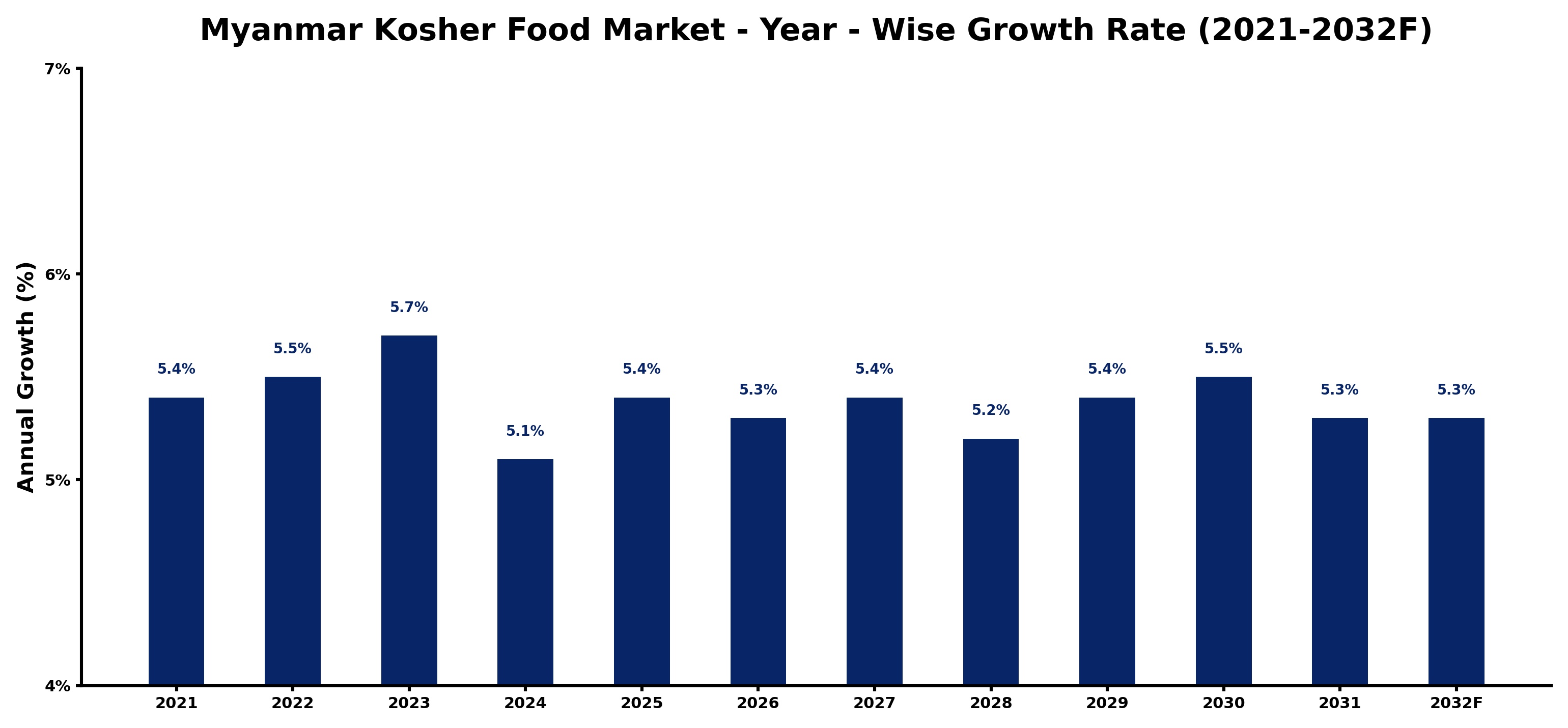
The table below presents the year‑wise growth rates along with the key drivers influencing the market
| Year | Growth Rate | Major Drivers |
| 2021 | 5.4% | Improved processing techniques boosted output in kosher food production |
| 2022 | 5.5% | Smart packaging technology adoption boosts Myanmar kosher food exports |
| 2023 | 5.7% | Export driven demand for kosher certification boosts food processing investment |
| 2024 | 5.1% | Higher demand for halal certification drives kosher food production investments |
| 2025 | 5.4% | Kosher food certification streamlines production processes for export readiness |
| 2026 | 5.3% | Manufacturing investments in cold storage enhance food safety compliance |
| 2027 | 5.4% | Improved factory efficiencies boosted output of kosher food products |
| 2028 | 5.2% | Smart packaging solutions drive kosher food distribution efficiency |
| 2029 | 5.4% | Supply chain optimization boosted kosher ingredient sourcing efficiency |
| 2030 | 5.5% | Domestic halal certification improvements boost local kosher food production |
| 2031 | 5.3% | Local processing plants boosted kosher ingredient sourcing for demand |
| 2032 | 5.3% | Local processing plants scaled capacity for increased kosher food demand |
Note - Market size estimations and growth projections presented in this report are based on 6Wresearch's advanced forecasting approach, validated with industry datasets as of June 2026.
Myanmar Kosher Food Market Synopsis
The strongest force currently shaping the Myanmar Kosher Food Market is the heightened awareness and appreciation for kosher dietary practices among the local population. This is not just limited to the Jewish community; a growing segment of health-conscious consumers is turning to kosher foods for their perceived safety and quality.
Furthermore, the globalization of food supply chains has made kosher products more accessible, contributing to a steady increase in both availability and variety. As international food brands enter the market, they are helping to educate consumers and expand the reach of kosher-certified products across Myanmar.
Myanmar Kosher Food Market Key Takeaways
- The market is experiencing a steady growth trajectory, primarily driven by increased awareness of kosher practices.
- Health-conscious consumers are increasingly seeking kosher products for their perceived safety and quality.
- Government policies are actively supporting the growth of the kosher food sector, promoting diversity and dietary options.
- Logistical challenges, including sourcing and certification, remain significant hurdles for market expansion.
- Competition from non-kosher alternatives continues to influence consumer choices, despite growing interest in kosher foods.
Evaluation of Restraints in Myanmar Kosher Food Market
Despite the promising growth prospects, the Myanmar Kosher Food Market faces several restraints that could limit its expansion. One notable challenge is the relatively low awareness of kosher dietary laws among the predominantly Buddhist population, which could hinder broader acceptance of these products. Additionally, the logistical difficulties associated with sourcing kosher-certified ingredients and navigating certification processes present significant barriers to entry for new market players. Coupled with stiff competition from readily available non-kosher alternatives, these factors pose real challenges for sustained market growth.
Myanmar Kosher Food Market Trends
Currently, there is a notable trend toward clean-label foods, with consumers increasingly seeking transparency about food sources and preparation methods. This trend aligns well with kosher certification, which emphasizes compliance with stringent dietary guidelines. Moreover, the rise of online retail channels is making kosher products more accessible, particularly to urban populations. As e-commerce continues to grow, it offers a platform for niche products like kosher foods to reach broader audiences.
Myanmar Kosher Food Market Opportunities
The market presents genuine opportunities for growth, particularly in developing more localized kosher food options that cater to regional tastes. By innovating and adapting kosher products to suit the preferences of Myanmar's diverse population, businesses can tap into untapped segments. Additionally, partnerships with international brands can facilitate knowledge transfer and improve the market's overall quality standards, making kosher products even more appealing.
Government Initiatives in the Myanmar Kosher Food Market
The Myanmar government is proactively promoting the kosher food market to support religious diversity and meet specific dietary needs. Policies have been introduced to ensure compliance with kosher certification standards, alongside incentives for food producers to develop kosher-certified products. Furthermore, initiatives aimed at raising consumer awareness are crucial, facilitating access to kosher food options and enhancing the market's overall viability.
Future Insights of the Myanmar Kosher Food Market
Looking ahead to 2026-2032, the Myanmar Kosher Food Market is poised for continued growth driven by consumer education and increasing demand for quality food options. As more individuals become informed about the benefits of kosher foods, their acceptance is likely to broaden, presenting a unique opportunity for businesses. The focus on health and safety in food choices will further reinforce the market's growth trajectory as the industry adapts to meet evolving consumer needs.
Myanmar Kosher Food Market Latest Developments (May 2025 - June 2026)
Recent developments within the Myanmar kosher food sector include initiatives aimed at enhancing distribution networks and improving the availability of kosher products across urban centers. Market stakeholders are increasingly collaborating with local producers to streamline certification processes, thereby expanding the range of products available to consumers. Furthermore, growing interest from international brands is fostering innovation, leading to a broader variety of kosher food options tailored to local tastes.
Myanmar Kosher Food Market - Key Attractiveness of the Report
- 10 Years of Market Numbers
- Historical Data Starting from 2022 to 2025
- Base Year: 2025
- Forecast Data until 2032
- Key Performance Indicators Impacting the Market
- Major Upcoming Developments and Projects
Key Highlights of the Report:
- Myanmar Kosher Food Market Outlook
- Market Size of Myanmar Kosher Food Market, 2025
- Forecast of Myanmar Kosher Food Market, 2032
- Historical Data and Forecast of Myanmar Kosher Food Revenues & Volume for the Period 2022-2032F
- Myanmar Kosher Food Market Trend Evolution
- Myanmar Kosher Food Market Drivers and Challenges
- Myanmar Kosher Food Price Trends
- Myanmar Kosher Food Porter's Five Forces
- Myanmar Kosher Food Industry Life Cycle
- Historical Data and Forecast of Myanmar Kosher Food Market Revenues & Volume By Type for the Period 2022-2032F
- Historical Data and Forecast of Myanmar Kosher Food Market Revenues & Volume By Meat for the Period 2022-2032F
- Historical Data and Forecast of Myanmar Kosher Food Market Revenues & Volume By Dairy for the Period 2022-2032F
- Historical Data and Forecast of Myanmar Kosher Food Market Revenues & Volume By Pareve for the Period 2022-2032F
- Historical Data and Forecast of Myanmar Kosher Food Market Revenues & Volume By Application for the Period 2022-2032F
- Historical Data and Forecast of Myanmar Kosher Food Market Revenues & Volume By Seafood for the Period 2022-2032F
- Historical Data and Forecast of Myanmar Kosher Food Market Revenues & Volume By Processed Meat and Poultry for the Period 2022-2032F
- Historical Data and Forecast of Myanmar Kosher Food Market Revenues & Volume By Beverages for the Period 2022-2032F
- Historical Data and Forecast of Myanmar Kosher Food Market Revenues & Volume By Staples for the Period 2022-2032F
- Historical Data and Forecast of Myanmar Kosher Food Market Revenues & Volume By Snacks & Savoury for the Period 2022-2032F
- Historical Data and Forecast of Myanmar Kosher Food Market Revenues & Volume By Bakery and Confectionery for the Period 2022-2032F
- Historical Data and Forecast of Myanmar Kosher Food Market Revenues & Volume By Others for the Period 2022-2032F
- Historical Data and Forecast of Myanmar Kosher Food Market Revenues & Volume By Distribution Channel for the Period 2022-2032F
- Historical Data and Forecast of Myanmar Kosher Food Market Revenues & Volume By Supermarkets and Hypermarkets for the Period 2022-2032F
- Historical Data and Forecast of Myanmar Kosher Food Market Revenues & Volume By Grocery Stores for the Period 2022-2032F
- Historical Data and Forecast of Myanmar Kosher Food Market Revenues & Volume By Online Stores for the Period 2022-2032F
- Myanmar Kosher Food Import Export Trade Statistics
- Market Opportunity Assessment By Type
- Market Opportunity Assessment By Application
- Market Opportunity Assessment By Distribution Channel
- Myanmar Kosher Food Top Companies Market Share
- Myanmar Kosher Food Competitive Benchmarking By Technical and Operational Parameters
- Myanmar Kosher Food Company Profiles
- Myanmar Kosher Food Key Strategic Recommendations






































