Myanmar Laboratory Equipment Market Size Growth Rate
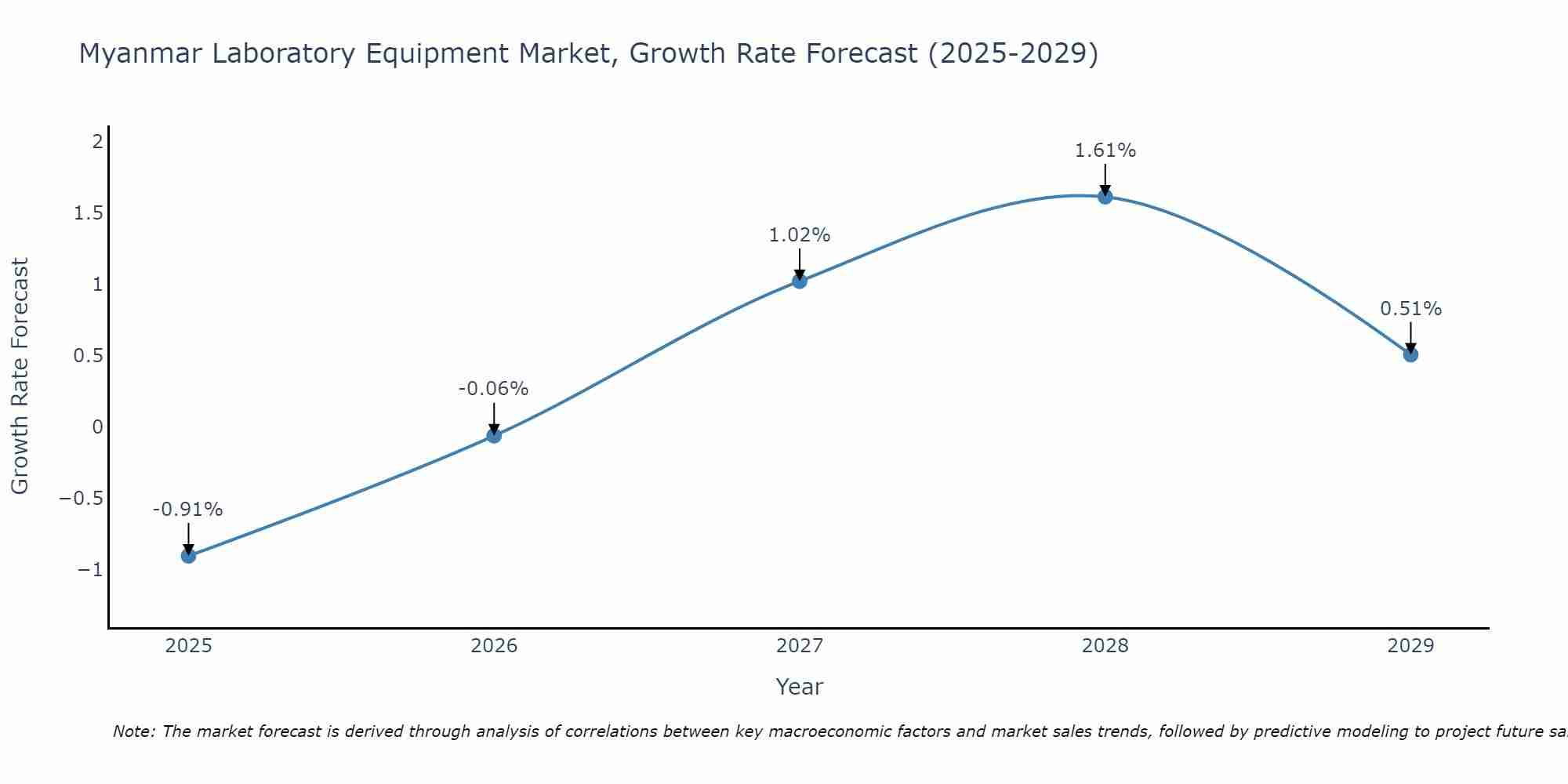
The Myanmar Laboratory Equipment Market is projected to witness mixed growth rate patterns during 2025 to 2029. Growth accelerates to 1.61% in 2028, following an initial rate of -0.91%, before easing to 0.51% at the end of the period.
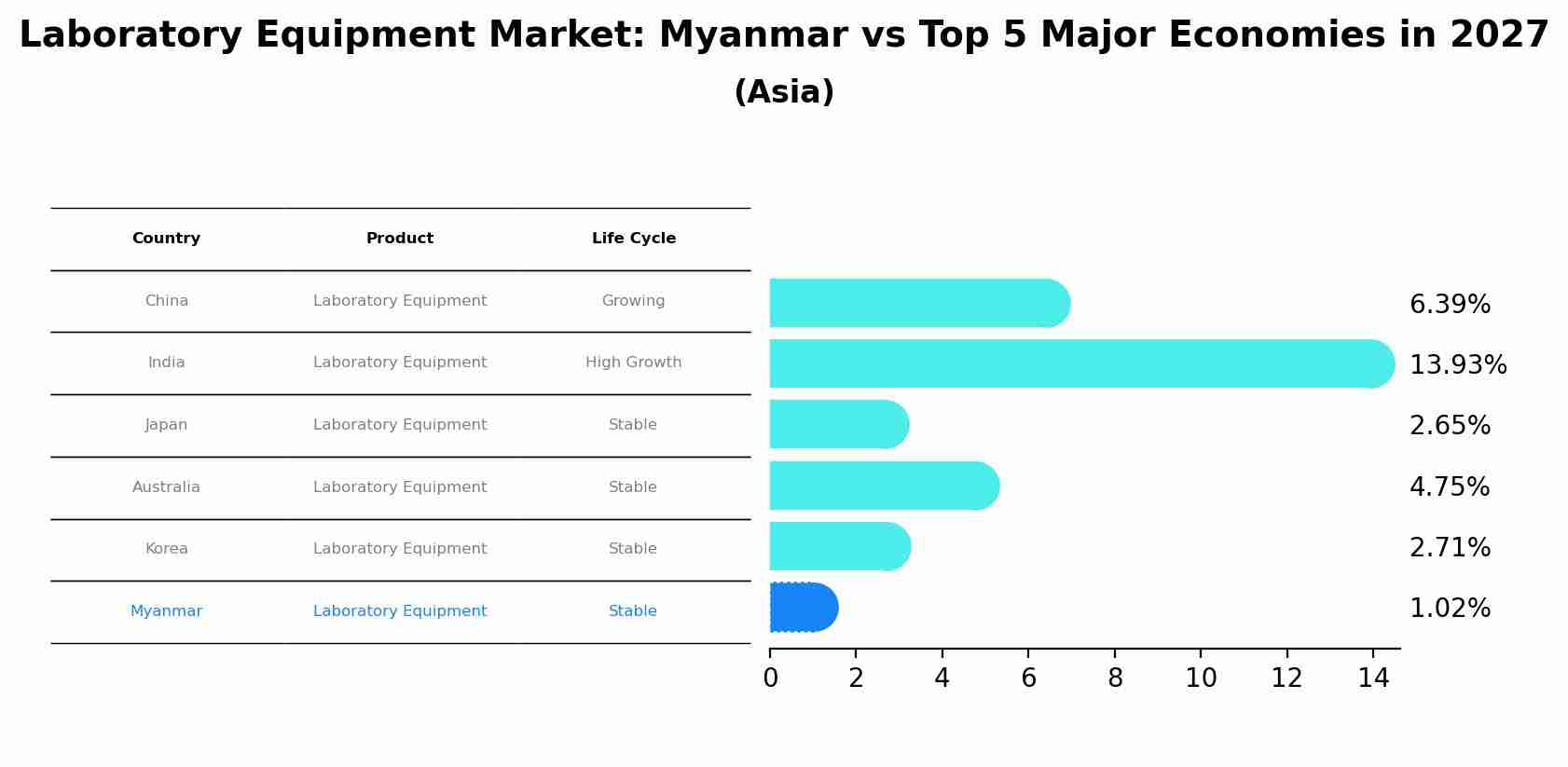
Laboratory Equipment Market: Myanmar vs Top 5 Major Economies in 2027 (Asia)
The Laboratory Equipment market in Myanmar is projected to grow at a stable growth rate of 1.02% by 2027, highlighting the country's increasing focus on advanced technologies within the Asia region, where China holds the dominant position, followed closely by India, Japan, Australia and South Korea, shaping overall regional demand.
Myanmar Laboratory Equipment Market Overview
The laboratory equipment market in Myanmar is expanding due to the growing focus on scientific research, healthcare, and industrial development. The market includes equipment such as microscopes, spectrometers, and chromatography systems. Investment in healthcare infrastructure and educational institutions is boosting demand for advanced laboratory equipment.
Drivers of the market
The modernization of laboratories and the expansion of scientific research facilities propel the demand for laboratory equipment in Myanmar. Laboratory equipment encompasses a wide range of instruments and devices used for sample analysis, experimentation, and data collection across various scientific disciplines. Moreover, the increasing investment in healthcare infrastructure, academic institutions, and industrial research centers drives the adoption of advanced laboratory equipment with features such as automation, precision, and connectivity. Additionally, the emergence of interdisciplinary research areas and the integration of technologies such as robotics and artificial intelligence (AI) contribute to the growth of the laboratory equipment market in Myanmar.
Challenges of the market
The laboratory equipment market in Myanmar faces challenges such as limited investment in research and development infrastructure, high import tariffs on scientific instruments, and scarcity of skilled technicians for equipment maintenance. Moreover, concerns over product quality, warranty, and after-sales support hinder market growth.
Government Policy of the market
In efforts to enhance research and development capabilities, the government has implemented policies to support the growth of the laboratory equipment market in Myanmar. These policies include incentives for technology adoption by research institutions and industries, investments in laboratory infrastructure, and measures to promote collaboration between academia, industry, and government in technology transfer and innovation.
Key Highlights of the Report:
- Myanmar Laboratory Equipment Market Outlook
- Market Size of Myanmar Laboratory Equipment Market, 2024
- Forecast of Myanmar Laboratory Equipment Market, 2031
- Historical Data and Forecast of Myanmar Laboratory Equipment Revenues & Volume for the Period 2021-2031
- Myanmar Laboratory Equipment Market Trend Evolution
- Myanmar Laboratory Equipment Market Drivers and Challenges
- Myanmar Laboratory Equipment Price Trends
- Myanmar Laboratory Equipment Porter's Five Forces
- Myanmar Laboratory Equipment Industry Life Cycle
- Historical Data and Forecast of Myanmar Laboratory Equipment Market Revenues & Volume By Product Type for the Period 2021-2031
- Historical Data and Forecast of Myanmar Laboratory Equipment Market Revenues & Volume By Autoclaves for the Period 2021-2031
- Historical Data and Forecast of Myanmar Laboratory Equipment Market Revenues & Volume By Incubators for the Period 2021-2031
- Historical Data and Forecast of Myanmar Laboratory Equipment Market Revenues & Volume By Centrifuges for the Period 2021-2031
- Historical Data and Forecast of Myanmar Laboratory Equipment Market Revenues & Volume By Spectrometers for the Period 2021-2031
- Historical Data and Forecast of Myanmar Laboratory Equipment Market Revenues & Volume By Sonicators for the Period 2021-2031
- Historical Data and Forecast of Myanmar Laboratory Equipment Market Revenues & Volume By Scopes for the Period 2021-2031
- Historical Data and Forecast of Myanmar Laboratory Equipment Market Revenues & Volume By Others for the Period 2021-2031
- Historical Data and Forecast of Myanmar Laboratory Equipment Market Revenues & Volume By Application for the Period 2021-2031
- Historical Data and Forecast of Myanmar Laboratory Equipment Market Revenues & Volume By Genetic Testing for the Period 2021-2031
- Historical Data and Forecast of Myanmar Laboratory Equipment Market Revenues & Volume By Endocrinology for the Period 2021-2031
- Historical Data and Forecast of Myanmar Laboratory Equipment Market Revenues & Volume By Hematology for the Period 2021-2031
- Historical Data and Forecast of Myanmar Laboratory Equipment Market Revenues & Volume By Microbiology for the Period 2021-2031
- Historical Data and Forecast of Myanmar Laboratory Equipment Market Revenues & Volume By Biochemistry for the Period 2021-2031
- Historical Data and Forecast of Myanmar Laboratory Equipment Market Revenues & Volume By Others for the Period 2021-2031
- Historical Data and Forecast of Myanmar Laboratory Equipment Market Revenues & Volume By End-users for the Period 2021-2031
- Historical Data and Forecast of Myanmar Laboratory Equipment Market Revenues & Volume By Diagnostic Laboratories for the Period 2021-2031
- Historical Data and Forecast of Myanmar Laboratory Equipment Market Revenues & Volume By Hospitals and Clinics for the Period 2021-2031
- Historical Data and Forecast of Myanmar Laboratory Equipment Market Revenues & Volume By Others for the Period 2021-2031
- Myanmar Laboratory Equipment Import Export Trade Statistics
- Market Opportunity Assessment By Product Type
- Market Opportunity Assessment By Application
- Market Opportunity Assessment By End-users
- Myanmar Laboratory Equipment Top Companies Market Share
- Myanmar Laboratory Equipment Competitive Benchmarking By Technical and Operational Parameters
- Myanmar Laboratory Equipment Company Profiles
- Myanmar Laboratory Equipment Key Strategic Recommendations






































