Myanmar lawn & garden equipment Market Size, Share & Growth Rate
The Myanmar lawn & garden equipment Market was estimated at USD 363 Million in 2025 and is projected to reach USD 488 Million by 2032, growing at a CAGR of 4.3% from 2026 to 2032. This growth trajectory is significantly driven by urbanization trends and increasing disposable income, which empower households to invest in maintaining and enhancing their outdoor living spaces. Moreover, the rising enthusiasm for home gardening and landscaping further accelerates the demand for a diverse range of gardening tools and equipment across the country.
Myanmar lawn & garden equipment Market Year-wise Growth Rate and Key Drivers
This graph highlights how the Myanmar lawn & garden equipment Market has steadily grown over the years, supported by major growth factors.
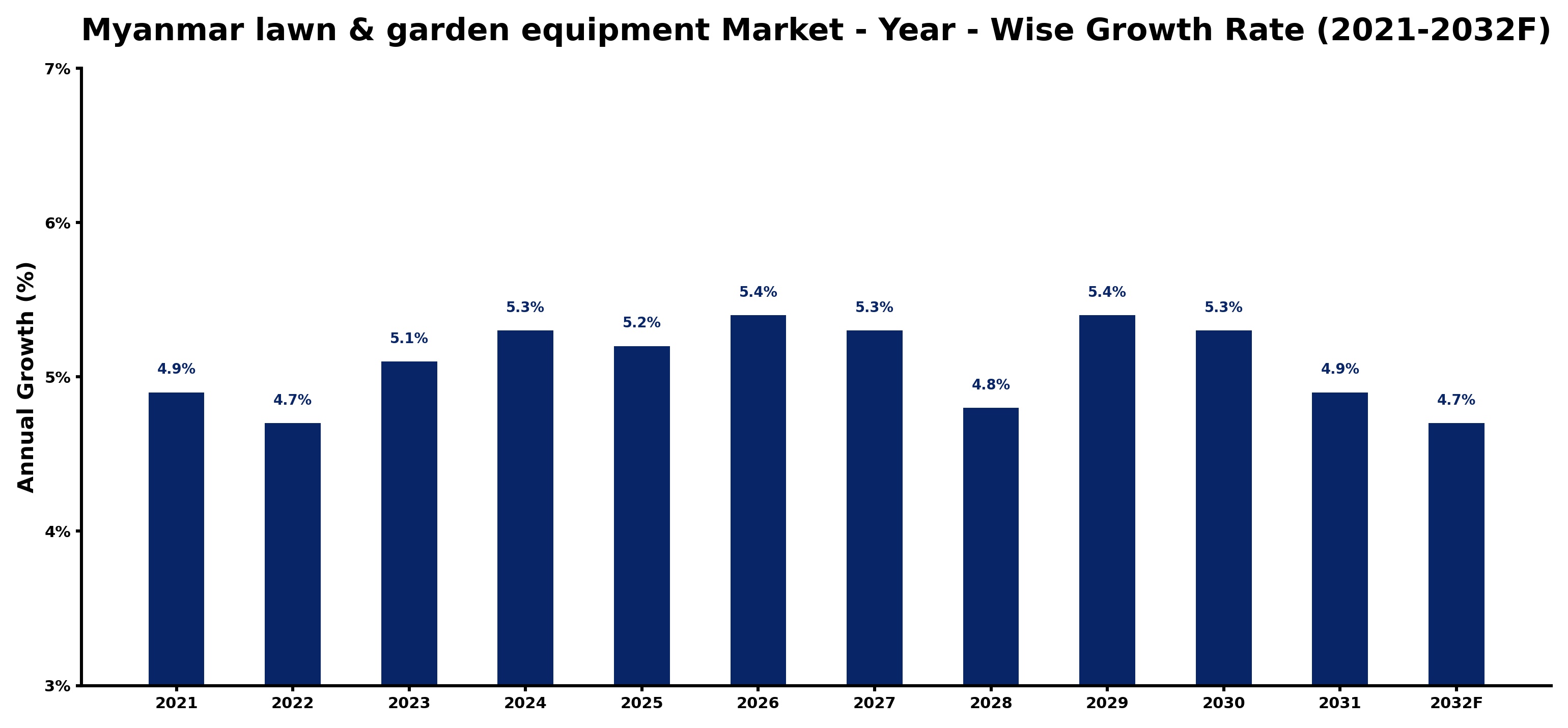
The table below presents the year‑wise growth rates along with the key drivers influencing the market
| Year | Growth Rate | Major Drivers |
| 2021 | 4.9% | Urban gardening trends gained popularity |
| 2022 | 4.7% | Sustainable gardening practices expanded adoption |
| 2023 | 5.1% | Home improvement projects increased demand |
| 2024 | 5.3% | Technological advancements improved efficiency |
| 2025 | 5.2% | Consumer interest in landscaping grew |
| 2026 | 5.4% | Eco-friendly products gained market traction |
| 2027 | 5.3% | Increased disposable income drove purchases |
| 2028 | 4.8% | Community gardening initiatives flourished |
| 2029 | 5.4% | Online shopping for tools surged |
| 2030 | 5.3% | DIY gardening projects became popular |
| 2031 | 4.9% | Industrial activity supported growth |
| 2032 | 4.7% | Market expansion drove consumption |
Note - Market size estimations and growth projections presented in this report are based on 6Wresearch’s advanced forecasting approach, validated with industry datasets as of June 2026.
Myanmar lawn & garden equipment Market Synopsis
Urbanization is currently the most influential factor shaping the Myanmar lawn & garden equipment market. As cities expand and more families move into urban areas, the interest in maintaining aesthetically pleasing outdoor spaces continues to grow. This shift toward city living, combined with a rise in gardening hobbies, drives consumers toward investing in quality lawn and garden tools.
Furthermore, an increasing number of households are embracing sustainable gardening practices, which is significantly reshaping purchasing decisions. This growing preference for eco-friendly options, such as battery-powered equipment, is fostering an environment ripe for innovation and investment, making the market more attractive for local and international suppliers.
Myanmar lawn & garden equipment Market Key Takeaways
- The Myanmar lawn & garden equipment market is projected to experience steady growth driven by urbanization and rising incomes.
- Interest in home gardening is expanding, with a notable shift towards sustainable gardening practices influencing purchasing trends.
- E-commerce platforms are enhancing product accessibility, aiding market expansion for residential and commercial consumers alike.
- Investment opportunities are arising from government initiatives focused on beautification projects and sustainable practices.
- Challenges related to consumer awareness and infrastructure remain, yet they present avenues for education and innovation.
Evaluation of Restraints in Myanmar lawn & garden equipment Market
Despite the positive market dynamics, several constraints inhibit the growth of the Myanmar lawn & garden equipment sector. Limited consumer awareness regarding modern gardening practices poses significant barriers, as many potential buyers remain unfamiliar with the advantages of contemporary tools. Additionally, high import duties complicate access for international brands seeking to introduce innovative products. The existing supply chain infrastructure can be inconsistent, which affects product availability, especially in rural areas. Furthermore, counterfeit products not only dilute brand value but also undermine consumer trust in legitimate offerings, creating challenges that must be navigated for sustainable market development.
Myanmar lawn & garden equipment Market Trends
Recent trends in the Myanmar lawn & garden equipment market highlight a marked shift toward sustainability, with consumers increasingly favoring electric or battery-operated tools to reduce environmental impact. Additionally, there is a growing demand for smart gardening technologies and automated solutions, reflecting a broader global trend towards digitization in the gardening sector. E-commerce is also reshaping distribution channels, facilitating greater access to a variety of products and enhancing the purchasing experience.
Myanmar lawn & garden equipment Market Opportunities
The market's growth potential lies in addressing the needs of the expanding middle to high-income households, which are increasingly prioritizing outdoor aesthetics. Foreign investors can tap into this opportunity by forming partnerships with local distributors or launching innovative products that meet rising consumer expectations. Additionally, focusing on educational campaigns that promote modern gardening techniques can empower consumers, driving demand for advanced gardening equipment.
Government Initiatives in the Myanmar lawn & garden equipment Market
The Myanmar government is actively promoting sustainable practices within the lawn & garden equipment sector. Policies are being implemented to encourage the use of eco-friendly tools and technologies, such as electric and battery-powered equipment, which aim to reduce emissions and pollution. Moreover, the government is focused on improving safety and quality standards for imported goods, ensuring that products in the market meet required regulations, thus enhancing consumer protection and encouraging trust in legitimate brands.
Future Insights of the Myanmar lawn & garden equipment Market
Looking towards 2026-2032, the Myanmar lawn & garden equipment market is expected to benefit from continued urbanization and increasing disposable incomes. As awareness of sustainable practices rises, the demand for battery-powered equipment will likely surge. Moreover, government initiatives aimed at enhancing green spaces and beautifying urban areas will catalyze further growth. While challenges regarding consumer knowledge and market accessibility persist, the overall trajectory remains positive, fostering a climate conducive for innovation and investment.
Myanmar lawn & garden equipment Market Latest Developments (May 2025 - June 2026)
Recent industry developments in the Myanmar lawn & garden equipment market indicate a shift toward digitalization and e-commerce solutions. Retailers are increasingly leveraging online platforms to reach a broader consumer base, streamlining the purchasing process for both residential and commercial clients. Furthermore, local manufacturers are exploring new technologies to meet demand for sustainable products, aligning with both consumer preferences and government initiatives focused on environmental sustainability.
Myanmar lawn & garden equipment Market - Key Attractiveness of the Report
- 10 Years of Market Numbers
- Historical Data Starting from 2022 to 2025
- Base Year: 2025
- Forecast Data until 2032
- Key Performance Indicators Impacting the Market
- Major Upcoming Developments and Projects
Key Highlights of the Report:
- Myanmar lawn & garden equipment Market Outlook
- Market Size of Myanmar lawn & garden equipment Market, 2025
- Forecast of Myanmar lawn & garden equipment Market, 2032
- Historical Data and Forecast of Myanmar lawn & garden equipment Revenues & Volume for the Period 2022-2032F
- Myanmar lawn & garden equipment Market Trend Evolution
- Myanmar lawn & garden equipment Market Drivers and Challenges
- Myanmar lawn & garden equipment Price Trends
- Myanmar lawn & garden equipment Porter's Five Forces
- Myanmar lawn & garden equipment Industry Life Cycle
- Historical Data and Forecast of Myanmar lawn & garden equipment Market Revenues & Volume By Power for the Period 2022-2032F
- Historical Data and Forecast of Myanmar lawn & garden equipment Market Revenues & Volume By Manual for the Period 2022-2032F
- Historical Data and Forecast of Myanmar lawn & garden equipment Market Revenues & Volume By Electric-powered for the Period 2022-2032F
- Historical Data and Forecast of Myanmar lawn & garden equipment Market Revenues & Volume By Gas-powered for the Period 2022-2032F
- Historical Data and Forecast of Myanmar lawn & garden equipment Market Revenues & Volume By Others for the Period 2022-2032F
- Historical Data and Forecast of Myanmar lawn & garden equipment Market Revenues & Volume By End-use for the Period 2022-2032F
- Historical Data and Forecast of Myanmar lawn & garden equipment Market Revenues & Volume By Residential for the Period 2022-2032F
- Historical Data and Forecast of Myanmar lawn & garden equipment Market Revenues & Volume By Golf Courses for the Period 2022-2032F
- Historical Data and Forecast of Myanmar lawn & garden equipment Market Revenues & Volume By Playgrounds for the Period 2022-2032F
- Historical Data and Forecast of Myanmar lawn & garden equipment Market Revenues & Volume By Operation for the Period 2022-2032F
- Historical Data and Forecast of Myanmar lawn & garden equipment Market Revenues & Volume By Walk-behind for the Period 2022-2032F
- Historical Data and Forecast of Myanmar lawn & garden equipment Market Revenues & Volume By Riders for the Period 2022-2032F
- Historical Data and Forecast of Myanmar lawn & garden equipment Market Revenues & Volume By Others for the Period 2022-2032F
- Historical Data and Forecast of Myanmar lawn & garden equipment Market Revenues & Volume By Product for the Period 2022-2032F
- Historical Data and Forecast of Myanmar lawn & garden equipment Market Revenues & Volume By Blowers for the Period 2022-2032F
- Historical Data and Forecast of Myanmar lawn & garden equipment Market Revenues & Volume By Chain Saws for the Period 2022-2032F
- Historical Data and Forecast of Myanmar lawn & garden equipment Market Revenues & Volume By Cutters & Shredders for the Period 2022-2032F
- Historical Data and Forecast of Myanmar lawn & garden equipment Market Revenues & Volume By Tractors for the Period 2022-2032F
- Historical Data and Forecast of Myanmar lawn & garden equipment Market Revenues & Volume By Lawn Mowers for the Period 2022-2032F
- Historical Data and Forecast of Myanmar lawn & garden equipment Market Revenues & Volume By Sprinkler & Hoses for the Period 2022-2032F
- Historical Data and Forecast of Myanmar lawn & garden equipment Market Revenues & Volume By Others for the Period 2022-2032F
- Myanmar lawn & garden equipment Import Export Trade Statistics
- Market Opportunity Assessment By Power
- Market Opportunity Assessment By End-use
- Market Opportunity Assessment By Operation
- Market Opportunity Assessment By Product
- Myanmar lawn & garden equipment Top Companies Market Share
- Myanmar lawn & garden equipment Competitive Benchmarking By Technical and Operational Parameters
- Myanmar lawn & garden equipment Company Profiles
- Myanmar lawn & garden equipment Key Strategic Recommendations






































