Myanmar Leather Market Summary
The myanmar leather market was estimated at USD 389 Million in 2025 and is projected to reach USD 550 Million by 2032, growing at a CAGR of 5.9% from 2026 to 2032.
Myanmar Leather Market Year-wise Growth Rate and Key Drivers
This graph highlights how the Myanmar Leather Market has steadily grown over the past five years, supported by major growth factors.
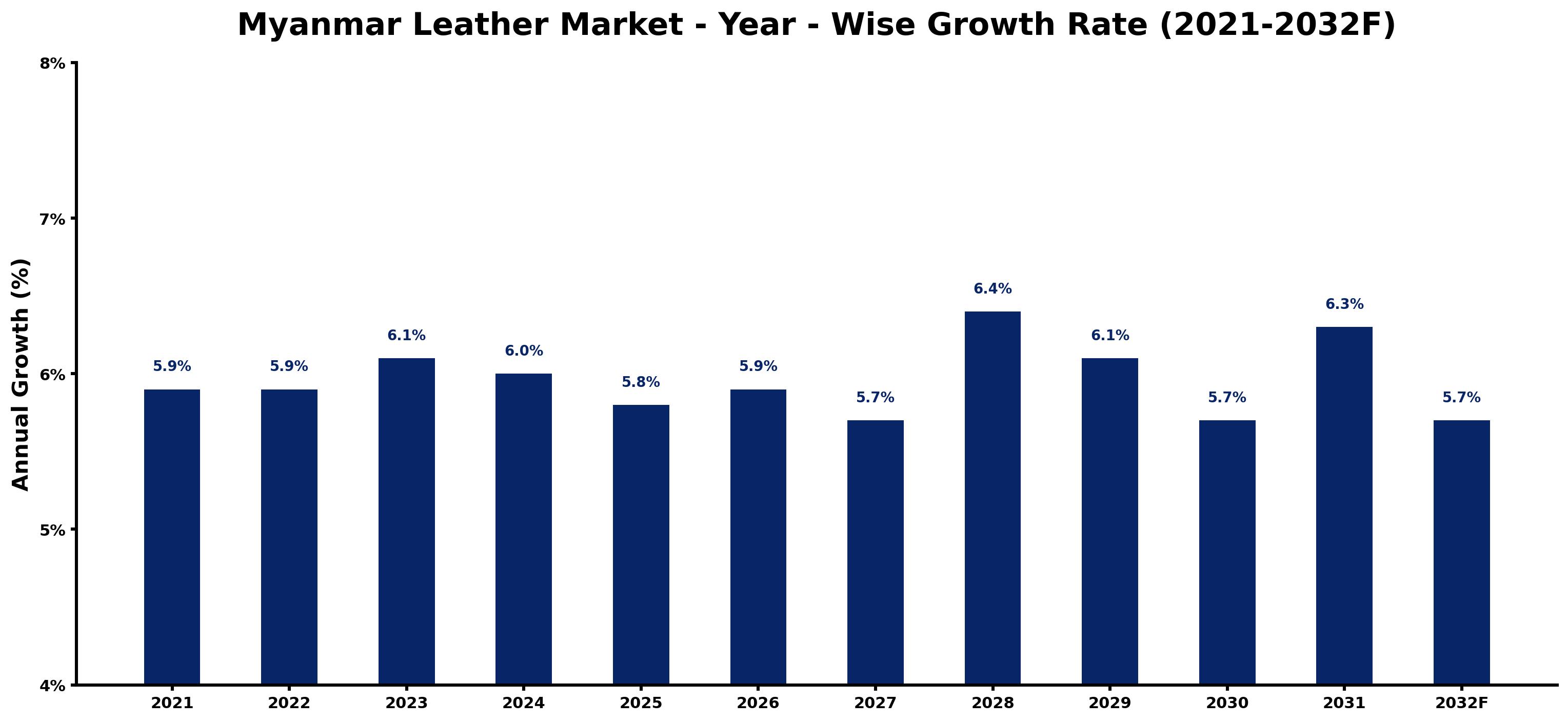
The table below presents the year wise growth rates along with the key drivers influencing the market
| Year | Growth Rate | Major Drivers |
| 2021 | 5.9% | Increased customization options in leather goods attract discerning consumers across Myanmar's urban centers. |
| 2022 | 5.9% | Local artisans gain recognition, promoting a resurgence of traditional leather craftsmanship in Myanmar. |
| 2023 | 6.1% | Export opportunities emerge as international brands seek ethically sourced leather products from Myanmar. |
| 2024 | 6.0% | Rural production facilities expand, creating jobs and boosting local economies in leather production zones. |
| 2025 | 5.8% | Younger consumers embrace sustainable fashion trends, influencing leather purchasing behaviors significantly. |
| 2026 | 5.9% | Investment in local supply chains enhances quality and availability of raw materials for leather. |
| 2027 | 5.7% | Increased tourism drives demand for locally made leather souvenirs and luxury items. |
| 2028 | 6.4% | Collaborations between local brands and global designers enhance product visibility and market reach. |
| 2029 | 6.1% | E-commerce platforms flourish, making leather products accessible to broader demographics across Myanmar. |
| 2030 | 5.7% | Technological innovations in production streamline processes, reducing costs while improving product quality. |
| 2031 | 6.3% | Growing awareness of ethical sourcing practices aligns with global consumer preferences for leather. |
| 2032 | 5.7% | Established local brands expand into international markets, promoting Myanmar's rich leather heritage globally. |
Note - Market size estimations and growth projections presented in this report are based on 6Wresearch's advanced forecasting approach, validated with industry datasets as of June 2026.
Myanmar Leather Market Synopsis
The Myanmar Leather Market is projected to reach 5.9% and witness significant growth during the forecast period (2026-2032). The development of the leather industry within Myanmar can be attributed to increasing consumer demand for high-quality leather footwear and accessories, alongside rising income levels across various demographics. Government initiatives aimed at stimulating investment in the leather sector are also noteworthy, creating a conducive environment for market expansion.
Myanmar Leather Market Growth Drivers
Several key factors are propelling the growth of the Myanmar Leather Market. The primary drivers include:
- Rising demand for leather products, particularly in footwear, as consumers increasingly prioritize quality and durability.
- Higher disposable income levels, enabling consumers to invest in premium leather items, thus expanding the market base.
- Government incentives designed to attract foreign investment in the leather industry, fostering a competitive landscape.
- The expansion of existing manufacturing facilities, which allows businesses to increase production capacity and meet growing demand.
- The introduction of high-value-added products, such as luxury handbags and wallets, which cater to evolving consumer preferences and trends.
Myanmar Leather Market Trends and Opportunities
As the Myanmar Leather Market evolves, several trends and opportunities are emerging within the industry landscape:
- A shift towards sustainable and eco-friendly leather production methods, responding to global consumer demand for ethical sourcing.
- Digital transformation in marketing and sales channels, allowing manufacturers to reach a broader audience through online platforms.
- Collaborations and partnerships within the supply chain to enhance product offerings and streamline operations.
- The potential for export growth as Myanmar positions itself as an emerging producer of leather goods in the Southeast Asian region.
- Increased investment in research and development to innovate product designs and improve manufacturing processes.
Myanmar Leather Market Challenges and Restraints
Despite the promising growth prospects, the Myanmar Leather Market faces several challenges that could impede its progress:
- Inconsistent access to high-quality raw materials, which can affect the overall production quality in the leather industry.
- Regulatory hurdles that might complicate the establishment and operation of enterprises within the sector.
- Competition from established global brands that have a strong foothold in the leather market, making it difficult for new entrants to gain market share.
- Environmental concerns related to leather production processes, which could lead to stricter regulations and operational constraints.
- Skills gaps in the workforce that affect production efficiency and innovation capabilities in the industry.
Myanmar Leather Market Government Investment and Initiatives
The government of Myanmar has been actively pursuing initiatives aimed at fostering the growth of the leather market. Key measures include:
- Implementation of policies that provide financial incentives for both domestic and foreign investments in the leather manufacturing sector.
- Development plans that focus on infrastructure improvements, which are essential for facilitating smoother logistics and supply chain operations.
- Training and educational programs aimed at enhancing the skills of the workforce involved in leather production and related activities.
- Support for research initiatives that promote innovation in sustainable leather production processes.
- Promotion of international trade agreements to enhance export opportunities for Myanmar-made leather goods.
Myanmar Leather Market Latest Developments (May 2025 - June 2026)
Recent developments in the Myanmar Leather Market indicate a shift towards modernization and increased competitiveness. During the period from May 2025 to June 2026, the market has observed:
- A rise in the establishment of new manufacturing facilities, enhancing the country's production capabilities and market supply.
- Increased participation in global leather fairs, allowing local manufacturers to showcase their products to international buyers.
- Collaborative efforts between the government and industry stakeholders to address environmental challenges associated with leather production.
- Strategic investment in technology to upgrade production processes, improving efficiency and product quality.
- A growing trend towards customization, where manufacturers are catering to specific consumer preferences for unique designs and features in leather products.
Myanmar Leather Market - Key Attractiveness of the Report
- 10 Years of Market Numbers
- Historical Data Starting from 2022 to 2025
- Base Year: 2025
- Forecast Data until 2032
- Key Performance Indicators Impacting the Market
- Major Upcoming Developments and Projects
Key Highlights of the Report:
- Myanmar Leather Market Outlook
- Market Size of Myanmar Leather Market, 2025
- Forecast of Myanmar Leather Market, 2032F
- Historical Data and Forecast of Myanmar Leather Revenues & Volume for the Period 2022-2032F
- Myanmar Leather Market Trend Evolution
- Myanmar Leather Market Drivers and Challenges
- Myanmar Leather Price Trends
- Myanmar Leather Porter's Five Forces
- Myanmar Leather Industry Life Cycle
- Historical Data and Forecast of Myanmar Leather Market Revenues & Volume By Type for the Period 2022-2032F
- Historical Data and Forecast of Myanmar Leather Market Revenues & Volume By Luggage for the Period 2022-2032F
- Historical Data and Forecast of Myanmar Leather Market Revenues & Volume By Footwear for the Period 2022-2032F
- Historical Data and Forecast of Myanmar Leather Market Revenues & Volume By Accessories for the Period 2022-2032F
- Historical Data and Forecast of Myanmar Leather Market Revenues & Volume By Distribution Channel for the Period 2022-2032F
- Historical Data and Forecast of Myanmar Leather Market Revenues & Volume By Online for the Period 2022-2032F
- Historical Data and Forecast of Myanmar Leather Market Revenues & Volume By Offline for the Period 2022-2032F
- Myanmar Leather Import Export Trade Statistics
- Market Opportunity Assessment By Type
- Market Opportunity Assessment By Distribution Channel
- Myanmar Leather Top Companies Market Share
- Myanmar Leather Competitive Benchmarking By Technical and Operational Parameters
- Myanmar Leather Company Profiles
- Myanmar Leather Key Strategic Recommendations






































