Myanmar LED Traffic Signs and Signals Market Size, Share & Growth Rate
The Myanmar LED Traffic Signs and Signals Market was estimated at USD 484 Million in 2025 and is projected to reach USD 682 Million by 2032, growing at a CAGR of 5.0% from 2026 to 2032. This upward trajectory is largely driven by the government's commitment to enhancing infrastructure and urban development, coupled with the rising adoption of energy-efficient traffic management solutions. The increased focus on road safety measures and modern traffic systems further underscores the demand for advanced LED technology in urban centers across the nation.
Myanmar LED Traffic Signs and Signals Market Year-wise Growth Rate and Key Drivers
This graph highlights how the Myanmar LED Traffic Signs and Signals Market has steadily grown over the years, supported by major growth factors.
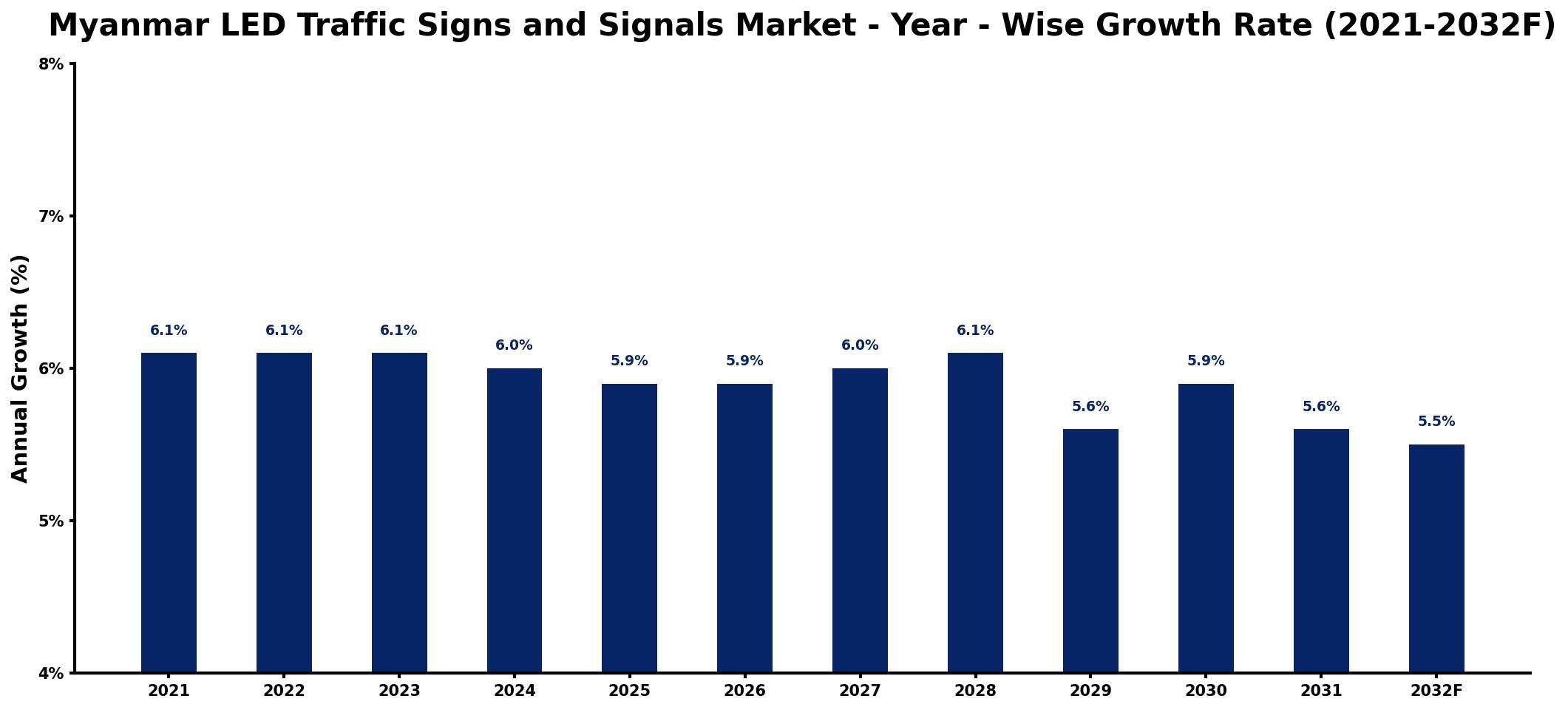
The table below presents the year‑wise growth rates along with the key drivers influencing the market
| Year | Growth Rate | Major Drivers |
| 2021 | 6.1% | Increased urban infrastructure investments |
| 2022 | 6.1% | Rising safety regulation compliance |
| 2023 | 6.1% | Growing smart city initiatives |
| 2024 | 6.0% | Expansion of renewable energy projects |
| 2025 | 5.9% | Enhanced public transportation systems |
| 2026 | 5.9% | Development of urban planning policies |
| 2027 | 6.0% | Increased government funding allocations |
| 2028 | 6.1% | Boost in public awareness campaigns |
| 2029 | 5.6% | Emergence of innovative technology solutions |
| 2030 | 5.9% | Strengthened environmental sustainability efforts |
| 2031 | 5.6% | Growing partnerships with private sector |
| 2032 | 5.5% | Rising demand for urban mobility |
Note: Market size estimations and growth projections presented in this report are based on 6Wresearch's proprietary forecasting methodology, utilizing the latest available industry data, government publications, and primary research inputs.
Myanmar LED Traffic Signs and Signals Market Synopsis
In Myanmar, the transition towards LED traffic signs and signals marks a significant shift in urban traffic management strategies. This evolution is fueled by the need for improved visibility and efficiency in traffic systems, as the nation undergoes rapid urbanization and infrastructure enhancement.
The adoption of LED technology is not just a trend but a response to the practical challenges faced by Myanmar's transportation infrastructure. With an emphasis on sustainability and energy conservation, local authorities are increasingly considering LED solutions to address road safety and traffic flow issues effectively.
Myanmar LED Traffic Signs and Signals Market Key Takeaways
- Steady growth in the market is driven by urbanization and infrastructure investment.
- LED technology's energy efficiency and durability position it as a preferred choice over traditional systems.
- Government policies are increasingly supporting the integration of advanced traffic management solutions.
- Investment opportunities abound as demand for innovative traffic signaling rises.
- Current challenges include regulatory inconsistencies and logistical issues in installation.
Evaluation of Restraints in Myanmar LED Traffic Signs and Signals Market
Despite promising growth prospects, the Myanmar LED Traffic Signs and Signals Market faces substantial challenges that can impede progress. One major constraint is the inconsistent regulatory framework, which creates uncertainty for stakeholders looking to implement LED technologies. The relatively high initial costs associated with LED installations deter certain government entities and organizations from adopting these advanced solutions. Furthermore, inadequate infrastructure in rural areas complicates the logistics of installation and maintenance. Lastly, the availability of lower-cost, traditional alternatives hinders the market penetration of LED systems, making it imperative for companies to navigate these obstacles effectively to capitalize on growth opportunities.
Myanmar LED Traffic Signs and Signals Market Trends
As the demand for advanced traffic signaling solutions grows, several trends are emerging within the Myanmar LED Traffic Signs and Signals Market. There is a notable integration of smart technologies, including connectivity and sensors, which enable real-time data monitoring to optimize traffic management. Additionally, a shift toward environmentally-friendly solutions is evident, aligning with global sustainability goals. These trends not only enhance visibility and effectiveness but also reflect the broader aspiration of modernizing Myanmar's transportation systems.
Myanmar LED Traffic Signs and Signals Market Opportunities
Investment opportunities in the Myanmar LED Traffic Signs and Signals Market are robust, particularly given the government's ongoing infrastructure initiatives. Companies that can offer innovative, energy-efficient LED solutions are well-positioned to benefit from the rising demand for advanced traffic management systems. Collaborations with local authorities and construction firms can facilitate market entry and expansion, while also addressing public safety needs. The long-term sustainability of LED technology and its positive impact on traffic systems further enhance its attractiveness for potential investors.
Government Initiatives in the Myanmar LED Traffic Signs and Signals Market
The Myanmar government has initiated various policies aimed at enhancing road safety and improving traffic management through the use of LED technology. Regulations mandating the implementation of LED solutions in traffic signs and signals have been established to ensure higher visibility and efficiency. Additionally, there are quality assurance guidelines that align with international standards, promoting the adoption of energy-efficient solutions across the country. These government initiatives underscore a commitment to modernizing transportation infrastructure while contributing to sustainability goals.
Future Insights of the Myanmar LED Traffic Signs and Signals Market
Looking ahead to 2026-2032, the Myanmar LED Traffic Signs and Signals Market is on track for significant expansion, bolstered by ongoing urbanization and infrastructure development initiatives. The focus on enhancing road safety and traffic efficiency will continue to drive demand for sophisticated traffic management systems. Moreover, as the country invests further in smart city initiatives, the integration of LED technology will likely become increasingly critical. With these developments, the market presents numerous opportunities for innovation and growth, catering to the evolving needs of urban traffic management.
Myanmar LED Traffic Signs and Signals Market Latest Developments (2025 - 2026)
Recent developments in the Myanmar LED Traffic Signs and Signals Market indicate a growing momentum towards integrating smart technologies into traffic management systems. The focus has shifted to creating more interconnected traffic networks that facilitate real-time data sharing and enhance road safety. Furthermore, local authorities are increasingly prioritizing energy-efficient solutions as part of broader sustainability efforts, reflecting a proactive approach to modernizing infrastructure while addressing environmental concerns.
Myanmar LED Traffic Signs and Signals Market - Key Attractiveness of the Report
- 10 Years of Market Numbers
- Historical Data Starting from 2022 to 2025
- Base Year: 2025
- Forecast Data until 2032
- Key Performance Indicators Impacting the Market
- Major Upcoming Developments and Projects
Key Highlights of the Report:
- Myanmar LED Traffic Signs and Signals Market Outlook
- Market Size of Myanmar LED Traffic Signs and Signals Market, 2025
- Forecast of Myanmar LED Traffic Signs and Signals Market, 2032
- Historical Data and Forecast of Myanmar LED Traffic Signs and Signals Revenues & Volume for the Period 2022-2032F
- Myanmar LED Traffic Signs and Signals Market Trend Evolution
- Myanmar LED Traffic Signs and Signals Market Drivers and Challenges
- Myanmar LED Traffic Signs and Signals Price Trends
- Myanmar LED Traffic Signs and Signals Porter's Five Forces
- Myanmar LED Traffic Signs and Signals Industry Life Cycle
- Historical Data and Forecast of Myanmar LED Traffic Signs and Signals Market Revenues & Volume By Product for the Period 2022-2032F
- Historical Data and Forecast of Myanmar LED Traffic Signs and Signals Market Revenues & Volume By LED Traffic Signals for the Period 2022-2032F
- Historical Data and Forecast of Myanmar LED Traffic Signs and Signals Market Revenues & Volume By LED Traffic Signs for the Period 2022-2032F
- Myanmar LED Traffic Signs and Signals Import Export Trade Statistics
- Market Opportunity Assessment By Product
- Myanmar LED Traffic Signs and Signals Top Companies Market Share
- Myanmar LED Traffic Signs and Signals Competitive Benchmarking By Technical and Operational Parameters
- Myanmar LED Traffic Signs and Signals Company Profiles
- Myanmar LED Traffic Signs and Signals Key Strategic Recommendations






































