Myanmar Linen Yarn Market Size, Share & Growth Rate
The Myanmar Linen Yarn Market was estimated at USD 814 Million in 2025 and is projected to reach USD 1161 Million by 2032, growing at a CAGR of 5.2% from 2026 to 2032. This growth trajectory is propelled by a burgeoning demand for high-quality, eco-friendly textiles in both domestic and international markets. Additionally, the increasing awareness of sustainable fashion trends coupled with favorable government policies is further stimulating market expansion.
Myanmar Linen Yarn Market Year-wise Growth Rate and Key Drivers
This graph highlights how the Myanmar Linen Yarn Market has steadily grown over the years, supported by major growth factors.
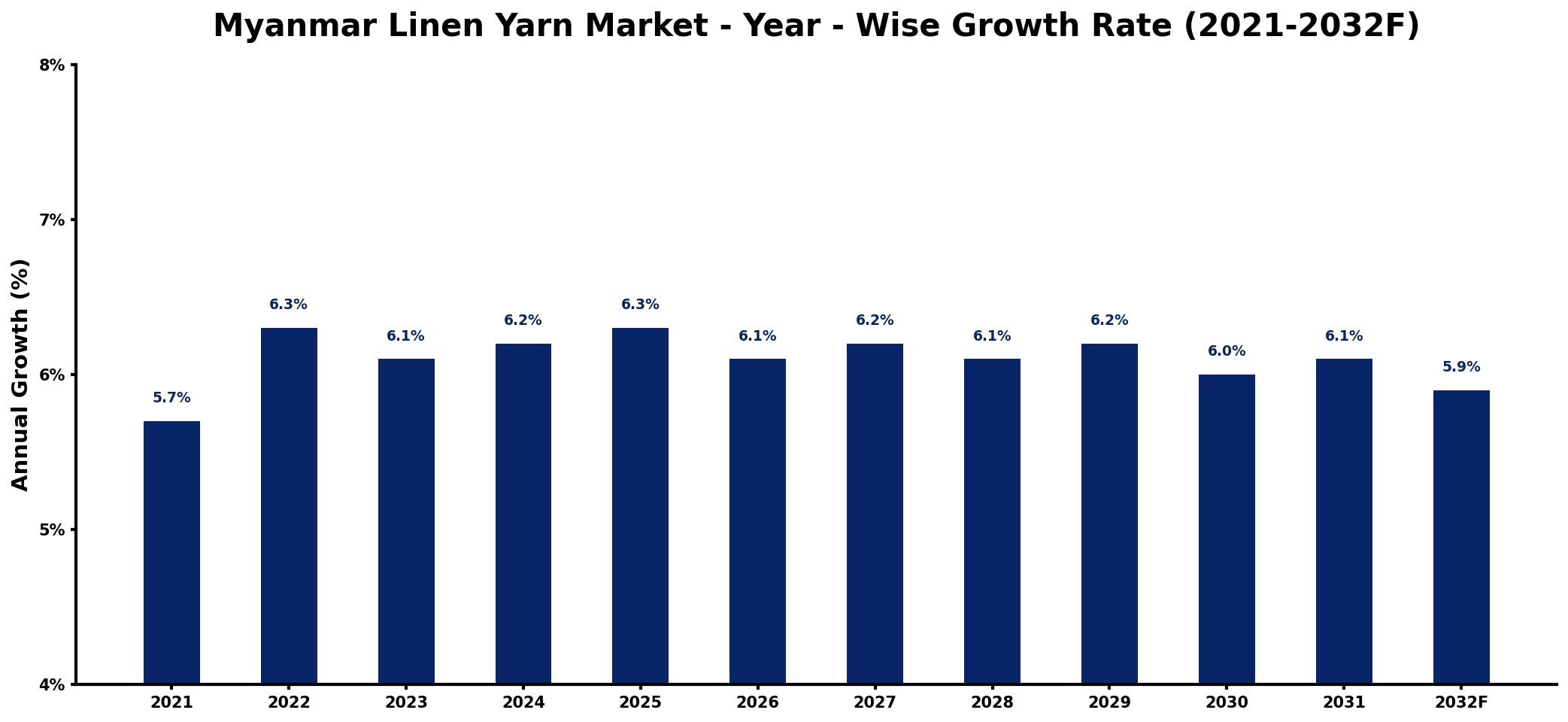
The table below presents the year‑wise growth rates along with the key drivers influencing the market
| Year | Growth Rate | Major Drivers |
| 2021 | 5.7% | Increased exports to international markets |
| 2022 | 6.3% | Rising demand for sustainable textiles |
| 2023 | 6.1% | Growth in eco-friendly fashion industry |
| 2024 | 6.2% | Expansion of domestic manufacturing capacity |
| 2025 | 6.3% | Investment in textile technology advancements |
| 2026 | 6.1% | Emergence of new consumer preferences |
| 2027 | 6.2% | Strengthened supply chain partnerships |
| 2028 | 6.1% | Boost in local artisan production |
| 2029 | 6.2% | Growing popularity of natural fibers |
| 2030 | 6.0% | Enhanced global trade agreements |
| 2031 | 6.1% | Increased awareness of sustainable practices |
| 2032 | 5.9% | Development of niche market segments |
Note: Market size estimations and growth projections presented in this report are based on 6Wresearch's proprietary forecasting methodology, utilizing the latest available industry data, government publications, and primary research inputs.
Myanmar Linen Yarn Market Synopsis
The Myanmar Linen Yarn Market is currently witnessing an uptick in consumer preference for sustainable textile solutions. As local and international apparel manufacturers prioritize eco-conscious sourcing, linen yarn has emerged as a preferred choice due to its natural properties and sustainability. This trend not only aligns with global consumer preferences but also positions Myanmar as a key player in the sustainable yarn segment.
Innovations in production techniques are enhancing the quality and competitiveness of Myanmar's linen yarn offerings. As the country continues to develop its textile infrastructure, local manufacturers are increasingly adapting to meet international standards, thus improving their market potential both locally and overseas.
Myanmar Linen Yarn Market Key Takeaways
- The market is experiencing a significant shift towards eco-friendly and sustainable production practices.
- Rising disposable incomes among consumers are leading to a higher demand for quality linen yarn.
- Government initiatives are focused on enhancing the competitiveness of the textile sector.
- Technological advancements in yarn production are improving product quality and efficiency.
- Import dependency due to limited domestic production capacity poses challenges to market stability.
Evaluation of Restraints in Myanmar Linen Yarn Market
Despite its promising outlook, the Myanmar Linen Yarn Market faces several critical restraints. A significant challenge is the limited domestic production capacity, which leads to high reliance on imports to meet market demands. Fluctuating raw material prices further exacerbate production costs, creating unpredictability for manufacturers. Additionally, the absence of advanced technology for yarn production can hinder efficiency and quality control, making it challenging to compete with other fiber markets. Political instability and regulatory uncertainties in Myanmar also present considerable risks, potentially impacting investment and growth opportunities in the sector.
Myanmar Linen Yarn Market Trends
The movement towards sustainability is a defining trend in the Myanmar Linen Yarn Market. Consumers are increasingly aware of environmental issues, driving the demand for biodegradable and natural fiber products like linen. Companies are responding by focusing on transparency in sourcing and production processes, catering to this eco-conscious market segment. Furthermore, there's a growing emphasis on innovation in production techniques, enhancing the quality and versatility of linen yarn, which is crucial for meeting diverse consumer needs.
Myanmar Linen Yarn Market Opportunities
With the rising demand for sustainable textiles, there are substantial investment opportunities within the Myanmar Linen Yarn Market. Investors can consider establishing production facilities or forming partnerships with local manufacturers to tap into the growing interest in eco-friendly materials. Moreover, Myanmar's competitive edge in producing high-quality linen yarn at relatively lower costs presents a unique opportunity for those looking to expand their reach in the global market.
Government Initiatives in the Myanmar Linen Yarn Market
The government of Myanmar is actively working to bolster the textile sector by promoting sustainable production practices and supporting local artisans. Initiatives include subsidies for flax cultivation, which is essential for linen yarn production, and training programs aimed at enhancing production efficiency and quality. Furthermore, trade agreements are being pursued to boost exports, thus fostering growth within the linen yarn market and contributing to the overall development of the textile industry.
Future Insights of the Myanmar Linen Yarn Market
Looking ahead to the period between 2026 and 2032, the Myanmar Linen Yarn Market is positioned for steady growth. The global emphasis on sustainable textiles and natural fibers is likely to bolster demand for linen products, as consumers increasingly gravitate towards eco-friendly alternatives. Additionally, ongoing government support and the potential for technological advancements present opportunities for enhancing production capabilities. Nonetheless, addressing challenges related to infrastructure and political stability will be crucial to fully realizing the market's growth potential.
Myanmar Linen Yarn Market Latest Developments (2025 - 2026)
Recent developments in the Myanmar Linen Yarn Market indicate a heightened focus on sustainability and quality improvement. Companies are investing in eco-friendly production processes and technologies to enhance product appeal to both domestic and international consumers. Additionally, collaborative efforts between the government and industry stakeholders are underway to streamline the export process, aiming to elevate Myanmar's status in the global linen yarn market.
Myanmar Linen Yarn Market - Key Attractiveness of the Report
- 10 Years of Market Numbers
- Historical Data Starting from 2022 to 2025
- Base Year: 2025
- Forecast Data until 2032
- Key Performance Indicators Impacting the Market
- Major Upcoming Developments and Projects
Key Highlights of the Report:
- Myanmar Linen Yarn Market Outlook
- Market Size of Myanmar Linen Yarn Market, 2025
- Forecast of Myanmar Linen Yarn Market, 2032
- Historical Data and Forecast of Myanmar Linen Yarn Revenues & Volume for the Period 2022-2032F
- Myanmar Linen Yarn Market Trend Evolution
- Myanmar Linen Yarn Market Drivers and Challenges
- Myanmar Linen Yarn Price Trends
- Myanmar Linen Yarn Porter's Five Forces
- Myanmar Linen Yarn Industry Life Cycle
- Historical Data and Forecast of Myanmar Linen Yarn Market Revenues & Volume By Products for the Period 2022-2032F
- Historical Data and Forecast of Myanmar Linen Yarn Market Revenues & Volume By Dry spun yarn for the Period 2022-2032F
- Historical Data and Forecast of Myanmar Linen Yarn Market Revenues & Volume By Wet spun yarn for the Period 2022-2032F
- Historical Data and Forecast of Myanmar Linen Yarn Market Revenues & Volume By Blended yarn for the Period 2022-2032F
- Historical Data and Forecast of Myanmar Linen Yarn Market Revenues & Volume By Applications for the Period 2022-2032F
- Historical Data and Forecast of Myanmar Linen Yarn Market Revenues & Volume By Clothings for the Period 2022-2032F
- Historical Data and Forecast of Myanmar Linen Yarn Market Revenues & Volume By Beddings for the Period 2022-2032F
- Historical Data and Forecast of Myanmar Linen Yarn Market Revenues & Volume By Others for the Period 2022-2032F
- Myanmar Linen Yarn Import Export Trade Statistics
- Market Opportunity Assessment By Products
- Market Opportunity Assessment By Applications
- Myanmar Linen Yarn Top Companies Market Share
- Myanmar Linen Yarn Competitive Benchmarking By Technical and Operational Parameters
- Myanmar Linen Yarn Company Profiles
- Myanmar Linen Yarn Key Strategic Recommendations






































