Myanmar Lithium Carbonate Market Size, Share & Growth Rate
The Myanmar Lithium Carbonate Market was estimated at USD 442 Million in 2025 and is projected to reach USD 632 Million by 2032, growing at a CAGR of 5.2% from 2026 to 2032. This growth trajectory is primarily driven by the surging demand for lithium-ion batteries across key sectors such as automotive, consumer electronics, and energy storage. As Myanmar embraces electric vehicle technology and renewable energy projects, the relevance of lithium carbonate in battery production becomes increasingly significant.
Myanmar Lithium Carbonate Market Year-wise Growth Rate and Key Drivers
This graph highlights how the Myanmar Lithium Carbonate Market has steadily grown over the years, supported by major growth factors.
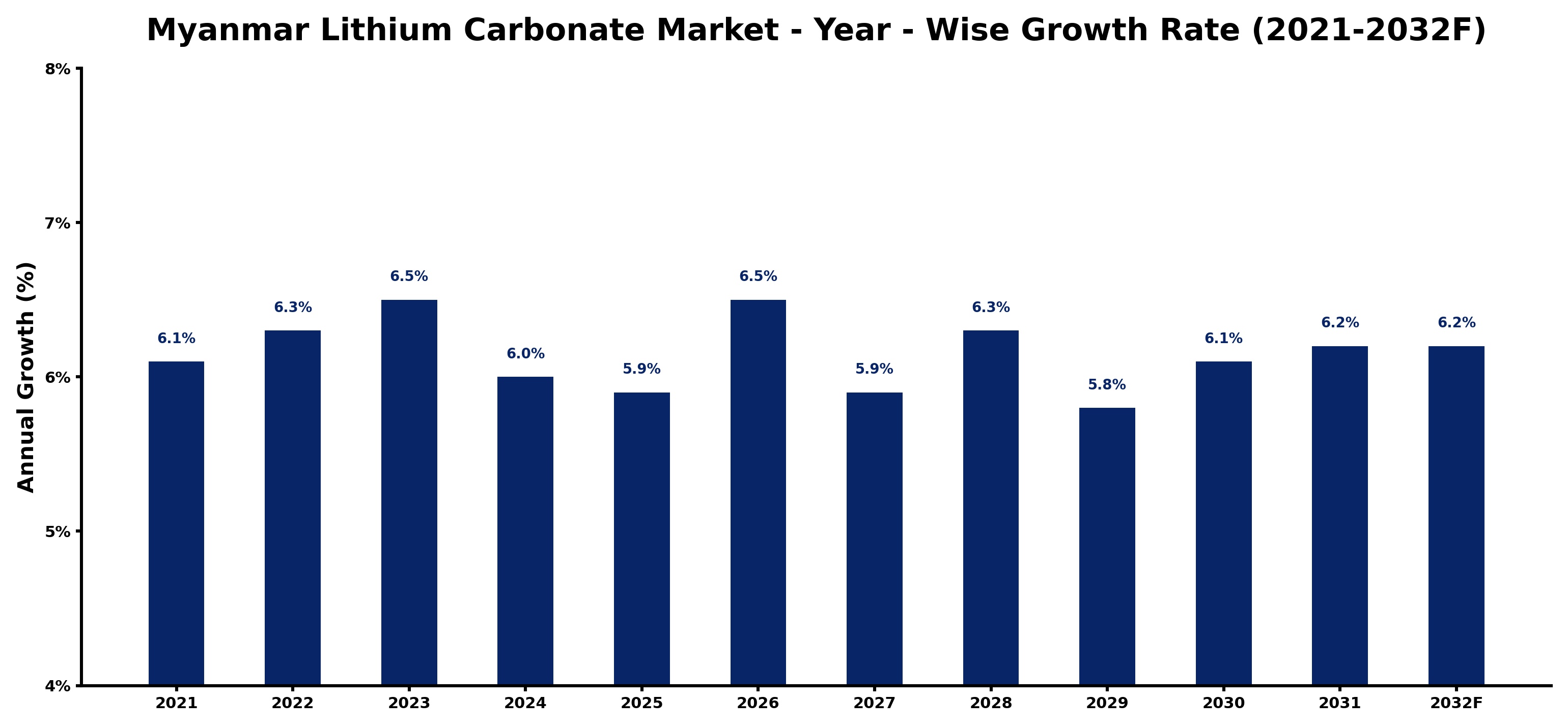
The table below presents the year‑wise growth rates along with the key drivers influencing the market
| Year | Growth Rate | Major Drivers |
| 2021 | 6.1% | Rising electric vehicle demand |
| 2022 | 6.3% | Increased battery production capacity |
| 2023 | 6.5% | Technological advancements in extraction |
| 2024 | 6.0% | Growing renewable energy investments |
| 2025 | 5.9% | Expansion of lithium mining operations |
| 2026 | 6.5% | Higher global lithium prices |
| 2027 | 5.9% | Increased adoption of energy storage |
| 2028 | 6.3% | Emerging markets driving consumption |
| 2029 | 5.8% | Sustainable mining practices gaining traction |
| 2030 | 6.1% | Government incentives for green technologies |
| 2031 | 6.2% | Partnerships enhancing supply chain efficiency |
| 2032 | 6.2% | Innovations in lithium recycling methods |
Note - Market size estimations and growth projections presented in this report are based on 6Wresearch’s advanced forecasting approach, validated with industry datasets as of June 2026.
Myanmar Lithium Carbonate Market Synopsis
The most influential force shaping the Myanmar Lithium Carbonate Market is the escalating demand for electric vehicles (EVs). This demand is closely linked to global trends toward sustainability and reduced carbon emissions, making lithium carbonate essential for battery performance. Additionally, Myanmar's growing energy storage requirements provide a robust backdrop for expanding lithium carbonate usage.
Another critical factor is the government's proactive stance on fostering clean energy initiatives. By offering incentives for local extraction and processing, the government aims to position Myanmar as a key player in the lithium carbonate supply chain, especially given the market's pivot toward green technologies.
Myanmar Lithium Carbonate Market Key Takeaways
- The market is largely driven by the increasing adoption of lithium-ion batteries in electric vehicles and renewable energy systems.
- Government policies are encouraging local extraction and processing, enhancing the sector's growth potential.
- Advancements in battery technology are propelling demand, particularly in energy storage applications.
- Environmental considerations play a significant role in shaping regulatory frameworks and market dynamics.
- Competition from established international suppliers presents ongoing challenges for local producers.
Evaluation of Restraints in Myanmar Lithium Carbonate Market
Despite the promising outlook, several constraints are limiting the potential growth of the Myanmar Lithium Carbonate Market. One of the main issues is the limited domestic production capacity, which hampers the ability to meet rising demand. Additionally, concerns regarding extraction and processing methods raise environmental flags, leading to regulatory scrutiny. The competition from well-established international suppliers can overshadow local players, further complicating market entry for new businesses. These factors collectively present challenges that need to be navigated for sustained growth.
Myanmar Lithium Carbonate Market Trends
Current trends indicate a significant shift toward sustainable practices within the lithium carbonate market. The advancement of battery technologies has not only improved energy density but also enhanced longevity, making lithium-ion batteries more efficient. Furthermore, the integration of smart technologies into electric vehicles and energy storage systems is creating a surge in demand for high-performance materials. As consumers become more eco-conscious, the preference for lithium carbonate sourced through ethical and sustainable practices is gaining traction.
Myanmar Lithium Carbonate Market Opportunities
Opportunities for growth in the Myanmar Lithium Carbonate Market are abundant, particularly in sectors poised for expansion. The push for electric vehicle adoption offers a lucrative avenue for investment, as does the development of grid-scale energy storage systems. Moreover, potential collaborations between government bodies and private enterprises to enhance extraction technologies present a path for innovation. As Myanmar seeks to elevate its position in the global lithium supply chain, these emerging sectors will play a critical role in defining the market's future.
Government Initiatives in the Myanmar Lithium Carbonate Market
The Myanmar government has recognized the strategic importance of lithium carbonate in fostering a sustainable economy. Policies have been implemented to promote local extraction and processing, ensuring adherence to environmental and safety standards. Furthermore, there is a concerted effort to encourage research and innovation in battery applications, which underlines the government's commitment to advancing clean energy solutions. These initiatives are vital in positioning Myanmar as a competitive player in the global lithium market.
Future Insights of the Myanmar Lithium Carbonate Market
Looking ahead to 2026-2032, the Myanmar Lithium Carbonate Market is set for significant expansion. Increased global emphasis on electric vehicles and renewable energy will likely fuel demand, creating a sustainable growth environment. As local production capacity improves and extraction methods become more efficient, Myanmar could emerge as a key supplier in Southeast Asia. Moreover, strategic partnerships and international collaborations could further enhance market access and innovation.
Myanmar Lithium Carbonate Market Latest Developments (May 2025 - June 2026)
In recent months, the Myanmar Lithium Carbonate Market has witnessed a series of strategic developments. The government has rolled out initiatives aimed at bolstering local production capabilities while ensuring environmentally sustainable practices. Additionally, advancements in processing technologies are under consideration to enhance the efficiency of extraction methods. Industry players are also exploring collaborations that could facilitate technology transfer and improve market access, reflecting a dynamic shift in the competitive landscape.
Myanmar Lithium Carbonate Market - Key Attractiveness of the Report
- 10 Years of Market Numbers
- Historical Data Starting from 2022 to 2025
- Base Year: 2025
- Forecast Data until 2032
- Key Performance Indicators Impacting the Market
- Major Upcoming Developments and Projects
Key Highlights of the Report:
- Myanmar Lithium Carbonate Market Outlook
- Market Size of Myanmar Lithium Carbonate Market, 2025
- Forecast of Myanmar Lithium Carbonate Market, 2032
- Historical Data and Forecast of Myanmar Lithium Carbonate Revenues & Volume for the Period 2022-2032F
- Myanmar Lithium Carbonate Market Trend Evolution
- Myanmar Lithium Carbonate Market Drivers and Challenges
- Myanmar Lithium Carbonate Price Trends
- Myanmar Lithium Carbonate Porter's Five Forces
- Myanmar Lithium Carbonate Industry Life Cycle
- Historical Data and Forecast of Myanmar Lithium Carbonate Market Revenues & Volume By Purity for the Period 2022-2032F
- Historical Data and Forecast of Myanmar Lithium Carbonate Market Revenues & Volume By 98.5% - 99.4% for the Period 2022-2032F
- Historical Data and Forecast of Myanmar Lithium Carbonate Market Revenues & Volume By 99.5% - 99.8% for the Period 2022-2032F
- Historical Data and Forecast of Myanmar Lithium Carbonate Market Revenues & Volume By 0.999 for the Period 2022-2032F
- Historical Data and Forecast of Myanmar Lithium Carbonate Market Revenues & Volume By Grade for the Period 2022-2032F
- Historical Data and Forecast of Myanmar Lithium Carbonate Market Revenues & Volume By High Purity for the Period 2022-2032F
- Historical Data and Forecast of Myanmar Lithium Carbonate Market Revenues & Volume By Battery for the Period 2022-2032F
- Historical Data and Forecast of Myanmar Lithium Carbonate Market Revenues & Volume By Pharmaceutical for the Period 2022-2032F
- Historical Data and Forecast of Myanmar Lithium Carbonate Market Revenues & Volume By Application for the Period 2022-2032F
- Historical Data and Forecast of Myanmar Lithium Carbonate Market Revenues & Volume By Li-ion batteries for the Period 2022-2032F
- Historical Data and Forecast of Myanmar Lithium Carbonate Market Revenues & Volume By Glass & Ceramics for the Period 2022-2032F
- Historical Data and Forecast of Myanmar Lithium Carbonate Market Revenues & Volume By Cement Manufacturing for the Period 2022-2032F
- Historical Data and Forecast of Myanmar Lithium Carbonate Market Revenues & Volume By Aluminum Production for the Period 2022-2032F
- Historical Data and Forecast of Myanmar Lithium Carbonate Market Revenues & Volume By Pharmaceutical Industry for the Period 2022-2032F
- Historical Data and Forecast of Myanmar Lithium Carbonate Market Revenues & Volume By Others for the Period 2022-2032F
- Myanmar Lithium Carbonate Import Export Trade Statistics
- Market Opportunity Assessment By Purity
- Market Opportunity Assessment By Grade
- Market Opportunity Assessment By Application
- Myanmar Lithium Carbonate Top Companies Market Share
- Myanmar Lithium Carbonate Competitive Benchmarking By Technical and Operational Parameters
- Myanmar Lithium Carbonate Company Profiles
- Myanmar Lithium Carbonate Key Strategic Recommendations






































