Myanmar Low Power Wide Area Network Market Size & Growth Rate (2026-2032)
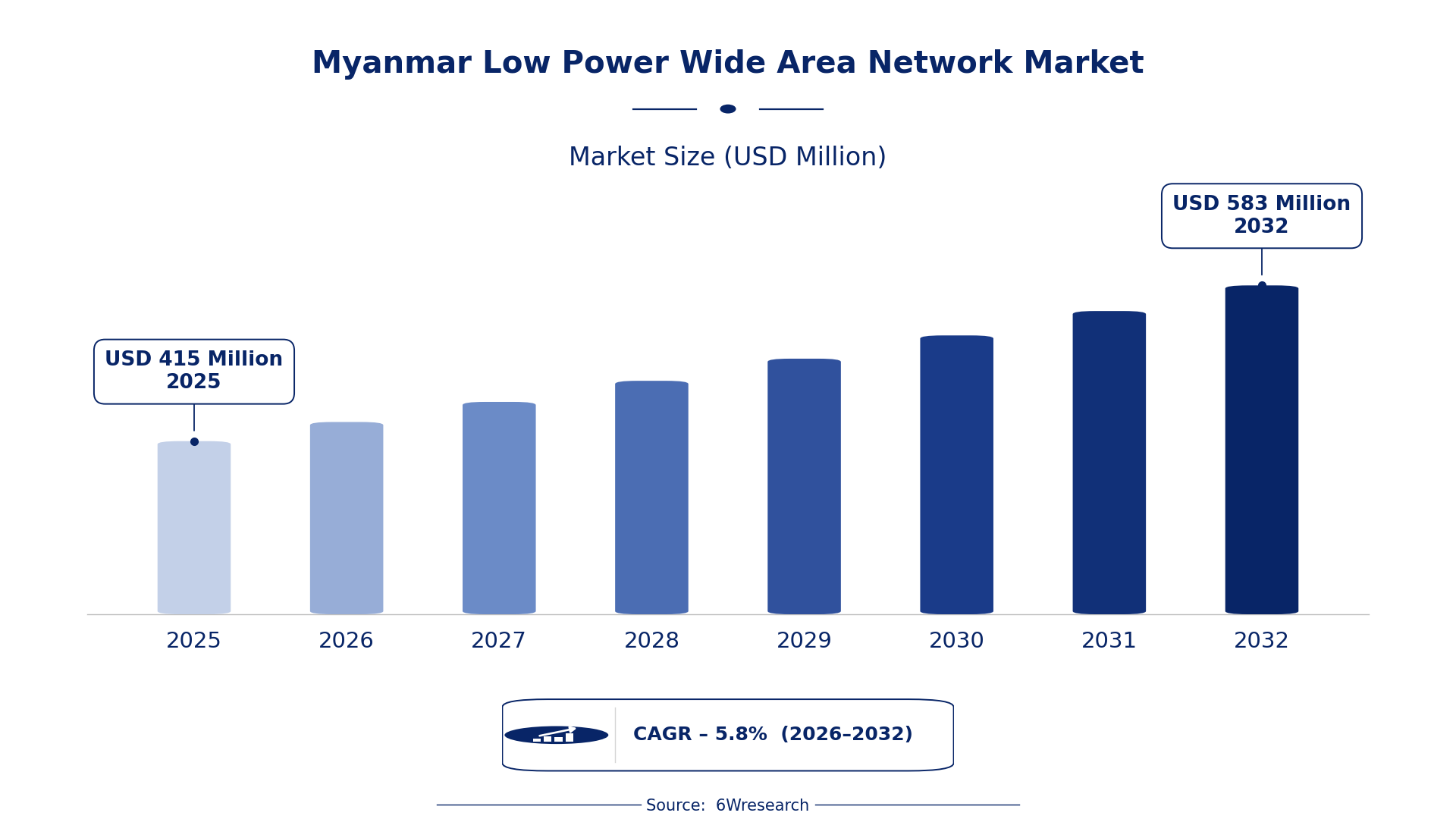
The Myanmar Low Power Wide Area Network Market was estimated at USD 415 Million in 2025 and is projected to reach USD 583 Million by 2032, growing at a CAGR of 5.8% from 2026 to 2032.
Myanmar Low Power Wide Area Network Market Synopsis
In recent years, the Myanmar Low Power Wide Area Network (LPWAN) market has seen robust growth driven by the rapid adoption of Internet of Things (IoT) applications across sectors like agriculture and logistics. This momentum is set against the backdrop of a pressing need for efficient connectivity solutions, particularly in rural areas where traditional infrastructure falls short.
Looking ahead, the market is anticipated to expand further as more organizations recognize the advantages of LPWAN technologies like LoRaWAN and Sigfox. This expansion aligns with Myanmar's broader digital transformation goals, offering tailored solutions that meet the specific needs of local industries while enhancing operational efficiencies.
Myanmar Low Power Wide Area Network Market Year-wise Growth Rate and Key Drivers
This graph illustrates the annual growth rates of the Myanmar Low Power Wide Area Network Market from 2021 to 2032, highlighting a steady upward trajectory and projected expansion over the forecast period.
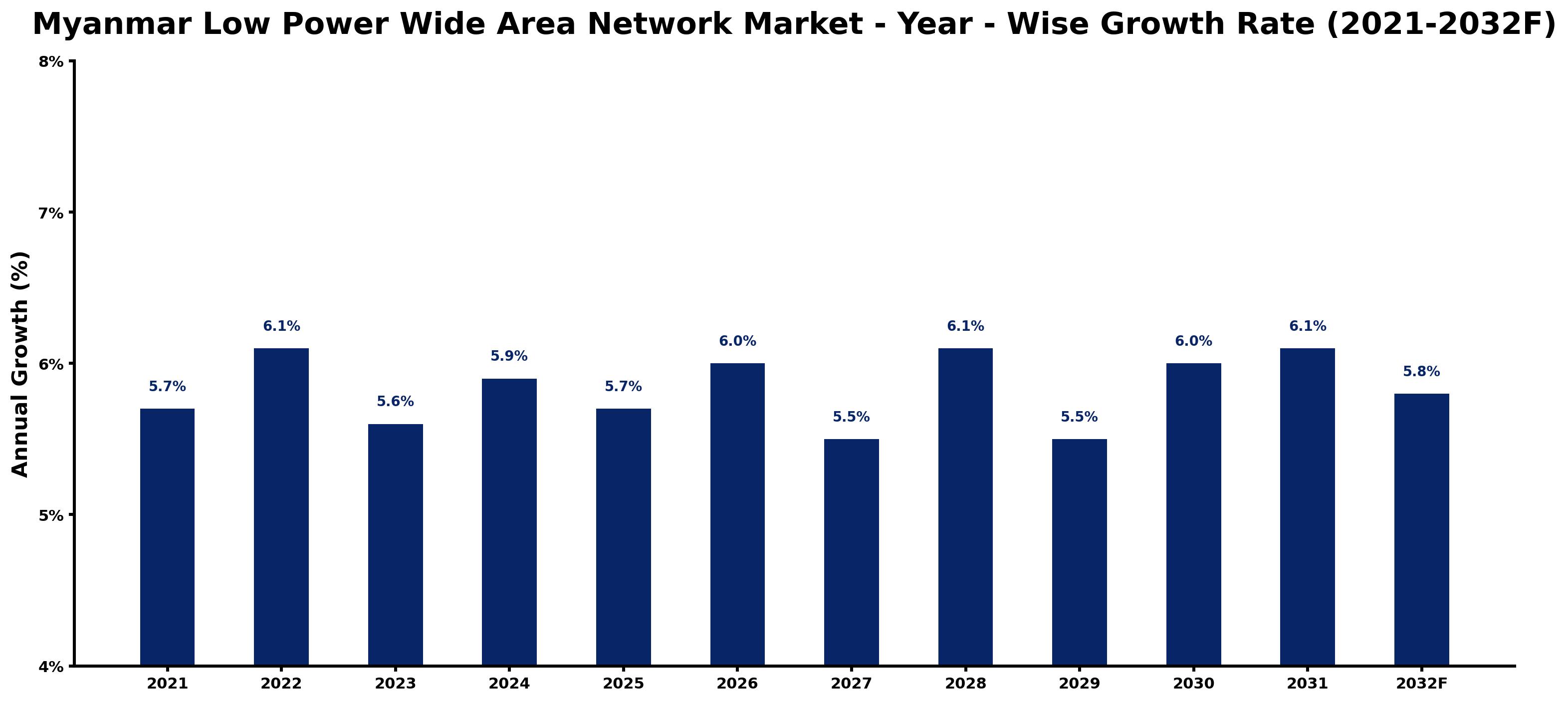
The table below presents the year‑wise growth rates along with the key drivers influencing the market
| Year | Growth Rate | Major Drivers |
| 2021 | 5.7% | Adoption of IoT solutions for flood monitoring initiatives. |
| 2022 | 6.1% | Government-backed agricultural technology innovation programs boost connectivity. |
| 2023 | 5.6% | Enhanced connectivity for remote health services in rural areas. |
| 2024 | 5.9% | Increased investment in smart agriculture by local cooperatives. |
| 2025 | 5.7% | Development of logistics solutions leveraging LPWAN technology. |
| 2026 | 6.0% | Rising smartphone penetration facilitating IoT device usage. |
| 2027 | 5.5% | Partnerships with international tech firms for network expansion. |
| 2028 | 6.1% | Government fintech initiatives driving demand for IoT applications. |
| 2029 | 5.5% | Push for energy-efficient urban solutions in Myanmar's cities. |
| 2030 | 6.0% | Local manufacturing of IoT devices reducing import dependencies. |
| 2031 | 6.1% | Increased environmental monitoring due to climate change concerns. |
| 2032 | 5.8% | Growing interest in telemedicine solutions post-pandemic. |
Note: Market size estimations and growth projections presented in this report are based on 6Wresearch's proprietary forecasting methodology, utilizing the latest available industry data, government publications, and primary research inputs.
Myanmar Low Power Wide Area Network Market Key Takeaways
Below are some of the specific key takeaways from the market, including:
- The adoption of LPWAN solutions is primarily driven by the growth of IoT applications in various sectors.
- Cost-effective and energy-efficient technologies, such as LoRaWAN, are gaining popularity.
- Partnerships between LPWAN providers and local telecommunications companies are expanding network reach.
- Government initiatives are playing a critical role in fostering the deployment of LPWAN technologies.
- Rural areas remain a focus for future infrastructure developments in the LPWAN sector.
Evaluation of Restraints in Myanmar Low Power Wide Area Network Market
The Myanmar Low Power Wide Area Network market is grappling with several substantial restraints that hinder its potential. Chief among these is the lack of adequate infrastructure, particularly in rural regions, where connectivity challenges severely limit the deployment of LPWAN technologies. This not only stifles innovation in applications like smart agriculture and asset tracking but also raises concerns among investors looking for market entry.
Additionally, unclear regulatory frameworks regarding spectrum allocation and licensing introduce a level of uncertainty, further complicating market dynamics. The shortage of skilled professionals in LPWAN technology adds another layer of difficulty, slowing down adoption rates. Tackling these issues is essential for unlocking the market's full potential.
Myanmar Low Power Wide Area Network Market Trends
Several key trends are currently shaping the Myanmar LPWAN market. The deployment of LoRaWAN technology is gaining momentum due to its long-range capabilities and cost efficiency. Businesses are increasingly seeking LPWAN solutions that offer low power consumption, which is crucial for the widespread adoption of IoT devices.
Partnerships between local telecommunications firms and LPWAN providers are enhancing network coverage, especially in underserved areas. Government initiatives aimed at promoting digital transformation are encouraging investments and infrastructure developments, ultimately driving market growth.
Myanmar Low Power Wide Area Network Market Opportunities
The Myanmar LPWAN market is ripe with investment opportunities, particularly in IoT applications across various sectors. The increasing demand for efficient data transmission, coupled with the necessity for remote monitoring solutions, presents a lucrative avenue for investors. With the local economy modernizing, there is potential for substantial returns in LPWAN infrastructure development and service provision.
Forming strategic partnerships with telecommunications providers and government entities will facilitate market entry and navigate the regulatory landscape, further enhancing prospects for growth and innovation.
Government Initiatives in the Myanmar Low Power Wide Area Network Market
The government of Myanmar is actively shaping the LPWAN market through various policies aimed at fostering technology adoption and infrastructure development. By introducing initiatives that facilitate spectrum licensing and regulatory frameworks, authorities aim to stimulate the growth of LPWAN networks across the country. This proactive stance is essential for driving digital transformation and enhancing connectivity, especially in rural areas.
- A spectrum licensing initiative launched in early 2025 aims to streamline regulations for LPWAN providers.
- A national digital infrastructure upgrade program is currently underway, focusing on enhancing network connectivity in remote regions.
- Policies encouraging investment in LPWAN technology, including subsidies for businesses deploying solutions, have recently been introduced.
- Upcoming initiatives include public-private partnerships expected to broaden telecom infrastructure access by 2028.
Future Insights of the Myanmar Low Power Wide Area Network Market
Looking toward 2026-2032, the Myanmar LPWAN market appears to be on a trajectory of sustained growth, driven largely by the increasing adoption of IoT devices across key industries. The favorable regulatory climate and ongoing government initiatives to enhance digital infrastructure will likely catalyze market development further. As organizations recognize the operational efficiencies afforded by LPWAN technology, demand for solutions will likely escalate, paving the way for innovation and new business models in Myanmar's IoT ecosystem.
Myanmar Low Power Wide Area Network Market Latest Developments
In the last 12-14 months, the Myanmar LPWAN market has been characterized by a flurry of activity aimed at building a more connected and efficient environment. With increased government support and private sector involvement, numerous projects aimed at expanding LPWAN capabilities have been initiated. These developments signal a commitment to modernizing the country's infrastructure and enhancing connectivity.
- A major technology vendor announced a partnership in early 2025 with a local telecom operator to roll out LPWAN services across urban centers.
- A pilot program for smart agriculture solutions utilizing LPWAN technology has been initiated and remains ongoing, demonstrating practical applications in the field.
- Regulatory authorities are currently drafting new guidelines for LPWAN deployment, aimed for completion in late 2026.
- An upcoming initiative planned for Q2 2026 aims to extend LPWAN coverage to underserved rural areas through community-based projects.
Myanmar Low Power Wide Area Network Market - Key Attractiveness of the Report
- 10 Years of Market Numbers
- Historical Data Starting from 2022 to 2025
- Base Year: 2025
- Forecast Data until 2032
- Key Performance Indicators Impacting the Market
- Major Upcoming Developments and Projects
Key Highlights of the Report:
- Myanmar Low Power Wide Area Network Market Outlook
- Market Size of Myanmar Low Power Wide Area Network Market, 2025
- Forecast of Myanmar Low Power Wide Area Network Market, 2032
- Historical Data and Forecast of Myanmar Low Power Wide Area Network Revenues & Volume for the Period 2022-2032F
- Myanmar Low Power Wide Area Network Market Trend Evolution
- Myanmar Low Power Wide Area Network Market Drivers and Challenges
- Myanmar Low Power Wide Area Network Price Trends
- Myanmar Low Power Wide Area Network Porter's Five Forces
- Myanmar Low Power Wide Area Network Industry Life Cycle
- Historical Data and Forecast of Myanmar Low Power Wide Area Network Market Revenues & Volume By Connectivity Technology for the Period 2022-2032F
- Historical Data and Forecast of Myanmar Low Power Wide Area Network Market Revenues & Volume By SIGFOX for the Period 2022-2032F
- Historical Data and Forecast of Myanmar Low Power Wide Area Network Market Revenues & Volume By LoRaWAN for the Period 2022-2032F
- Historical Data and Forecast of Myanmar Low Power Wide Area Network Market Revenues & Volume By Weigthless for the Period 2022-2032F
- Historical Data and Forecast of Myanmar Low Power Wide Area Network Market Revenues & Volume By Others for the Period 2022-2032F
- Historical Data and Forecast of Myanmar Low Power Wide Area Network Market Revenues & Volume By Verticals for the Period 2022-2032F
- Historical Data and Forecast of Myanmar Low Power Wide Area Network Market Revenues & Volume By Agriculture for the Period 2022-2032F
- Historical Data and Forecast of Myanmar Low Power Wide Area Network Market Revenues & Volume By Smart Logistic and Transportation for the Period 2022-2032F
- Historical Data and Forecast of Myanmar Low Power Wide Area Network Market Revenues & Volume By Healthcare for the Period 2022-2032F
- Historical Data and Forecast of Myanmar Low Power Wide Area Network Market Revenues & Volume By Industrial Manufacturing for the Period 2022-2032F
- Historical Data and Forecast of Myanmar Low Power Wide Area Network Market Revenues & Volume By Oil and Gas for the Period 2022-2032F
- Historical Data and Forecast of Myanmar Low Power Wide Area Network Market Revenues & Volume By Consumer Electronics for the Period 2022-2032F
- Historical Data and Forecast of Myanmar Low Power Wide Area Network Market Revenues & Volume By Others for the Period 2022-2032F
- Historical Data and Forecast of Myanmar Low Power Wide Area Network Market Revenues & Volume By Application for the Period 2022-2032F
- Historical Data and Forecast of Myanmar Low Power Wide Area Network Market Revenues & Volume By Smart Waste Management for the Period 2022-2032F
- Historical Data and Forecast of Myanmar Low Power Wide Area Network Market Revenues & Volume By Smart Buildings for the Period 2022-2032F
- Historical Data and Forecast of Myanmar Low Power Wide Area Network Market Revenues & Volume By Smart Gas and Water Metering for the Period 2022-2032F
- Historical Data and Forecast of Myanmar Low Power Wide Area Network Market Revenues & Volume By Smart Streetlights for the Period 2022-2032F
- Historical Data and Forecast of Myanmar Low Power Wide Area Network Market Revenues & Volume By Smart Parking for the Period 2022-2032F
- Historical Data and Forecast of Myanmar Low Power Wide Area Network Market Revenues & Volume By Livestock Monitoring for the Period 2022-2032F
- Historical Data and Forecast of Myanmar Low Power Wide Area Network Market Revenues & Volume By Others for the Period 2022-2032F
- Historical Data and Forecast of Myanmar Low Power Wide Area Network Market Revenues & Volume By Network Deployment for the Period 2022-2032F
- Historical Data and Forecast of Myanmar Low Power Wide Area Network Market Revenues & Volume By Public Sector for the Period 2022-2032F
- Historical Data and Forecast of Myanmar Low Power Wide Area Network Market Revenues & Volume By Private Sector for the Period 2022-2032F
- Historical Data and Forecast of Myanmar Low Power Wide Area Network Market Revenues & Volume By Technology Service for the Period 2022-2032F
- Historical Data and Forecast of Myanmar Low Power Wide Area Network Market Revenues & Volume By Managed Services for the Period 2022-2032F
- Historical Data and Forecast of Myanmar Low Power Wide Area Network Market Revenues & Volume By Professional Services for the Period 2022-2032F
- Myanmar Low Power Wide Area Network Import Export Trade Statistics
- Market Opportunity Assessment By Connectivity Technology
- Market Opportunity Assessment By Verticals
- Market Opportunity Assessment By Application
- Market Opportunity Assessment By Network Deployment
- Market Opportunity Assessment By Technology Service
- Myanmar Low Power Wide Area Network Top Companies Market Share
- Myanmar Low Power Wide Area Network Competitive Benchmarking By Technical and Operational Parameters
- Myanmar Low Power Wide Area Network Company Profiles
- Myanmar Low Power Wide Area Network Key Strategic Recommendations






































