Myanmar Managed Mobility Services Market Size & Growth Rate (2026-2032)
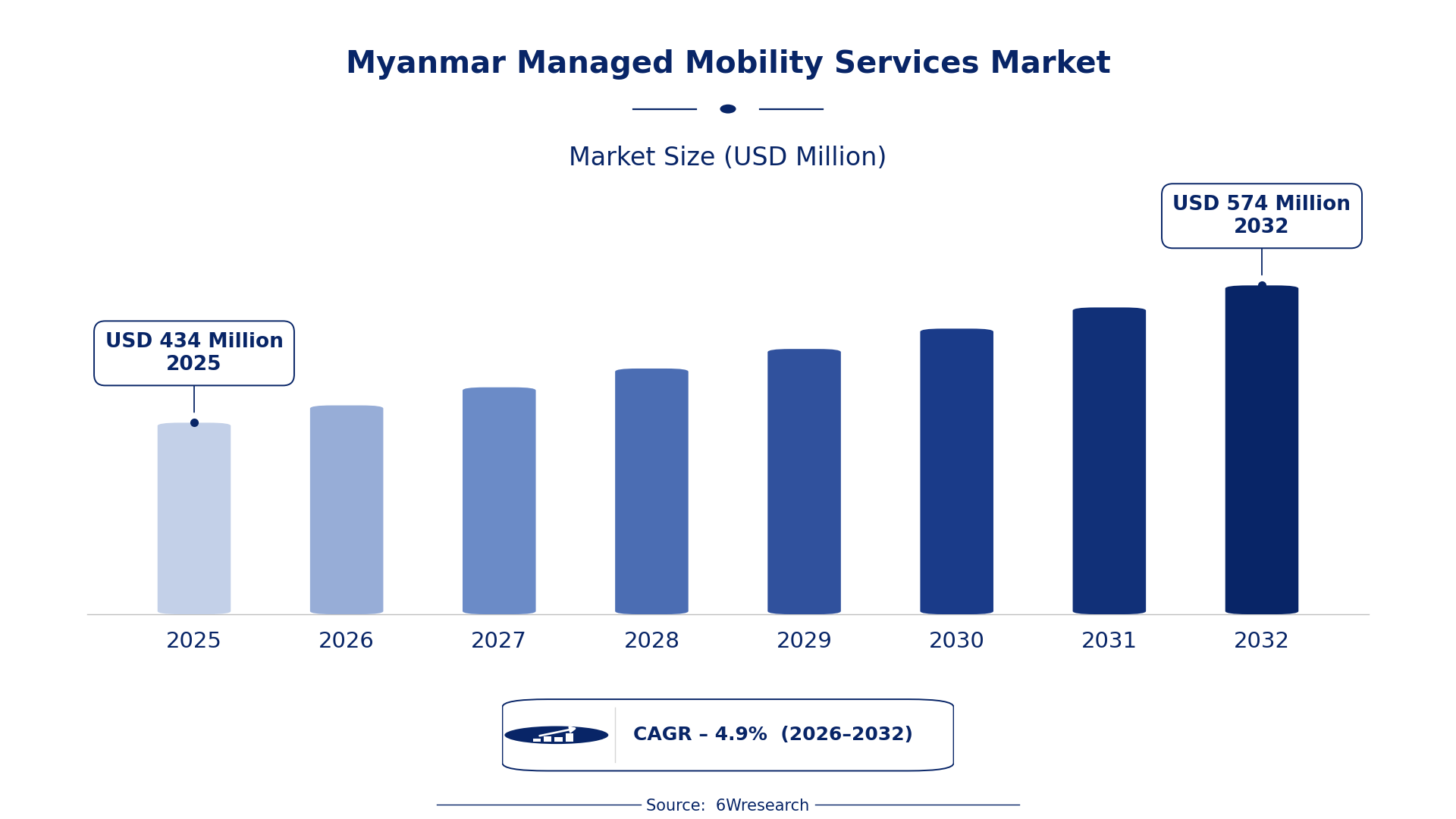
The Myanmar Managed Mobility Services Market was estimated at USD 434 Million in 2025 and is projected to reach USD 574 Million by 2032, growing at a CAGR of 4.9% from 2026 to 2032.
Myanmar Managed Mobility Services Market Synopsis
The Myanmar Managed Mobility Services Market is currently experiencing a notable surge in demand as businesses embrace mobile technologies. This momentum marks a clear shift from conventional practices to more integrated mobile operations, demonstrating a readiness for innovation.
Looking forward, the market's trajectory indicates an expanding ecosystem centered around efficient mobile device management, propelled by the rising prevalence of smartphones and tablets. This transformation is underlined by an urgent need for cost-effective solutions tailored to specific business requirements, indicating a vibrant future.
Myanmar Managed Mobility Services Market Year-wise Growth Rate and Key Drivers
This graph illustrates the annual growth rates of the Myanmar Managed Mobility Services Market from 2021 to 2032, highlighting a steady upward trajectory and projected expansion over the forecast period.
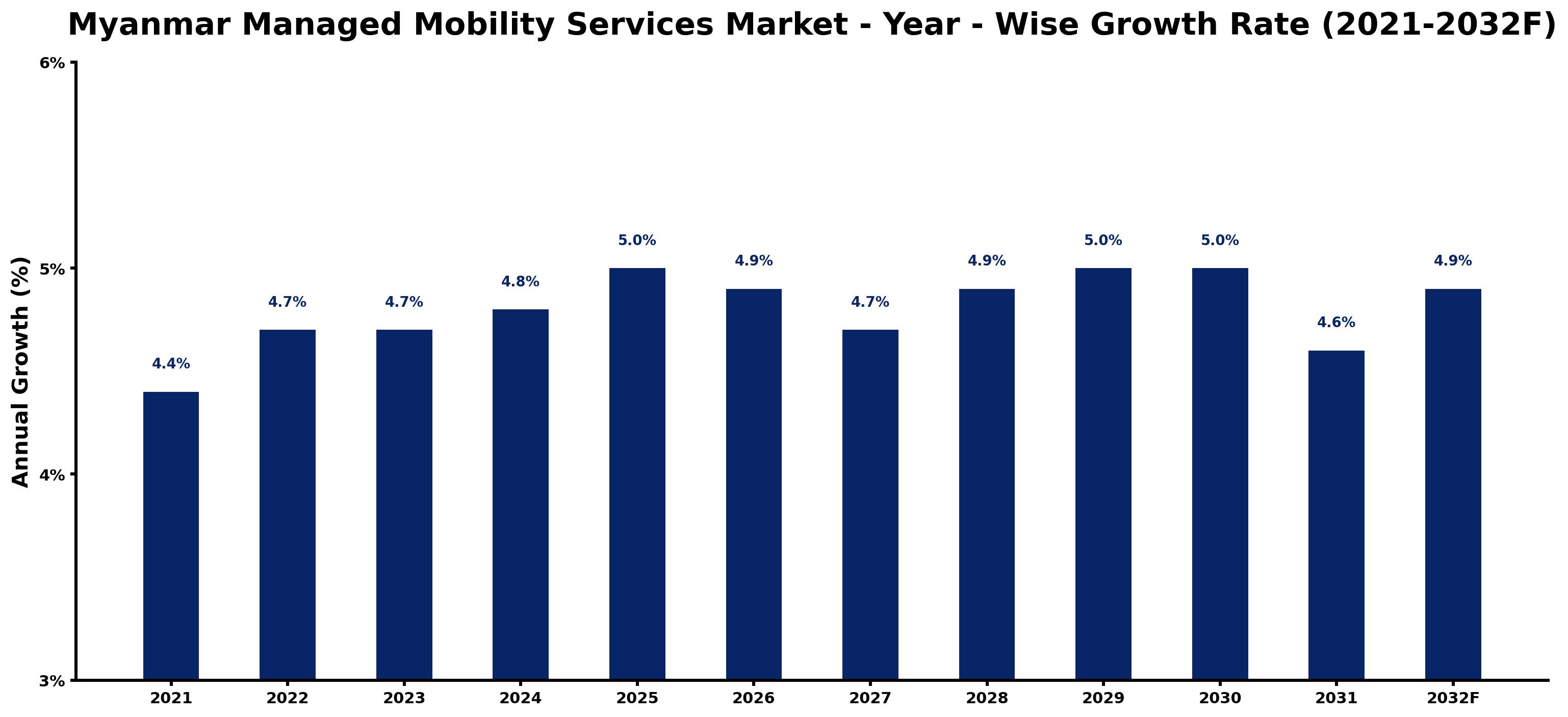
The table below presents the year‑wise growth rates along with the key drivers influencing the market
| Year | Growth Rate | Major Drivers |
| 2021 | 4.4% | Increased smartphone penetration among urban youth demographic. |
| 2022 | 4.7% | Rising interest in mobile app development among startups. |
| 2023 | 4.7% | Government initiative to enhance 4G network coverage nationwide. |
| 2024 | 4.8% | Emerging fintech startups boosting managed mobile solutions. |
| 2025 | 5.0% | Increased foreign investment in tech-driven service sectors. |
| 2026 | 4.9% | Growing adoption of BYOD policies in SMEs. |
| 2027 | 4.7% | Enhanced mobile cybersecurity regulations by Central Bank. |
| 2028 | 4.9% | Youth-led demand for handheld e-learning tools. |
| 2029 | 5.0% | Partnerships with telecom firms for advanced mobility services. |
| 2030 | 5.0% | Evolving customer expectations for personalized mobile experiences. |
| 2031 | 4.6% | Increased awareness of mobile health applications. |
| 2032 | 4.9% | Demand for integrated logistics solutions post-pandemic. |
Note: Market size estimations and growth projections presented in this report are based on 6Wresearch's proprietary forecasting methodology, utilizing the latest available industry data, government publications, and primary research inputs.
Myanmar Managed Mobility Services Market Key Takeaways
Below are some of the specific key takeaways from the market, including:
- Organizations in Myanmar are increasingly opting for managed mobility services to streamline their mobile device operations.
- Rising smartphone and tablet adoption directly contributes to the growth of the managed mobility services market.
- There is a growing demand for tailored, cost-effective mobility solutions among businesses.
- Despite challenges in infrastructure and skilled personnel, the market is evolving with government support and policy initiatives.
Evaluation of Restraints in Myanmar Managed Mobility Services Market
Several factors limit the growth potential of the Myanmar Managed Mobility Services Market. A significant barrier is the limited technological infrastructure, which hampers the implementation of advanced mobility solutions. Furthermore, the financial burden associated with setting up and maintaining these services presents a challenge for many businesses. The shortage of skilled professionals capable of effectively managing mobility services only exacerbates these issues, leaving organizations struggling to harness the full benefits of mobile technology.
Myanmar Managed Mobility Services Market Trends
Key trends are emerging that define the future of managed mobility services in Myanmar. As organizations seek to enhance productivity, the integration of advanced security measures and robust device management systems has become increasingly prevalent. Additionally, the shift toward remote work and digital collaboration tools is further fueling demand for flexible mobility solutions. Such trends signify a clear understanding among businesses of the critical role that mobility services will play in their operational efficiency.
Myanmar Managed Mobility Services Market Opportunities
The future of the Myanmar Managed Mobility Services Market presents several avenues for growth and investment. Businesses are keen on optimizing operational efficiency, creating opportunities for service providers to develop tailored solutions that address specific organizational needs. The increasing focus on cybersecurity and data protection opens up new prospects for managed service providers to expand their offerings. With government initiatives promoting digital transformation, the environment for investment in managed mobility solutions looks promising.
Government Initiatives in the Myanmar Managed Mobility Services Market
Government policy is significantly shaping the Myanmar Managed Mobility Services Market by emphasizing digital transformation and improving business efficiency. Current regulations focus on cybersecurity and data protection, facilitating a conducive environment for service providers. By fostering innovation and supporting infrastructure development, the government aims to enhance the overall digital ecosystem in Myanmar.
- A recently completed national digital security policy aims to bolster cybersecurity measures across industries.
- Currently underway is a public-private partnership aimed at upgrading telecommunications infrastructure, enhancing mobile connectivity nationwide.
- A planned initiative focuses on providing grants to businesses investing in managed mobility solutions, expected to launch in 2026.
- A regulatory framework introduced in 2025 mandates that all managed mobility services adhere to stringent data protection guidelines.
Future Insights of the Myanmar Managed Mobility Services Market
Between 2026 and 2032, the Myanmar Managed Mobility Services Market is set to evolve significantly. Businesses will increasingly seek integrated solutions that not only streamline operations but also enhance security protocols. This growth will be driven by both a greater reliance on mobile technologies and proactive government support aimed at fostering innovation. As organizations adapt to new operational demands, the market will likely witness a diversification of service offerings and an increased emphasis on customized solutions.
Myanmar Managed Mobility Services Market Latest Developments
Recent activity in the Myanmar Managed Mobility Services Market highlights a dynamic shift toward innovative solutions and increased investment. Over the past year, several significant developments have emerged that reflect both market growth and evolving business needs.
- A leading technology provider launched a mobile device management solution tailored to the unique needs of SMEs in early 2025.
- An initiative that began in mid-2025 focuses on training programs aimed at increasing the skill level of IT personnel in managed mobility services.
- A new partnership was formed in Q3 2025 between a regional telecom operator and a technology firm, enhancing service offerings for mobile asset management.
- A rollout expected to begin in the second half of 2026 will introduce advanced analytics capabilities into existing mobility solutions, improving decision-making for businesses.
Myanmar Managed Mobility Services Market - Key Attractiveness of the Report
- 10 Years of Market Numbers
- Historical Data Starting from 2022 to 2025
- Base Year: 2025
- Forecast Data until 2032
- Key Performance Indicators Impacting the Market
- Major Upcoming Developments and Projects
Key Highlights of the Report:
- Myanmar Managed Mobility Services Market Outlook
- Market Size of Myanmar Managed Mobility Services Market, 2025
- Forecast of Myanmar Managed Mobility Services Market, 2032
- Historical Data and Forecast of Myanmar Managed Mobility Services Revenues & Volume for the Period 2022-2032F
- Myanmar Managed Mobility Services Market Trend Evolution
- Myanmar Managed Mobility Services Market Drivers and Challenges
- Myanmar Managed Mobility Services Price Trends
- Myanmar Managed Mobility Services Porter's Five Forces
- Myanmar Managed Mobility Services Industry Life Cycle
- Historical Data and Forecast of Myanmar Managed Mobility Services Market Revenues & Volume By Function for the Period 2022-2032F
- Historical Data and Forecast of Myanmar Managed Mobility Services Market Revenues & Volume By Device Management for the Period 2022-2032F
- Historical Data and Forecast of Myanmar Managed Mobility Services Market Revenues & Volume By Application Management for the Period 2022-2032F
- Historical Data and Forecast of Myanmar Managed Mobility Services Market Revenues & Volume By Security Management for the Period 2022-2032F
- Historical Data and Forecast of Myanmar Managed Mobility Services Market Revenues & Volume By Maintenance & Support for the Period 2022-2032F
- Historical Data and Forecast of Myanmar Managed Mobility Services Market Revenues & Volume By Organization Size for the Period 2022-2032F
- Historical Data and Forecast of Myanmar Managed Mobility Services Market Revenues & Volume By SMEs for the Period 2022-2032F
- Historical Data and Forecast of Myanmar Managed Mobility Services Market Revenues & Volume By Large Enterprises for the Period 2022-2032F
- Historical Data and Forecast of Myanmar Managed Mobility Services Market Revenues & Volume By Industry Vertical for the Period 2022-2032F
- Historical Data and Forecast of Myanmar Managed Mobility Services Market Revenues & Volume By Healthcare for the Period 2022-2032F
- Historical Data and Forecast of Myanmar Managed Mobility Services Market Revenues & Volume By Manufacturing for the Period 2022-2032F
- Historical Data and Forecast of Myanmar Managed Mobility Services Market Revenues & Volume By Logistics and Transportation for the Period 2022-2032F
- Historical Data and Forecast of Myanmar Managed Mobility Services Market Revenues & Volume By Retail for the Period 2022-2032F
- Historical Data and Forecast of Myanmar Managed Mobility Services Market Revenues & Volume By Financial Services for the Period 2022-2032F
- Historical Data and Forecast of Myanmar Managed Mobility Services Market Revenues & Volume By Telecom and IT for the Period 2022-2032F
- Historical Data and Forecast of Myanmar Managed Mobility Services Market Revenues & Volume By Media and Entertainment for the Period 2022-2032F
- Historical Data and Forecast of Myanmar Managed Mobility Services Market Revenues & Volume By Travel and Hospitality for the Period 2022-2032F
- Myanmar Managed Mobility Services Import Export Trade Statistics
- Market Opportunity Assessment By Function
- Market Opportunity Assessment By Organization Size
- Market Opportunity Assessment By Industry Vertical
- Myanmar Managed Mobility Services Top Companies Market Share
- Myanmar Managed Mobility Services Competitive Benchmarking By Technical and Operational Parameters
- Myanmar Managed Mobility Services Company Profiles
- Myanmar Managed Mobility Services Key Strategic Recommendations






































