Myanmar Manganese Mining Market Size, Share & Growth Rate
The Myanmar Manganese Mining Market was estimated at USD 173 Million in 2025 and is projected to reach USD 240 Million by 2032, growing at a CAGR of 4.8% from 2026 to 2032. This upward trajectory is primarily driven by the burgeoning global demand for manganese, particularly in the steel and battery industries. As international markets seek reliable sources of this critical mineral, Myanmar's rich deposits provide a unique opportunity for expansion and investment.
Myanmar Manganese Mining Market Year-wise Growth Rate and Key Drivers
This graph highlights how the Myanmar Manganese Mining Market has steadily grown over the years, supported by major growth factors.
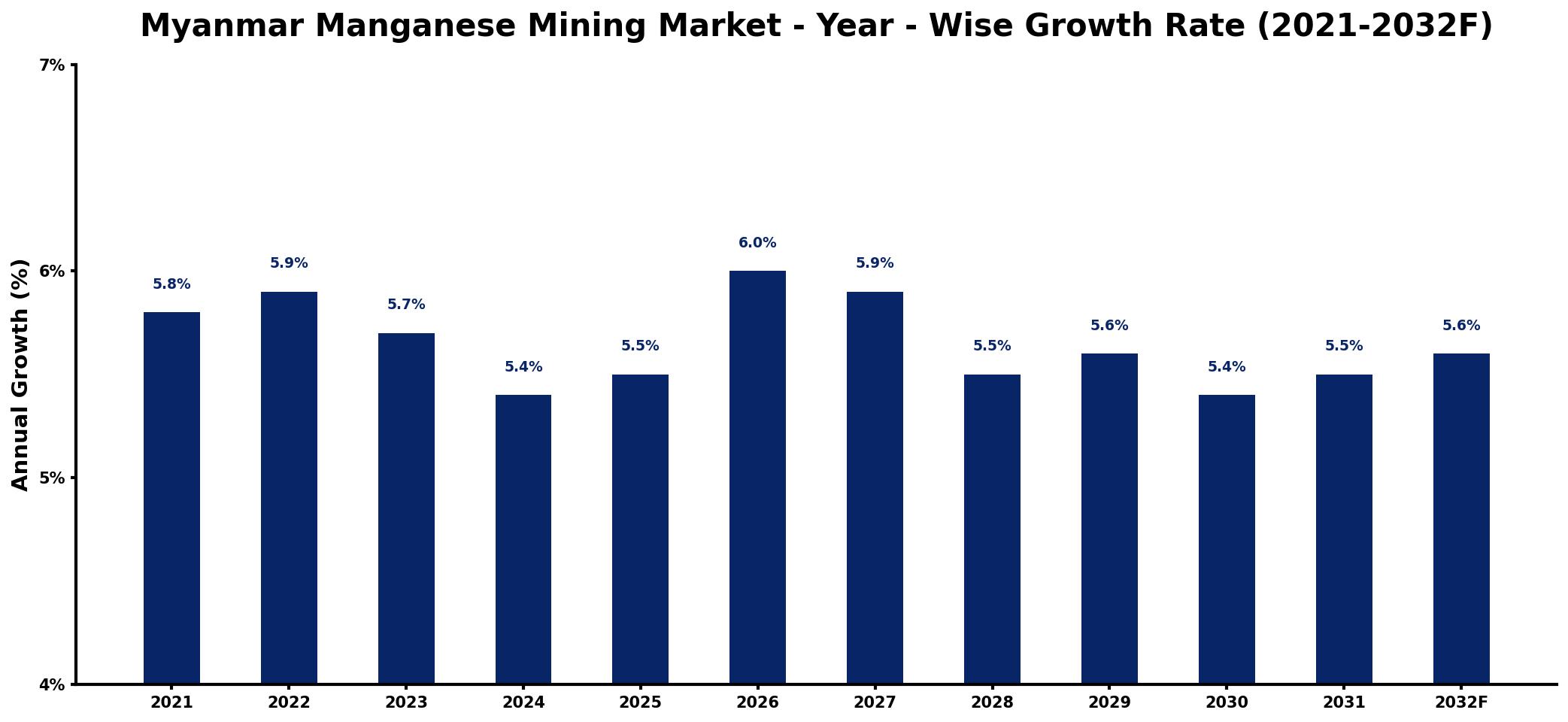
The table below presents the year‑wise growth rates along with the key drivers influencing the market
| Year | Growth Rate | Major Drivers |
| 2021 | 5.8% | Increased demand from construction sector |
| 2022 | 5.9% | Higher investments in infrastructure projects |
| 2023 | 5.7% | Growing automotive industry requirements |
| 2024 | 5.4% | Expansion of renewable energy initiatives |
| 2025 | 5.5% | Rising global electric vehicle adoption |
| 2026 | 6.0% | Strengthened international trade agreements |
| 2027 | 5.9% | Technological advancements in production |
| 2028 | 5.5% | Increased focus on sustainable practices |
| 2029 | 5.6% | Growing demand from electronics industry |
| 2030 | 5.4% | growing emerging market penetration |
| 2031 | 5.5% | Diversification of supply chain sources |
| 2032 | 5.6% | Enhanced regulations promoting local sourcing |
Note: Market size estimations and growth projections presented in this report are based on 6Wresearch's proprietary forecasting methodology, utilizing the latest available industry data, government publications, and primary research inputs.
Myanmar Manganese Mining Market Synopsis
Manganese ore in Myanmar is primarily located in the northern and central regions, where geological conditions favor the formation of high-quality deposits. The increasing adoption of manganese in the production of electric vehicle batteries is creating significant demand, positioning Myanmar as a strategic player in the global supply chain.
The country's mining sector is witnessing modernization as companies invest in advanced extraction and processing technologies. This transition not only enhances productivity but also aligns with environmental sustainability goals that are increasingly prioritized by both the government and international investors.
Myanmar Manganese Mining Market Key Takeaways
- The market is expected to benefit from Myanmar's substantial manganese ore reserves.
- Foreign investment is on the rise, fueled by favorable government policies and incentives.
- Technological advancements are streamlining operations, resulting in increased efficiency.
- Sustainable mining practices are becoming a focal point for both local and international stakeholders.
- There is significant potential for revenue generation through partnerships with local communities.
Evaluation of Restraints in Myanmar Manganese Mining Market
Despite its promising outlook, the Myanmar manganese mining market faces several restraints. Regulatory uncertainty remains a significant barrier, with changes in legislation potentially affecting investment stability. Environmental concerns are also prevalent, particularly regarding mining's impact on local ecosystems. Infrastructure challenges, including underdeveloped transportation networks and energy supply issues, add to the complexities of operational costs and logistics. Addressing these challenges will require a coordinated effort between the government, industry players, and communities.
Myanmar Manganese Mining Market Trends
A noticeable trend in the Myanmar manganese mining sector is the shift towards mechanization. Companies are prioritizing the adoption of innovative technologies to improve extraction processes and enhance the quality of the ore produced. Additionally, an increasing number of partnerships are forming between mining firms and government bodies, aimed at fostering responsible practices and ensuring equitable revenue distribution. The focus on sustainable operations is also driving the integration of environmentally-friendly methods and waste reduction strategies within the industry.
Myanmar Manganese Mining Market Opportunities
Investment opportunities in the Myanmar manganese mining market are abundant, particularly in exploration and production. The government is keen on enhancing infrastructure to facilitate mining activities, which presents lucrative prospects for investors interested in logistics and transportation solutions. With the rise of demand from industries such as battery manufacturing and steel production, there is a compelling case for investing in the development of processing facilities to increase value-added exports.
Government Initiatives in the Myanmar Manganese Mining Market
The Myanmar government has made strides in creating a regulatory framework aimed at promoting sustainable mining practices. This includes mandatory permits and adherence to environmental standards for mining companies. To encourage foreign investments, the government offers various incentives such as tax breaks and expedited approval processes for projects that align with national development goals. Furthermore, community engagement initiatives are being emphasized, underscoring the government's commitment to balancing economic growth with social responsibility.
Future Insights of the Myanmar Manganese Mining Market
Looking ahead to the 2026-2032 period, the Myanmar manganese mining market is poised for steady growth. As global industries increasingly seek sustainable sources of manganese, Myanmar's natural resources will become even more critical. With the continued implementation of government initiatives to foster a conducive investment climate, coupled with advancements in mining technology, the market is likely to attract significant foreign investment. However, the ability to navigate regulatory and infrastructural challenges will be pivotal in realizing this potential.
Myanmar Manganese Mining Market Latest Developments (2025 - 2026)
Recent developments within the Myanmar manganese mining market indicate a growing commitment to modernization and sustainability. Various mining companies are exploring innovative extraction methods to minimize environmental impact while maximizing productivity. Collaborative projects between the government and industry stakeholders have emerged, aimed at improving local infrastructure and fostering community development. These initiatives reflect a concerted effort to position Myanmar as a responsible player in the global manganese supply chain.
Myanmar Manganese Mining Market - Key Attractiveness of the Report
- 10 Years of Market Numbers
- Historical Data Starting from 2022 to 2025
- Base Year: 2025
- Forecast Data until 2032
- Key Performance Indicators Impacting the Market
- Major Upcoming Developments and Projects
Key Highlights of the Report:
- Myanmar Manganese Mining Market Outlook
- Market Size of Myanmar Manganese Mining Market, 2025
- Forecast of Myanmar Manganese Mining Market, 2032
- Historical Data and Forecast of Myanmar Manganese Mining Revenues & Volume for the Period 2022-2032F
- Myanmar Manganese Mining Market Trend Evolution
- Myanmar Manganese Mining Market Drivers and Challenges
- Myanmar Manganese Mining Price Trends
- Myanmar Manganese Mining Porter's Five Forces
- Myanmar Manganese Mining Industry Life Cycle
- Historical Data and Forecast of Myanmar Manganese Mining Market Revenues & Volume By Application for the Period 2022-2032F
- Historical Data and Forecast of Myanmar Manganese Mining Market Revenues & Volume By Alloys for the Period 2022-2032F
- Historical Data and Forecast of Myanmar Manganese Mining Market Revenues & Volume By Othes for the Period 2022-2032F
- Myanmar Manganese Mining Import Export Trade Statistics
- Market Opportunity Assessment By Application
- Myanmar Manganese Mining Top Companies Market Share
- Myanmar Manganese Mining Competitive Benchmarking By Technical and Operational Parameters
- Myanmar Manganese Mining Company Profiles
- Myanmar Manganese Mining Key Strategic Recommendations






































