Myanmar Military Laser Rangefinder Market Size, Share & Growth Rate
The Myanmar Military Laser Rangefinder Market was estimated at USD 311 Million in 2025 and is projected to reach USD 439 Million by 2032, growing at a CAGR of 5.0% from 2026 to 2032. The growth trajectory is primarily driven by an increasing demand for precise targeting capabilities within Myanmar's defense sector. As military operations evolve, the integration of advanced rangefinding technology with existing systems such as UAVs and artillery platforms becomes critical for enhancing operational effectiveness.
Myanmar Military Laser Rangefinder Market Year-wise Growth Rate and Key Drivers
This graph highlights how the Myanmar Military Laser Rangefinder Market has steadily grown over the years, supported by major growth factors.
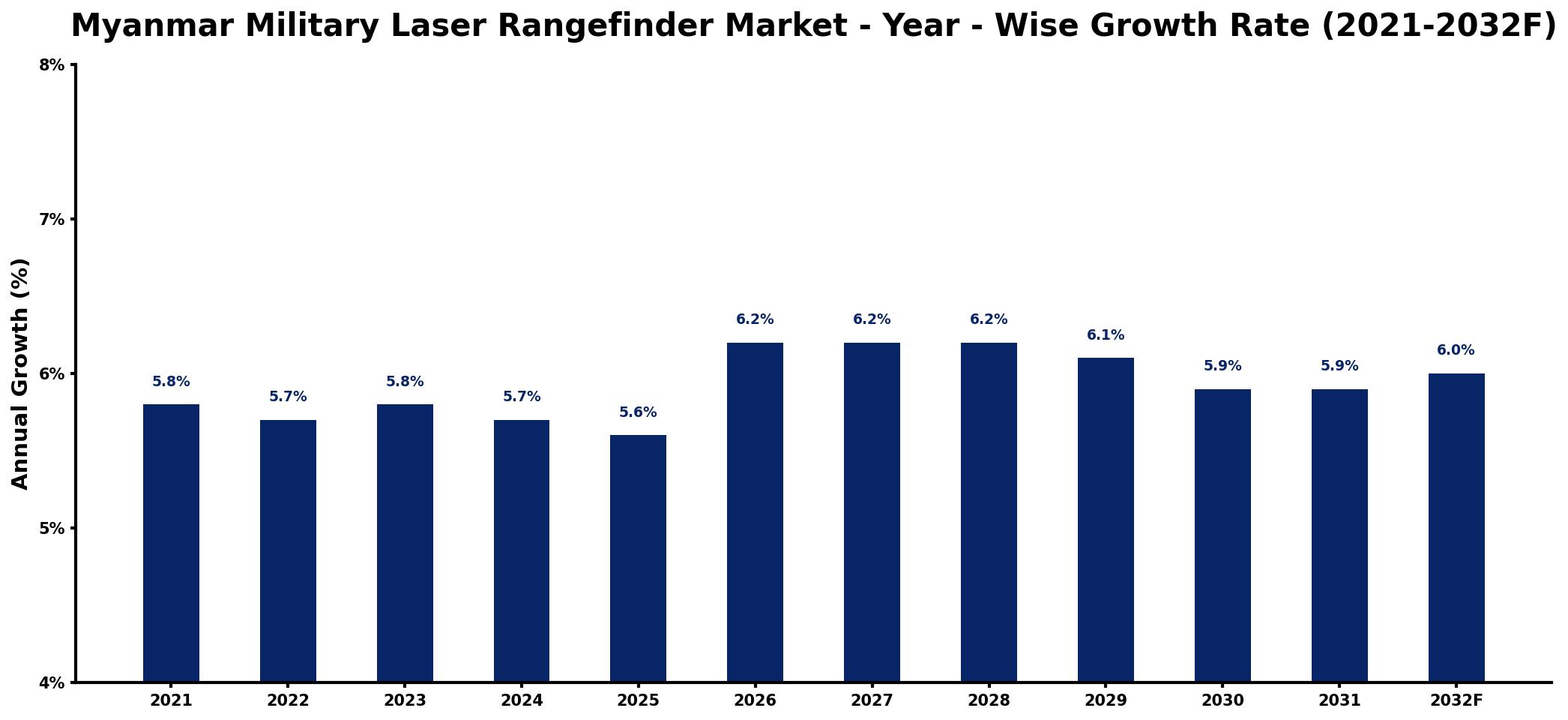
The table below presents the year‑wise growth rates along with the key drivers influencing the market
| Year | Growth Rate | Major Drivers |
| 2021 | 5.8% | Increased defense sector investments |
| 2022 | 5.7% | Growing interest in advanced technologies |
| 2023 | 5.8% | Expansion of border security initiatives |
| 2024 | 5.7% | Rising demand for precision equipment |
| 2025 | 5.6% | Enhanced training program requirements |
| 2026 | 6.2% | Strengthened international partnerships formed |
| 2027 | 6.2% | Emerging regional security collaborations |
| 2028 | 6.2% | Technological advancements in surveillance |
| 2029 | 6.1% | Increased focus on tactical operations |
| 2030 | 5.9% | Growing presence of defense contractors |
| 2031 | 5.9% | increased pharmaceutical industry usage |
| 2032 | 6.0% | Rising adoption of innovative solutions |
Note: Market size estimations and growth projections presented in this report are based on 6Wresearch's proprietary forecasting methodology, utilizing the latest available industry data, government publications, and primary research inputs.
Myanmar Military Laser Rangefinder Market Synopsis
The demand for accurate and reliable laser rangefinders is escalating as Myanmars defense forces focus on modernizing their military capabilities. This shift not only demands advanced technology but also a greater emphasis on interoperability between systems, marking an essential evolution in military strategy.
Moreover, as the geopolitical landscape shifts, the urgency for improved reconnaissance and targeting systems propels investment in laser rangefinding technology. These systems are pivotal for missions requiring high precision and reliability, crucial for effective military operations.
Myanmar Military Laser Rangefinder Market Key Takeaways
- The market is poised for significant growth driven by the need for accuracy in military operations.
- Integration with unmanned systems is becoming a key driver of technology adoption.
- Local manufacturing efforts are being encouraged to overcome import reliance.
- Government policies are progressively supporting advancements in laser rangefinder technology.
- The market faces challenges such as skill shortages and high development costs.
Evaluation of Restraints in Myanmar Military Laser Rangefinder Market
The Myanmar Military Laser Rangefinder Market encounters notable restraints, notably stemming from its limited local production capabilities. This dependence on imported components can lead to supply chain vulnerabilities, potentially hindering timely access to critical technology. Furthermore, the high costs associated with developing and implementing advanced laser rangefinding technologies may be daunting for defense agencies, particularly in light of economic uncertainties. The lack of skilled professionals further complicates matters, resulting in an ongoing struggle to maintain product quality and innovation within this sector.
Myanmar Military Laser Rangefinder Market Trends
The market is currently witnessing a trend toward the modernization of military assets, with laser rangefinders being integrated into diverse platforms such as artillery and UAVs. The push for enhanced interoperability signifies a shift towards systems that work cohesively, allowing for improved data sharing and operational efficiency. Additionally, emerging technologies like AI and advanced optics are beginning to influence the design and capabilities of laser rangefinders, promising enhanced performance in future applications.
Myanmar Military Laser Rangefinder Market Opportunities
There lies significant growth potential in the local manufacturing sector, as government initiatives aim to boost domestic production capabilities. This move not only addresses supply chain issues but also enhances self-reliance in military technologies. Furthermore, investments in research and development present an opportunity for the creation of innovative rangefinding solutions that meet the specific needs of the Myanmar military. Collaborative ventures between governmental and private sectors may drive advancements that could reshape the landscape of military operations in the country.
Government Initiatives in the Myanmar Military Laser Rangefinder Market
The Myanmar government is actively promoting the use of military laser rangefinders, recognizing their importance in enhancing precision targeting and reconnaissance capabilities. Policies are being developed to ensure the accuracy and reliability of these systems, while simultaneously encouraging local manufacturing and investment in R&D. This supportive regulatory framework aims to create a conducive environment for technological advancement and self-sufficiency in military equipment.
Future Insights of the Myanmar Military Laser Rangefinder Market
Looking ahead to 2026-2032, the Myanmar Military Laser Rangefinder Market is anticipated to expand steadily, fueled by ongoing modernization efforts and heightened military preparedness. As geopolitical tensions evolve, the demand for precision and efficiency in military operations is set to increase, necessitating the continuous upgrading of rangefinding technologies. Enhanced collaboration between military and technology sectors could facilitate significant advancements, ultimately contributing to improved operational capabilities.
Myanmar Military Laser Rangefinder Market Latest Developments (2025 - 2026)
Recent developments in the Myanmar Military Laser Rangefinder Market indicate a strategic pivot towards greater investment in domestic capabilities. Collaborative initiatives aimed at enhancing technological expertise are becoming increasingly common. Meanwhile, advancements in laser rangefinder technologies are on the rise, with increased focus on integrating these systems with emerging military platforms and technologies, underscoring a commitment to modernizing the defense landscape.
Myanmar Military Laser Rangefinder Market - Key Attractiveness of the Report
- 10 Years of Market Numbers
- Historical Data Starting from 2022 to 2025
- Base Year: 2025
- Forecast Data until 2032
- Key Performance Indicators Impacting the Market
- Major Upcoming Developments and Projects
Key Highlights of the Report:
- Myanmar Military Laser Rangefinder Market Outlook
- Market Size of Myanmar Military Laser Rangefinder Market, 2025
- Forecast of Myanmar Military Laser Rangefinder Market, 2032
- Historical Data and Forecast of Myanmar Military Laser Rangefinder Revenues & Volume for the Period 2022-2032F
- Myanmar Military Laser Rangefinder Market Trend Evolution
- Myanmar Military Laser Rangefinder Market Drivers and Challenges
- Myanmar Military Laser Rangefinder Price Trends
- Myanmar Military Laser Rangefinder Porter's Five Forces
- Myanmar Military Laser Rangefinder Industry Life Cycle
- Historical Data and Forecast of Myanmar Military Laser Rangefinder Market Revenues & Volume By Type for the Period 2022-2032F
- Historical Data and Forecast of Myanmar Military Laser Rangefinder Market Revenues & Volume By Man-Portable for the Period 2022-2032F
- Historical Data and Forecast of Myanmar Military Laser Rangefinder Market Revenues & Volume By Vehicle-Mounted for the Period 2022-2032F
- Historical Data and Forecast of Myanmar Military Laser Rangefinder Market Revenues & Volume By Application for the Period 2022-2032F
- Historical Data and Forecast of Myanmar Military Laser Rangefinder Market Revenues & Volume By Weapon Guidance for the Period 2022-2032F
- Historical Data and Forecast of Myanmar Military Laser Rangefinder Market Revenues & Volume By Detection for the Period 2022-2032F
- Myanmar Military Laser Rangefinder Import Export Trade Statistics
- Market Opportunity Assessment By Type
- Market Opportunity Assessment By Application
- Myanmar Military Laser Rangefinder Top Companies Market Share
- Myanmar Military Laser Rangefinder Competitive Benchmarking By Technical and Operational Parameters
- Myanmar Military Laser Rangefinder Company Profiles
- Myanmar Military Laser Rangefinder Key Strategic Recommendations






































