Myanmar Mineral Processing Equipment Market Size, Share & Growth Rate
The Myanmar Mineral Processing Equipment Market was estimated at USD 568 Million in 2025 and is projected to reach USD 824 Million by 2032, growing at a CAGR of 5.5% from 2026 to 2032. This growth is primarily driven by the increasing demand for minerals such as gold, copper, and coal, which are essential to both domestic and international markets. Additionally, government efforts to attract foreign investment into the mining sector are creating a favorable environment for the mineral processing equipment market.
Myanmar Mineral Processing Equipment Market Year-wise Growth Rate and Key Drivers
This graph highlights how the Myanmar Mineral Processing Equipment Market has steadily grown over the years, supported by major growth factors.
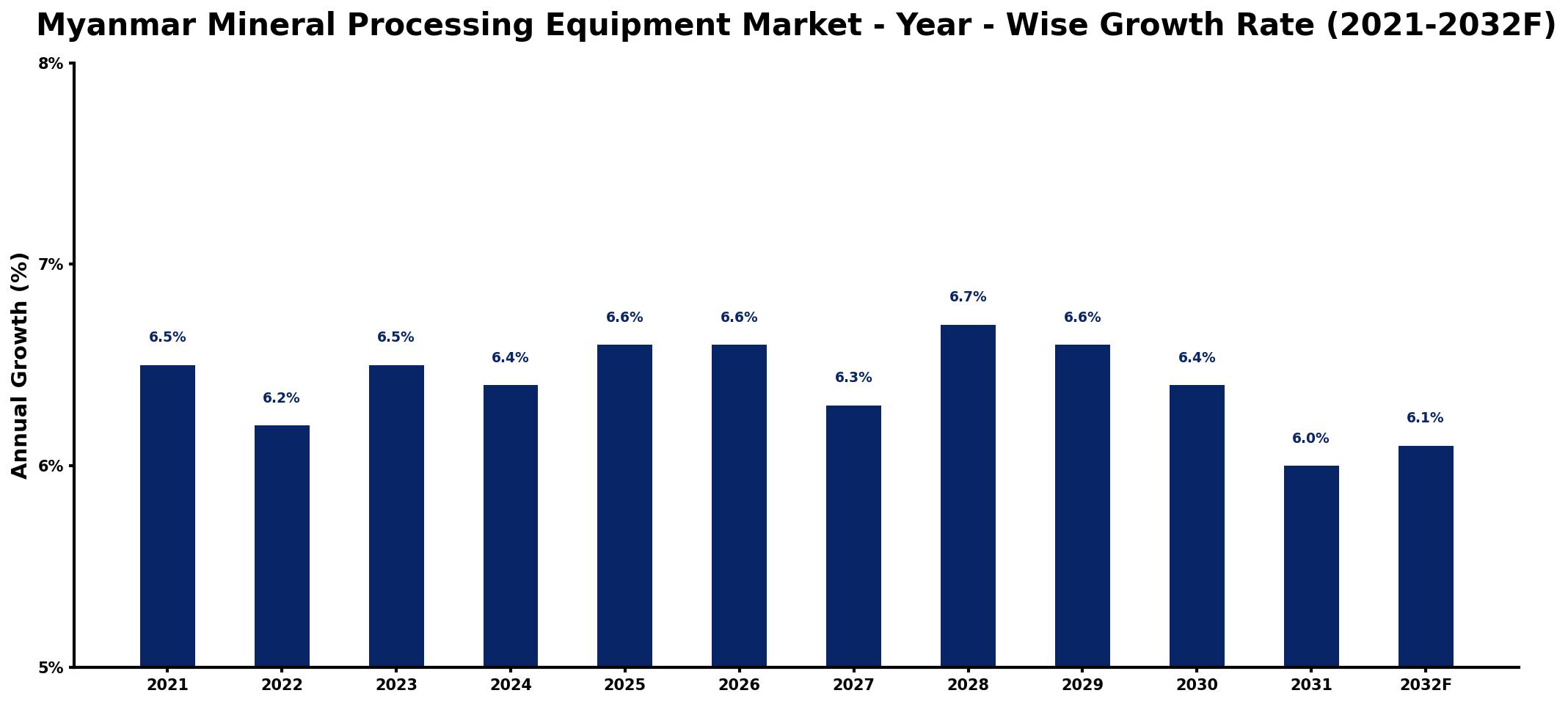
The table below presents the year‑wise growth rates along with the key drivers influencing the market
| Year | Growth Rate | Major Drivers |
| 2021 | 6.5% | Rising demand from construction sector |
| 2022 | 6.2% | Increased investments in infrastructure projects |
| 2023 | 6.5% | Growth in mining industry activities |
| 2024 | 6.4% | Expansion of energy sector investments |
| 2025 | 6.6% | Technological advancements in extraction |
| 2026 | 6.6% | Surge in foreign direct investments |
| 2027 | 6.3% | Development of regional trade agreements |
| 2028 | 6.7% | enhanced product quality standards |
| 2029 | 6.6% | Increased exploration activities nationwide |
| 2030 | 6.4% | Strengthening demand for sustainable solutions |
| 2031 | 6.0% | Emergence of new market players |
| 2032 | 6.1% | Focus on efficiency and productivity |
Note: Market size estimations and growth projections presented in this report are based on 6Wresearch's proprietary forecasting methodology, utilizing the latest available industry data, government publications, and primary research inputs.
Myanmar Mineral Processing Equipment Market Synopsis
The most significant force shaping the Myanmar Mineral Processing Equipment Market currently is the countrys intensifying focus on the mining industry. As global mineral demand rises, Myanmar is strategically positioning itself as a key player, leading to increased investments in essential mineral processing technologies.
This commitment is accompanied by the rising importance of environmentally sustainable practices and advanced technological solutions. As the industry modernizes, there is a concurrent shift towards adopting automation, AI, and IoT, which enhances efficiency and safety in mineral processing operations.
Myanmar Mineral Processing Equipment Market Key Takeaways
- The market is projected to grow from USD 568 Million in 2025 to USD 824 Million by 2032, at a CAGR of 5.5%.
- Technological advancements are revolutionizing equipment efficiency, emphasizing automation and eco-friendly solutions.
- Government initiatives are promoting investment in sustainable mining practices and local manufacturing.
- Challenges such as infrastructure limitations and skill shortages need to be addressed for market progression.
- Opportunities abound for investments in modern processing technologies to support the burgeoning mining sector.
Evaluation of Restraints in Myanmar Mineral Processing Equipment Market
Despite its growth potential, the Myanmar Mineral Processing Equipment Market faces significant restraints. Inadequate infrastructure hampers efficient transportation and operation of mineral processing facilities, limiting the market's ability to respond to increasing demand. Additionally, a persistent shortage of skilled labor restricts the sector's ability to modernize effectively. Moreover, regulatory uncertainties and political instability remain hurdles for potential investors, impacting confidence in long-term investment opportunities.
Myanmar Mineral Processing Equipment Market Trends
Current trends indicate a robust shift towards advanced technology adoption in the mineral processing sector. Automation, AI, and IoT are becoming integral components, enhancing operational efficiencies. Simultaneously, an increasing demand for environmentally friendly equipment is reshaping procurement strategies. The emphasis on safety standards is also pushing manufacturers towards developing equipment with enhanced safety features, meeting both regulatory requirements and industry expectations.
Myanmar Mineral Processing Equipment Market Opportunities
The Myanmar Mineral Processing Equipment Market presents lucrative opportunities for investors, driven by the nations untapped mineral resources. There is a growing need for modern machinery such as crushers, separators, and conveyor systems to optimize mineral extraction and processing. Furthermore, technological innovations that focus on minimizing environmental impacts are increasingly sought after, opening avenues for companies offering sustainable solutions. By investing in this market, stakeholders can capitalize on the countrys expanding mining sector and align with government initiatives aimed at modernization and efficiency.
Government Initiatives in the Myanmar Mineral Processing Equipment Market
The Myanmar government is actively implementing policies to foster a sustainable mining environment, underscoring the importance of environmental protection and responsible mining practices. Regulations now require environmental impact assessments and adherence to standards set by the Ministry of Natural Resources and Environmental Conservation. Additionally, initiatives are in place to encourage the use of domestically manufactured equipment, thus supporting local industries while reducing reliance on imports. Overall, these government efforts are essential for creating a conducive atmosphere for growth in the mineral processing equipment market.
Future Insights of the Myanmar Mineral Processing Equipment Market
The future of the Myanmar Mineral Processing Equipment Market appears bright, with anticipated steady growth from 2026 to 2032. Infrastructure development projects are likely to gain momentum, enhancing the overall mining landscape. As the global demand for minerals continues to surge, Myanmar is set to leverage its rich resource base. Nonetheless, the markets success will hinge on overcoming challenges related to infrastructure and regulatory frameworks, as well as the continued push towards embracing advanced technologies for sustainable processing.
Myanmar Mineral Processing Equipment Market Latest Developments (2025 - 2026)
Recent developments in the Myanmar Mineral Processing Equipment Market suggest a growing momentum towards modernization. There is a notable increase in partnerships between local entities and foreign firms focusing on technological transfer and skill development. Additionally, ongoing infrastructure improvement projects are expected to facilitate smoother operations in the mining sector, thereby increasing the demand for advanced processing equipment. The governments renewed focus on transparency and accountability is shaping the market's regulatory landscape, further influencing investment decisions.
Myanmar Mineral Processing Equipment Market - Key Attractiveness of the Report
- 10 Years of Market Numbers
- Historical Data Starting from 2022 to 2025
- Base Year: 2025
- Forecast Data until 2032
- Key Performance Indicators Impacting the Market
- Major Upcoming Developments and Projects
Key Highlights of the Report:
- Myanmar Mineral Processing Equipment Market Outlook
- Market Size of Myanmar Mineral Processing Equipment Market, 2025
- Forecast of Myanmar Mineral Processing Equipment Market, 2032
- Historical Data and Forecast of Myanmar Mineral Processing Equipment Revenues & Volume for the Period 2022-2032F
- Myanmar Mineral Processing Equipment Market Trend Evolution
- Myanmar Mineral Processing Equipment Market Drivers and Challenges
- Myanmar Mineral Processing Equipment Price Trends
- Myanmar Mineral Processing Equipment Porter's Five Forces
- Myanmar Mineral Processing Equipment Industry Life Cycle
- Historical Data and Forecast of Myanmar Mineral Processing Equipment Market Revenues & Volume By Mineral Mining Sector for the Period 2022-2032F
- Historical Data and Forecast of Myanmar Mineral Processing Equipment Market Revenues & Volume By Bauxite for the Period 2022-2032F
- Historical Data and Forecast of Myanmar Mineral Processing Equipment Market Revenues & Volume By Iron for the Period 2022-2032F
- Historical Data and Forecast of Myanmar Mineral Processing Equipment Market Revenues & Volume By Lithium for the Period 2022-2032F
- Historical Data and Forecast of Myanmar Mineral Processing Equipment Market Revenues & Volume By Others for the Period 2022-2032F
- Historical Data and Forecast of Myanmar Mineral Processing Equipment Market Revenues & Volume By Equipment for the Period 2022-2032F
- Historical Data and Forecast of Myanmar Mineral Processing Equipment Market Revenues & Volume By Crushers for the Period 2022-2032F
- Historical Data and Forecast of Myanmar Mineral Processing Equipment Market Revenues & Volume By Feeders for the Period 2022-2032F
- Historical Data and Forecast of Myanmar Mineral Processing Equipment Market Revenues & Volume By Conveyors for the Period 2022-2032F
- Historical Data and Forecast of Myanmar Mineral Processing Equipment Market Revenues & Volume By Drills & Breakers for the Period 2022-2032F
- Historical Data and Forecast of Myanmar Mineral Processing Equipment Market Revenues & Volume By Others for the Period 2022-2032F
- Historical Data and Forecast of Myanmar Mineral Processing Equipment Market Revenues & Volume By Application for the Period 2022-2032F
- Historical Data and Forecast of Myanmar Mineral Processing Equipment Market Revenues & Volume By Construction for the Period 2022-2032F
- Historical Data and Forecast of Myanmar Mineral Processing Equipment Market Revenues & Volume By Mining for the Period 2022-2032F
- Historical Data and Forecast of Myanmar Mineral Processing Equipment Market Revenues & Volume By Others for the Period 2022-2032F
- Myanmar Mineral Processing Equipment Import Export Trade Statistics
- Market Opportunity Assessment By Mineral Mining Sector
- Market Opportunity Assessment By Equipment
- Market Opportunity Assessment By Application
- Myanmar Mineral Processing Equipment Top Companies Market Share
- Myanmar Mineral Processing Equipment Competitive Benchmarking By Technical and Operational Parameters
- Myanmar Mineral Processing Equipment Company Profiles
- Myanmar Mineral Processing Equipment Key Strategic Recommendations






































