Myanmar Mobile Security Market Size & Growth Rate (2026-2032)
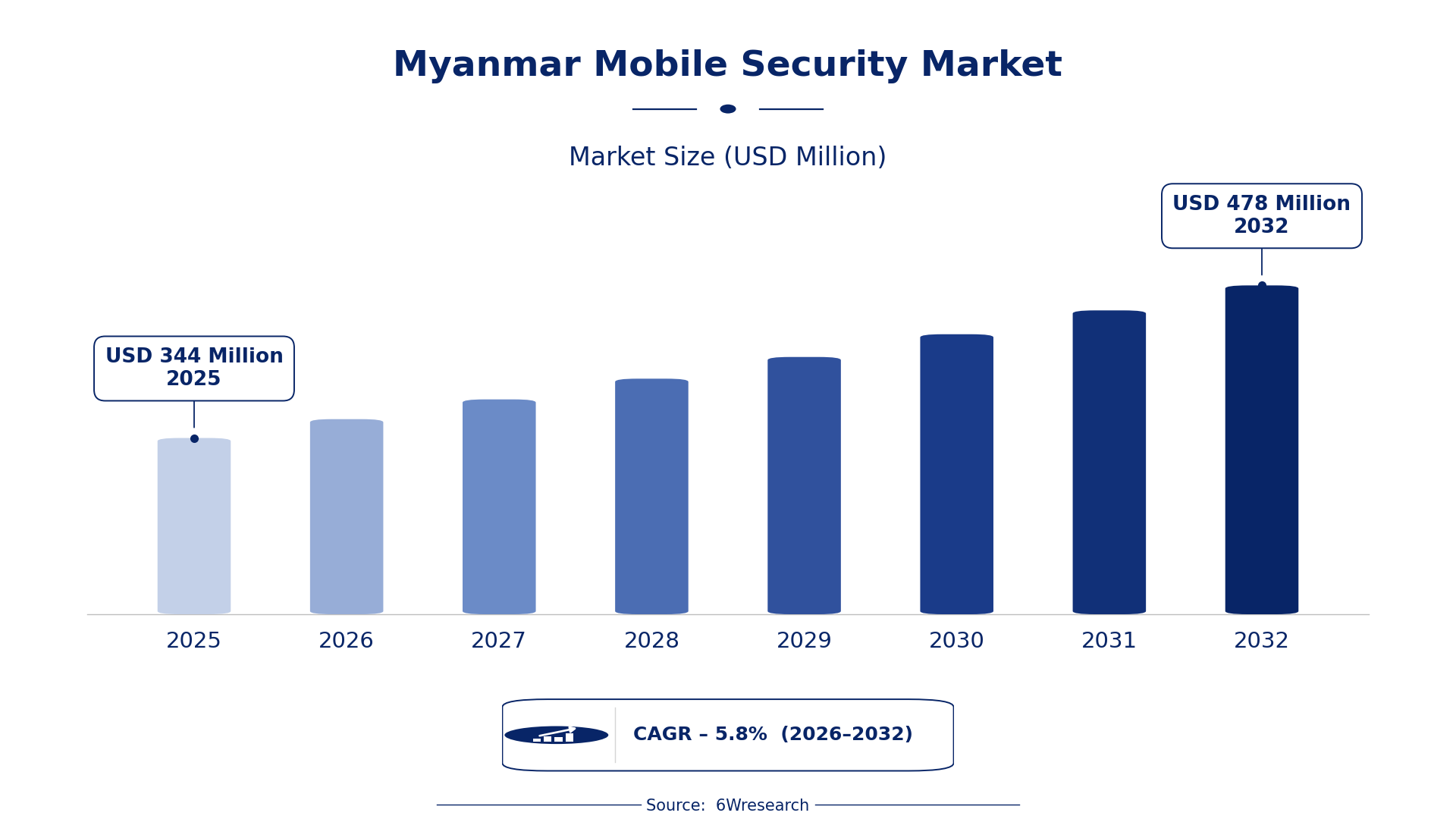
The Myanmar Mobile Security Market was estimated at USD 344 Million in 2025 and is projected to reach USD 478 Million by 2032, growing at a CAGR of 5.8% from 2026 to 2032.
Myanmar Mobile Security Market Synopsis
The mobile security market in Myanmar is currently experiencing significant momentum, driven by the rising concerns surrounding cyber threats and data protection. As mobile usage surges, so does the necessity for effective security solutions to safeguard sensitive information.
Looking ahead, the market is set to evolve rapidly, fueled by technological advancements and increasing enterprise adoption of mobile devices. Companies are becoming more aware of the need for robust security measures, indicating a healthy growth trajectory for mobile security solutions in the coming years.
Myanmar Mobile Security Market Year-wise Growth Rate and Key Drivers
This graph illustrates the annual growth rates of the Myanmar Mobile Security Market from 2021 to 2032, highlighting a steady upward trajectory and projected expansion over the forecast period.
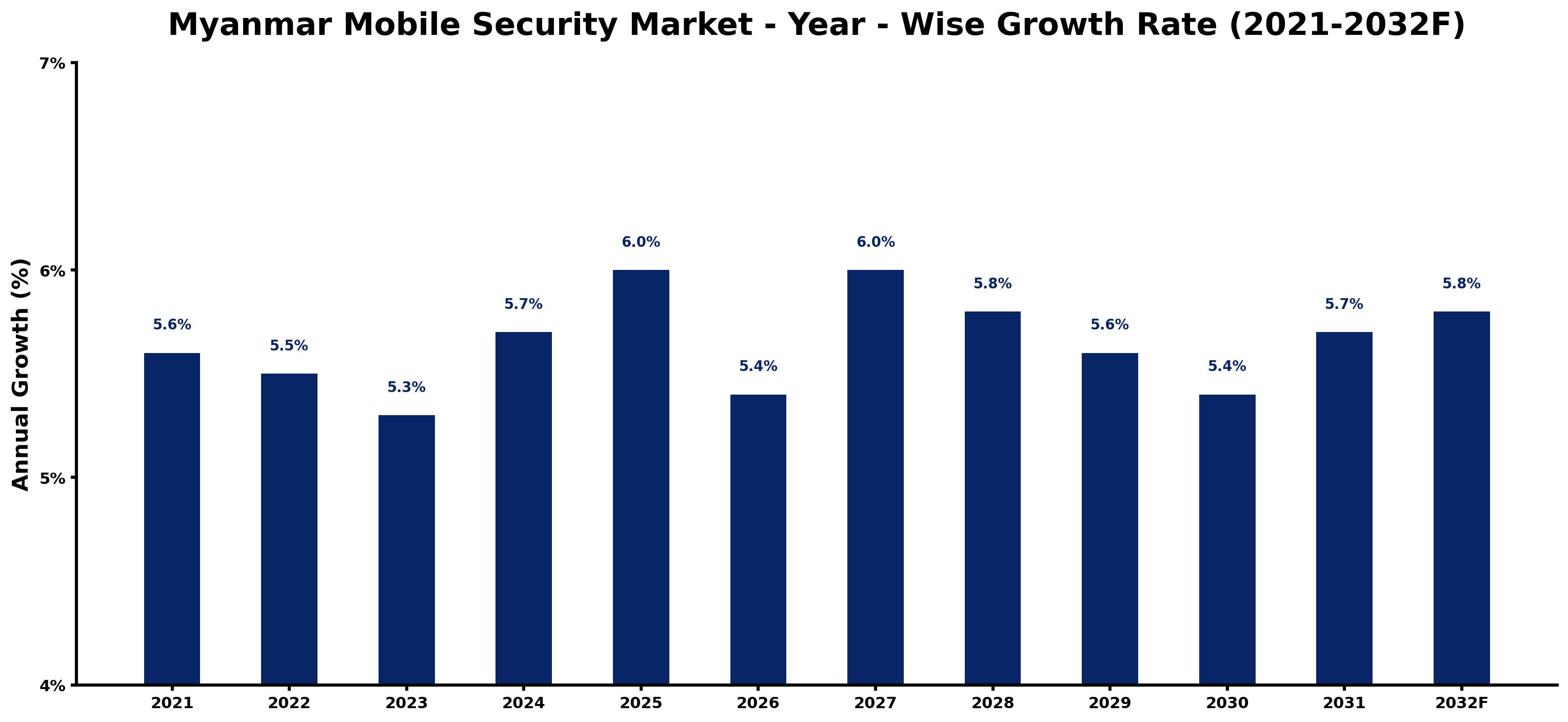
The table below presents the year‑wise growth rates along with the key drivers influencing the market
| Year | Growth Rate | Major Drivers |
| 2021 | 5.6% | Rising mobile penetration fostering security solution demand. |
| 2022 | 5.5% | Government cybersecurity initiatives enhance data protection awareness. |
| 2023 | 5.3% | Increased online transactions drive mobile security requirements. |
| 2024 | 5.7% | Awareness campaigns by telecom operators boost security adoption. |
| 2025 | 6.0% | Growing e-commerce sector necessitates robust mobile security measures. |
| 2026 | 5.4% | Youth population drives demand for advanced security features. |
| 2027 | 6.0% | Regulatory pressure on data privacy enhances security investments. |
| 2028 | 5.8% | International partnerships improve local mobile security technologies. |
| 2029 | 5.6% | Surge in mobile app usage heightens security concerns. |
| 2030 | 5.4% | Rising cyber threats compel businesses to invest in protection. |
| 2031 | 5.7% | Remote work trends increase reliance on mobile security solutions. |
| 2032 | 5.8% | Integration of AI in mobile security improves threat mitigation. |
Note: Market size estimations and growth projections presented in this report are based on 6Wresearch's proprietary forecasting methodology, utilizing the latest available industry data, government publications, and primary research inputs.
Myanmar Mobile Security Market Key Takeaways
Below are some of the specific key takeaways from the market, including:
- Growing adoption of mobile threat defense solutions is essential for protecting sensitive user data.
- Increased awareness of cybersecurity risks among SMEs is driving demand for comprehensive mobile security solutions.
- The rise of bring-your-own-device (BYOD) policies in workplaces is influencing security strategies.
- Government regulations are expected to foster greater security compliance and protection for users.
- Investments in skilled cybersecurity talent are crucial to mitigating risks associated with mobile vulnerabilities.
Evaluation of Restraints in Myanmar Mobile Security Market
The Myanmar mobile security market faces several limitations that hinder its full potential. One significant challenge is the low awareness level regarding cybersecurity threats, particularly among small and medium-sized enterprises. These organizations often lack the resources and knowledge to implement effective security measures.
Additionally, the absence of stringent data protection laws exacerbates the vulnerability of sensitive information, leaving organizations at risk of cyberattacks. The shortage of skilled cybersecurity professionals only adds to these challenges, limiting the market's ability to effectively counter emerging threats.
Myanmar Mobile Security Market Trends
Current trends shaping the Myanmar mobile security market include a shift towards comprehensive mobile threat management solutions. Enterprises are increasingly prioritizing the security of their mobile infrastructure as they integrate mobile technologies into their operations.
There is also a noticeable uptick in mobile application security investments, as businesses recognize the risks associated with mobile app vulnerabilities. This growing focus on end-to-end security for mobile devices indicates a shift in how companies approach cybersecurity.
Myanmar Mobile Security Market Opportunities
Several opportunities exist within the Myanmar mobile security market. The increasing acceptance of mobile devices in workplaces opens avenues for solutions tailored to protect corporate data. on top of that, as digital transformation accelerates, organizations will require more sophisticated mobile security measures to counteract evolving threats.
Investments in education and training around cybersecurity best practices can also yield significant returns. As awareness grows, demand for mobile security solutions that cater to SMEs will expand, presenting a key area for growth in the years ahead.
Government Initiatives in the Myanmar Mobile Security Market
Government initiatives are crucial in shaping the Myanmar mobile security market. The regulatory landscape is evolving, focusing on enhancing user data protection and improving compliance standards. These efforts are essential as the government seeks to build a safer digital environment for citizens and businesses alike.
- A national cybersecurity strategy was launched in early 2025, focusing on strengthening mobile security frameworks.
- The government is currently undertaking an initiative to promote cybersecurity awareness among SMEs, which began in mid-2025 and is ongoing.
- Planned updates to mobile security regulations are expected to roll out by 2026, mandating stronger data protection measures.
- A public-private partnership is being developed to enhance the digital skills of the workforce, slated to start in 2027.
- Ongoing efforts to integrate mobile security solutions within government services aim to improve data integrity and user trust.
Future Insights of the Myanmar Mobile Security Market
Looking ahead to 2026-2032, the Myanmar mobile security market is set for substantial growth as digital threats continue to evolve. With increasing mobile device penetration and the rise of remote work, organizations will need to prioritize security investment. Emerging technologies such as artificial intelligence and machine learning will likely play significant roles in fortifying mobile security strategies, presenting new avenues for innovation and growth.
Myanmar Mobile Security Market Latest Developments
Recent activity in the Myanmar mobile security market indicates a shift towards more integrated security solutions. Over the past 12-14 months, various initiatives have emerged, showcasing an industry responsive to growing cybersecurity needs.
- A new mobile security platform was launched in Q3 2025, offering advanced threat detection capabilities to users.
- In early 2025, a leading regional operator completed the rollout of a comprehensive mobile application security service.
- Currently underway, a public awareness campaign aims to educate users on mobile security risks and best practices.
- Upcoming partnerships between tech firms and local cybersecurity experts are planned to enhance service offerings by mid-2026.
- A major upgrade to existing mobile security regulations is expected by late 2026 to reinforce data protection protocols.
Myanmar Mobile Security Market - Key Attractiveness of the Report
- 10 Years of Market Numbers
- Historical Data Starting from 2022 to 2025
- Base Year: 2025
- Forecast Data until 2032
- Key Performance Indicators Impacting the Market
- Major Upcoming Developments and Projects
Key Highlights of the Report:
- Myanmar Mobile Security Market Outlook
- Market Size of Myanmar Mobile Security Market, 2025
- Forecast of Myanmar Mobile Security Market, 2032
- Historical Data and Forecast of Myanmar Mobile Security Revenues & Volume for the Period 2022-2032F
- Myanmar Mobile Security Market Trend Evolution
- Myanmar Mobile Security Market Drivers and Challenges
- Myanmar Mobile Security Price Trends
- Myanmar Mobile Security Porter's Five Forces
- Myanmar Mobile Security Industry Life Cycle
- Historical Data and Forecast of Myanmar Mobile Security Market Revenues & Volume By End User for the Period 2022-2032F
- Historical Data and Forecast of Myanmar Mobile Security Market Revenues & Volume By Individual for the Period 2022-2032F
- Historical Data and Forecast of Myanmar Mobile Security Market Revenues & Volume By Enterprise (Solution (Authentication, Application Security, & Device Security), Service) for the Period 2022-2032F
- Historical Data and Forecast of Myanmar Mobile Security Market Revenues & Volume By Deployment Mode for the Period 2022-2032F
- Historical Data and Forecast of Myanmar Mobile Security Market Revenues & Volume By On-premises for the Period 2022-2032F
- Historical Data and Forecast of Myanmar Mobile Security Market Revenues & Volume By Cloud for the Period 2022-2032F
- Historical Data and Forecast of Myanmar Mobile Security Market Revenues & Volume By Organization Size for the Period 2022-2032F
- Historical Data and Forecast of Myanmar Mobile Security Market Revenues & Volume By Small and Medium-Sized Enterprises (SMEs) for the Period 2022-2032F
- Historical Data and Forecast of Myanmar Mobile Security Market Revenues & Volume By Large Enterprises for the Period 2022-2032F
- Historical Data and Forecast of Myanmar Mobile Security Market Revenues & Volume By Vertical for the Period 2022-2032F
- Historical Data and Forecast of Myanmar Mobile Security Market Revenues & Volume By BFSI for the Period 2022-2032F
- Historical Data and Forecast of Myanmar Mobile Security Market Revenues & Volume By Telecom & IT for the Period 2022-2032F
- Historical Data and Forecast of Myanmar Mobile Security Market Revenues & Volume By Retail for the Period 2022-2032F
- Historical Data and Forecast of Myanmar Mobile Security Market Revenues & Volume By Healthcare for the Period 2022-2032F
- Historical Data and Forecast of Myanmar Mobile Security Market Revenues & Volume By Government & Defense for the Period 2022-2032F
- Historical Data and Forecast of Myanmar Mobile Security Market Revenues & Volume By Manufacturing for the Period 2022-2032F
- Historical Data and Forecast of Myanmar Mobile Security Market Revenues & Volume By Others for the Period 2022-2032F
- Historical Data and Forecast of Myanmar Mobile Security Market Revenues & Volume By Operating System for the Period 2022-2032F
- Historical Data and Forecast of Myanmar Mobile Security Market Revenues & Volume By iOS for the Period 2022-2032F
- Historical Data and Forecast of Myanmar Mobile Security Market Revenues & Volume By Android for the Period 2022-2032F
- Myanmar Mobile Security Import Export Trade Statistics
- Market Opportunity Assessment By End User
- Market Opportunity Assessment By Deployment Mode
- Market Opportunity Assessment By Organization Size
- Market Opportunity Assessment By Vertical
- Market Opportunity Assessment By Operating System
- Myanmar Mobile Security Top Companies Market Share
- Myanmar Mobile Security Competitive Benchmarking By Technical and Operational Parameters
- Myanmar Mobile Security Company Profiles
- Myanmar Mobile Security Key Strategic Recommendations






































