Myanmar Natural Fragrance Market Size, Share & Growth Rate
The Myanmar Natural Fragrance Market was estimated at USD 487 Million in 2025 and is projected to reach USD 686 Million by 2032, growing at a CAGR of 5.0% from 2026 to 2032. This growth trajectory is largely driven by an increasing consumer shift towards organic and eco-friendly personal care products, with natural fragrances being perceived as safer alternatives to synthetic options. Additionally, the cultural importance of fragrances in Myanmar's traditional practices continues to enhance market demand.
Myanmar Natural Fragrance Market Year-wise Growth Rate and Key Drivers
This graph highlights how the Myanmar Natural Fragrance Market has steadily grown over the years, supported by major growth factors.
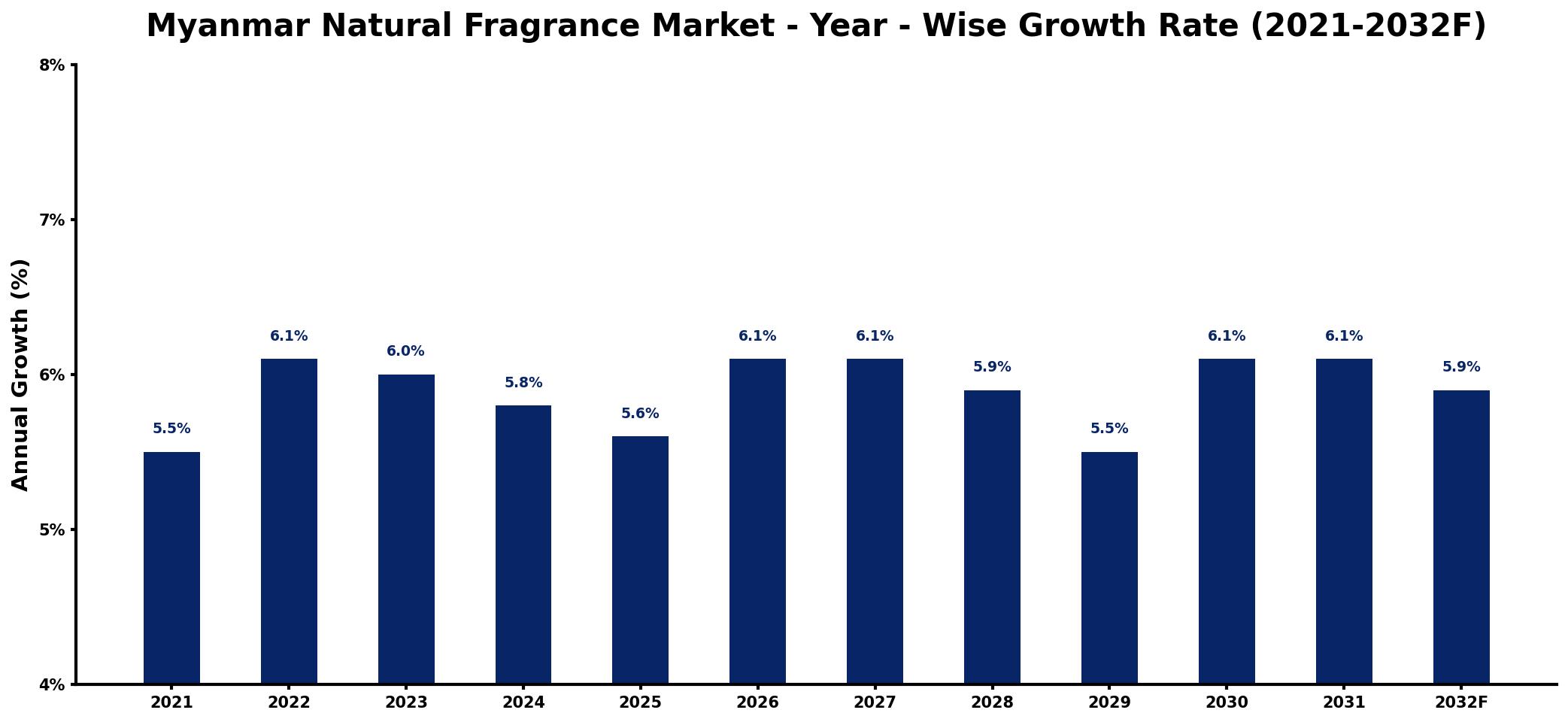
The table below presents the year‑wise growth rates along with the key drivers influencing the market
| Year | Growth Rate | Major Drivers |
| 2021 | 5.5% | Rising consumer wellness awareness |
| 2022 | 6.1% | Growing herbal ingredient popularity |
| 2023 | 6.0% | Increased e-commerce adoption rates |
| 2024 | 5.8% | Expansion of retail distribution channels |
| 2025 | 5.6% | Surge in local artisanal products |
| 2026 | 6.1% | Boost in tourism and gifting |
| 2027 | 6.1% | Strengthened eco-friendly brand initiatives |
| 2028 | 5.9% | Emergence of online subscription services |
| 2029 | 5.5% | Growth in premium product offerings |
| 2030 | 6.1% | Rise in cultural heritage appreciation |
| 2031 | 6.1% | Increased investment in sustainability |
| 2032 | 5.9% | Development of innovative product lines |
Note: Market size estimations and growth projections presented in this report are based on 6Wresearch's proprietary forecasting methodology, utilizing the latest available industry data, government publications, and primary research inputs.
Myanmar Natural Fragrance Market Synopsis
In Myanmar, the natural fragrance market is witnessing a transformation fueled by a growing consciousness of wellness and sustainability among consumers. This shift has resulted in heightened interest in plant-based ingredients, which are preferred for their purity and environmental benefits.
Moreover, the market reflects an evolving landscape where traditional methods of fragrance production are being revitalized. This interplay between ancient practices and modern consumer expectations is creating a unique niche for natural fragrance producers in Myanmar.
Myanmar Natural Fragrance Market Key Takeaways
- The market is experiencing a notable shift towards organic and sustainable products, aligning with global wellness trends.
- Cultural significance and traditional uses of fragrances in Myanmar enhance consumer loyalty and preference.
- Growing awareness of health risks associated with synthetic ingredients is driving demand for natural alternatives.
- Challenges regarding sustainable sourcing and product authenticity pose significant hurdles for market participants.
- Government support for local cultivation and research fosters innovation within the natural fragrance sector.
Evaluation of Restraints in Myanmar Natural Fragrance Market
Despite its promising growth, the Myanmar natural fragrance market faces several restraints. One major issue is the difficulty in sourcing sustainable raw materials, which can compromise both supply chain reliability and product authenticity. As demand surges, manufacturers are under increasing pressure to ensure transparent and ethical practices in their sourcing. Furthermore, the competition from established synthetic fragrance brands poses challenges for differentiation, making it crucial for natural fragrance companies to innovate continually.
Myanmar Natural Fragrance Market Trends
Current trends in the Myanmar natural fragrance market indicate a rising interest in artisanal and locally sourced products. This trend is closely tied to the growing consumer desire for authenticity and connection with the products they use. Additionally, the incorporation of modern extraction techniques is enhancing the quality and variety of natural fragrances available, appealing to a broader consumer base.
Myanmar Natural Fragrance Market Opportunities
The genuine growth opportunities lie within the expansion of e-commerce platforms and the potential to reach a wider audience. Companies can leverage digital marketing strategies to enhance brand visibility and consumer education about the benefits of natural fragrances. Furthermore, partnerships with local farmers to source unique botanicals can foster both community development and product differentiation in a competitive marketplace.
Government Initiatives in the Myanmar Natural Fragrance Market
The Myanmar government is actively promoting the natural fragrance sector through various initiatives aimed at boosting local production and ensuring product quality. Policies designed to support ethical sourcing practices, alongside public funding for research and development, encourage innovation in fragrance formulations. These initiatives are instrumental in fostering a vibrant ecosystem for natural fragrance manufacturers in the country.
Future Insights of the Myanmar Natural Fragrance Market
Looking ahead to 2026-2032, the Myanmar natural fragrance market is poised for significant advancements driven by changing consumer preferences and increased awareness of sustainability. As the market matures, more brands will likely emphasize transparency and ethical practices, resulting in a more educated consumer base. Innovations in sourcing and production are expected to redefine traditional fragrance categories, ensuring a competitive edge for businesses willing to adapt to evolving market dynamics.
Myanmar Natural Fragrance Market Latest Developments (2025 - 2026)
Recent developments in the Myanmar natural fragrance market indicate a noticeable increase in local collaborations among farmers and manufacturers to enhance product authenticity and sustainability. Efforts to standardize quality benchmarks for natural fragrances are also underway, contributing to consumer trust. Additionally, several brands have started introducing unique blends that highlight indigenous botanicals, reflecting the rich cultural heritage of Myanmar.
Myanmar Natural Fragrance Market - Key Attractiveness of the Report
- 10 Years of Market Numbers
- Historical Data Starting from 2022 to 2025
- Base Year: 2025
- Forecast Data until 2032
- Key Performance Indicators Impacting the Market
- Major Upcoming Developments and Projects
Key Highlights of the Report:
- Myanmar Natural Fragrance Market Outlook
- Market Size of Myanmar Natural Fragrance Market, 2025
- Forecast of Myanmar Natural Fragrance Market, 2032
- Historical Data and Forecast of Myanmar Natural Fragrance Revenues & Volume for the Period 2022-2032F
- Myanmar Natural Fragrance Market Trend Evolution
- Myanmar Natural Fragrance Market Drivers and Challenges
- Myanmar Natural Fragrance Price Trends
- Myanmar Natural Fragrance Porter's Five Forces
- Myanmar Natural Fragrance Industry Life Cycle
- Historical Data and Forecast of Myanmar Natural Fragrance Market Revenues & Volume By Ingredient for the Period 2022-2032F
- Historical Data and Forecast of Myanmar Natural Fragrance Market Revenues & Volume By Essential Oils for the Period 2022-2032F
- Historical Data and Forecast of Myanmar Natural Fragrance Market Revenues & Volume By Natural Extracts for the Period 2022-2032F
- Historical Data and Forecast of Myanmar Natural Fragrance Market Revenues & Volume By Type for the Period 2022-2032F
- Historical Data and Forecast of Myanmar Natural Fragrance Market Revenues & Volume By Top note for the Period 2022-2032F
- Historical Data and Forecast of Myanmar Natural Fragrance Market Revenues & Volume By Middle Note for the Period 2022-2032F
- Historical Data and Forecast of Myanmar Natural Fragrance Market Revenues & Volume By Base Note for the Period 2022-2032F
- Historical Data and Forecast of Myanmar Natural Fragrance Market Revenues & Volume By Application for the Period 2022-2032F
- Historical Data and Forecast of Myanmar Natural Fragrance Market Revenues & Volume By Fine Fragrances for the Period 2022-2032F
- Historical Data and Forecast of Myanmar Natural Fragrance Market Revenues & Volume By Personal Care & Cosmetics for the Period 2022-2032F
- Historical Data and Forecast of Myanmar Natural Fragrance Market Revenues & Volume By Household Care for the Period 2022-2032F
- Myanmar Natural Fragrance Import Export Trade Statistics
- Market Opportunity Assessment By Ingredient
- Market Opportunity Assessment By Type
- Market Opportunity Assessment By Application
- Myanmar Natural Fragrance Top Companies Market Share
- Myanmar Natural Fragrance Competitive Benchmarking By Technical and Operational Parameters
- Myanmar Natural Fragrance Company Profiles
- Myanmar Natural Fragrance Key Strategic Recommendations






































