Myanmar Nylon Market Size Growth Rate
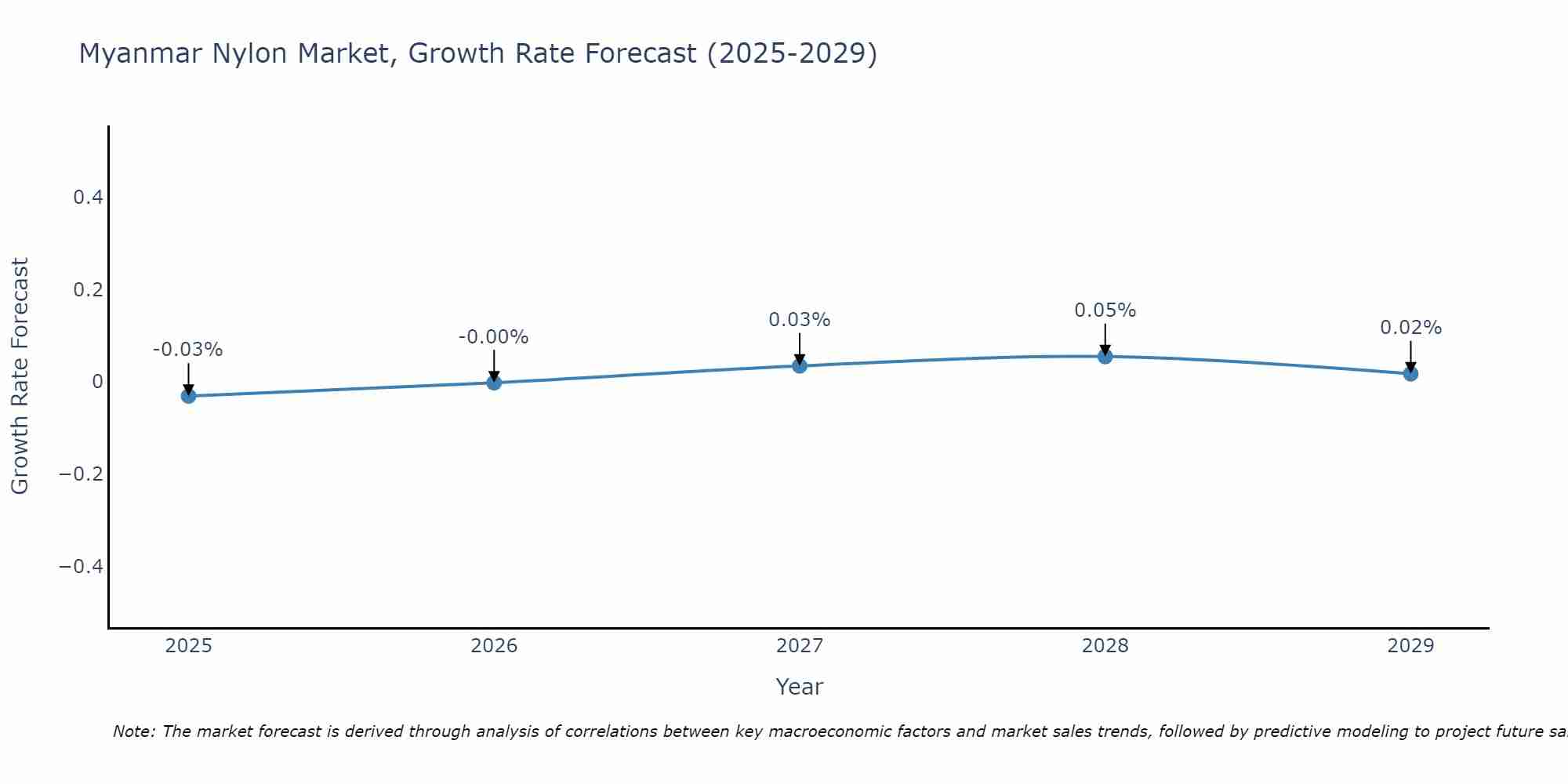
The Myanmar Nylon Market is projected to witness mixed growth rate patterns during 2025 to 2029. The growth rate begins at -0.03% in 2025, climbs to a high of 0.05% in 2028, and moderates to 0.02% by 2029.
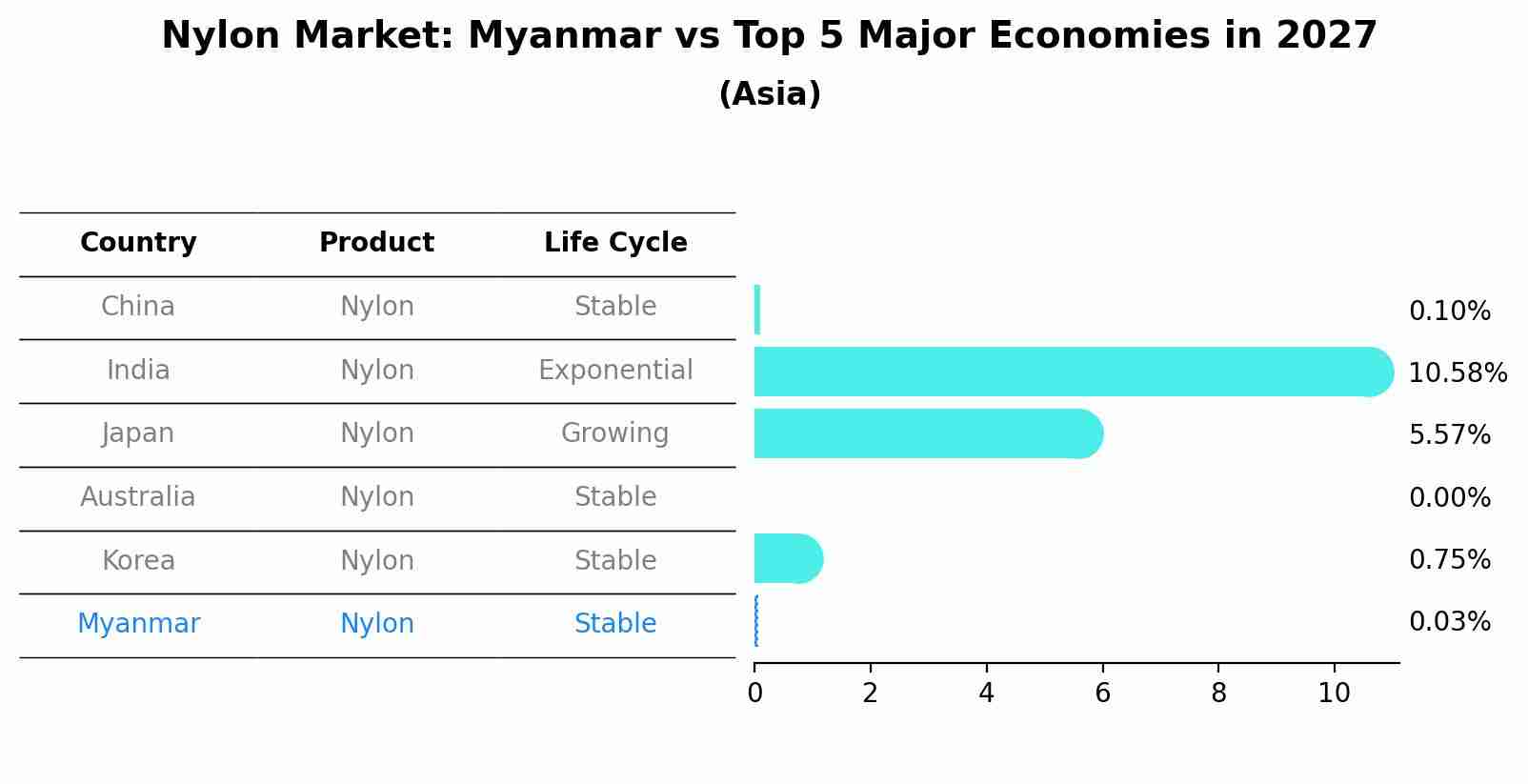
Nylon Market: Myanmar vs Top 5 Major Economies in 2027 (Asia)
In the Asia region, the Nylon market in Myanmar is projected to expand at a stable growth rate of 0.03% by 2027. The largest economy is China, followed by India, Japan, Australia and South Korea.
Myanmar Nylon Market Overview
The Myanmar nylon market is experiencing steady growth driven by the increasing demand for nylon products in various industries such as textiles, automotive, and packaging. The market is characterized by a growing number of local manufacturers producing nylon yarns, fabrics, and other products. The textile industry is a key consumer of nylon in Myanmar, utilizing it for the production of garments, home textiles, and industrial fabrics. Additionally, the automotive sector is driving demand for nylon for applications such as automotive components and upholstery. With the country`s economy opening up to foreign investment and trade, the Myanmar nylon market is expected to further expand in the coming years, presenting opportunities for both domestic and international players to capitalize on the growing demand for nylon products in the country.
Myanmar Nylon Market Trends
The Myanmar Nylon Market is witnessing a growing demand for high-quality nylon products across various industries such as textiles, automotive, and consumer goods. The increasing disposable income of the population has led to a rise in consumer spending on durable and fashionable nylon products, driving the market growth. Additionally, the emphasis on sustainability and eco-friendly materials has led to a shift towards recycled nylon materials in the market. Manufacturers are focusing on innovation, product differentiation, and strategic partnerships to stay competitive in the market. The rapid industrialization and infrastructure development in Myanmar are also contributing to the demand for nylon products, making it a promising market for both domestic and international players.
Myanmar Nylon Market Challenges
The Myanmar Nylon market faces several challenges, including limited domestic production capacity, heavy reliance on imports, fluctuating raw material prices, and competition from alternative synthetic fibers. The lack of advanced technology and infrastructure for nylon production hinders the market`s growth potential. Additionally, the country`s political instability and regulatory uncertainties create an unpredictable business environment for industry players. The presence of counterfeit products in the market also poses a threat to the reputation and profitability of genuine nylon manufacturers. To overcome these challenges, industry stakeholders need to invest in technology upgrades, improve supply chain efficiency, and enhance product quality to remain competitive in the global nylon market.
Myanmar Nylon Market Investment Opportunities
The Myanmar Nylon Market presents several investment opportunities for potential investors. With the growing demand for nylon products in various industries such as textiles, automotive, electronics, and packaging, there is a significant potential for growth and profitability. Investing in the production and distribution of nylon fibers, yarns, and fabrics could be a lucrative venture. Additionally, the increasing focus on sustainability and eco-friendly materials provides an opportunity for investments in the development of bio-based or recycled nylon products to cater to the evolving market needs. Collaborating with local manufacturers and suppliers to capitalize on the abundant raw materials available in Myanmar could also be a strategic investment approach in the nylon market.
Myanmar Nylon Market Government Policy
Government policies related to the Myanmar Nylon Market include regulations on import and export of nylon materials, tariffs on imported nylon products, and initiatives to promote domestic production of nylon. The government has implemented measures to support local nylon manufacturers, such as providing incentives for investment in the sector, promoting research and development activities, and ensuring compliance with environmental and safety standards. Additionally, there are policies in place to monitor and control the quality of nylon products in the market to protect consumers and maintain industry standards. Overall, the government aims to balance the interests of domestic nylon producers with the need to maintain a competitive market environment while ensuring the sustainability and growth of the Myanmar Nylon Market.
Myanmar Nylon Market Future Outlook
The future outlook for the Myanmar Nylon Market is optimistic, driven by increasing demand from various end-use industries such as textiles, automotive, and packaging. The market is expected to witness steady growth due to factors like rising disposable income, urbanization, and increasing investment in infrastructure projects. Additionally, the growing trend towards sustainable and eco-friendly materials is likely to create opportunities for bio-based nylons in the market. However, challenges such as volatility in raw material prices and competition from alternative materials may impact the market growth. Overall, with the expanding industrial base and favorable government policies promoting manufacturing and exports, the Myanmar Nylon Market is poised for growth in the coming years.
Key Highlights of the Report:
- Myanmar Nylon Market Outlook
- Market Size of Myanmar Nylon Market, 2021
- Forecast of Myanmar Nylon Market, 2031
- Historical Data and Forecast of Myanmar Nylon Revenues & Volume for the Period 2018 - 2031
- Myanmar Nylon Market Trend Evolution
- Myanmar Nylon Market Drivers and Challenges
- Myanmar Nylon Price Trends
- Myanmar Nylon Porter's Five Forces
- Myanmar Nylon Industry Life Cycle
- Historical Data and Forecast of Myanmar Nylon Market Revenues & Volume By Product for the Period 2018 - 2031
- Historical Data and Forecast of Myanmar Nylon Market Revenues & Volume By Nylon 6 for the Period 2018 - 2031
- Historical Data and Forecast of Myanmar Nylon Market Revenues & Volume By Nylon 66 for the Period 2018 - 2031
- Historical Data and Forecast of Myanmar Nylon Market Revenues & Volume By Application for the Period 2018 - 2031
- Historical Data and Forecast of Myanmar Nylon Market Revenues & Volume By Automobile for the Period 2018 - 2031
- Historical Data and Forecast of Myanmar Nylon Market Revenues & Volume By Electrical & Electronics for the Period 2018 - 2031
- Historical Data and Forecast of Myanmar Nylon Market Revenues & Volume By Engineering Plastics for the Period 2018 - 2031
- Historical Data and Forecast of Myanmar Nylon Market Revenues & Volume By Textiles for the Period 2018 - 2031
- Historical Data and Forecast of Myanmar Nylon Market Revenues & Volume By Others for the Period 2018 - 2031
- Myanmar Nylon Import Export Trade Statistics
- Market Opportunity Assessment By Product
- Market Opportunity Assessment By Application
- Myanmar Nylon Top Companies Market Share
- Myanmar Nylon Competitive Benchmarking By Technical and Operational Parameters
- Myanmar Nylon Company Profiles
- Myanmar Nylon Key Strategic Recommendations






































