Myanmar Oilfield Air Drilling Market Size, Share & Growth Rate
The Myanmar Oilfield Air Drilling Market was estimated at USD 705 Million in 2025 and is projected to reach USD 1202 Million by 2032, growing at a CAGR of 7.9% from 2026 to 2032. This growth trajectory is driven primarily by enhanced foreign investments in the energy sector, spurred by the country's rich oil and gas reserves. Additionally, technological advancements have enabled exploration of deeper reserves, significantly increasing the attractiveness of air drilling operations in Myanmar.
Myanmar Oilfield Air Drilling Market Growth Rate Analysis (2021-2032)
The Myanmar oilfield air drilling market is poised for robust growth, with annual increases projected from 7.1% in 2021 to a remarkable 11.5% by 2032. This upward trend can be attributed to surging demand for efficient drilling technologies amid an evolving energy landscape, as Myanmar seeks to enhance its production capabilities. Investments in infrastructure and technological advancements have bolstered operational efficiencies, enabling companies to respond effectively to rising consumer demand for oil and gas. Furthermore, supportive government policies aiming to attract foreign investment play a crucial role in stimulating market activity. As Myanmar continues to transition towards sustainable energy practices, the air drilling segment stands to gain significantly.
Myanmar Oilfield Air Drilling Market Year-wise Growth Rate and Key Drivers
This graph highlights how the Myanmar Oilfield Air Drilling Market has steadily grown over the past five years, supported by major growth factors.
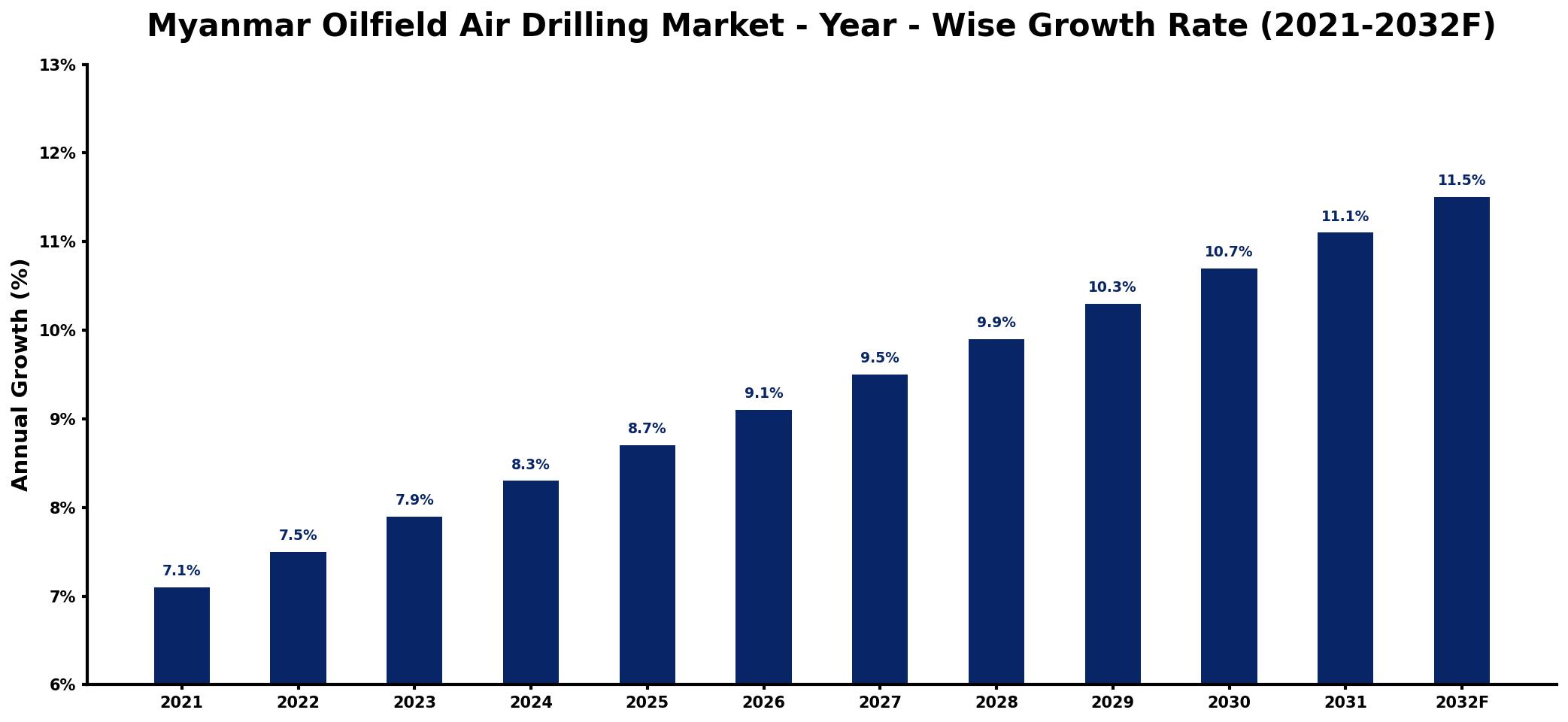
The table below presents the year‑wise growth rates along with the key drivers influencing the market
| Year | Growth Rate | Major Drivers |
| 2021 | 7.1% | Rising energy sector investments |
| 2022 | 7.5% | Growing infrastructure development projects |
| 2023 | 7.9% | Increased demand for energy resources |
| 2024 | 8.3% | Expansion of exploration activities |
| 2025 | 8.7% | Technological advancements in extraction |
| 2026 | 9.1% | Strong foreign investment influx |
| 2027 | 9.5% | Improved regulatory frameworks established |
| 2028 | 9.9% | Rising global energy prices |
| 2029 | 10.3% | Enhanced environmental sustainability practices |
| 2030 | 10.7% | Growing domestic energy consumption |
| 2031 | 11.1% | Diversification of energy supply sources |
| 2032 | 11.5% | Strengthened regional energy partnerships |
Note: Market size estimations and growth projections presented in this report are based on 6Wresearch's proprietary forecasting methodology, utilizing the latest available industry data, government publications, and primary research inputs.
Myanmar Oilfield Air Drilling Market Synopsis
The most significant force shaping the Myanmar Oilfield Air Drilling Market today is the surge in international investment. Companies are eager to tap into the countrys burgeoning energy landscape, drawn by its potential for high-yield exploration. With air drilling becoming a preferred method for reaching untapped resources, this market is poised for dynamic growth.
Technological innovation stands as a key pillar supporting this market. Cutting-edge drilling technologies have enhanced operational efficiency and safety, minimizing the risks traditionally associated with oil extraction in complex geological environments. As a result, companies are increasingly adopting air drilling methodologies, setting the stage for robust market expansion.
Myanmar Oilfield Air Drilling Market Key Takeaways
- The Myanmar Oilfield Air Drilling Market is on a robust growth path driven by foreign investment and technological advancements.
- Air drilling presents operational efficiencies that are crucial for exploring deep reserves in challenging geological settings.
- The market is supported by favorable government initiatives aimed at improving transparency and investment conditions.
- Safety and regulatory improvements remain vital for mitigating operational risks associated with air drilling.
- Major international companies play a significant role in shaping the competitive landscape, leveraging their expertise in the region.
Evaluation of Restraints in Myanmar Oilfield Air Drilling Market
Despite a favorable growth outlook, the Myanmar Oilfield Air Drilling Market faces significant constraints. Outdated infrastructure continues to hinder operational efficiency, affecting timelines and cost-effectiveness. Safety remains a pressing issue, with insufficient regulatory frameworks creating risks for both operators and local communities. Corruption further complicates dealings with local partners, making entry into the market challenging for foreign companies. Additionally, the complexity of tax laws for foreign investments acts as a deterrent for potential entrants.
Myanmar Oilfield Air Drilling Market Trends
Key trends shaping the Myanmar Oilfield Air Drilling Market include an increasing focus on sustainability and digital transformation. Companies are exploring innovative technologies that reduce environmental impact while enhancing drilling efficiency. The integration of data analytics and immersive technologies is becoming common, enabling better decision-making processes in the field. Furthermore, partnerships between local firms and international players are emerging as a strategy for enhancing local capabilities and compliance with regulatory standards.
Myanmar Oilfield Air Drilling Market Opportunities
Significant growth opportunities are emerging within the Myanmar Oilfield Air Drilling Market. The exploration of untapped offshore fields represents a lucrative avenue for investment. Additionally, the increasing demand for energy due to regional economic growth is likely to drive further exploration activities. Enhanced collaboration with local entities can also yield synergies that facilitate smoother project execution and alignment with local regulations.
Government Initiatives in the Myanmar Oilfield Air Drilling Market
The Myanmar government is actively pursuing policies designed to stimulate growth within the oil and gas sector. Incentives for foreign investment and improvements in regulatory transparency are key components of this strategy. Public spending aimed at upgrading infrastructure and enhancing the safety framework is also critical. These initiatives aim to foster a more attractive environment for international firms looking to engage in air drilling operations.
Future Insights of the Myanmar Oilfield Air Drilling Market
Looking ahead to the period from 2026 to 2032, the Myanmar Oilfield Air Drilling Market is expected to continue its upward trajectory. The blend of government support, technological advancements, and increased foreign investment will likely drive significant growth. As the market evolves, the emphasis on safety, sustainability, and innovative practices will become paramount in shaping its landscape. Companies that adapt to these trends and foster strong local partnerships are poised to capture substantial market share.
Myanmar Oilfield Air Drilling Market Latest Developments (2025 - 2026)
Recent developments in the Myanmar Oilfield Air Drilling Market highlight an ongoing shift towards advanced technologies and more strategic partnerships. Companies are increasingly investing in digital solutions that streamline operations and enhance safety. Regulatory changes aimed at promoting greater transparency have also been noted, creating a more conducive environment for international stakeholders. These trends reflect the broader evolution of the industry in response to both domestic needs and global market dynamics.
Myanmar Oilfield Air Drilling Market - Key Attractiveness of the Report
- 10 Years of Market Numbers
- Historical Data Starting from 2022 to 2025
- Base Year: 2025
- Forecast Data until 2032
- Key Performance Indicators Impacting the Market
- Major Upcoming Developments and Projects
Key Highlights of the Report:
- Myanmar Oilfield Air Drilling Market Outlook
- Market Size of Myanmar Oilfield Air Drilling Market, 2025
- Forecast of Myanmar Oilfield Air Drilling Market, 2032
- Historical Data and Forecast of Myanmar Oilfield Air Drilling Revenues & Volume for the Period 2022-2032F
- Myanmar Oilfield Air Drilling Market Trend Evolution
- Myanmar Oilfield Air Drilling Market Drivers and Challenges
- Myanmar Oilfield Air Drilling Price Trends
- Myanmar Oilfield Air Drilling Porter's Five Forces
- Myanmar Oilfield Air Drilling Industry Life Cycle
- Historical Data and Forecast of Myanmar Oilfield Air Drilling Market Revenues & Volume By Type for the Period 2022-2032F
- Historical Data and Forecast of Myanmar Oilfield Air Drilling Market Revenues & Volume By Dust for the Period 2022-2032F
- Historical Data and Forecast of Myanmar Oilfield Air Drilling Market Revenues & Volume By Aerated fluid for the Period 2022-2032F
- Historical Data and Forecast of Myanmar Oilfield Air Drilling Market Revenues & Volume By Foam for the Period 2022-2032F
- Historical Data and Forecast of Myanmar Oilfield Air Drilling Market Revenues & Volume By Mist for the Period 2022-2032F
- Historical Data and Forecast of Myanmar Oilfield Air Drilling Market Revenues & Volume By Nitrogen membrane for the Period 2022-2032F
- Myanmar Oilfield Air Drilling Import Export Trade Statistics
- Market Opportunity Assessment By Type
- Myanmar Oilfield Air Drilling Top Companies Market Share
- Myanmar Oilfield Air Drilling Competitive Benchmarking By Technical and Operational Parameters
- Myanmar Oilfield Air Drilling Company Profiles
- Myanmar Oilfield Air Drilling Key Strategic Recommendations






































