Myanmar Organic Poultry Market Size, Share & Growth Rate
The Myanmar Organic Poultry Market was estimated at USD 484 Million in 2025 and is projected to reach USD 700 Million by 2032, growing at a CAGR of 5.4% from 2026 to 2032. This growth is primarily fueled by a surge in health-conscious consumers opting for organic poultry products, driven by increasing awareness of food safety. Additionally, supportive government policies promoting sustainable farming practices are reinforcing this upward trajectory.
Myanmar Organic Poultry Market Year-wise Growth Rate and Key Drivers
This graph highlights how the Myanmar Organic Poultry Market has steadily grown over the years, supported by major growth factors.
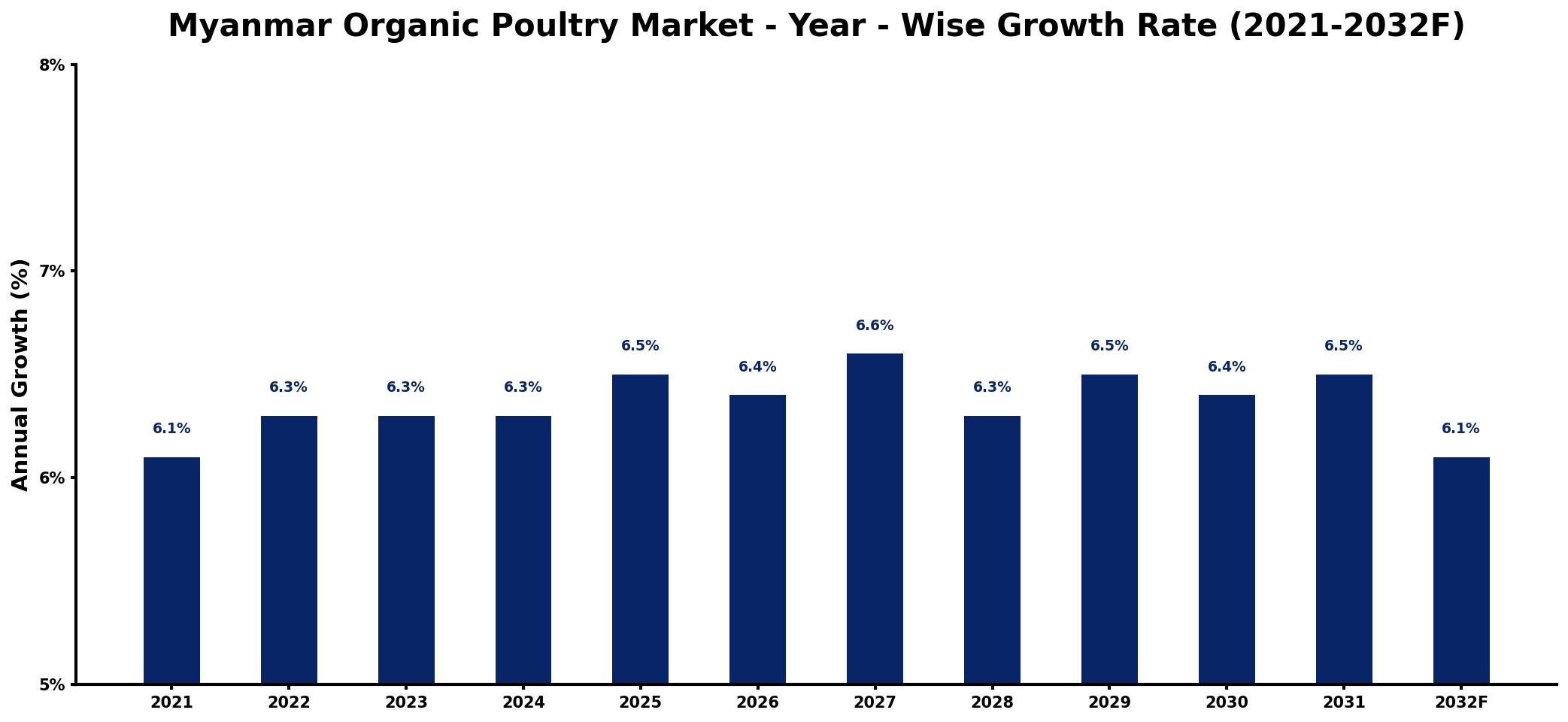
The table below presents the year‑wise growth rates along with the key drivers influencing the market
| Year | Growth Rate | Major Drivers |
| 2021 | 6.1% | Rising consumer health consciousness |
| 2022 | 6.3% | Increased investment in agriculture |
| 2023 | 6.3% | Growing demand for local sourcing |
| 2024 | 6.3% | Expansion of distribution networks |
| 2025 | 6.5% | Higher awareness of sustainability practices |
| 2026 | 6.4% | Development of eco-friendly certifications |
| 2027 | 6.6% | Surge in online retail platforms |
| 2028 | 6.3% | Strengthening of farmer cooperatives |
| 2029 | 6.5% | Boost in export opportunities |
| 2030 | 6.4% | Enhanced government support initiatives |
| 2031 | 6.5% | Innovations in feed technology |
| 2032 | 6.1% | Emergence of new market players |
Note: Market size estimations and growth projections presented in this report are based on 6Wresearch's proprietary forecasting methodology, utilizing the latest available industry data, government publications, and primary research inputs.
Myanmar Organic Poultry Market Synopsis
The demand for organic poultry products in Myanmar is witnessing remarkable growth, particularly in urban areas where consumers are becoming increasingly discerning about their food choices. With a market environment that is gradually shifting towards sustainability, organic chicken and eggs are gaining traction among both local consumers and expatriates.
On the supply side, local farmers are adapting to meet the rising demand by adopting organic farming practices. This trend is supported by government initiatives that provide training and resources aimed at enhancing organic poultry production, ultimately creating a more robust supply chain for organic products in the country.
Myanmar Organic Poultry Market Key Takeaways
- The market is anticipated to grow significantly, reflecting a shift toward organic and healthy food choices among consumers.
- Government policies are increasingly supporting organic farming, which is expected to enhance production capacity.
- Urbanization is driving higher demand for organic poultry, with consumers willing to invest in premium products.
- Local farmers are pivoting towards sustainable practices, responding to both consumer demands and regulatory encouragement.
- Investment opportunities are emerging across the organic poultry value chain, from farming to distribution.
Evaluation of Restraints in Myanmar Organic Poultry Market
Despite the promising outlook, the Myanmar organic poultry market faces several restraints that hinder its expansion. One major limitation is the high cost of organic production, which includes expenses related to organic feed and farming practices. Additionally, the lack of widespread knowledge about organic certification among both farmers and consumers poses a barrier to market growth. Infrastructure deficiencies for organic poultry farming further complicate the landscape, making it difficult for producers to scale effectively. There is also competition from conventional poultry products, which are often more affordable, presenting challenges for organic offerings to penetrate wider markets.
Myanmar Organic Poultry Market Trends
Current trends within the Myanmar organic poultry market indicate a rising consumer preference for free-range and antibiotic-free poultry products. As consumers become more informed about the benefits of organic food, the demand for organic chicken and eggs is increasing steadily. Furthermore, urban consumers, alongside expatriates and tourists, are particularly interested in sourcing high-quality organic poultry, driving producers to enhance their offerings. The growing trend of e-commerce is also making organic poultry products more accessible, allowing consumers to purchase directly from farms and suppliers.
Myanmar Organic Poultry Market Opportunities
Investors should note the wealth of opportunities within the Myanmar organic poultry market, especially as the demand for organic products continues to rise. Key areas for investment include establishing organic poultry farms, developing supply chains for organic feed, and creating robust distribution channels that effectively reach health-conscious consumers. Additionally, investing in organic certification processes and marketing strategies will be crucial for differentiating products in a competitive marketplace and capturing the attention of an increasingly discerning consumer base.
Government Initiatives in the Myanmar Organic Poultry Market
The government of Myanmar is actively working to bolster the organic poultry market through a variety of supportive initiatives. Policies aimed at providing financial assistance and subsidies to organic farmers are being implemented, alongside training programs designed to enhance agricultural practices and productivity. Moreover, collaboration with international organizations is enhancing safety standards and overall quality of organic poultry products. These efforts aim to foster sustainable agricultural practices while catering to the growing demand for organic poultry in the market.
Future Insights of the Myanmar Organic Poultry Market
Looking ahead to 2026-2032, the Myanmar organic poultry market is poised for steady growth as consumer awareness of health and environmental issues continues to rise. This shift in consumer behavior towards organic and ethically produced food is expected to drive demand further. Additionally, the government's focus on promoting organic farming, coupled with the growing trend of urban consumers seeking organic options, will likely contribute to market expansion. The potential for e-commerce to provide greater access to organic products for a broader audience also signals a positive future for this sector.
Myanmar Organic Poultry Market Latest Developments (2025 - 2026)
Recent developments in the Myanmar organic poultry market reflect a dynamic shift towards sustainable practices. Farmers are increasingly adopting organic methods in response to rising consumer demand, while new training programs are being rolled out to enhance organic production techniques. Moreover, the rise of online marketplaces is facilitating greater consumer access to organic poultry products, creating a more competitive landscape that encourages innovation among producers.
Myanmar Organic Poultry Market - Key Attractiveness of the Report
- 10 Years of Market Numbers
- Historical Data Starting from 2022 to 2025
- Base Year: 2025
- Forecast Data until 2032
- Key Performance Indicators Impacting the Market
- Major Upcoming Developments and Projects
Key Highlights of the Report:
- Myanmar Organic Poultry Market Outlook
- Market Size of Myanmar Organic Poultry Market, 2025
- Forecast of Myanmar Organic Poultry Market, 2032
- Historical Data and Forecast of Myanmar Organic Poultry Revenues & Volume for the Period 2022-2032F
- Myanmar Organic Poultry Market Trend Evolution
- Myanmar Organic Poultry Market Drivers and Challenges
- Myanmar Organic Poultry Price Trends
- Myanmar Organic Poultry Porter's Five Forces
- Myanmar Organic Poultry Industry Life Cycle
- Historical Data and Forecast of Myanmar Organic Poultry Market Revenues & Volume By Type for the Period 2022-2032F
- Historical Data and Forecast of Myanmar Organic Poultry Market Revenues & Volume By Organic Eggs for the Period 2022-2032F
- Historical Data and Forecast of Myanmar Organic Poultry Market Revenues & Volume By Organic Meat for the Period 2022-2032F
- Historical Data and Forecast of Myanmar Organic Poultry Market Revenues & Volume By Sales Channel for the Period 2022-2032F
- Historical Data and Forecast of Myanmar Organic Poultry Market Revenues & Volume By Business To Business for the Period 2022-2032F
- Historical Data and Forecast of Myanmar Organic Poultry Market Revenues & Volume By Business To Consumer for the Period 2022-2032F
- Myanmar Organic Poultry Import Export Trade Statistics
- Market Opportunity Assessment By Type
- Market Opportunity Assessment By Sales Channel
- Myanmar Organic Poultry Top Companies Market Share
- Myanmar Organic Poultry Competitive Benchmarking By Technical and Operational Parameters
- Myanmar Organic Poultry Company Profiles
- Myanmar Organic Poultry Key Strategic Recommendations






































