Myanmar Ornamental Fish Market Size, Share & Growth Rate
The Myanmar Ornamental Fish Market was estimated at USD 204 Million in 2025 and is projected to reach USD 270 Million by 2032, growing at a CAGR of 4.1% from 2026 to 2032. This upward trajectory is primarily driven by an increasing interest in aquarium keeping and pet ownership among the urban population, particularly in cities like Yangon and Mandalay. Furthermore, the shift towards sustainable practices and the rising demand for exotic species are amplifying market growth.
Myanmar Ornamental Fish Market Year-wise Growth Rate and Key Drivers
This graph highlights how the Myanmar Ornamental Fish Market has steadily grown over the years, supported by major growth factors.
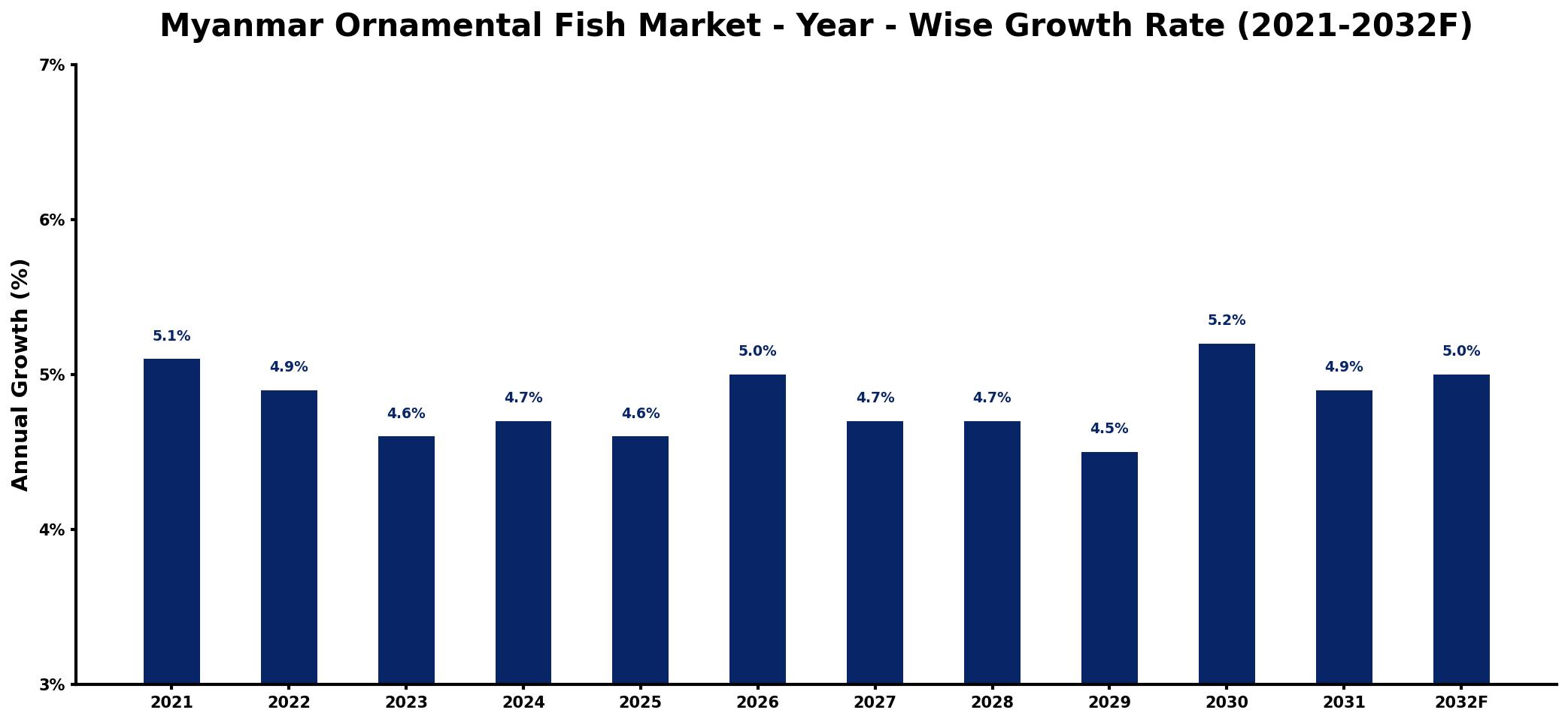
The table below presents the year‑wise growth rates along with the key drivers influencing the market
| Year | Growth Rate | Major Drivers |
| 2021 | 5.1% | Rising demand for home aquariums |
| 2022 | 4.9% | Increase in local breeding facilities |
| 2023 | 4.6% | Growth in online retail channels |
| 2024 | 4.7% | Expansion of export opportunities |
| 2025 | 4.6% | Development of sustainable practices |
| 2026 | 5.0% | Investments in aquaculture technology |
| 2027 | 4.7% | Enhancement of distribution networks |
| 2028 | 4.7% | Surge in hobbyist communities |
| 2029 | 4.5% | Collaboration with tourism industry |
| 2030 | 5.2% | Emergence of new species markets |
| 2031 | 4.9% | Strengthening of regulatory frameworks |
| 2032 | 5.0% | Boost in educational initiatives |
Note: Market size estimations and growth projections presented in this report are based on 6Wresearch's proprietary forecasting methodology, utilizing the latest available industry data, government publications, and primary research inputs.
Myanmar Ornamental Fish Market Synopsis
In Myanmar, the ornamental fish market is characterized by a strong preference for freshwater species, particularly guppies and bettas, which are favored by local enthusiasts. Additionally, the emergence of online sales platforms has significantly broadened the reach of these fish, allowing hobbyists easy access to diverse species and breeding information.
Despite challenges such as limited infrastructure and quality control, local breeders are increasingly capitalizing on the growing interest in unique and colorful varieties. The market is witnessing an evolution in breeding practices, with a notable shift towards locally bred fish, reflecting a trend towards sustainability among consumers.
Myanmar Ornamental Fish Market Key Takeaways
- The market is primarily driven by urban pet ownership and a growing interest in aquarium keeping.
- Retail sales through online platforms are increasingly significant, connecting buyers with sellers effectively.
- Challenges such as inadequate infrastructure and lack of regulatory standards hinder potential growth.
- Investment opportunities exist in modern aquaculture and specialized retail establishments.
- Government initiatives aim to promote sustainability and protect native fish species.
Evaluation of Restraints in Myanmar Ornamental Fish Market
The Myanmar Ornamental Fish Market faces several significant restraints that impede its growth potential. The infrastructure for breeding and transportation is still underdeveloped, making it difficult for suppliers to meet rising demand efficiently. Additionally, the absence of standardized quality control measures limits the market's ability to command premium pricing, which is crucial for attracting investment and developing a robust export profile. Political instability and regulatory uncertainties further complicate market dynamics, creating an environment where long-term planning becomes challenging for stakeholders.
Myanmar Ornamental Fish Market Trends
The market is witnessing a burgeoning interest in exotic and unique fish species, as aquarium hobbyists seek to differentiate their setups. A notable trend is the rise of nano aquarium setups, which cater to urban consumers with limited space. Additionally, the emphasis on sustainable practices is prompting consumers to prefer locally bred fish over wild-caught varieties. Social media platforms are playing an essential role in educating potential fish keepers, providing tips on care and maintenance, further enhancing engagement within the community.
Myanmar Ornamental Fish Market Opportunities
Investment opportunities abound in the Myanmar ornamental fish market, particularly for local and international players looking to tap into the growing demand. Breeding operations focusing on high-quality and diverse species can capitalize on the rising consumer interest. The establishment of specialized retail outlets and online marketplaces is also crucial for meeting the needs of urban dwellers. Additionally, collaboration with local breeders presents a pathway for building expertise and expanding market reach effectively.
Government Initiatives in the Myanmar Ornamental Fish Market
The Myanmar government has implemented various policies aimed at promoting sustainability within the ornamental fish market. The Department of Fisheries oversees the industry, enforcing regulations that encourage responsible breeding practices and protect native aquatic species. Additionally, initiatives such as licensing for fish breeders and exporters are designed to ensure compliance with environmental standards, reflecting the government's commitment to balancing economic opportunities with biodiversity preservation.
Future Insights of the Myanmar Ornamental Fish Market
The Myanmar Ornamental Fish Market is poised for steady growth through 2026-2032, buoyed by increasing disposable incomes and urbanization trends. With an expanding middle-class population that seeks leisure activities like aquarium keeping, the demand for ornamental fish is expected to rise. However, the market must overcome challenges related to infrastructure and technology access to fully realize its potential. Continued investments and regulatory support will be essential for sustaining growth and facilitating entry into international markets.
Myanmar Ornamental Fish Market Latest Developments (2025 - 2026)
Recent developments in the Myanmar ornamental fish market indicate a shift towards modern breeding techniques and a growing emphasis on quality control measures. Increased participation in local and regional aquaculture exhibitions has bolstered networking opportunities among breeders and suppliers. Additionally, the introduction of educational programs aimed at hobbyists is fostering better understanding of sustainable practices and proper care, further enhancing the overall market ecosystem.
Myanmar Ornamental Fish Market - Key Attractiveness of the Report
- 10 Years of Market Numbers
- Historical Data Starting from 2022 to 2025
- Base Year: 2025
- Forecast Data until 2032
- Key Performance Indicators Impacting the Market
- Major Upcoming Developments and Projects
Key Highlights of the Report:
- Myanmar Ornamental Fish Market Outlook
- Market Size of Myanmar Ornamental Fish Market, 2025
- Forecast of Myanmar Ornamental Fish Market, 2032
- Historical Data and Forecast of Myanmar Ornamental Fish Revenues & Volume for the Period 2022-2032F
- Myanmar Ornamental Fish Market Trend Evolution
- Myanmar Ornamental Fish Market Drivers and Challenges
- Myanmar Ornamental Fish Price Trends
- Myanmar Ornamental Fish Porter's Five Forces
- Myanmar Ornamental Fish Industry Life Cycle
- Historical Data and Forecast of Myanmar Ornamental Fish Market Revenues & Volume By Product for the Period 2022-2032F
- Historical Data and Forecast of Myanmar Ornamental Fish Market Revenues & Volume By Tropical Freshwater for the Period 2022-2032F
- Historical Data and Forecast of Myanmar Ornamental Fish Market Revenues & Volume By Temperate for the Period 2022-2032F
- Historical Data and Forecast of Myanmar Ornamental Fish Market Revenues & Volume By Marine for the Period 2022-2032F
- Historical Data and Forecast of Myanmar Ornamental Fish Market Revenues & Volume By Application for the Period 2022-2032F
- Historical Data and Forecast of Myanmar Ornamental Fish Market Revenues & Volume By Commercial for the Period 2022-2032F
- Historical Data and Forecast of Myanmar Ornamental Fish Market Revenues & Volume By Household for the Period 2022-2032F
- Myanmar Ornamental Fish Import Export Trade Statistics
- Market Opportunity Assessment By Product
- Market Opportunity Assessment By Application
- Myanmar Ornamental Fish Top Companies Market Share
- Myanmar Ornamental Fish Competitive Benchmarking By Technical and Operational Parameters
- Myanmar Ornamental Fish Company Profiles
- Myanmar Ornamental Fish Key Strategic Recommendations






































