Myanmar Orphan Drugs Market Size, Share & Growth Rate
The Myanmar Orphan Drugs Market was estimated at USD 303 Million in 2025 and is projected to reach USD 429 Million by 2032, growing at a CAGR of 5.1% from 2026 to 2032. This growth trajectory is propelled by increasing awareness about rare diseases and the government's commitment to enhancing healthcare infrastructure. As patients seek more specialized treatments, the market is responding with a gradual rise in availability and accessibility of orphan drugs.
Myanmar Orphan Drugs Market Year-wise Growth Rate and Key Drivers
This graph highlights how the Myanmar Orphan Drugs Market has steadily grown over the years, supported by major growth factors.
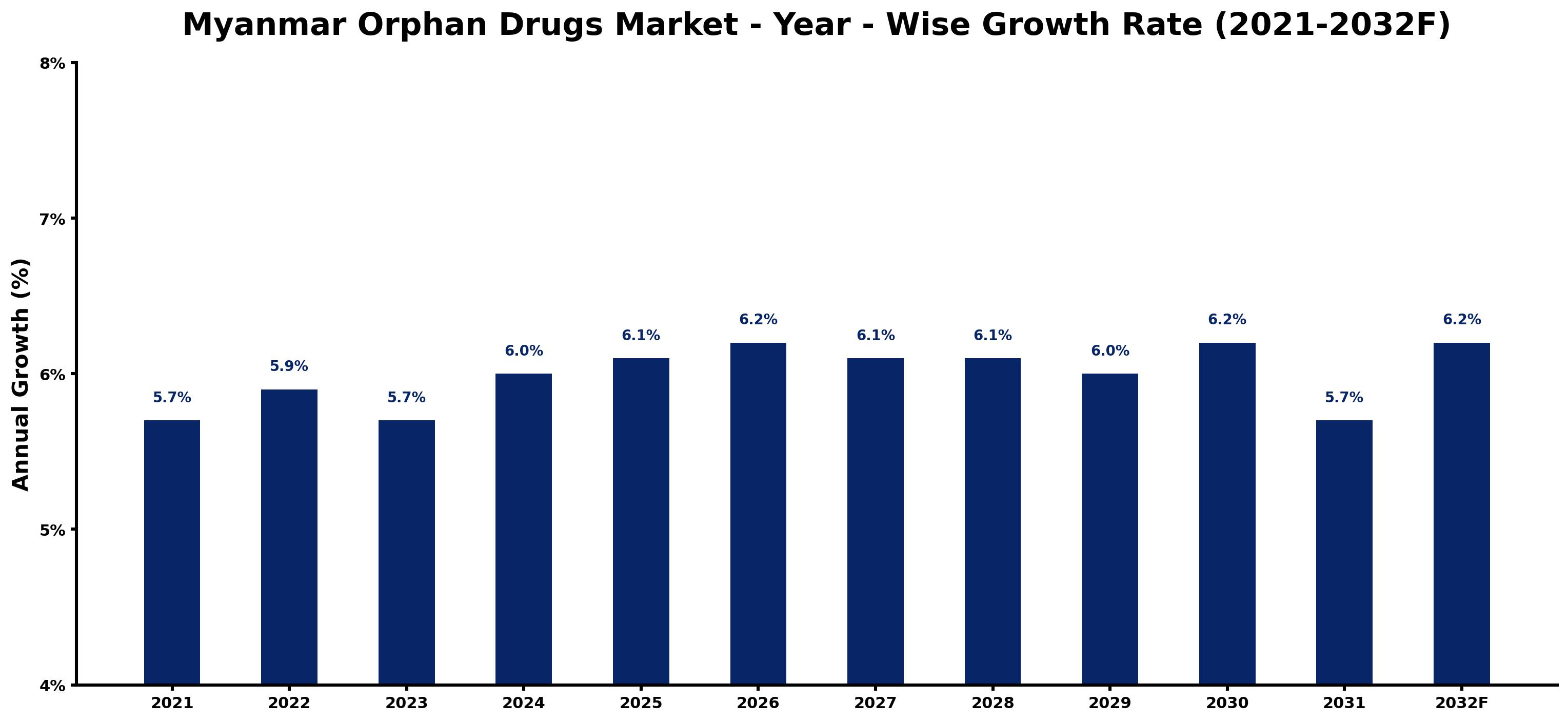
The table below presents the year‑wise growth rates along with the key drivers influencing the market
| Year | Growth Rate | Major Drivers |
| 2021 | 5.7% | Expansion of transportation and logistics networks |
| 2022 | 5.9% | Increasing industrial automation investments |
| 2023 | 5.7% | Expansion of commercial construction activities |
| 2024 | 6.0% | Increasing adoption of advanced technologies |
| 2025 | 6.1% | Increasing industrial infrastructure investments |
| 2026 | 6.2% | Rapid growth in telecom and data center sectors |
| 2027 | 6.1% | Increasing industrial automation investments |
| 2028 | 6.1% | Expansion of manufacturing activities |
| 2029 | 6.0% | Growing urbanization and commercial development |
| 2030 | 6.2% | Government infrastructure modernization initiatives |
| 2031 | 5.7% | Increasing industrial infrastructure investments |
| 2032 | 6.2% | Expansion of manufacturing activities |
Note - Market size estimations and growth projections presented in this report are based on 6Wresearch's advanced forecasting approach, validated with industry datasets as of June 2026.
Myanmar Orphan Drugs Market Synopsis
Currently, the availability of orphan drugs in Myanmar is limited due to a small number of manufacturers and a lack of widespread awareness among healthcare providers. This creates significant barriers for patients with rare diseases, who often struggle to receive proper diagnoses and treatment.
However, the tide is shifting as governmental initiatives seek to address these challenges, aiming to improve healthcare access and to enhance the understanding of rare diseases. Collaborative efforts between local organizations and international pharmaceutical companies are expected to further catalyze market growth.
Myanmar Orphan Drugs Market Key Takeaways
- The market is characterized by an increasing demand for targeted therapies for rare diseases.
- Government initiatives are vital for improving healthcare infrastructure and access to orphan drugs.
- Collaboration between local and international entities is key to expanding the market.
- The high cost of orphan drugs remains a critical barrier for patients seeking treatment.
- Personalized medicine is emerging as a trend within the orphan drugs market, driving innovation.
Evaluation of Restraints in Myanmar Orphan Drugs Market
Despite the promising outlook for the Myanmar orphan drugs market, several key restraints hinder its expansion. A significant factor is the limited understanding and awareness of rare diseases among healthcare professionals, which often results in underdiagnosis. Additionally, the scarcity of specialized healthcare facilities and trained personnel compounds the issue, making it difficult for patients to access necessary treatments. The high costs associated with orphan drugs, alongside the absence of robust reimbursement mechanisms, leave many patients unable to afford these critical therapies, thereby widening the gap in healthcare equity.
Myanmar Orphan Drugs Market Trends
The market is currently witnessing a surge in demand for orphan drugs that target specific rare diseases. This shift is influenced by the patients' need for more effective and personalized treatments. Additionally, the trend towards precision medicine is gaining momentum, with innovative orphan drugs being developed to cater to individual patient profiles. The increasing collaboration among pharmaceutical companies and local healthcare organizations is also making strides in enhancing the availability of these specialized medications.
Myanmar Orphan Drugs Market Opportunities
Investors have a substantial opportunity in the Myanmar orphan drugs market, largely due to the rising demand for specialized treatments. With approximately 6.5 million people in Myanmar affected by rare diseases, there exists a compelling need for effective orphan drugs. The government's focus on improving healthcare access and infrastructure can also facilitate significant growth in this sector, presenting lucrative investment opportunities for both local and international players.
Government Initiatives in the Myanmar Orphan Drugs Market
The Myanmar government has enacted various policies to streamline the importation and distribution of orphan drugs. Oversight by the Ministry of Health and Sports ensures that these medications are registered with a focus on safety, efficacy, and quality. Special status is granted to orphan drugs, which expedites their approval processes, thereby aiming to improve patient access. Furthermore, the government's transparency initiatives within the pharmaceutical industry are fostering an environment conducive to enhancing healthcare outcomes.
Future Insights of the Myanmar Orphan Drugs Market
Looking forward to the period between 2026 and 2032, the Myanmar orphan drugs market shows promising growth potential. With a heightened awareness of rare diseases and an increasing push from the government to bolster healthcare infrastructure, the environment is becoming more favorable for orphan drug accessibility. Streamlined regulatory processes and incentives for pharmaceutical investments will likely facilitate entry and growth in this niche market, addressing critical unmet medical needs.
Myanmar Orphan Drugs Market Latest Developments (May 2025 - June 2026)
Recent developments in the Myanmar orphan drugs market have showcased increased collaboration between international pharmaceutical companies and local health organizations. Efforts to raise awareness about rare diseases have also intensified, driven by advocacy groups and governmental initiatives. These developments are not only enhancing market visibility but are also laying the groundwork for improved access to orphan drugs for the population.
Myanmar Orphan Drugs Market - Key Attractiveness of the Report
- 10 Years of Market Numbers
- Historical Data Starting from 2022 to 2025
- Base Year: 2025
- Forecast Data until 2032
- Key Performance Indicators Impacting the Market
- Major Upcoming Developments and Projects
Key Highlights of the Report:
- Myanmar Orphan Drugs Market Outlook
- Market Size of Myanmar Orphan Drugs Market, 2025
- Forecast of Myanmar Orphan Drugs Market, 2032
- Historical Data and Forecast of Myanmar Orphan Drugs Revenues & Volume for the Period 2022-2032F
- Myanmar Orphan Drugs Market Trend Evolution
- Myanmar Orphan Drugs Market Drivers and Challenges
- Myanmar Orphan Drugs Price Trends
- Myanmar Orphan Drugs Porter's Five Forces
- Myanmar Orphan Drugs Industry Life Cycle
- Historical Data and Forecast of Myanmar Orphan Drugs Market Revenues & Volume By Drugs for the Period 2022-2032F
- Historical Data and Forecast of Myanmar Orphan Drugs Market Revenues & Volume By Revlimid for the Period 2022-2032F
- Historical Data and Forecast of Myanmar Orphan Drugs Market Revenues & Volume By Rituxan for the Period 2022-2032F
- Historical Data and Forecast of Myanmar Orphan Drugs Market Revenues & Volume By Opdivo for the Period 2022-2032F
- Historical Data and Forecast of Myanmar Orphan Drugs Market Revenues & Volume By Keytruda for the Period 2022-2032F
- Historical Data and Forecast of Myanmar Orphan Drugs Market Revenues & Volume By Imbruvica for the Period 2022-2032F
- Historical Data and Forecast of Myanmar Orphan Drugs Market Revenues & Volume By Soliris for the Period 2022-2032F
- Historical Data and Forecast of Myanmar Orphan Drugs Market Revenues & Volume By Other Orphan Drugs for the Period 2022-2032F
- Historical Data and Forecast of Myanmar Orphan Drugs Market Revenues & Volume By Drug Type for the Period 2022-2032F
- Historical Data and Forecast of Myanmar Orphan Drugs Market Revenues & Volume By Biologics for the Period 2022-2032F
- Historical Data and Forecast of Myanmar Orphan Drugs Market Revenues & Volume By Non-Biologics for the Period 2022-2032F
- Historical Data and Forecast of Myanmar Orphan Drugs Market Revenues & Volume By Therapy Class for the Period 2022-2032F
- Historical Data and Forecast of Myanmar Orphan Drugs Market Revenues & Volume By Oncology for the Period 2022-2032F
- Historical Data and Forecast of Myanmar Orphan Drugs Market Revenues & Volume By Blood for the Period 2022-2032F
- Historical Data and Forecast of Myanmar Orphan Drugs Market Revenues & Volume By Endocrine for the Period 2022-2032F
- Historical Data and Forecast of Myanmar Orphan Drugs Market Revenues & Volume By Central Nervous Systems for the Period 2022-2032F
- Historical Data and Forecast of Myanmar Orphan Drugs Market Revenues & Volume By Cardiovascular for the Period 2022-2032F
- Historical Data and Forecast of Myanmar Orphan Drugs Market Revenues & Volume By Respiratory for the Period 2022-2032F
- Myanmar Orphan Drugs Import Export Trade Statistics
- Market Opportunity Assessment By Drugs
- Market Opportunity Assessment By Drug Type
- Market Opportunity Assessment By Therapy Class
- Myanmar Orphan Drugs Top Companies Market Share
- Myanmar Orphan Drugs Competitive Benchmarking By Technical and Operational Parameters
- Myanmar Orphan Drugs Company Profiles
- Myanmar Orphan Drugs Key Strategic Recommendations






































