Myanmar Pearl Jewelry Market Size, Share & Growth Rate
The Myanmar Pearl Jewelry Market was estimated at USD 397 Million in 2025 and is projected to reach USD 528 Million by 2032, growing at a CAGR of 4.2% from 2026 to 2032. This growth trajectory is fueled by a rising domestic middle class and increased international interest in ethically sourced luxury goods. The unique characteristics of Myanmar's pearls—renowned for their luster and diversity of color—further enhance their appeal in both local and global markets.
Myanmar Pearl Jewelry Market Year-wise Growth Rate and Key Drivers
This graph highlights how the Myanmar Pearl Jewelry Market has steadily grown over the years, supported by major growth factors.
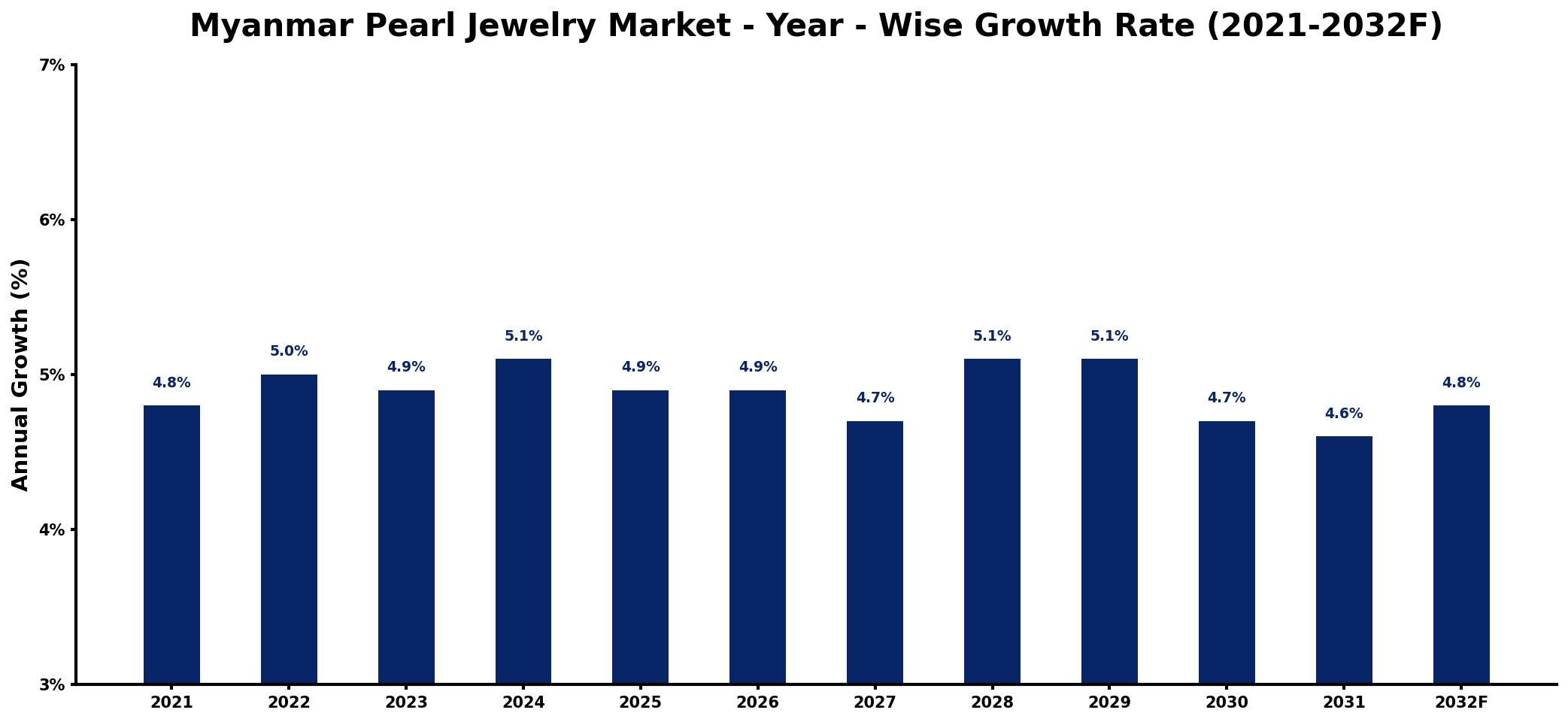
The table below presents the year‑wise growth rates along with the key drivers influencing the market
| Year | Growth Rate | Major Drivers |
| 2021 | 4.8% | Rising consumer spending on luxury |
| 2022 | 5.0% | Increased tourism boosting retail sales |
| 2023 | 4.9% | Growing interest in sustainable sourcing |
| 2024 | 5.1% | Expansion of online retail channels |
| 2025 | 4.9% | Strengthened local artisan collaborations |
| 2026 | 4.9% | Higher disposable income among consumers |
| 2027 | 4.7% | Enhanced marketing strategies attracting buyers |
| 2028 | 5.1% | Diversification of product offerings available |
| 2029 | 5.1% | Increased investments in local craftsmanship |
| 2030 | 4.7% | Strengthening international trade agreements |
| 2031 | 4.6% | Growing awareness of heritage products |
| 2032 | 4.8% | Emerging trends in luxury gifting |
Note: Market size estimations and growth projections presented in this report are based on 6Wresearch's proprietary forecasting methodology, utilizing the latest available industry data, government publications, and primary research inputs.
Myanmar Pearl Jewelry Market Synopsis
Myanmar's pearl jewelry market is at a pivotal juncture, distinguished by its exceptional quality and sustainable sourcing practices. As tourism in the country expands, there's an increasing appreciation for locally crafted pearl jewelry that embodies Myanmar's rich cultural heritage.
The market predominantly features traditional pearl jewelry items, but there is a notable shift towards contemporary and minimalist designs. This evolution aligns with the changing preferences of consumers who value uniqueness and craftsmanship in their purchases.
Myanmar Pearl Jewelry Market Key Takeaways
- The Myanmar Pearl Jewelry Market is experiencing significant growth, driven by rising demand for sustainable luxury goods.
- Ethically sourced pearls are becoming increasingly important to consumers, impacting purchasing decisions.
- Modern design trends favor minimalist styles, expanding the market for everyday wearable pearl pieces.
- Investment opportunities exist for enhancing local pearl farms and marketing unique cultural designs.
- Government regulations are actively promoting sustainability and quality control in pearl cultivation and processing.
Evaluation of Restraints in Myanmar Pearl Jewelry Market
Despite its potential, the Myanmar Pearl Jewelry Market faces several constraints. Competition from established pearl-producing nations like Japan and China threatens to overshadow Myanmar's offerings. Additionally, the industry's lack of modern technology and infrastructure limits efficiency in pearl cultivation and processing. Ongoing political instability and trade restrictions further complicate access to international markets, while concerns over unethical practices in pearl farming pose challenges to maintaining quality and transparency throughout the supply chain.
Myanmar Pearl Jewelry Market Trends
Current trends in the Myanmar Pearl Jewelry Market reflect a strong movement towards sustainability and ethical sourcing. Consumers are becoming more discerning, opting for pearls that contribute positively to the environment and local communities. The demand for handmade and customized pieces is also on the rise, with artisans creating unique designs that showcase the beauty of the pearls. Additionally, the popularity of online retail platforms is transforming how consumers access and purchase pearl jewelry, allowing for greater market reach and engagement.
Myanmar Pearl Jewelry Market Opportunities
The Myanmar Pearl Jewelry Market offers lucrative investment opportunities, particularly for entities interested in sustainable practices. Collaborations with local pearl farms can enhance the ethical sourcing of pearls while supporting community development. Furthermore, leveraging Myanmar's cultural richness to design distinctive pearl jewelry can attract both domestic consumers and international buyers. As awareness of these pearls grows, investments in marketing and distribution strategies can significantly capitalize on the increasing demand.
Government Initiatives in the Myanmar Pearl Jewelry Market
The government of Myanmar has implemented various initiatives aimed at fostering growth in the pearl jewelry market. Regulations have been put in place to monitor pearl harvesting and promote responsible practices. These measures include certification and licensing procedures to ensure quality and sustainability. Furthermore, the government actively supports marketing efforts to raise awareness of Myanmar pearls on the global stage, thereby enhancing the sector's competitiveness.
Future Insights of the Myanmar Pearl Jewelry Market
Looking ahead to 2026-2032, the Myanmar Pearl Jewelry Market is poised for continued expansion, driven by increasing consumer preferences for unique and ethically produced luxury items. The trend towards sustainability will likely amplify, aligning with global shifts towards environmentally conscious consumption. Additionally, the growth of e-commerce presents a robust avenue for reaching broader audiences, which can facilitate further market penetration. Overall, the outlook remains positive as consumer interest in high-quality, sustainable pearl jewelry continues to escalate.
Myanmar Pearl Jewelry Market Latest Developments (2025 - 2026)
Recent developments in the Myanmar Pearl Jewelry Market indicate a growing trend towards international collaborations aimed at improving sustainability in pearl farming. Innovative marketing campaigns are being launched to highlight the uniqueness of Myanmar pearls, both online and in retail settings. Additionally, emerging designer brands are integrating traditional techniques with modern aesthetics, catering to a diverse range of consumer preferences. The interplay between local artisans and global markets is becoming increasingly evident as the sector evolves.
Myanmar Pearl Jewelry Market - Key Attractiveness of the Report
- 10 Years of Market Numbers
- Historical Data Starting from 2022 to 2025
- Base Year: 2025
- Forecast Data until 2032
- Key Performance Indicators Impacting the Market
- Major Upcoming Developments and Projects
Key Highlights of the Report:
- Myanmar Pearl Jewelry Market Outlook
- Market Size of Myanmar Pearl Jewelry Market, 2025
- Forecast of Myanmar Pearl Jewelry Market, 2032
- Historical Data and Forecast of Myanmar Pearl Jewelry Revenues & Volume for the Period 2022-2032F
- Myanmar Pearl Jewelry Market Trend Evolution
- Myanmar Pearl Jewelry Market Drivers and Challenges
- Myanmar Pearl Jewelry Price Trends
- Myanmar Pearl Jewelry Porter's Five Forces
- Myanmar Pearl Jewelry Industry Life Cycle
- Historical Data and Forecast of Myanmar Pearl Jewelry Market Revenues & Volume By Pearl Type for the Period 2022-2032F
- Historical Data and Forecast of Myanmar Pearl Jewelry Market Revenues & Volume By Freshwater for the Period 2022-2032F
- Historical Data and Forecast of Myanmar Pearl Jewelry Market Revenues & Volume By Saltwater for the Period 2022-2032F
- Historical Data and Forecast of Myanmar Pearl Jewelry Market Revenues & Volume By Material Type for the Period 2022-2032F
- Historical Data and Forecast of Myanmar Pearl Jewelry Market Revenues & Volume By Gold for the Period 2022-2032F
- Historical Data and Forecast of Myanmar Pearl Jewelry Market Revenues & Volume By Silver for the Period 2022-2032F
- Historical Data and Forecast of Myanmar Pearl Jewelry Market Revenues & Volume By Others for the Period 2022-2032F
- Historical Data and Forecast of Myanmar Pearl Jewelry Market Revenues & Volume By Jewelry Type for the Period 2022-2032F
- Historical Data and Forecast of Myanmar Pearl Jewelry Market Revenues & Volume By Necklace for the Period 2022-2032F
- Historical Data and Forecast of Myanmar Pearl Jewelry Market Revenues & Volume By Earrings for the Period 2022-2032F
- Historical Data and Forecast of Myanmar Pearl Jewelry Market Revenues & Volume By Rings for the Period 2022-2032F
- Historical Data and Forecast of Myanmar Pearl Jewelry Market Revenues & Volume By Others for the Period 2022-2032F
- Myanmar Pearl Jewelry Import Export Trade Statistics
- Market Opportunity Assessment By Pearl Type
- Market Opportunity Assessment By Material Type
- Market Opportunity Assessment By Jewelry Type
- Myanmar Pearl Jewelry Top Companies Market Share
- Myanmar Pearl Jewelry Competitive Benchmarking By Technical and Operational Parameters
- Myanmar Pearl Jewelry Company Profiles
- Myanmar Pearl Jewelry Key Strategic Recommendations






































