Myanmar Perchloroethylene Market Size, Share & Growth Rate
The Myanmar Perchloroethylene Market was estimated at USD 354 Million in 2025 and is projected to reach USD 484 Million by 2032, growing at a CAGR of 4.6% from 2026 to 2032. This growth is primarily fueled by the surging demand from the dry cleaning, textile, and metal degreasing sectors. As urbanization accelerates and consumer preferences evolve, the reliance on perchloroethylene as a key solvent in these industries is poised to expand further.
Myanmar Perchloroethylene Market Year-wise Growth Rate and Key Drivers
This graph highlights how the Myanmar Perchloroethylene Market has steadily grown over the years, supported by major growth factors.
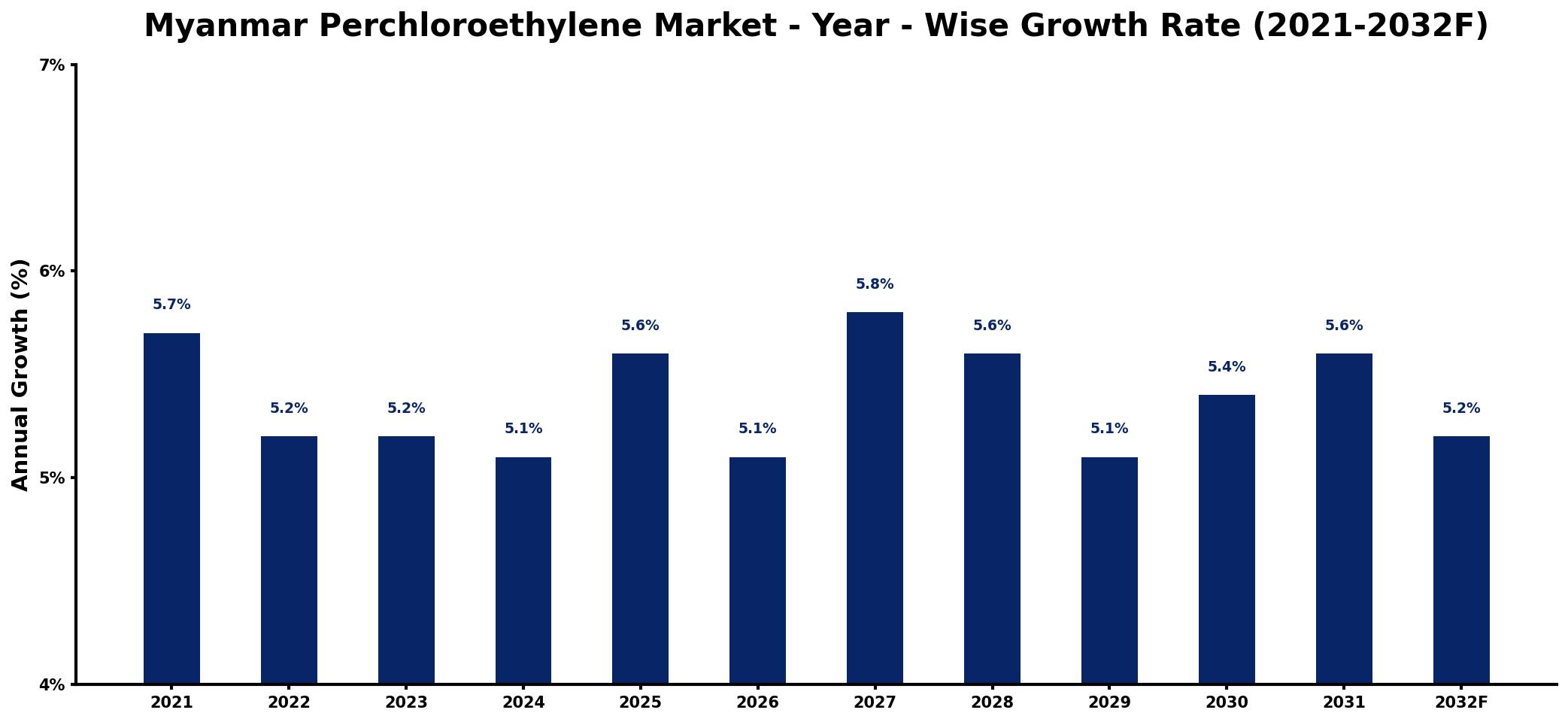
The table below presents the year‑wise growth rates along with the key drivers influencing the market
| Year | Growth Rate | Major Drivers |
| 2021 | 5.7% | Rising demand from textile industry |
| 2022 | 5.2% | Growth in automotive cleaning applications |
| 2023 | 5.2% | Increased industrial cleaning needs |
| 2024 | 5.1% | Expansion of manufacturing facilities |
| 2025 | 5.6% | Surge in electronics sector usage |
| 2026 | 5.1% | strengthening underlying market demand |
| 2027 | 5.8% | Increased focus on environmental compliance |
| 2028 | 5.6% | Rising investments in chemical sector |
| 2029 | 5.1% | increased production capacity utilization |
| 2030 | 5.4% | growing downstream application demand |
| 2031 | 5.6% | increased overall sector activity |
| 2032 | 5.2% | Growing demand for precision cleaning |
Note: Market size estimations and growth projections presented in this report are based on 6Wresearch's proprietary forecasting methodology, utilizing the latest available industry data, government publications, and primary research inputs.
Myanmar Perchloroethylene Market Synopsis
The demand for perchloroethylene in Myanmar is significantly driven by the textile and dry cleaning industries, where it is valued for its exceptional cleaning properties. With the rise of urban centers and an increasing standard of living, the need for efficient and effective cleaning solutions in both commercial and residential sectors is becoming more pronounced.
While the market remains largely dependent on imports due to limited domestic production, growing environmental concerns are prompting a shift towards sustainable alternatives. This shift may influence future demand dynamics, compelling market players to innovate and adapt in order to maintain competitiveness in this evolving landscape.
Myanmar Perchloroethylene Market Key Takeaways
- Strong growth trajectory driven by key industries such as textiles and dry cleaning.
- Market dynamics influenced by a growing shift towards sustainable and eco-friendly alternatives.
- Significant reliance on imported perchloroethylene due to limited local production capabilities.
- Government regulations aiming to manage environmental impacts are reshaping market strategies.
- Opportunities for investments in manufacturing and distribution are growing in tandem with market demand.
Evaluation of Restraints in Myanmar Perchloroethylene Market
The Myanmar Perchloroethylene market faces notable challenges that hinder its potential for growth. Among these is the limited awareness and understanding of perchloroethylene among potential users, which can restrict its adoption across industries. Moreover, inadequate infrastructure for storage and distribution complicates logistics and supply chain management. Additionally, inconsistencies in regulatory frameworks create uncertainty, while the availability of cheaper alternative chemicals further complicates the scenario. Addressing these barriers will require a concerted effort to educate stakeholders and improve the existing infrastructure.
Myanmar Perchloroethylene Market Trends
The Myanmar Perchloroethylene market is witnessing several transformative trends, including a strong push towards environmentally friendly practices. This has prompted manufacturers to invest in research and development, leading to the creation of safer and more efficient products. Furthermore, there is a noticeable trend of collaboration among industry players aiming to enhance market presence and meet rising demand. These partnerships focus on sharing knowledge and resources, positioning companies to better navigate the competitive landscape.
Myanmar Perchloroethylene Market Opportunities
With the continual growth in the demand for dry cleaning services and industrial applications, the Myanmar perchloroethylene market presents significant investment opportunities. As urbanization progresses, there is an expanding consumer base reliant on dry cleaning services, which in turn boosts the need for perchloroethylene. Investors can explore avenues for establishing manufacturing facilities or creating distribution networks. Moreover, forming partnerships with existing businesses in the dry cleaning sector could further enhance market penetration and yield favorable returns.
Government Initiatives in the Myanmar Perchloroethylene Market
The Myanmar government has implemented stringent regulations to manage the use of perchloroethylene, particularly in the dry cleaning sector. These regulations aim to protect public health and the environment by limiting usage and ensuring compliance through regular inspections. Additionally, there are ongoing efforts to encourage the adoption of alternative cleaning methods that are less harmful to the environment. These initiatives indicate a focused approach towards sustainable chemical management in Myanmar.
Future Insights of the Myanmar Perchloroethylene Market
The future outlook for the Myanmar Perchloroethylene market is bright, propelled by the ongoing growth in textile and dry cleaning industries. As the economy expands and industrial development continues, demand for perchloroethylene is expected to increase. However, environmental concerns and the quest for sustainability will likely catalyze the exploration of eco-friendly alternatives. For market players, the focus must remain on innovation and diversification to harness these evolving opportunities effectively.
Myanmar Perchloroethylene Market Latest Developments (2025 - 2026)
Recent developments in the Myanmar perchloroethylene market reflect a growing focus on sustainability and regulatory compliance. Companies are enhancing their operational processes to align with environmental standards, while new partnerships are being formed to streamline supply chains and improve product offerings. Additionally, there is an increasing emphasis on R&D to innovate safer alternatives, demonstrating the industry's responsiveness to changing consumer preferences and regulatory landscapes.
Myanmar Perchloroethylene Market - Key Attractiveness of the Report
- 10 Years of Market Numbers
- Historical Data Starting from 2022 to 2025
- Base Year: 2025
- Forecast Data until 2032
- Key Performance Indicators Impacting the Market
- Major Upcoming Developments and Projects
Key Highlights of the Report:
- Myanmar Perchloroethylene Market Outlook
- Market Size of Myanmar Perchloroethylene Market, 2025
- Forecast of Myanmar Perchloroethylene Market, 2032
- Historical Data and Forecast of Myanmar Perchloroethylene Revenues & Volume for the Period 2022-2032F
- Myanmar Perchloroethylene Market Trend Evolution
- Myanmar Perchloroethylene Market Drivers and Challenges
- Myanmar Perchloroethylene Price Trends
- Myanmar Perchloroethylene Porter's Five Forces
- Myanmar Perchloroethylene Industry Life Cycle
- Historical Data and Forecast of Myanmar Perchloroethylene Market Revenues & Volume By Type for the Period 2022-2032F
- Historical Data and Forecast of Myanmar Perchloroethylene Market Revenues & Volume By Ethylene Oxychlorination for the Period 2022-2032F
- Historical Data and Forecast of Myanmar Perchloroethylene Market Revenues & Volume By Acetylene Method for the Period 2022-2032F
- Historical Data and Forecast of Myanmar Perchloroethylene Market Revenues & Volume By Ethylene Direct Chlorination for the Period 2022-2032F
- Historical Data and Forecast of Myanmar Perchloroethylene Market Revenues & Volume By End-use for the Period 2022-2032F
- Historical Data and Forecast of Myanmar Perchloroethylene Market Revenues & Volume By Dry Cleaning Agent for the Period 2022-2032F
- Historical Data and Forecast of Myanmar Perchloroethylene Market Revenues & Volume By Solvent for the Period 2022-2032F
- Historical Data and Forecast of Myanmar Perchloroethylene Market Revenues & Volume By Others for the Period 2022-2032F
- Myanmar Perchloroethylene Import Export Trade Statistics
- Market Opportunity Assessment By Type
- Market Opportunity Assessment By End-use
- Myanmar Perchloroethylene Top Companies Market Share
- Myanmar Perchloroethylene Competitive Benchmarking By Technical and Operational Parameters
- Myanmar Perchloroethylene Company Profiles
- Myanmar Perchloroethylene Key Strategic Recommendations






































