Myanmar Pharmaceutical Packaging Market Summary
The myanmar pharmaceutical packaging market was estimated at USD 152 Million in 2025 and is projected to reach USD 214 Million by 2032, growing at a CAGR of 5.6% from 2026 to 2032.
Myanmar Pharmaceutical Packaging Market Year-wise Growth Rate and Key Drivers
This graph highlights how the Myanmar Pharmaceutical Packaging Market has steadily grown over the past five years, supported by major growth factors.
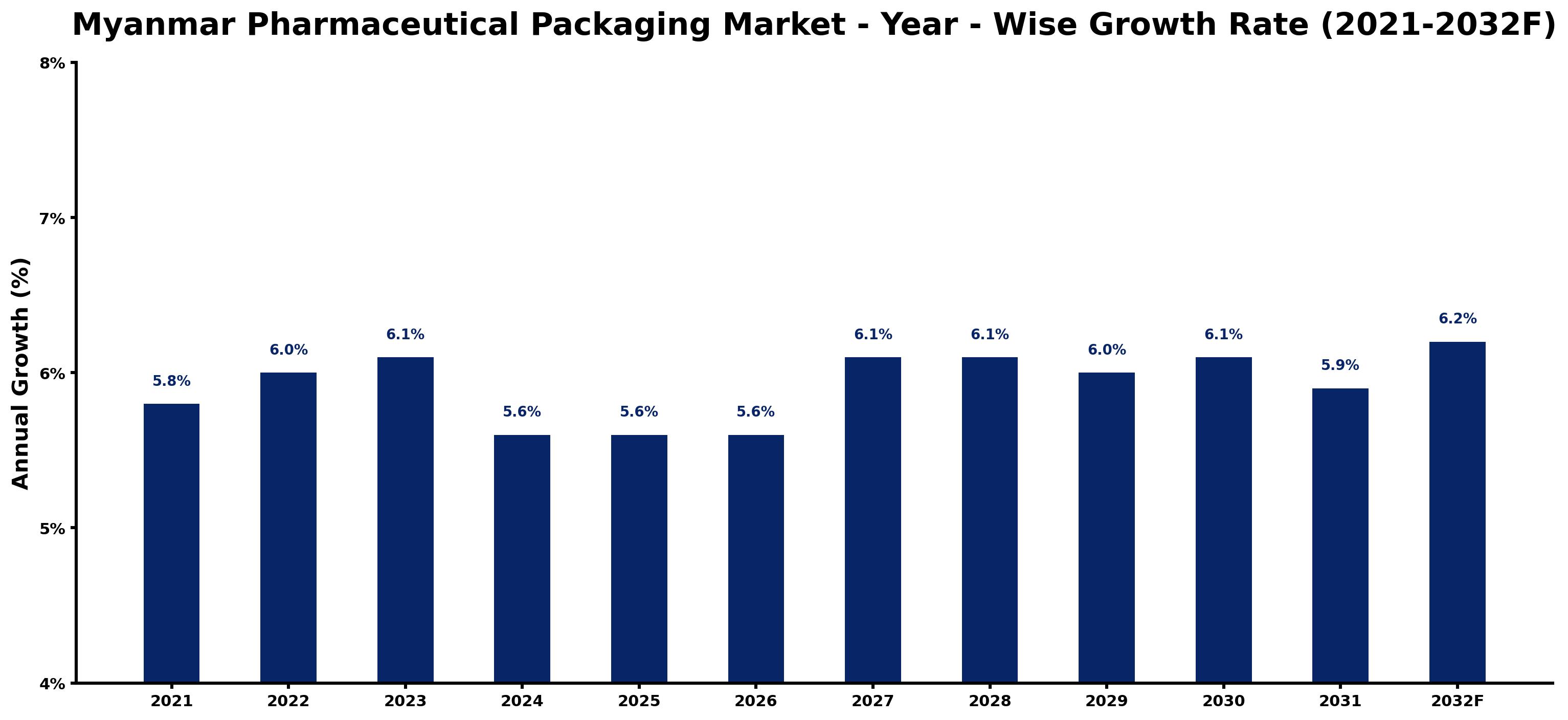
The table below presents the year wise growth rates along with the key drivers influencing the market
| Year | Growth Rate | Major Drivers |
| 2021 | 5.8% | Increased healthcare access led to a surge in pharmaceutical consumption across Myanmar. |
| 2022 | 6.0% | Local manufacturers began investing in modernizing packaging technologies to improve efficiency. |
| 2023 | 6.1% | Aging infrastructure prompted urgent needs for reliable and adaptable packaging solutions. |
| 2024 | 5.6% | Consumer awareness of product quality emphasized the importance of effective pharmaceutical packaging. |
| 2025 | 5.6% | E-commerce platforms gained popularity, creating demand for robust and safe delivery packaging. |
| 2026 | 5.6% | Partnerships between global companies and local firms strengthened the supply chain dynamics. |
| 2027 | 6.1% | Sustainability trends encouraged the development of eco-friendly packaging materials in the market. |
| 2028 | 6.1% | Emerging health trends spurred innovation in customized and patient-centric packaging solutions. |
| 2029 | 6.0% | Investments in research and development enhanced the local production capabilities significantly. |
| 2030 | 6.1% | Technological integration improved the tracking and tracing of pharmaceutical products significantly. |
| 2031 | 5.9% | Collaboration with universities fostered fresh ideas and innovations in packaging design. |
| 2032 | 6.2% | Enhanced regulatory frameworks ensured higher quality standards for pharmaceutical packaging compliance. |
Note - Market size estimations and growth projections presented in this report are based on 6Wresearch's advanced forecasting approach, validated with industry datasets as of June 2026.
Myanmar Pharmaceutical Packaging Market Synopsis
The Myanmar Pharmaceutical Packaging Market is projected to reach 5.6% and witness significant growth during the forecast period (2026-2032). This growth trajectory is anticipated to be driven by several factors, including an increasing demand for efficient and safe drug delivery methods, government initiatives focusing on healthcare infrastructure, and advances in packaging technologies. The rise in disease prevalence, coupled with rapid urbanization, further supports this growth dynamic, creating a robust framework for the expansion of the pharmaceutical packaging sector in Myanmar.
Myanmar Pharmaceutical Packaging Market Growth Drivers
One of the primary drivers of the Myanmar Pharmaceutical Packaging Market is the escalating demand for efficient drug delivery systems. As the healthcare sector evolves, there is a growing emphasis on reliable packaging that ensures the safety and efficacy of pharmaceuticals. Additionally, government initiatives aimed at enhancing the healthcare infrastructure are projected to foster growth in this market. These initiatives often include funding for healthcare projects and regulatory support that encourages investments in pharmaceutical manufacturing and packaging.
Moreover, technological advancements in packaging materials and processes play a crucial role in market expansion. Innovations in biodegradable materials and user-friendly designs not only cater to the needs of healthcare providers but also resonate with environmentally conscious consumers. Furthermore, as urbanization accelerates, the demand for accessible healthcare services rises, amplifying the need for effective pharmaceutical delivery systems.
- The increasing focus on patient safety and medication adherence is compelling pharmaceutical companies to invest in packaging solutions that enhance usability and reduce the risk of errors.
- Growing awareness regarding the role of packaging in product branding and consumer trust is pushing companies to adopt more sophisticated packaging solutions.
- As international standards for pharmaceutical packaging evolve, local manufacturers are adapting to meet these regulations, driving innovation within the sector.
- Rising competition among pharmaceutical companies in Myanmar is leading to increased investments in packaging technologies that provide a competitive edge.
- Lastly, the shift towards personalized medicine necessitates packaging innovations that accommodate varied pharmaceutical forms, further stimulating market growth.
Myanmar Pharmaceutical Packaging Market Challenges and Restraints
Despite the promising growth prospects of the Myanmar Pharmaceutical Packaging Market, several challenges may hinder its development. One significant constraint is the regulatory landscape, where compliance with international standards and local laws can impose additional costs on packaging manufacturers. Navigating these regulations can be a complex process, particularly for smaller firms lacking the necessary resources.
Moreover, fluctuations in the costs of raw materials, especially plastics, pose a considerable risk to the stability of the market. Volatile prices can impact profit margins and compel companies to rethink their strategies. Additionally, the lack of advanced manufacturing facilities in Myanmar may limit the capabilities of local packaging firms to innovate effectively.
- There is also a notable shortage of skilled labor in the pharmaceutical packaging sector, which can lead to inefficiencies in production processes.
- The dependency on imported packaging materials can create supply chain vulnerabilities, especially during periods of geopolitical tension or global disruptions.
- Environmental concerns around plastic waste are prompting stricter regulations that could challenge traditional packaging methods currently in use.
- Consumer preferences are shifting towards sustainable packaging, and companies that fail to adapt may lose market share.
- Lastly, the ongoing economic fluctuations can affect consumer purchasing power, thereby impacting the overall demand for pharmaceuticals and their packaging.
Myanmar Pharmaceutical Packaging Market Government Investment and Initiatives
The government of Myanmar has been proactive in promoting investments in the healthcare and pharmaceutical sectors, which includes initiatives specifically aimed at enhancing the pharmaceutical packaging landscape. Policy frameworks are being developed to attract foreign direct investment, which is essential for modernizing local manufacturing capabilities and advancing packaging technologies.
Furthermore, public spending on healthcare infrastructure has been increasing, with several programs designed to improve access to essential medicines and enhance healthcare delivery systems. These initiatives not only bolster the pharmaceutical market but also stimulate demand for high-quality packaging solutions that ensure product integrity.
In alignment with global sustainability goals, the government is encouraging the use of environmentally friendly materials in packaging, thereby supporting the shift toward biodegradable options in the pharmaceutical sector. Various incentive programs are being introduced to promote research and development in this area, fostering innovation within the industry.
- Increased funding for healthcare has led to the establishment of new pharmaceutical facilities that prioritize advanced packaging solutions.
- Government collaborations with international organizations are paving the way for knowledge transfer regarding best practices in pharmaceutical packaging.
- Training programs aimed at upskilling the workforce are being initiated to fill the skill gaps in the packaging sector.
- Regulatory frameworks are being streamlined to facilitate easier compliance for local manufacturers, promoting a more business-friendly environment.
- Public health campaigns supported by the government emphasize the importance of proper medication packaging, raising awareness among manufacturers and consumers alike.
Myanmar Pharmaceutical Packaging Market Latest Developments (May 2025 - June 2026)
In the period from May 2025 to June 2026, the Myanmar Pharmaceutical Packaging Market has witnessed significant developments that reflect the shifting dynamics of the industry. The trend towards adopting sustainable packaging materials has gained traction, with more local companies exploring biodegradable options to meet both consumer demand and regulatory pressure.
Moreover, technological advancements in printing and labeling have led to enhanced aesthetics and functionality in pharmaceutical packaging. Manufacturers are increasingly focusing on smart packaging solutions that allow for better tracking and monitoring of pharmaceuticals, contributing to improved supply chain efficiency.
Additionally, collaborations between local manufacturers and international firms have emerged, providing opportunities for knowledge sharing and access to advanced packaging technologies. These partnerships are pivotal in elevating the standards of pharmaceutical packaging in Myanmar.
- There has also been an uptick in industry conferences and workshops aimed at fostering dialogue around innovations in pharmaceutical packaging.
- The government has introduced new guidelines aimed at standardizing the quality of packaging materials used in pharmaceuticals to align with global best practices.
- Consumer awareness campaigns focusing on the importance of packaging for safety and efficacy have been ramped up, impacting purchasing decisions.
- Research initiatives aimed at developing new materials and techniques for packaging are gaining funding, reflecting a commitment to innovation in the sector.
- Lastly, the overall healthcare sector's growth has provided a favorable environment for pharmaceutical packaging investments, encouraging companies to expand their product offerings.
Myanmar Pharmaceutical Packaging Market - Key Attractiveness of the Report
- 10 Years of Market Numbers
- Historical Data Starting from 2022 to 2025
- Base Year: 2025
- Forecast Data until 2032
- Key Performance Indicators Impacting the Market
- Major Upcoming Developments and Projects
Key Highlights of the Report:
- Myanmar Pharmaceutical Packaging Market Outlook
- Market Size of Myanmar Pharmaceutical Packaging Market, 2025
- Forecast of Myanmar Pharmaceutical Packaging Market, 2032F
- Historical Data and Forecast of Myanmar Pharmaceutical Packaging Revenues & Volume for the Period 2022-2032F
- Myanmar Pharmaceutical Packaging Market Trend Evolution
- Myanmar Pharmaceutical Packaging Market Drivers and Challenges
- Myanmar Pharmaceutical Packaging Price Trends
- Myanmar Pharmaceutical Packaging Porter's Five Forces
- Myanmar Pharmaceutical Packaging Industry Life Cycle
- Historical Data and Forecast of Myanmar Pharmaceutical Packaging Market Revenues & Volume By Material Types for the Period 2022-2032F
- Historical Data and Forecast of Myanmar Pharmaceutical Packaging Market Revenues & Volume By Plastics & Polymers for the Period 2022-2032F
- Historical Data and Forecast of Myanmar Pharmaceutical Packaging Market Revenues & Volume By Paper & Paperboard for the Period 2022-2032F
- Historical Data and Forecast of Myanmar Pharmaceutical Packaging Market Revenues & Volume By Glass for the Period 2022-2032F
- Historical Data and Forecast of Myanmar Pharmaceutical Packaging Market Revenues & Volume By Aluminum Foil for the Period 2022-2032F
- Historical Data and Forecast of Myanmar Pharmaceutical Packaging Market Revenues & Volume By Others for the Period 2022-2032F
- Historical Data and Forecast of Myanmar Pharmaceutical Packaging Market Revenues & Volume By Product Types for the Period 2022-2032F
- Historical Data and Forecast of Myanmar Pharmaceutical Packaging Market Revenues & Volume By Primary Pharmaceutical Packaging for the Period 2022-2032F
- Historical Data and Forecast of Myanmar Pharmaceutical Packaging Market Revenues & Volume By Secondary Pharmaceutical Packaging for the Period 2022-2032F
- Historical Data and Forecast of Myanmar Pharmaceutical Packaging Market Revenues & Volume By Tertiary Pharmaceutical Packaging for the Period 2022-2032F
- Historical Data and Forecast of Myanmar Pharmaceutical Packaging Market Revenues & Volume By End-users for the Period 2022-2032F
- Historical Data and Forecast of Myanmar Pharmaceutical Packaging Market Revenues & Volume By Pharmaceutical Manufacturing for the Period 2022-2032F
- Historical Data and Forecast of Myanmar Pharmaceutical Packaging Market Revenues & Volume By Retail Pharmacy for the Period 2022-2032F
- Historical Data and Forecast of Myanmar Pharmaceutical Packaging Market Revenues & Volume By Contract Packaging for the Period 2022-2032F
- Historical Data and Forecast of Myanmar Pharmaceutical Packaging Market Revenues & Volume By Institutional Pharmacy for the Period 2022-2032F
- Historical Data and Forecast of Myanmar Pharmaceutical Packaging Market Revenues & Volume By Others for the Period 2022-2032F
- Myanmar Pharmaceutical Packaging Import Export Trade Statistics
- Market Opportunity Assessment By Material Types
- Market Opportunity Assessment By Product Types
- Market Opportunity Assessment By End-users
- Myanmar Pharmaceutical Packaging Top Companies Market Share
- Myanmar Pharmaceutical Packaging Competitive Benchmarking By Technical and Operational Parameters
- Myanmar Pharmaceutical Packaging Company Profiles
- Myanmar Pharmaceutical Packaging Key Strategic Recommendations






































