Myanmar Plant Extracts Market Summary
The myanmar plant extracts market was estimated at USD 401 Million in 2025 and is projected to reach USD 567 Million by 2032, growing at a CAGR of 5.9% from 2026 to 2032.
Myanmar Plant Extracts Market Year-wise Growth Rate and Key Drivers
This graph highlights how the Myanmar Plant Extracts Market has steadily grown over the past five years, supported by major growth factors.
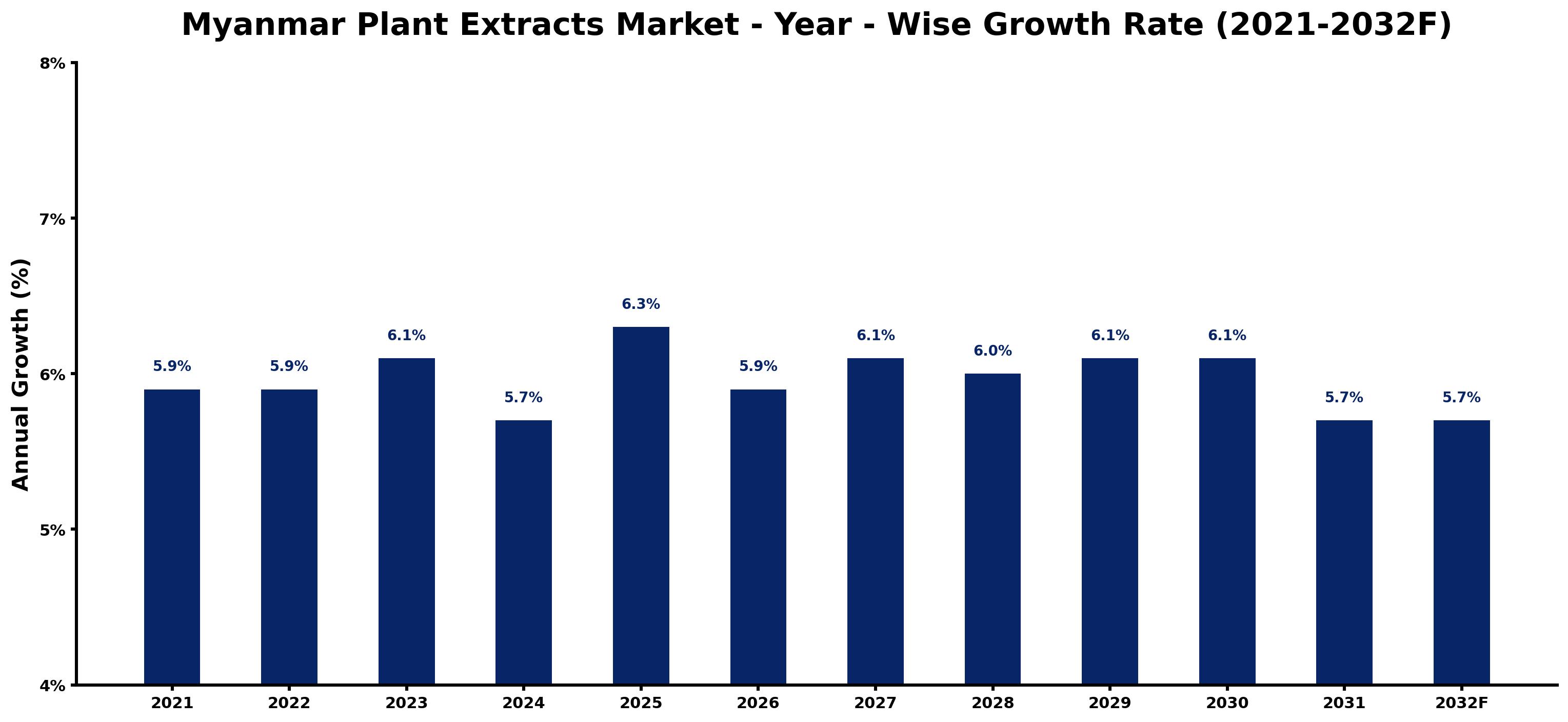
The table below presents the year wise growth rates along with the key drivers influencing the market
| Year | Growth Rate | Major Drivers |
| 2021 | 5.9% | Local farmers increasingly recognize the economic benefits of cultivating plant extracts. |
| 2022 | 5.9% | International brands show interest, enhancing Myanmar's presence in the global market. |
| 2023 | 6.1% | Sustainable practices gain traction, attracting eco-conscious investors and consumers alike. |
| 2024 | 5.7% | Consumer preferences shift towards natural products, indicating a potential market expansion. |
| 2025 | 6.3% | E-commerce platforms emerge, enabling wider distribution of plant extract offerings. |
| 2026 | 5.9% | Collaborations with local universities boost research on native plant properties. |
| 2027 | 6.1% | Emerging health trends promote the use of herbal remedies and natural supplements. |
| 2028 | 6.0% | Investment in logistics improves, facilitating faster delivery and fresher products. |
| 2029 | 6.1% | Export opportunities expand, connecting Myanmar products with international markets. |
| 2030 | 6.1% | Technological advancements streamline extraction methods, increasing efficiency and yield. |
| 2031 | 5.7% | Consumer education initiatives highlight the benefits of plant extracts, enhancing awareness. |
| 2032 | 5.7% | Regional partnerships form, leveraging cross-border trade to strengthen market presence. |
Note - Market size estimations and growth projections presented in this report are based on 6Wresearch's advanced forecasting approach, validated with industry datasets as of June 2026.
Myanmar Plant Extracts Market Synopsis
The Myanmar Plant Extracts Market is projected to reach 5.9% and witness significant growth during the forecast period (2026-2032). This market benefits from the country's abundant biodiversity, providing a myriad of botanical resources for extraction. Growing awareness and demand for natural ingredients across industries such as food and beverages, pharmaceuticals, and cosmetics contribute to the upward trajectory of this market.
Myanmar Plant Extracts Market Growth Drivers
The growth of the Myanmar Plant Extracts Market is primarily fueled by several key factors:
- Increasing consumer preference for natural and organic products is compelling manufacturers across various sectors to incorporate plant extracts into their formulations, driving demand significantly.
- The therapeutic and medicinal properties of plant extracts make them indispensable in pharmaceutical formulations, further contributing to market expansion.
- The food and beverage industry increasingly utilizes plant extracts for flavoring and preservation, enhancing demand as global consumers pursue healthier food options.
- With a rich traditional knowledge of herbal medicine, Myanmar offers a plethora of native plant species, which serves as a vast resource for extraction, ensuring a unique advantage for local manufacturers.
- The emphasis on sustainability and eco-friendly sourcing methods aligns with global sustainability trends, encouraging investments in the plant extracts sector.
Myanmar Plant Extracts Market Challenges and Restraints
Despite its favorable growth prospects, the Myanmar Plant Extracts Market confronts several challenges:
- Limited access to high-quality raw materials can hamper production, as the dependability of extraction relies heavily on the quality of sourced plants.
- The lack of advanced technical expertise and infrastructure poses challenges for manufacturers aiming to meet quality standards and regulatory requirements.
- Competition from synthetic alternatives can undermine the market for plant extracts, as these substances often provide cost-effective solutions for manufacturers.
- Fluctuating demand in end-user industries can lead to unpredictability in the market, affecting the stability of plant extract producers.
- Sustainable sourcing practices and biodiversity conservation are increasingly vital, necessitating investments in ethical harvesting methods to align with global standards.
Myanmar Plant Extracts Market Future Outlook
The outlook for the Myanmar Plant Extracts Market remains positive in the upcoming years. As global trends continue to favor natural ingredients, local manufacturers are poised to capitalize on the growing demand for plant extracts. The collaboration between public and private sectors can pave the way for advancements in extraction techniques and product development, further enhancing market growth. This growth trajectory will also be bolstered by increasing consumer awareness and preference for products derived from sustainable practices.
Myanmar Plant Extracts Market Government Investment and Initiatives
The Myanmar government plays an instrumental role in supporting the plant extracts market through various initiatives and policies.
- Public spending focused on agricultural improvement and biodiversity conservation promotes the sustainable harvesting of local plant species.
- Government policies are designed to support local extract producers, ensuring they adhere to quality and regulatory standards while fostering market growth.
- Research and development initiatives are encouraged, aiming to explore new plant sources and extraction methods that can enhance product offerings.
- Training programs for local farmers and producers are vital, aiming to improve skills and knowledge related to herbal extraction and sustainable practices.
- Investment in infrastructure, such as processing facilities and logistics networks, is essential for ensuring efficient production and distribution of plant extracts.
Myanmar Plant Extracts Market Latest Developments (May 2025 - June 2026)
Recent developments in the Myanmar Plant Extracts Market indicate a significant trend towards increased collaboration between local farmers and manufacturing companies. There is a strong emphasis on fostering sustainable practices and ensuring environmental stewardship in extraction processes. Additionally, advancements in extraction technology are being explored, aimed at enhancing the quality and yield of plant extracts. Consumer education initiatives are also gaining traction, aiming to raise awareness about the benefits of using natural ingredients. This evolving landscape suggests a promising future for the market as it adapts to meet both domestic and international demands.
Myanmar Plant Extracts Market - Key Attractiveness of the Report
- 10 Years of Market Numbers
- Historical Data Starting from 2022 to 2025
- Base Year: 2025
- Forecast Data until 2032
- Key Performance Indicators Impacting the Market
- Major Upcoming Developments and Projects
Key Highlights of the Report:
- Myanmar Plant Extracts Market Outlook
- Market Size of Myanmar Plant Extracts Market, 2025
- Forecast of Myanmar Plant Extracts Market, 2032
- Historical Data and Forecast of Myanmar Plant Extracts Revenues & Volume for the Period 2022-2032F
- Myanmar Plant Extracts Market Trend Evolution
- Myanmar Plant Extracts Market Drivers and Challenges
- Myanmar Plant Extracts Price Trends
- Myanmar Plant Extracts Porter's Five Forces
- Myanmar Plant Extracts Industry Life Cycle
- Historical Data and Forecast of Myanmar Plant Extracts Market Revenues & Volume By Product Type for the Period 2022-2032F
- Historical Data and Forecast of Myanmar Plant Extracts Market Revenues & Volume By Spices for the Period 2022-2032F
- Historical Data and Forecast of Myanmar Plant Extracts Market Revenues & Volume By Essential oils for the Period 2022-2032F
- Historical Data and Forecast of Myanmar Plant Extracts Market Revenues & Volume By Flavors & fragrances for the Period 2022-2032F
- Historical Data and Forecast of Myanmar Plant Extracts Market Revenues & Volume By Phytomedicines & herbal extracts for the Period 2022-2032F
- Historical Data and Forecast of Myanmar Plant Extracts Market Revenues & Volume By Applications for the Period 2022-2032F
- Historical Data and Forecast of Myanmar Plant Extracts Market Revenues & Volume By Pharmaceuticals & dietary supplements for the Period 2022-2032F
- Historical Data and Forecast of Myanmar Plant Extracts Market Revenues & Volume By Food & beverages for the Period 2022-2032F
- Historical Data and Forecast of Myanmar Plant Extracts Market Revenues & Volume By Cosmetics for the Period 2022-2032F
- Historical Data and Forecast of Myanmar Plant Extracts Market Revenues & Volume By Others? for the Period 2022-2032F
- Historical Data and Forecast of Myanmar Plant Extracts Market Revenues & Volume By Source Types for the Period 2022-2032F
- Historical Data and Forecast of Myanmar Plant Extracts Market Revenues & Volume By Leaves for the Period 2022-2032F
- Historical Data and Forecast of Myanmar Plant Extracts Market Revenues & Volume By Fruits, Flowers, and Bulbs for the Period 2022-2032F
- Historical Data and Forecast of Myanmar Plant Extracts Market Revenues & Volume By Rhizomes & roots?? for the Period 2022-2032F
- Historical Data and Forecast of Myanmar Plant Extracts Market Revenues & Volume By Barks & stems for the Period 2022-2032F
- Historical Data and Forecast of Myanmar Plant Extracts Market Revenues & Volume By Others? for the Period 2022-2032F
- Myanmar Plant Extracts Import Export Trade Statistics
- Market Opportunity Assessment By Product Type
- Market Opportunity Assessment By Applications
- Market Opportunity Assessment By Source Types
- Myanmar Plant Extracts Top Companies Market Share
- Myanmar Plant Extracts Competitive Benchmarking By Technical and Operational Parameters
- Myanmar Plant Extracts Company Profiles
- Myanmar Plant Extracts Key Strategic Recommendations






































