Myanmar Plastic Film Market Summary
The myanmar plastic film market was estimated at USD 313 Million in 2025 and is projected to reach USD 416 Million by 2032, growing at a CAGR of 5.0% from 2026 to 2032.
Myanmar Plastic Film Market Year-wise Growth Rate and Key Drivers
This graph highlights how the Myanmar Plastic Film Market has steadily grown over the past five years, supported by major growth factors.
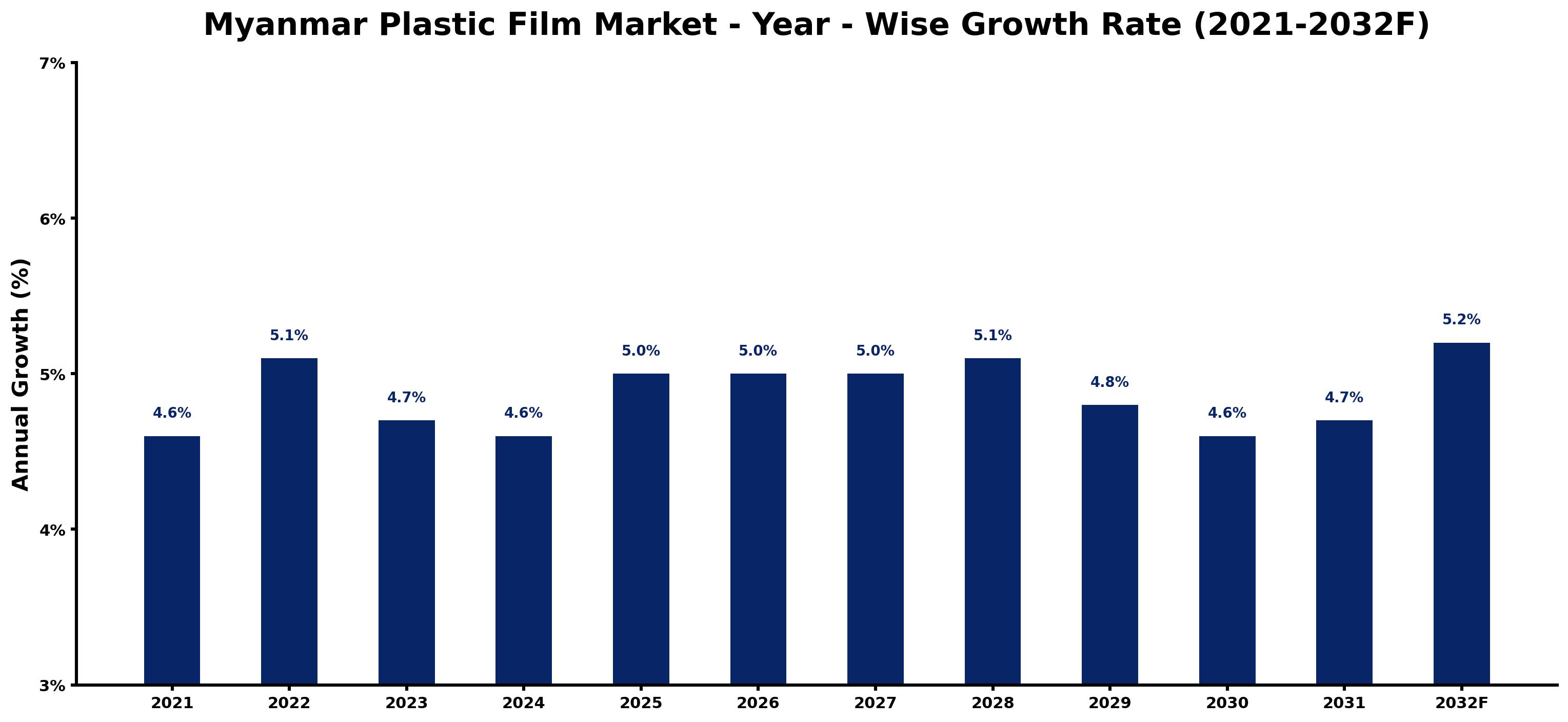
The table below presents the year wise growth rates along with the key drivers influencing the market
| Year | Growth Rate | Major Drivers |
| 2021 | 4.6% | Economic recovery post-COVID-19 led to increased industrial activity and packaging needs. |
| 2022 | 5.1% | Local manufacturing capacities began to expand, boosting demand for plastic film products. |
| 2023 | 4.7% | Rising consumer preferences for convenience packaging spurred innovation in plastic film designs. |
| 2024 | 4.6% | E-commerce growth intensified the need for durable packaging materials across sectors. |
| 2025 | 5.0% | Infrastructural developments in urban areas created more opportunities for plastic film applications. |
| 2026 | 5.0% | Increased agricultural practices prompted higher usage of plastic films for crop protection. |
| 2027 | 5.0% | Emergence of eco-friendly alternatives began influencing traditional plastic film production choices. |
| 2028 | 5.1% | Collaborations between local businesses and international firms fostered technology transfer in manufacturing. |
| 2029 | 4.8% | Consumer awareness on sustainability impacted plastic film product offerings and marketing strategies. |
| 2030 | 4.6% | Expansion of the food and beverage industry significantly drove demand for flexible packaging. |
| 2031 | 4.7% | Technological improvements in production efficiency helped reduce costs and enhance product quality. |
| 2032 | 5.2% | Integration of smart technologies in packaging solutions created new markets for plastic films. |
Note - Market size estimations and growth projections presented in this report are based on 6Wresearch's advanced forecasting approach, validated with industry datasets as of June 2026.
Myanmar Plastic Film Market Synopsis
The Myanmar Plastic Film Market is projected to reach 5.0% and witness significant growth during the forecast period (2026-2032). This growth is driven by several interrelated factors including an increasing demand for flexible packaging solutions, accelerated urbanization trends, and heightened consumer awareness regarding environmental safety. As a lightweight and versatile material, plastic films are utilized in various sectors such as food beverage, automotive, healthcare & pharmaceuticals, and agriculture & horticulture. Their role in extending product shelf life through effective wrapping against external contaminants such as dust and moisture further emphasizes their value in the e-commerce sector, where diverse applications span electronics and pharmaceuticals.
Myanmar Plastic Film Market Growth Drivers
As the Myanmar Plastic Film Market evolves, several key drivers are propelling its growth trajectory. Firstly, the demand for flexible packaging has skyrocketed, as businesses seek lightweight and efficient solutions to enhance product delivery and preservation. Secondly, urbanization is reshaping consumer behavior, fostering a preference for packaged goods that ensure convenience and safety. Additionally, increasing environmental consciousness among consumers is driving the shift towards sustainable packaging, prompting manufacturers to innovate with biodegradable options. This shift is further supported by the burgeoning e-commerce sector, where plastic films are indispensable for protecting a variety of products during transit. Lastly, the enhanced cost efficiency of plastic films makes them a preferred choice, especially for businesses aiming to optimize their operational expenditures.
Myanmar Plastic Film Market Trends and Opportunities
The Myanmar Plastic Film Market is witnessing notable trends that present significant opportunities for stakeholders. The integration of smart packaging technologies is transforming traditional packaging methods, incorporating features like QR codes and temperature indicators that enhance consumer engagement and product safety. Furthermore, the rise of eco-friendly materials is paving the way for innovative solutions that align with global sustainability goals. As consumers increasingly favor green products, manufacturers that adopt biodegradable or recyclable materials are likely to capture a larger market share. Additionally, the ongoing expansion of the food delivery sector presents new avenues for plastic films, as the need for secure and contamination-free food packaging escalates. Overall, these trends underline the dynamic nature of the market and its responsiveness to consumer preferences.
Myanmar Plastic Film Market Challenges and Restraints
Despite the promising growth prospects, the Myanmar Plastic Film Market faces several challenges that could impede its momentum. The presence of substitute materials, particularly paperboard, poses a significant threat as companies and consumers explore alternatives perceived to be more environmentally friendly. Additionally, fluctuating raw material prices can adversely affect production costs and pricing strategies, leading to instability in the market. Regulatory pressures aimed at curbing plastic waste also pose a challenge, as businesses must navigate compliance requirements while investing in sustainable practices. Moreover, limited recycling infrastructure can hinder the effective management of plastic waste, which may deter environmentally-conscious consumers. Addressing these challenges will be crucial for maintaining growth in the market.
Myanmar Plastic Film Market Government Investment and Initiatives
Government initiatives are playing a pivotal role in shaping the future of the Myanmar Plastic Film Market. Recently, policies aimed at promoting sustainable practices have led to increased public spending on research and development of biodegradable plastics. The government is also actively encouraging partnerships with private sector players to boost manufacturing capabilities within the country. Various grants and incentives are being rolled out to support eco-friendly innovations, thereby enhancing the overall competitiveness of the local industry. Furthermore, infrastructure development plans, particularly in logistics and waste management systems, are being prioritized to facilitate efficient distribution and recycling of plastic products. These government initiatives are integral to not only fostering growth in the Myanmar Plastic Film Market but also ensuring its alignment with environmental standards.
Myanmar Plastic Film Market Latest Developments (May 2025 - June 2026)
In the period from May 2025 to June 2026, the Myanmar Plastic Film Market has experienced a series of developments that indicate its ongoing transformation. The adoption of advanced manufacturing technologies has gained traction, allowing for the production of higher-quality plastic films that meet rising consumer expectations. Industry stakeholders have increasingly focused on sustainability, launching initiatives to reduce the carbon footprint of production processes. Additionally, collaborations between local manufacturers and international firms have been established to leverage best practices in eco-friendly packaging solutions. The rise in e-commerce has prompted logistics companies to invest in specialized plastic film packaging that ensures product integrity during delivery. Collectively, these developments highlight the market's adaptability and the proactive measures being taken by various entities to navigate challenges and capture opportunities.
Myanmar Plastic Film Market - Key Attractiveness of the Report
- 10 Years of Market Numbers
- Historical Data Starting from 2022 to 2025
- Base Year: 2025
- Forecast Data until 2032
- Key Performance Indicators Impacting the Market
- Major Upcoming Developments and Projects
Key Highlights of the Report:
- Myanmar Plastic Film Market Outlook
- Market Size of Myanmar Plastic Film Market, 2025
- Forecast of Myanmar Plastic Film Market, 2032F
- Historical Data and Forecast of Myanmar Plastic Film Revenues & Volume for the Period 2022-2032F
- Myanmar Plastic Film Market Trend Evolution
- Myanmar Plastic Film Market Drivers and Challenges
- Myanmar Plastic Film Price Trends
- Myanmar Plastic Film Porter's Five Forces
- Myanmar Plastic Film Industry Life Cycle
- Historical Data and Forecast of Myanmar Plastic Film Market Revenues & Volume By Product Types for the Period 2022-2032F
- Historical Data and Forecast of Myanmar Plastic Film Market Revenues & Volume By Polyethylene (PE) for the Period 2022-2032F
- Historical Data and Forecast of Myanmar Plastic Film Market Revenues & Volume By Polypropylene (PP) for the Period 2022-2032F
- Historical Data and Forecast of Myanmar Plastic Film Market Revenues & Volume By Polyvinyl chloride (PVC) for the Period 2022-2032F
- Historical Data and Forecast of Myanmar Plastic Film Market Revenues & Volume By Polyethylene terephthalate (PET) for the Period 2022-2032F
- Historical Data and Forecast of Myanmar Plastic Film Market Revenues & Volume By Others for the Period 2022-2032F
- Historical Data and Forecast of Myanmar Plastic Film Market Revenues & Volume By Applications for the Period 2022-2032F
- Historical Data and Forecast of Myanmar Plastic Film Market Revenues & Volume By Packaging for the Period 2022-2032F
- Historical Data and Forecast of Myanmar Plastic Film Market Revenues & Volume By Construction for the Period 2022-2032F
- Historical Data and Forecast of Myanmar Plastic Film Market Revenues & Volume By Electricals & Electronics for the Period 2022-2032F
- Historical Data and Forecast of Myanmar Plastic Film Market Revenues & Volume By Automotive for the Period 2022-2032F
- Historical Data and Forecast of Myanmar Plastic Film Market Revenues & Volume By Pharmaceutical for the Period 2022-2032F
- Historical Data and Forecast of Myanmar Plastic Film Market Revenues & Volume By Agriculture for the Period 2022-2032F
- Historical Data and Forecast of Myanmar Plastic Film Market Revenues & Volume By Consumer Goods for the Period 2022-2032F
- Historical Data and Forecast of Myanmar Plastic Film Market Revenues & Volume By Utility for the Period 2022-2032F
- Myanmar Plastic Film Import Export Trade Statistics
- Market Opportunity Assessment By Product Types
- Market Opportunity Assessment By Applications
- Myanmar Plastic Film Top Companies Market Share
- Myanmar Plastic Film Competitive Benchmarking By Technical and Operational Parameters
- Myanmar Plastic Film Company Profiles
- Myanmar Plastic Film Key Strategic Recommendations






































