Myanmar Plumbing Fixtures Market Size, Share & Growth Rate
The Myanmar Plumbing Fixtures Market was estimated at USD 336 Million in 2025 and is projected to reach USD 477 Million by 2032, growing at a CAGR of 5.1% from 2026 to 2032. This growth trajectory is underpinned by a confluence of factors, primarily the rapid urbanization and expansion of infrastructure projects across the country. As the population continues to migrate towards urban centers, the demand for essential plumbing fixtures, such as sinks, faucets, and toilets, is increasing, fostering a robust market environment.
Myanmar Plumbing Fixtures Market Year-wise Growth Rate and Key Drivers
This graph highlights how the Myanmar Plumbing Fixtures Market has steadily grown over the years, supported by major growth factors.
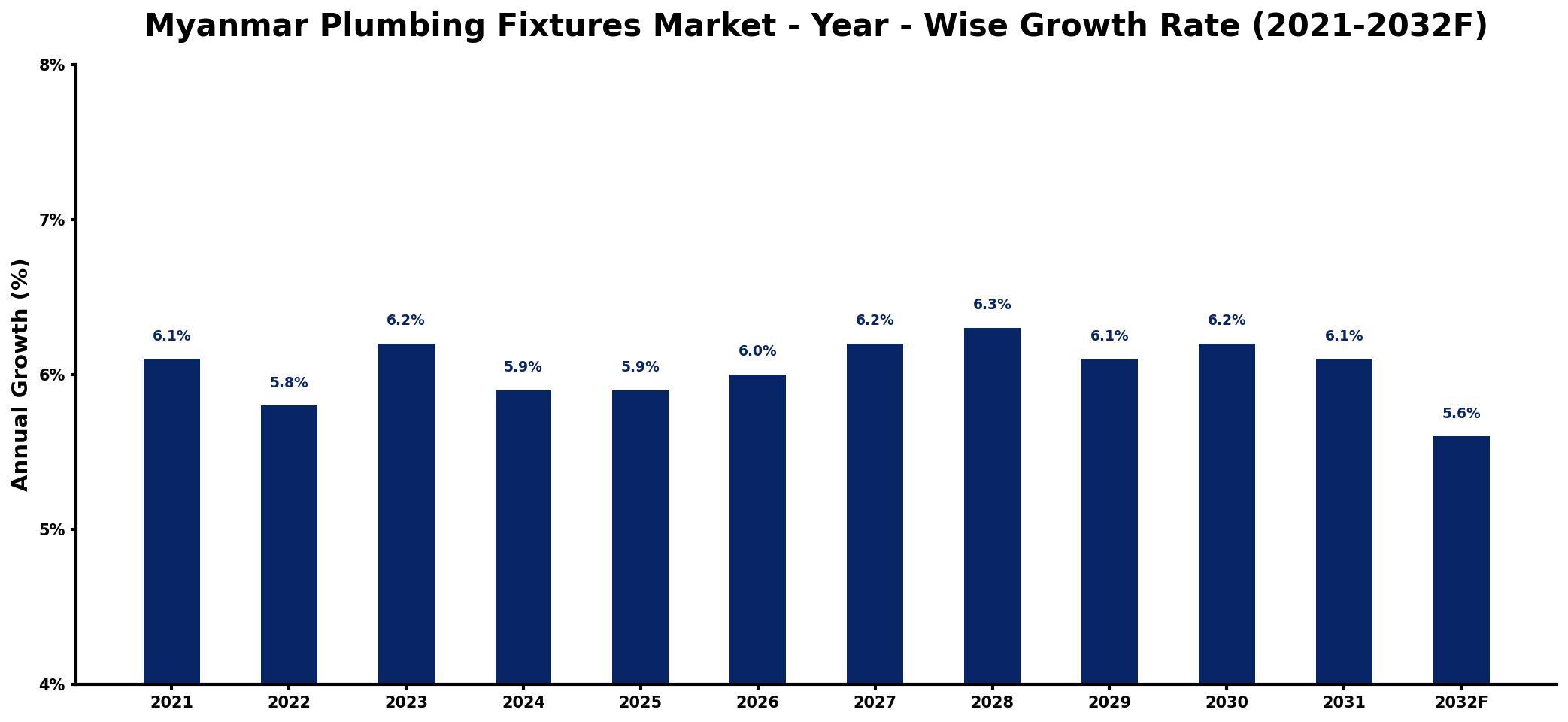
The table below presents the year‑wise growth rates along with the key drivers influencing the market
| Year | Growth Rate | Major Drivers |
| 2021 | 6.1% | Rising construction activity nationwide |
| 2022 | 5.8% | Increased urbanization and migration |
| 2023 | 6.2% | Government infrastructure development projects |
| 2024 | 5.9% | Growing demand for sustainable solutions |
| 2025 | 5.9% | Expansion of residential housing market |
| 2026 | 6.0% | Investment in renewable energy initiatives |
| 2027 | 6.2% | Surge in tourism industry growth |
| 2028 | 6.3% | Increased focus on sanitation improvements |
| 2029 | 6.1% | Rising disposable income levels |
| 2030 | 6.2% | Growth in commercial real estate |
| 2031 | 6.1% | Emergence of smart home technology |
| 2032 | 5.6% | Shift towards eco-friendly materials |
Note: Market size estimations and growth projections presented in this report are based on 6Wresearch's proprietary forecasting methodology, utilizing the latest available industry data, government publications, and primary research inputs.
Myanmar Plumbing Fixtures Market Synopsis
The most significant force shaping the Myanmar Plumbing Fixtures Market today is the government's commitment to enhancing infrastructure. As part of ongoing development initiatives, there is a notable emphasis on improving housing and sanitation facilities, which directly correlates with increased consumption of plumbing products. This attention to urban development is leading to a marked rise in demand for modern and efficient plumbing solutions, reflecting a shift towards enhanced living standards.
Furthermore, the growing consumer awareness regarding water efficiency and modern plumbing technologies is contributing to market growth. With rising concerns about hygiene and sustainability, there's a burgeoning interest in innovative plumbing solutions that not only meet regulatory standards but also align with environmental sustainability goals.
Myanmar Plumbing Fixtures Market Key Takeaways
- Rapid urbanization and infrastructure development are primary growth drivers.
- Government initiatives support local manufacturing and promote quality standards.
- Consumer demand is increasingly leaning towards water-efficient and sustainable solutions.
- Challenges include limited access to high-quality materials and technical expertise.
- The market is poised for continued expansion with significant investment opportunities.
Evaluation of Restraints in Myanmar Plumbing Fixtures Market
The Myanmar Plumbing Fixtures Market faces notable challenges that hinder its potential. A critical restraint is the limited access to quality materials, which impacts production standards and costs. Manufacturers often struggle with acquiring the necessary technology and expertise to produce durable and compliant fixtures, which can hinder competitiveness. Additionally, the influx of imported products presents a challenge for local manufacturers, forcing them to compete on pricing and quality, further complicating the landscape.
Moreover, fluctuating demand in the construction sector can create volatility in the market, making it difficult for manufacturers to maintain steady production levels. Ensuring compliance with safety and plumbing standards is paramount, as it is critical for building consumer trust. Overall, addressing these constraints is essential for sustained growth and market stability.
Myanmar Plumbing Fixtures Market Trends
Several key trends are emerging in the Myanmar Plumbing Fixtures Market, reflecting shifts in consumer preferences and technological advancements. There is a growing trend towards the adoption of smart plumbing solutions, incorporating IoT technology to enhance user experience and energy efficiency. Consumers are increasingly gravitating towards products that offer durability and efficiency while minimizing water consumption.
Additionally, sustainability has become a significant focus, with eco-friendly materials and design becoming prevalent in new product offerings. Manufacturers are investing in research and development to innovate in sustainable plumbing solutions, driven by both consumer demand and regulatory pressures.
Myanmar Plumbing Fixtures Market Opportunities
The Myanmar Plumbing Fixtures Market presents numerous growth and investment opportunities for stakeholders. One of the most promising areas lies in the development of water-efficient products, as rising water scarcity concerns drive demand for fixtures that conserve resources. Additionally, expanding into rural areas with tailored solutions for local needs can open new markets for manufacturers.
Moreover, collaboration with government initiatives focused on improving sanitation and infrastructure can lead to fruitful partnerships. Investment in local manufacturing capabilities to reduce reliance on imports may also enhance competitiveness while ensuring quality standards are met.
Government Initiatives in the Myanmar Plumbing Fixtures Market
The government of Myanmar is actively promoting the plumbing fixtures market as part of broader efforts to enhance sanitation and water management infrastructure. Policies are in place to ensure compliance with quality standards, supporting local manufacturers while also encouraging research and development in fixture efficiency and sustainability. Public spending initiatives aimed at improving urban infrastructure further bolster the market, creating a conducive environment for growth and investment.
Future Insights of the Myanmar Plumbing Fixtures Market
Looking ahead to 2026-2032, the Myanmar Plumbing Fixtures Market is expected to experience continued growth fueled by ongoing urbanization and government initiatives. As infrastructure development progresses, demand for innovative and efficient plumbing solutions will intensify. The market is likely to see further advancements in product technology, especially in smart plumbing solutions that cater to modern consumer needs. This evolution will not only enhance functionality but also align with sustainability goals, making the market a dynamic space for investment.
Myanmar Plumbing Fixtures Market Latest Developments (2025 - 2026)
Recent developments in the Myanmar Plumbing Fixtures Market indicate a growing emphasis on quality and sustainability. Companies are increasingly adopting advanced manufacturing technologies to enhance product durability and comply with international standards. There has been a notable increase in collaborations between local manufacturers and foreign suppliers to improve material access and share technical expertise. Additionally, consumer awareness campaigns focused on water conservation and hygiene have gained traction, further promoting the adoption of modern plumbing solutions.
Myanmar Plumbing Fixtures Market - Key Attractiveness of the Report
- 10 Years of Market Numbers
- Historical Data Starting from 2022 to 2025
- Base Year: 2025
- Forecast Data until 2032
- Key Performance Indicators Impacting the Market
- Major Upcoming Developments and Projects
Key Highlights of the Report:
- Myanmar Plumbing Fixtures Market Outlook
- Market Size of Myanmar Plumbing Fixtures Market, 2025
- Forecast of Myanmar Plumbing Fixtures Market, 2032
- Historical Data and Forecast of Myanmar Plumbing Fixtures Revenues & Volume for the Period 2022-2032F
- Myanmar Plumbing Fixtures Market Trend Evolution
- Myanmar Plumbing Fixtures Market Drivers and Challenges
- Myanmar Plumbing Fixtures Price Trends
- Myanmar Plumbing Fixtures Porter's Five Forces
- Myanmar Plumbing Fixtures Industry Life Cycle
- Historical Data and Forecast of Myanmar Plumbing Fixtures Market Revenues & Volume By Product for the Period 2022-2032F
- Historical Data and Forecast of Myanmar Plumbing Fixtures Market Revenues & Volume By Bathtub for the Period 2022-2032F
- Historical Data and Forecast of Myanmar Plumbing Fixtures Market Revenues & Volume By Sinks for the Period 2022-2032F
- Historical Data and Forecast of Myanmar Plumbing Fixtures Market Revenues & Volume By Toilets for the Period 2022-2032F
- Historical Data and Forecast of Myanmar Plumbing Fixtures Market Revenues & Volume By Showers for the Period 2022-2032F
- Historical Data and Forecast of Myanmar Plumbing Fixtures Market Revenues & Volume By Faucets & Taps for the Period 2022-2032F
- Historical Data and Forecast of Myanmar Plumbing Fixtures Market Revenues & Volume By Drains for the Period 2022-2032F
- Historical Data and Forecast of Myanmar Plumbing Fixtures Market Revenues & Volume By Others for the Period 2022-2032F
- Historical Data and Forecast of Myanmar Plumbing Fixtures Market Revenues & Volume By Deployment for the Period 2022-2032F
- Historical Data and Forecast of Myanmar Plumbing Fixtures Market Revenues & Volume By Residential for the Period 2022-2032F
- Historical Data and Forecast of Myanmar Plumbing Fixtures Market Revenues & Volume By Commercial for the Period 2022-2032F
- Historical Data and Forecast of Myanmar Plumbing Fixtures Market Revenues & Volume By Location for the Period 2022-2032F
- Historical Data and Forecast of Myanmar Plumbing Fixtures Market Revenues & Volume By Bathroom for the Period 2022-2032F
- Historical Data and Forecast of Myanmar Plumbing Fixtures Market Revenues & Volume By Kitchen for the Period 2022-2032F
- Historical Data and Forecast of Myanmar Plumbing Fixtures Market Revenues & Volume By Others for the Period 2022-2032F
- Historical Data and Forecast of Myanmar Plumbing Fixtures Market Revenues & Volume By Application for the Period 2022-2032F
- Historical Data and Forecast of Myanmar Plumbing Fixtures Market Revenues & Volume By New Construction for the Period 2022-2032F
- Historical Data and Forecast of Myanmar Plumbing Fixtures Market Revenues & Volume By Repair & Remodel for the Period 2022-2032F
- Historical Data and Forecast of Myanmar Plumbing Fixtures Market Revenues & Volume By Distribution Channel for the Period 2022-2032F
- Historical Data and Forecast of Myanmar Plumbing Fixtures Market Revenues & Volume By Online for the Period 2022-2032F
- Historical Data and Forecast of Myanmar Plumbing Fixtures Market Revenues & Volume By Offline for the Period 2022-2032F
- Myanmar Plumbing Fixtures Import Export Trade Statistics
- Market Opportunity Assessment By Product
- Market Opportunity Assessment By Deployment
- Market Opportunity Assessment By Location
- Market Opportunity Assessment By Application
- Market Opportunity Assessment By Distribution Channel
- Myanmar Plumbing Fixtures Top Companies Market Share
- Myanmar Plumbing Fixtures Competitive Benchmarking By Technical and Operational Parameters
- Myanmar Plumbing Fixtures Company Profiles
- Myanmar Plumbing Fixtures Key Strategic Recommendations






































