Myanmar Point Of Sale Terminals Market Size, Share & Growth Rate
The Myanmar Point Of Sale Terminals Market was estimated at USD 253 Million in 2025 and is projected to reach USD 347 Million by 2032, growing at a CAGR of 4.6% from 2026 to 2032. This growth trajectory is underpinned by the accelerated adoption of digital payment systems among retail and hospitality businesses, reflecting a broader shift towards a cashless economy. Moreover, government initiatives that foster mobile banking and improve payment infrastructure are further igniting demand for modern POS solutions.
Myanmar Point Of Sale Terminals Market Year-wise Growth Rate and Key Drivers
This graph highlights how the Myanmar Point Of Sale Terminals Market has steadily grown over the years, supported by major growth factors.
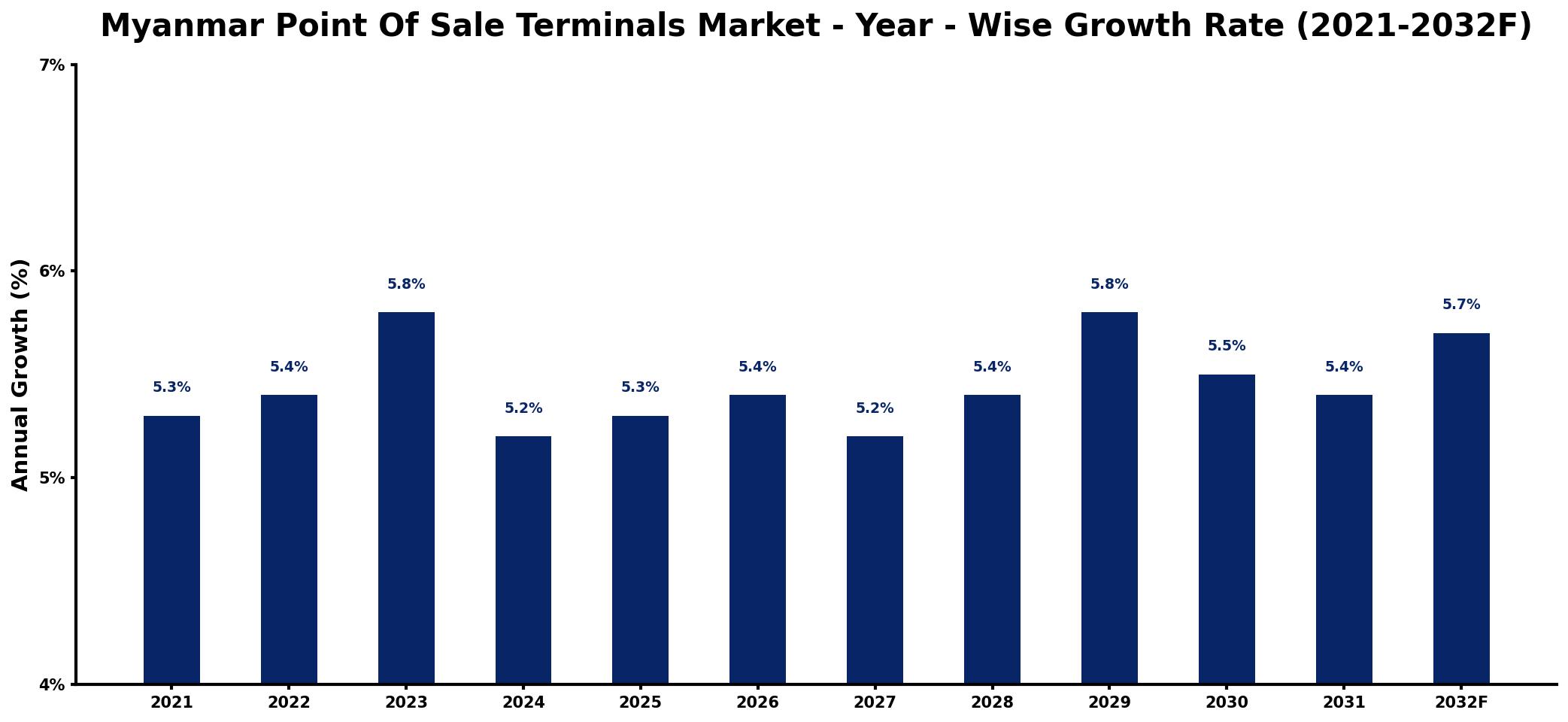
The table below presents the year‑wise growth rates along with the key drivers influencing the market
| Year | Growth Rate | Major Drivers |
| 2021 | 5.3% | Rising consumer electronic transactions |
| 2022 | 5.4% | Increased retail sector adoption |
| 2023 | 5.8% | Expansion of digital payment platforms |
| 2024 | 5.2% | Growth in e-commerce transactions |
| 2025 | 5.3% | Investment in fintech innovations |
| 2026 | 5.4% | Surge in mobile payment usage |
| 2027 | 5.2% | Adoption by small businesses |
| 2028 | 5.4% | Increase in cross-border trade |
| 2029 | 5.8% | increased capital investment inflows |
| 2030 | 5.5% | Rising urbanization and convenience |
| 2031 | 5.4% | expanding manufacturing base activity |
| 2032 | 5.7% | Increased focus on cybersecurity measures |
Note: Market size estimations and growth projections presented in this report are based on 6Wresearch's proprietary forecasting methodology, utilizing the latest available industry data, government publications, and primary research inputs.
Myanmar Point Of Sale Terminals Market Synopsis
The most significant force shaping the Myanmar Point Of Sale Terminals Market today is the explosive growth in the retail sector. As businesses increasingly prioritize digitalization and seek innovative ways to enhance transaction efficiency, the demand for advanced POS solutions has surged, leading to a robust market outlook.
This transition is characterized not only by a burgeoning e-commerce landscape but also by a growing acceptance of cashless transactions among consumers. As more businesses recognize the advantages of POS systems—such as secure payments and streamlined inventory management—market growth is poised to gain momentum.
Myanmar Point Of Sale Terminals Market Key Takeaways
- The market is driven by increasing retail sector growth and a nationwide shift towards digital payments.
- Government policies are creating a favorable environment for POS terminal adoption and integration.
- Ongoing advancements in payment technology are enhancing the functionality of POS systems.
- Consumer preferences are increasingly favoring cashless transactions, which bolster market demand.
- Educational initiatives for merchants about the benefits of POS systems are crucial for deeper market penetration.
Evaluation of Restraints in Myanmar Point Of Sale Terminals Market
Despite the positive outlook, several restraints are impacting the growth of the Myanmar Point Of Sale Terminals Market. Limited awareness among business owners regarding the benefits of POS systems can hinder their adoption, along with a lack of technical expertise to manage these systems effectively. Moreover, the investments required for technology and infrastructure development are substantial, especially for small and medium-sized enterprises. Ensuring compatibility with diverse existing payment systems and addressing security and data privacy concerns are critical hurdles that need to be navigated to fully realize market potential.
Myanmar Point Of Sale Terminals Market Trends
Current trends are increasingly leaning towards the incorporation of mobile payment solutions within POS systems. As smartphones become ubiquitous, businesses are adopting mobile-compatible terminals to cater to tech-savvy consumers. Furthermore, the integration of advanced analytics capabilities into POS systems is enabling businesses to derive actionable insights from customer transaction data, thereby enhancing customer engagement strategies. The move towards omnichannel solutions—allowing seamless transactions across online and offline channels—is also reshaping the landscape, presenting additional demand for advanced POS technologies.
Myanmar Point Of Sale Terminals Market Opportunities
There are genuine growth opportunities within the Myanmar Point Of Sale Terminals Market, particularly as the government continues to promote financial inclusion through digitization. Investments in infrastructure and technology can open pathways for local vendors to enter the market with innovative solutions tailored to the needs of Myanmars diverse retail landscape. Additionally, expanding into underserved regions presents a substantial opportunity for companies willing to educate merchants on the operational benefits and efficiencies offered by modern POS systems.
Government Initiatives in the Myanmar Point Of Sale Terminals Market
The Myanmar government plays a proactive role in fostering the adoption of point-of-sale terminals as a means to enhance financial inclusion and improve transaction security. Initiatives include ensuring the interoperability of different payment systems, which is crucial for the seamless operation of POS terminals. There are also policies in place to support local providers, thereby encouraging innovation and catering to the unique demands of the market. These efforts collectively contribute to a more conducive environment for the growth of the POS terminal sector.
Future Insights of the Myanmar Point Of Sale Terminals Market
Looking ahead to the period from 2026 to 2032, the Myanmar Point Of Sale Terminals Market is set to experience significant transformation driven by technological advancements and evolving consumer preferences. The continued rise of mobile banking and e-commerce will likely enhance the integration of POS systems, promoting a more unified payment experience. Moreover, as merchants increasingly recognize the operational efficiencies and customer engagement possibilities provided by advanced POS terminals, the market is expected to expand considerably, positioning itself as a crucial component of Myanmars retail ecosystem.
Myanmar Point Of Sale Terminals Market Latest Developments (2025 - 2026)
Recent developments in the Myanmar Point Of Sale Terminals Market indicate a continued push towards the digitization of transactions. Companies are exploring innovative payment solutions that accommodate the rising demand for cashless transactions. There has been an emphasis on developing user-friendly interfaces and reliable support systems, which is essential for driving merchant adoption. Additionally, partnerships between local banks and technology providers are emerging to enhance the availability of POS systems in diverse retail settings.
Myanmar Point Of Sale Terminals Market - Key Attractiveness of the Report
- 10 Years of Market Numbers
- Historical Data Starting from 2022 to 2025
- Base Year: 2025
- Forecast Data until 2032
- Key Performance Indicators Impacting the Market
- Major Upcoming Developments and Projects
Key Highlights of the Report:
- Myanmar Point Of Sale Terminals Market Outlook
- Market Size of Myanmar Point Of Sale Terminals Market, 2025
- Forecast of Myanmar Point Of Sale Terminals Market, 2032
- Historical Data and Forecast of Myanmar Point Of Sale Terminals Revenues & Volume for the Period 2022-2032F
- Myanmar Point Of Sale Terminals Market Trend Evolution
- Myanmar Point Of Sale Terminals Market Drivers and Challenges
- Myanmar Point Of Sale Terminals Price Trends
- Myanmar Point Of Sale Terminals Porter's Five Forces
- Myanmar Point Of Sale Terminals Industry Life Cycle
- Historical Data and Forecast of Myanmar Point Of Sale Terminals Market Revenues & Volume By Product for the Period 2022-2032F
- Historical Data and Forecast of Myanmar Point Of Sale Terminals Market Revenues & Volume By Fixed for the Period 2022-2032F
- Historical Data and Forecast of Myanmar Point Of Sale Terminals Market Revenues & Volume By Mobile for the Period 2022-2032F
- Historical Data and Forecast of Myanmar Point Of Sale Terminals Market Revenues & Volume By Component for the Period 2022-2032F
- Historical Data and Forecast of Myanmar Point Of Sale Terminals Market Revenues & Volume By Hardware for the Period 2022-2032F
- Historical Data and Forecast of Myanmar Point Of Sale Terminals Market Revenues & Volume By Software for the Period 2022-2032F
- Historical Data and Forecast of Myanmar Point Of Sale Terminals Market Revenues & Volume By Services for the Period 2022-2032F
- Historical Data and Forecast of Myanmar Point Of Sale Terminals Market Revenues & Volume By Deployment for the Period 2022-2032F
- Historical Data and Forecast of Myanmar Point Of Sale Terminals Market Revenues & Volume By Cloud for the Period 2022-2032F
- Historical Data and Forecast of Myanmar Point Of Sale Terminals Market Revenues & Volume By On-premise for the Period 2022-2032F
- Historical Data and Forecast of Myanmar Point Of Sale Terminals Market Revenues & Volume By End Use for the Period 2022-2032F
- Historical Data and Forecast of Myanmar Point Of Sale Terminals Market Revenues & Volume By Restaurants for the Period 2022-2032F
- Historical Data and Forecast of Myanmar Point Of Sale Terminals Market Revenues & Volume By Retail for the Period 2022-2032F
- Historical Data and Forecast of Myanmar Point Of Sale Terminals Market Revenues & Volume By Hospitality for the Period 2022-2032F
- Historical Data and Forecast of Myanmar Point Of Sale Terminals Market Revenues & Volume By Healthcare for the Period 2022-2032F
- Historical Data and Forecast of Myanmar Point Of Sale Terminals Market Revenues & Volume By Warehouse for the Period 2022-2032F
- Historical Data and Forecast of Myanmar Point Of Sale Terminals Market Revenues & Volume By Entertainment for the Period 2022-2032F
- Historical Data and Forecast of Myanmar Point Of Sale Terminals Market Revenues & Volume By Others for the Period 2022-2032F
- Myanmar Point Of Sale Terminals Import Export Trade Statistics
- Market Opportunity Assessment By Product
- Market Opportunity Assessment By Component
- Market Opportunity Assessment By Deployment
- Market Opportunity Assessment By End Use
- Myanmar Point Of Sale Terminals Top Companies Market Share
- Myanmar Point Of Sale Terminals Competitive Benchmarking By Technical and Operational Parameters
- Myanmar Point Of Sale Terminals Company Profiles
- Myanmar Point Of Sale Terminals Key Strategic Recommendations






































