Myanmar Print Label Market Size Growth Rate
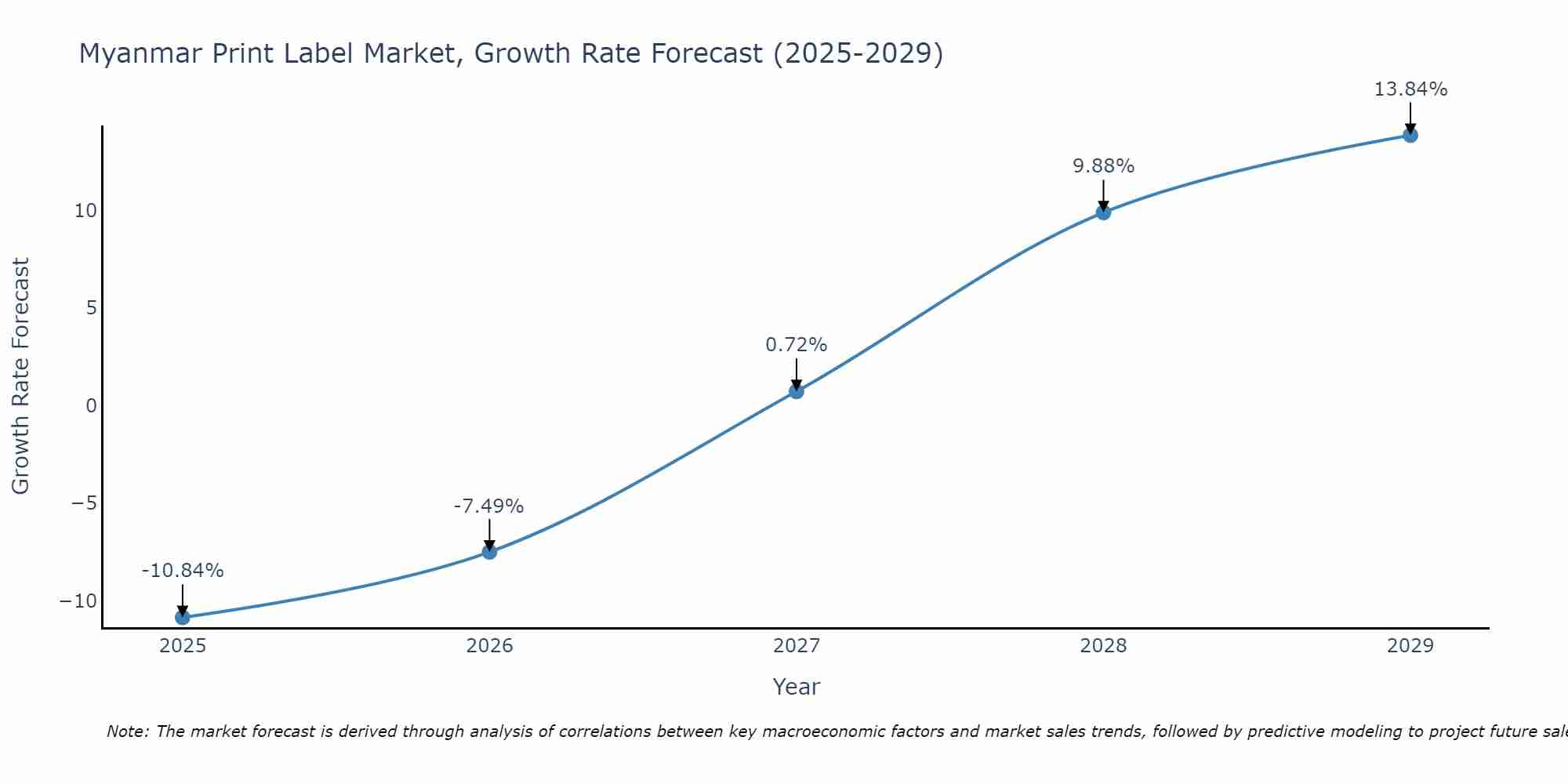
The Myanmar Print Label Market is likely to experience consistent growth rate gains over the period 2025 to 2029. Commencing at -10.84% in 2025, growth builds up to 13.84% by 2029.
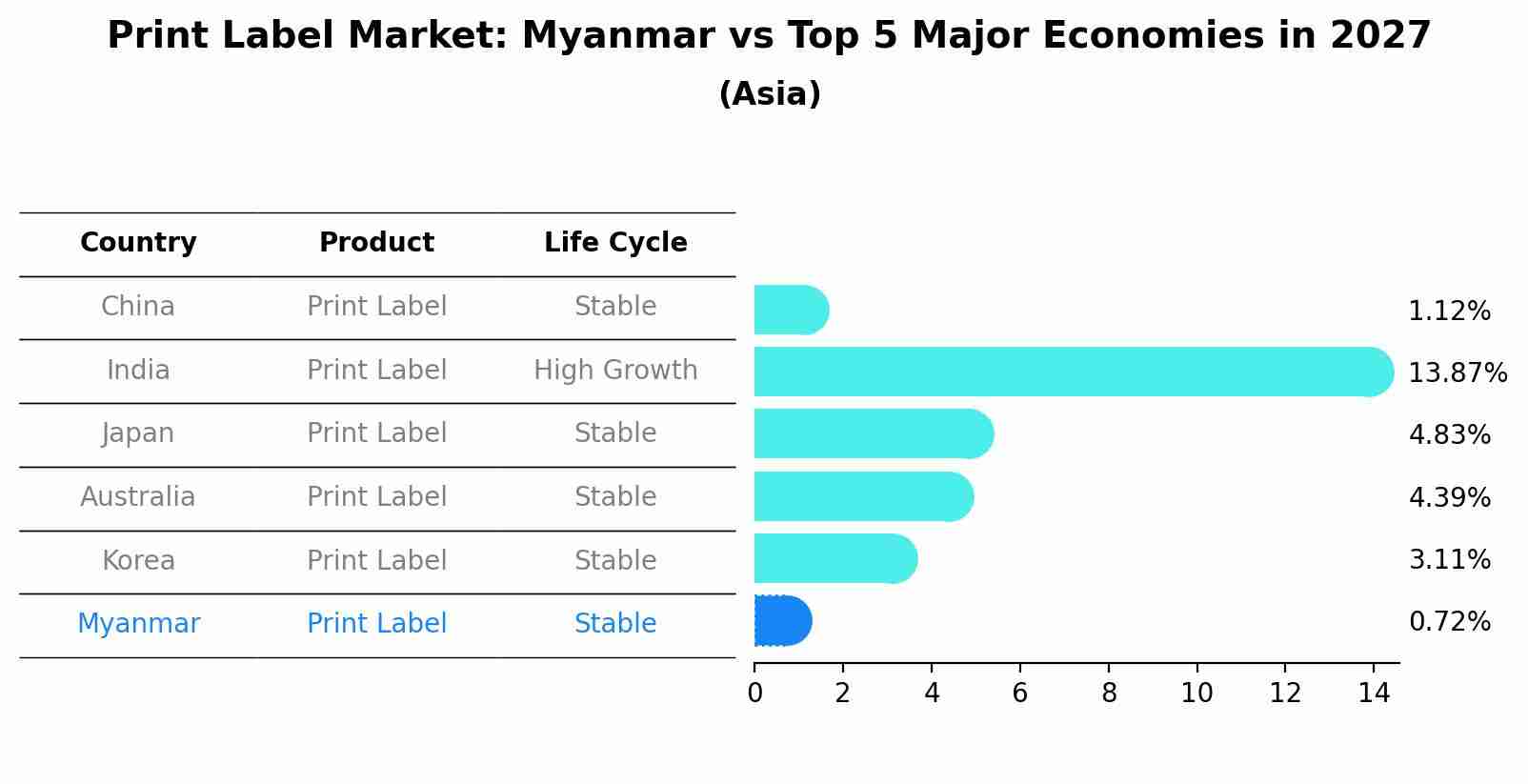
Print Label Market: Myanmar vs Top 5 Major Economies in 2027 (Asia)
Myanmar's Print Label market is anticipated to experience a stable growth rate of 0.72% by 2027, reflecting trends observed in the largest economy China, followed by India, Japan, Australia and South Korea.
Myanmar Print Label Market Overview
The Myanmar print label market is experiencing steady growth driven by expanding manufacturing and retail sectors. The demand for print labels is increasing across industries such as food and beverage, pharmaceuticals, and textiles. Key factors contributing to market growth include rising consumer awareness of product information and the need for anti-counterfeiting measures. Domestic label printers dominate the market, offering a range of solutions from basic labels to advanced security features. However, the market faces challenges such as limited technological capabilities and inconsistent quality standards. As the Myanmar economy continues to develop, the print label market is expected to witness further expansion, with opportunities for innovation and investment in efficient printing technologies.
Myanmar Print Label Market Trends
The Myanmar Print Label Market is experiencing a shift towards more sustainable and environmentally-friendly practices, with a growing demand for eco-friendly materials and printing techniques. Companies are increasingly focusing on providing labels that are not only visually appealing but also have a lower environmental impact. Digital printing technology is gaining popularity in the market due to its flexibility, cost-effectiveness, and ability to produce high-quality labels. Additionally, there is a rising preference for labels that incorporate security features to combat counterfeiting and ensure product authenticity. Overall, the Myanmar Print Label Market is moving towards innovation, sustainability, and enhanced product security to meet the evolving needs of consumers and businesses in the region.
Myanmar Print Label Market Challenges
In the Myanmar print label market, challenges primarily stem from the country`s political and economic instability, which can lead to uncertainty for businesses operating in the region. Limited access to modern printing technology and materials, as well as skilled labor, can hinder the industry`s growth and competitiveness. Additionally, the lack of intellectual property rights enforcement poses a risk of counterfeit products entering the market, impacting the reputation and trustworthiness of legitimate print label manufacturers. Infrastructure issues, such as unreliable power supply and transportation networks, can also disrupt production and distribution processes. Overall, navigating these challenges requires strategic planning, investment in technology and talent development, as well as strong partnerships to ensure the sustainability and success of businesses in the Myanmar print label market.
Myanmar Print Label Market Investment Opportunities
The Myanmar Print Label Market presents promising investment opportunities due to the country`s growing consumer goods and retail sectors. With increasing urbanization and rising disposable incomes, there is a growing demand for packaged goods, leading to a higher need for print labels. Investing in printing technologies and equipment for labels, as well as offering innovative labeling solutions such as eco-friendly materials or digital printing services, could be lucrative in this market. Additionally, partnering with local manufacturers or retailers to provide customized labeling solutions tailored to their specific needs can also be a strategic investment approach in Myanmar`s evolving print label industry.
Myanmar Print Label Market Government Policy
The Myanmar government has implemented various policies related to the Print Label Market to ensure consumer safety and fair trade practices. These policies include regulations on labeling requirements, such as mandatory information like product name, ingredients, country of origin, and expiration date to protect consumers from misleading or harmful products. Additionally, the government enforces quality standards for print labels to maintain consistency and accuracy in labeling across different products. Furthermore, there are guidelines in place to promote fair competition among label manufacturers and prevent monopolies in the market. Overall, these government policies aim to create a transparent and competitive environment in the Myanmar Print Label Market, benefiting both consumers and businesses.
Myanmar Print Label Market Future Outlook
The future outlook for the Myanmar Print Label Market is positive, driven by factors such as the increasing demand for packaged goods, growth in the retail sector, and expanding manufacturing industries. With the country`s economy showing signs of recovery and stability, there is a growing need for quality labeling solutions to meet the requirements of various industries. Additionally, the trend towards advanced printing technologies, eco-friendly materials, and customization options is expected to further drive the market growth. As Myanmar continues to attract foreign investment and improve its infrastructure, the print label market is likely to witness steady growth and opportunities for innovation and expansion in the coming years.
Key Highlights of the Report:
- Myanmar Print Label Market Outlook
- Market Size of Myanmar Print Label Market, 2021
- Forecast of Myanmar Print Label Market, 2031
- Historical Data and Forecast of Myanmar Print Label Revenues & Volume for the Period 2018 - 2031
- Myanmar Print Label Market Trend Evolution
- Myanmar Print Label Market Drivers and Challenges
- Myanmar Print Label Price Trends
- Myanmar Print Label Porter's Five Forces
- Myanmar Print Label Industry Life Cycle
- Historical Data and Forecast of Myanmar Print Label Market Revenues & Volume By Print Process for the Period 2018 - 2031
- Historical Data and Forecast of Myanmar Print Label Market Revenues & Volume By Offset lithography for the Period 2018 - 2031
- Historical Data and Forecast of Myanmar Print Label Market Revenues & Volume By Gravure for the Period 2018 - 2031
- Historical Data and Forecast of Myanmar Print Label Market Revenues & Volume By Flexography for the Period 2018 - 2031
- Historical Data and Forecast of Myanmar Print Label Market Revenues & Volume By Screen for the Period 2018 - 2031
- Historical Data and Forecast of Myanmar Print Label Market Revenues & Volume By Letterpress for the Period 2018 - 2031
- Historical Data and Forecast of Myanmar Print Label Market Revenues & Volume By Electrophotography for the Period 2018 - 2031
- Historical Data and Forecast of Myanmar Print Label Market Revenues & Volume By Inkjet for the Period 2018 - 2031
- Historical Data and Forecast of Myanmar Print Label Market Revenues & Volume By Label Format for the Period 2018 - 2031
- Historical Data and Forecast of Myanmar Print Label Market Revenues & Volume By Wet-glue labels for the Period 2018 - 2031
- Historical Data and Forecast of Myanmar Print Label Market Revenues & Volume By Pressure-sensitive labels for the Period 2018 - 2031
- Historical Data and Forecast of Myanmar Print Label Market Revenues & Volume By Linerless labels for the Period 2018 - 2031
- Historical Data and Forecast of Myanmar Print Label Market Revenues & Volume By Multi-part tracking labels for the Period 2018 - 2031
- Historical Data and Forecast of Myanmar Print Label Market Revenues & Volume By In-mold labels for the Period 2018 - 2031
- Historical Data and Forecast of Myanmar Print Label Market Revenues & Volume By Sleeves for the Period 2018 - 2031
- Historical Data and Forecast of Myanmar Print Label Market Revenues & Volume By End-User for the Period 2018 - 2031
- Historical Data and Forecast of Myanmar Print Label Market Revenues & Volume By Food for the Period 2018 - 2031
- Historical Data and Forecast of Myanmar Print Label Market Revenues & Volume By Beverage for the Period 2018 - 2031
- Historical Data and Forecast of Myanmar Print Label Market Revenues & Volume By Healthcare for the Period 2018 - 2031
- Historical Data and Forecast of Myanmar Print Label Market Revenues & Volume By Cosmetics for the Period 2018 - 2031
- Historical Data and Forecast of Myanmar Print Label Market Revenues & Volume By Household for the Period 2018 - 2031
- Historical Data and Forecast of Myanmar Print Label Market Revenues & Volume By Industrial for the Period 2018 - 2031
- Historical Data and Forecast of Myanmar Print Label Market Revenues & Volume By Logistics for the Period 2018 - 2031
- Historical Data and Forecast of Myanmar Print Label Market Revenues & Volume By Other for the Period 2018 - 2031
- Myanmar Print Label Import Export Trade Statistics
- Market Opportunity Assessment By Print Process
- Market Opportunity Assessment By Label Format
- Market Opportunity Assessment By End-User
- Myanmar Print Label Top Companies Market Share
- Myanmar Print Label Competitive Benchmarking By Technical and Operational Parameters
- Myanmar Print Label Company Profiles
- Myanmar Print Label Key Strategic Recommendations






































