Myanmar Sail Canvas Market Size, Share & Growth Rate
The Myanmar Sail Canvas Market was estimated at USD 1132 Million in 2025 and is projected to reach USD 2140 Million by 2032, growing at a CAGR of 9.5% from 2026 to 2032. This growth trajectory is significantly driven by the rising popularity of recreational boating and maritime tourism, both of which are fostering an increased demand for high-performance sailcloth materials. Additionally, the expanding commercial maritime activities within Myanmar are further amplifying the need for durable, weather-resistant sail fabrics, establishing a solid foundation for future market expansion.
Myanmar Sail Canvas Market Year-wise Growth Rate and Key Drivers
This graph highlights how the Myanmar Sail Canvas Market has steadily grown over the years, supported by major growth factors.
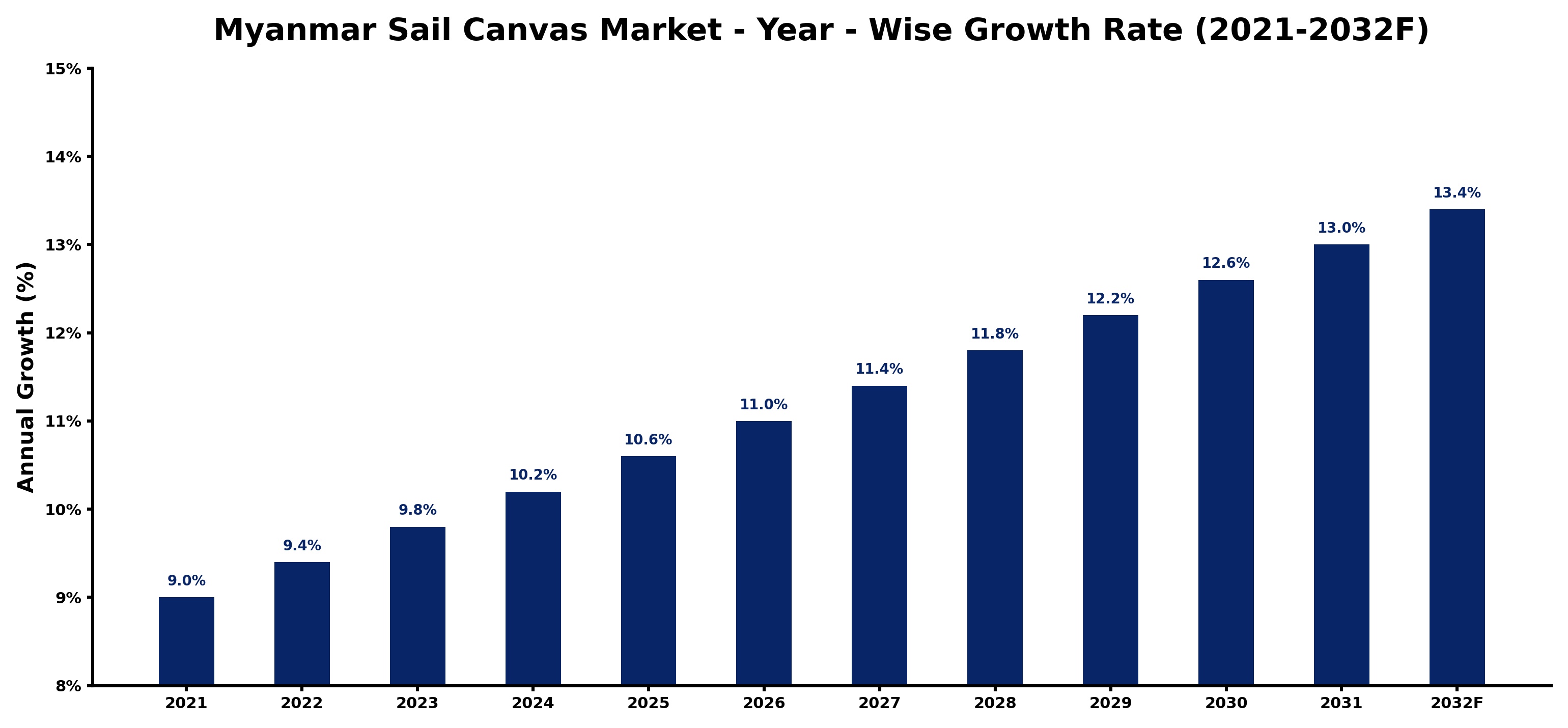
The table below presents the year‑wise growth rates along with the key drivers influencing the market
| Year | Growth Rate | Major Drivers |
| 2021 | 9.0% | Manufacturing investments boost local sail canvas production capacity |
| 2022 | 9.4% | Local manufacturers adopt advanced textiles, boosting sail canvas production efficiency |
| 2023 | 9.8% | New shipbuilding projects boost demand for specialized sail canvas |
| 2024 | 10.2% | Export driven demand for high tech sails boosts local manufacturing investments |
| 2025 | 10.6% | Export contracts for marine applications boosted sail canvas production capacity |
| 2026 | 11.0% | New investments in shipbuilding enhance canvas production capacity utilization |
| 2027 | 11.4% | Export demand for high performance sail canvases drives local manufacturing investments |
| 2028 | 11.8% | Export driven manufacturing investments boost local sail canvas production capabilities |
| 2029 | 12.2% | New manufacturing facilities boost local sail canvas production capacity |
| 2030 | 12.6% | Technological upgrades in sail production enhanced manufacturing efficiencies |
| 2031 | 13.0% | Local shipbuilding projects boosted demand for durable sail materials |
| 2032 | 13.4% | Rehabilitation projects boost demand for high performance sail materials |
Note - Market size estimations and growth projections presented in this report are based on 6Wresearch's advanced forecasting approach, validated with industry datasets as of June 2026.
Myanmar Sail Canvas Market Synopsis
The Myanmar sail canvas market is currently experiencing a surge in interest, largely influenced by the country's burgeoning maritime tourism sector. This trend is catalyzing investment in quality sailcloth production, as manufacturers strive to meet the evolving preferences of both recreational and commercial sailors.
Moreover, the interplay between traditional craftsmanship and modern textile technology is redefining market standards. As local manufacturers collaborate with boat builders, there is a growing emphasis on enhancing the durability and performance of sail canvases, reflecting a commitment to quality that aligns with global expectations.
Myanmar Sail Canvas Market Key Takeaways
- The market is experiencing rapid growth, driven by the rise in recreational boating and maritime tourism.
- Demand for high-quality, durable sail canvases is outpacing traditional offerings, particularly as weather resistance becomes a critical factor.
- Collaborations between textile manufacturers and boat builders are improving the overall quality of sail canvases.
- Government policies are fostering industry growth through grants and incentives, encouraging innovation in textile production.
- Challenges from synthetic alternatives and a decline in traditional sailing vessels are shaping competitive dynamics in the market.
Evaluation of Restraints in Myanmar Sail Canvas Market
Despite the promising growth indicators, the Myanmar sail canvas market is currently constrained by several significant factors. A notable challenge is the declining demand for traditional sailing vessels, which limits the overall market size. Additionally, competition from synthetic materials poses a risk, as these alternatives often provide lower cost and increased durability, appealing to budget-conscious consumers. Furthermore, limited investment in sailing infrastructure within Myanmar has hampered the development of a more robust maritime economy, ultimately affecting demand for traditional sail canvases.
Myanmar Sail Canvas Market Trends
Current trends in the Myanmar sail canvas market indicate a shift towards sustainable and environmentally friendly materials. As awareness of ecological impacts grows, manufacturers are exploring innovative fabric options that minimize environmental footprints while maintaining durability. Moreover, technological advancements in textile production are leading to the creation of new fabric blends that enhance sail performance, further influencing consumer preferences.
Additionally, there is a burgeoning interest in customized sail solutions, with consumers seeking tailor-made options to enhance their sailing experience. This trend highlights the importance of collaboration between textile engineers and end-users to develop unique sail designs that meet specific needs.
Myanmar Sail Canvas Market Opportunities
The Myanmar sail canvas market presents numerous growth and investment opportunities, particularly in the realm of innovation and sustainability. Companies focusing on R&D to develop advanced, weather-resistant materials can capture a significant share of the market, especially as recreational boating continues to grow. Additionally, partnerships with international manufacturers can facilitate knowledge transfer, allowing local producers to enhance their capabilities and compete on a global scale.
Moreover, as the government continues to support maritime tourism, there will be increased funding for sailing infrastructure projects, offering manufacturers a chance to expand their market presence through strategic collaborations in new projects.
Government Initiatives in the Myanmar Sail Canvas Market
The Myanmar government is actively promoting the sail canvas market through a range of supportive policies aimed at bolstering the textile and marine industries. Initiatives include grants for research and development focused on durable and weather-resistant fabrics, as well as tax incentives for companies that commit to local production. Furthermore, collaborations between textile manufacturers and boat builders are encouraged to foster innovation and enhance product quality. These efforts are complemented by initiatives aimed at facilitating international trade and attracting foreign investment in the market.
Future Insights of the Myanmar Sail Canvas Market
Looking ahead to 2026-2032, the Myanmar sail canvas market is poised for significant transformation. As consumer preferences evolve towards sustainability and customization, manufacturers who can adapt to these trends will likely find themselves at the forefront of the industry. The anticipated expansion of the maritime tourism sector, coupled with ongoing government support, indicates a robust growth trajectory. As collaborations between sectors deepen, the market is set to benefit from enhanced quality standards, driving further demand for high-performance sail canvases.
Myanmar Sail Canvas Market Latest Developments (May 2025 - June 2026)
Recent developments in the Myanmar sail canvas market highlight a growing emphasis on technological integration within manufacturing processes. Initiatives aimed at enhancing local production capabilities are emerging, with manufacturers investing in more advanced equipment to improve efficiency and product quality. Furthermore, collaborations between local companies and international experts are becoming increasingly common, facilitating the exchange of knowledge and technology that will drive innovation in sail fabric design.
Myanmar Sail Canvas Market - Key Attractiveness of the Report
- 10 Years of Market Numbers
- Historical Data Starting from 2022 to 2025
- Base Year: 2025
- Forecast Data until 2032
- Key Performance Indicators Impacting the Market
- Major Upcoming Developments and Projects
Key Highlights of the Report:
- Myanmar Sail Canvas Market Outlook
- Market Size of Myanmar Sail Canvas Market, 2025
- Forecast of Myanmar Sail Canvas Market, 2032
- Historical Data and Forecast of Myanmar Sail Canvas Revenues & Volume for the Period 2022-2032F
- Myanmar Sail Canvas Market Trend Evolution
- Myanmar Sail Canvas Market Drivers and Challenges
- Myanmar Sail Canvas Price Trends
- Myanmar Sail Canvas Porter's Five Forces
- Myanmar Sail Canvas Industry Life Cycle
- Historical Data and Forecast of Myanmar Sail Canvas Market Revenues & Volume By Type for the Period 2022-2032F
- Historical Data and Forecast of Myanmar Sail Canvas Market Revenues & Volume By 8 Ann Canvas for the Period 2022-2032F
- Historical Data and Forecast of Myanmar Sail Canvas Market Revenues & Volume By 12 Ann Canvas for the Period 2022-2032F
- Historical Data and Forecast of Myanmar Sail Canvas Market Revenues & Volume By Polyester Canvas for the Period 2022-2032F
- Historical Data and Forecast of Myanmar Sail Canvas Market Revenues & Volume By Others for the Period 2022-2032F
- Historical Data and Forecast of Myanmar Sail Canvas Market Revenues & Volume By Application for the Period 2022-2032F
- Historical Data and Forecast of Myanmar Sail Canvas Market Revenues & Volume By Sailing for the Period 2022-2032F
- Historical Data and Forecast of Myanmar Sail Canvas Market Revenues & Volume By Yacht for the Period 2022-2032F
- Historical Data and Forecast of Myanmar Sail Canvas Market Revenues & Volume By Others for the Period 2022-2032F
- Myanmar Sail Canvas Import Export Trade Statistics
- Market Opportunity Assessment By Type
- Market Opportunity Assessment By Application
- Myanmar Sail Canvas Top Companies Market Share
- Myanmar Sail Canvas Competitive Benchmarking By Technical and Operational Parameters
- Myanmar Sail Canvas Company Profiles
- Myanmar Sail Canvas Key Strategic Recommendations






































