Myanmar Sanitary Paper Market Summary
The myanmar sanitary paper market was estimated at USD 298 Million in 2025 and is projected to reach USD 417 Million by 2032, growing at a CAGR of 5.8% from 2026 to 2032.
Myanmar Sanitary Paper Market Year-wise Growth Rate and Key Drivers
This graph highlights how the Myanmar Sanitary Paper Market has steadily grown over the past five years, supported by major growth factors.
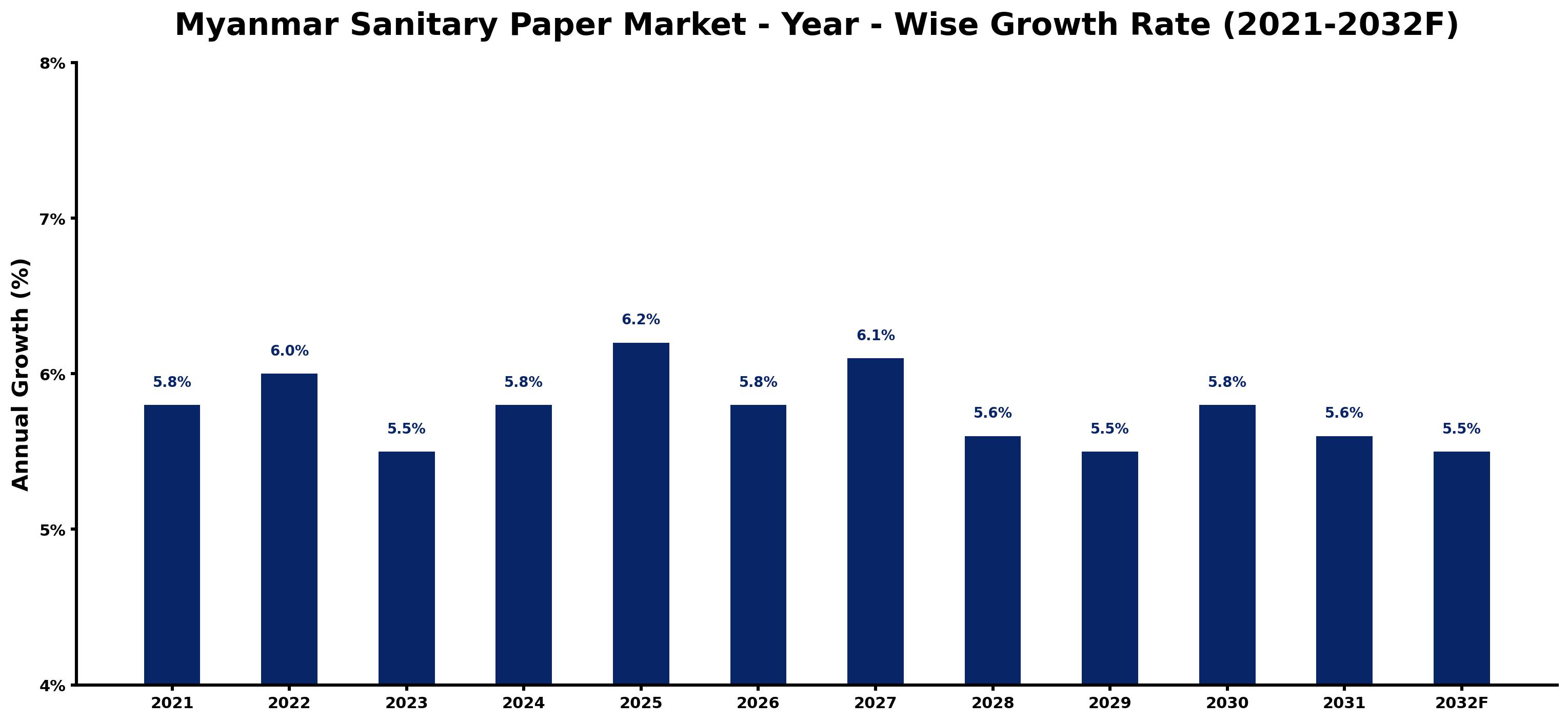
The table below presents the year wise growth rates along with the key drivers influencing the market
| Year | Growth Rate | Major Drivers |
| 2021 | 5.8% | Consumer awareness around hygiene prompted increased interest in sanitary paper products. |
| 2022 | 6.0% | Urbanization trends led to higher disposable incomes and increased purchasing power. |
| 2023 | 5.5% | Local manufacturers began expanding their product lines to meet growing consumer needs. |
| 2024 | 5.8% | E-commerce platforms gained traction, enhancing the accessibility of sanitary paper goods. |
| 2025 | 6.2% | Health crises underscored the importance of personal hygiene and sanitary products. |
| 2026 | 5.8% | Foreign investments in the region bolstered production capacities and modern technologies. |
| 2027 | 6.1% | Sustainable product demand pushed brands towards eco-friendly paper solutions. |
| 2028 | 5.6% | Cultural shifts towards modern living increased the acceptance of premium sanitary products. |
| 2029 | 5.5% | Rural electrification projects improved access to modern conveniences, including sanitary paper. |
| 2030 | 5.8% | Partnerships with local retailers expanded distribution channels for sanitary paper products. |
| 2031 | 5.6% | Innovations in product design catered to diverse consumer preferences and needs. |
| 2032 | 5.5% | The commitment to hygiene in public spaces solidified the sanitary paper market's growth. |
Note - Market size estimations and growth projections presented in this report are based on 6Wresearch's advanced forecasting approach, validated with industry datasets as of June 2026.
Myanmar Sanitary Paper Market Synopsis
The Myanmar Sanitary Paper Market is projected to reach 5.8% and witness significant growth during the forecast period (2026-2032). This growth is largely driven by a confluence of factors, including an increasing female literacy rate, a booming population, and rising disposable income levels among consumers. Additionally, heightened awareness regarding personal hygiene, particularly among women, has significantly fueled demand for sanitary napkins and toilet papers throughout the country in recent years.
Myanmar Sanitary Paper Market Growth Drivers
Several key drivers are propelling the Myanmar Sanitary Paper Market forward during the forecast period. Among these factors:
- The increasing female literacy rate has empowered women to prioritize personal hygiene, resulting in a greater demand for sanitary products.
- The growing population in Myanmar contributes to higher overall consumption rates of sanitary products, including sanitary napkins and toilet rolls.
- Rising disposable income levels enable consumers to spend more on quality hygiene products, facilitating market expansion.
- Awareness campaigns focused on personal hygiene have effectively shifted consumer preferences from traditional cloth pads to modern absorbent materials, such as disposable diapers and sanitary napkins.
- Innovations in product design and packaging have made sanitary products more convenient and appealing to consumers, further driving demand.
Myanmar Sanitary Paper Market Trends and Opportunities
The Myanmar Sanitary Paper Market is witnessing notable trends that are expected to create new opportunities for growth. These trends include:
- There is a marked shift towards sustainable and environmentally friendly sanitary products as consumers become more eco-conscious, presenting opportunities for manufacturers.
- Innovation in product offerings, such as biodegradable sanitary napkins and organic materials, is gaining traction as consumers seek healthier options.
- The introduction of lightweight packaging designs is expected to enhance shelf life and transport convenience, appealing to both retailers and consumers alike.
- The expansion of distribution channels, particularly in urban and previously underserved rural areas, is creating new market access points for various brands.
- Collaborative promotional strategies among manufacturers and retailers are increasingly effective in driving consumer awareness and market penetration.
Myanmar Sanitary Paper Market Challenges and Restraints
Despite significant growth prospects, the Myanmar Sanitary Paper Market faces several challenges that could impede progress:
- Limited access to basic sanitary products in rural regions can hinder overall market penetration and consumer awareness.
- Cultural norms and stigmas associated with menstruation can restrict open discussions and limit the acceptance of modern sanitary products in certain communities.
- Economic fluctuations can affect disposable income levels, impacting consumers’ ability to purchase preferred hygiene products.
- Competition from traditional methods of menstrual hygiene management still persists, presenting a challenge for market growth.
- Supply chain disruptions can be a concern, particularly in remote regions, affecting product availability and logistics for manufacturers.
Myanmar Sanitary Paper Market Government Investment and Initiatives
The government of Myanmar is actively involved in initiatives aimed at improving public health and personal hygiene standards, which directly influence the sanitary paper market. Key government investments and initiatives include:
- Public spending on health education campaigns is increasing, focusing on women's health and hygiene, which boosts awareness of sanitary products.
- Government policies promoting the hygiene sector encourage the establishment and growth of local manufacturing capabilities for sanitary products.
- Incentives for import and distribution of sanitary products are being explored to improve availability in underserved regions.
- Collaborations with non-governmental organizations (NGOs) aim to enhance education around menstrual health management, further opening market opportunities.
- Efforts to create favorable regulatory frameworks for eco-friendly product innovations help position Myanmar as a market responsive to environmental concerns.
Myanmar Sanitary Paper Market Latest Developments (May 2025 - June 2026)
The Myanmar Sanitary Paper Market has seen several significant developments between May 2025 and June 2026. Notable trends in this period include a surge in initiatives aimed at promoting the use of sustainable products following consumer advocacy for greener alternatives. Additionally, the industry has experienced an uptick in collaborative marketing efforts between manufacturers and local distributors, increasing product visibility and accessibility in both urban and rural markets. Furthermore, innovations in product formulation and design continue to emerge, with companies focusing on enhancing the user experience and biodegradability of their sanitary products.
Myanmar Sanitary Paper Market - Key Attractiveness of the Report
- 10 Years of Market Numbers
- Historical Data Starting from 2022 to 2025
- Base Year: 2025
- Forecast Data until 2032
- Key Performance Indicators Impacting the Market
- Major Upcoming Developments and Projects
Key Highlights of the Report:
- Myanmar Sanitary Paper Market Outlook
- Market Size of Myanmar Sanitary Paper Market, 2025
- Forecast of Myanmar Sanitary Paper Market, 2032F
- Historical Data and Forecast of Myanmar Sanitary Paper Revenues & Volume for the Period 2022-2032F
- Myanmar Sanitary Paper Market Trend Evolution
- Myanmar Sanitary Paper Market Drivers and Challenges
- Myanmar Sanitary Paper Price Trends
- Myanmar Sanitary Paper Porter's Five Forces
- Myanmar Sanitary Paper Industry Life Cycle
- Historical Data and Forecast of Myanmar Sanitary Paper Market Revenues & Volume By Product Types for the Period 2022-2032F
- Historical Data and Forecast of Myanmar Sanitary Paper Market Revenues & Volume By Tissues And Handkerchiefs for the Period 2022-2032F
- Historical Data and Forecast of Myanmar Sanitary Paper Market Revenues & Volume By Table Napkins for the Period 2022-2032F
- Historical Data and Forecast of Myanmar Sanitary Paper Market Revenues & Volume By Toilet Paper for the Period 2022-2032F
- Historical Data and Forecast of Myanmar Sanitary Paper Market Revenues & Volume By Towels for the Period 2022-2032F
- Historical Data and Forecast of Myanmar Sanitary Paper Market Revenues & Volume By Sanitary Napkins And Tampons for the Period 2022-2032F
- Historical Data and Forecast of Myanmar Sanitary Paper Market Revenues & Volume By Disposable Diapers for the Period 2022-2032F
- Historical Data and Forecast of Myanmar Sanitary Paper Market Revenues & Volume By Application? for the Period 2022-2032F
- Historical Data and Forecast of Myanmar Sanitary Paper Market Revenues & Volume By Residential for the Period 2022-2032F
- Historical Data and Forecast of Myanmar Sanitary Paper Market Revenues & Volume By Commercial for the Period 2022-2032F
- Myanmar Sanitary Paper Import Export Trade Statistics
- Market Opportunity Assessment By Product Types
- Market Opportunity Assessment By Application?
- Myanmar Sanitary Paper Top Companies Market Share
- Myanmar Sanitary Paper Competitive Benchmarking By Technical and Operational Parameters
- Myanmar Sanitary Paper Company Profiles
- Myanmar Sanitary Paper Key Strategic Recommendations






































