Myanmar Smart Warehousing Market Size & Growth Rate (2026-2032)
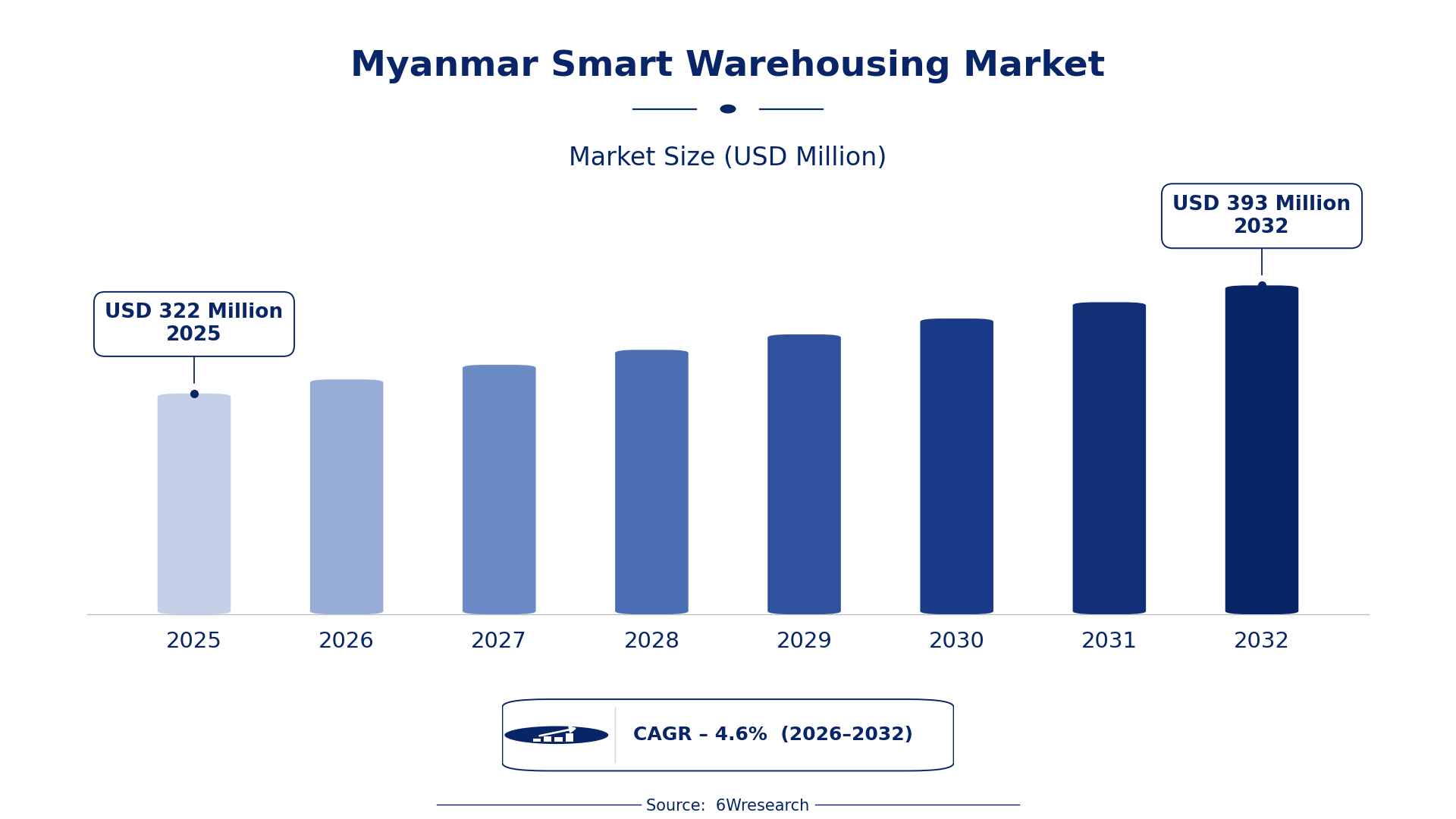
The Myanmar Smart Warehousing Market was estimated at USD 322 Million in 2025 and is projected to reach USD 393 Million by 2032, growing at a CAGR of 4.6% from 2026 to 2032.
Myanmar Smart Warehousing Market Synopsis
The primary force driving the Myanmar Smart Warehousing Market is the surge in industrialization coupled with the rapid expansion of e-commerce. As businesses strive to enhance their operational efficiency and streamline logistics, the demand for smart warehousing solutions is becoming increasingly pronounced.
With advancements in technologies such as IoT, robotics, and AI gaining traction, companies are increasingly adopting sophisticated warehouse management systems. This trend is transforming traditional warehousing operations into intelligent hubs that not only optimize storage but also improve inventory management and order fulfillment.
Myanmar Smart Warehousing Market Year-wise Growth Rate and Key Drivers
This graph illustrates the annual growth rates of the Myanmar Smart Warehousing Market from 2021 to 2032, highlighting a steady upward trajectory and projected expansion over the forecast period.
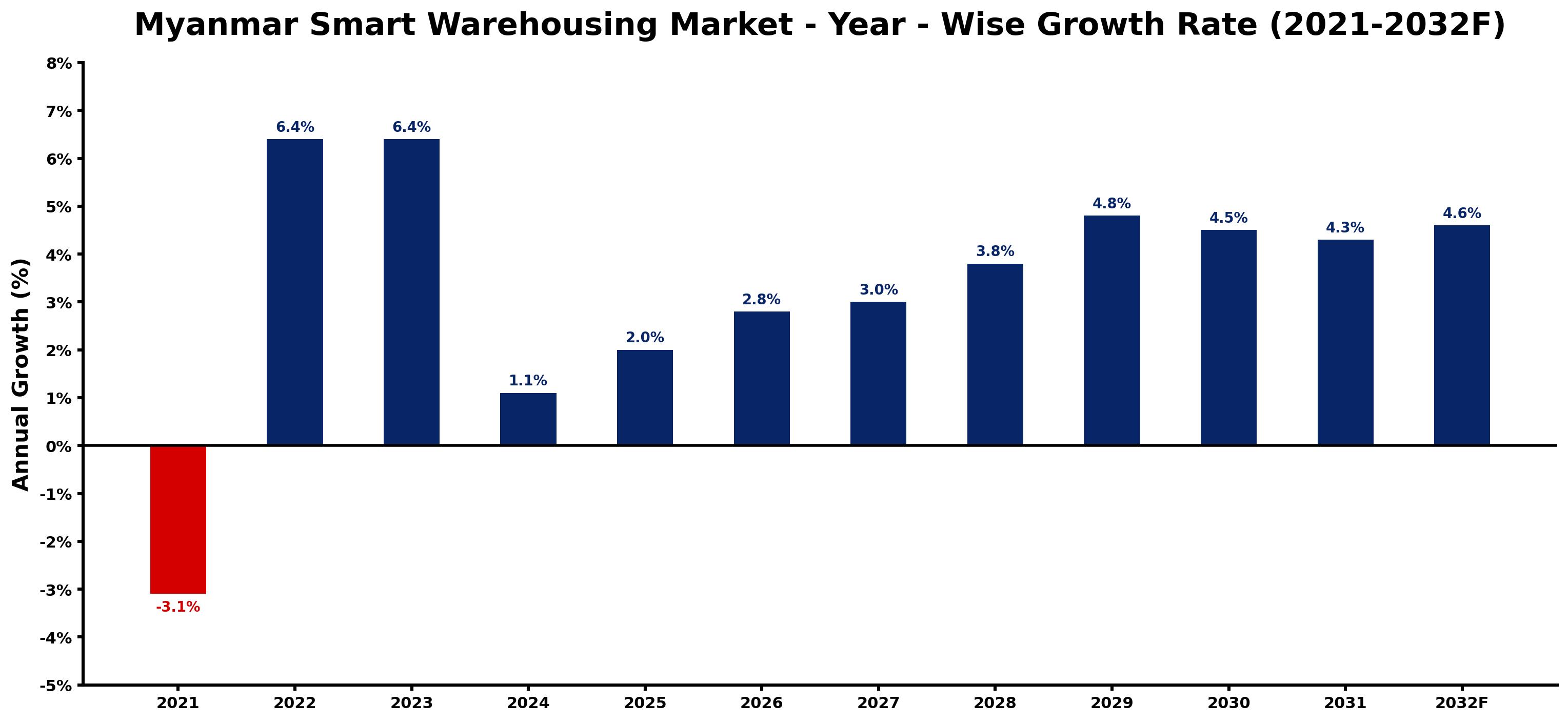
The table below presents the year‑wise growth rates along with the key drivers influencing the market
| Year | Growth Rate | Major Drivers |
| 2021 | -3.1% | COVID-19 restrictions limited warehouse construction projects. |
| 2022 | 6.4% | Government incentives for tech adoption in logistics sector |
| 2023 | 6.4% | Increase in e-commerce driving smart warehousing solutions |
| 2024 | 1.1% | Investment in urban infrastructure facilitates warehousing growth |
| 2025 | 2.0% | Local startups enhancing supply chain efficiency through innovation |
| 2026 | 2.8% | Foreign direct investment boosting logistics technology advancements |
| 2027 | 3.0% | Rising consumer expectations for delivery speed and accuracy |
| 2028 | 3.8% | Climate-smart warehouses supported by government sustainability initiatives |
| 2029 | 4.8% | Digital transformation initiatives promoting modern warehousing practices |
| 2030 | 4.5% | Improved internet access enhancing data-driven warehouse operations |
| 2031 | 4.3% | Partnerships with tech firms advancing automation solutions |
| 2032 | 4.6% | Focus on urban supply chain resilience post-pandemic |
Note: Market size estimations and growth projections presented in this report are based on 6Wresearch's proprietary forecasting methodology, utilizing the latest available industry data, government publications, and primary research inputs.
Myanmar Smart Warehousing Market Key Takeaways
Below are some of the specific key takeaways from the market, including:
- The market is characterized by a significant rise in e-commerce activities, driving the need for efficient logistics and warehousing solutions.
- Investment in automation technologies is critical for businesses seeking to enhance supply chain efficiency.
- Cloud-based warehouse management systems are gaining popularity due to their scalability and cost-effectiveness.
- Real-time data analytics is becoming essential for proactive decision-making in warehouse operations.
- Government initiatives aimed at improving infrastructure are creating a favorable environment for smart warehousing growth.
Evaluation of Restraints in Myanmar Smart Warehousing Market
Despite the optimistic outlook, several restraints hinder the Myanmar Smart Warehousing Market's growth. Limited infrastructure remains a pressing issue, with many regions lacking the necessary facilities to support advanced warehousing technologies. High initial investment costs present a barrier, particularly for small and medium-sized enterprises that may struggle to adopt smart solutions. on top of that, the shortage of a skilled workforce trained in smart technologies complicates the implementation of automated systems. Navigating regulatory challenges and bureaucratic hurdles can also deter potential investors looking to enter the market.
Myanmar Smart Warehousing Market Trends
A notable trend within the Myanmar Smart Warehousing Market is the increasing integration of IoT devices, enabling real-time monitoring and management of warehouse operations. This shift is complemented by the use of AI-driven analytics, which is enhancing operational efficiency and optimizing inventory management. The push for cloud-based solutions is notable, as these offer flexibility and scalability, catering to the diverse needs of businesses. As the logistics sector continues to evolve, the focus on automation and digitization remains central to meeting the demands of modern supply chains.
Myanmar Smart Warehousing Market Opportunities
The potential for growth in the Myanmar smart warehousing market is substantial, fueled by increasing consumer demand and the government's infrastructure initiatives. Investment opportunities are abundant in areas such as advanced warehouse management software and IoT-enabled devices. With the rise of e-commerce, businesses are seeking innovative solutions to streamline their logistics processes, making this an opportune time for vendors to introduce tailored offerings. Collaborations with local logistics firms and technology providers can further facilitate market entry and expansion.
Government Initiatives in the Myanmar Smart Warehousing Market
The Myanmar government is actively shaping the Smart Warehousing Market through various initiatives aimed at promoting technological adoption and improving logistics infrastructure. These policies are designed to modernize the warehousing sector and encourage investment, which is vital for supporting the country's economic growth.
- A national digital infrastructure upgrade programme launched in early 2023 aims to enhance connectivity and support digitalization efforts across industries.
- Ongoing initiatives focus on streamlining regulatory processes to make it easier for companies to establish smart warehousing operations.
- The government is currently promoting investment in automation technologies through tax incentives for companies adopting smart solutions.
- Plans for a logistics modernization initiative are expected to be unveiled in late 2024, aimed at improving supply chain efficiency.
- Public-private partnerships are being explored to develop training programs for the workforce in smart warehouse technologies.
Future Insights of the Myanmar Smart Warehousing Market
Looking ahead to 2026-2032, the Myanmar Smart Warehousing Market is set for notable expansion. The increasing adoption of automation technologies will be pivotal in transforming warehousing operations. With e-commerce continuing to thrive, businesses will increasingly rely on smart solutions to optimize their supply chains. Government support for infrastructure development will further enhance operational capabilities, making it an exciting period for innovation and investment in this sector.
Myanmar Smart Warehousing Market Latest Developments
Over the past year, the Myanmar Smart Warehousing Market has witnessed several key developments that reflect the sector's growth trajectory. Companies are increasingly prioritizing technological investments to remain competitive in a dynamic landscape.
- A major technology vendor launched a new IoT-enabled warehouse management system in Q1 2023, enhancing operational efficiency for several local businesses.
- An initiative that began in mid-2023 focuses on integrating AI-driven analytics into existing warehouse operations, currently underway in several pilot locations.
- Plans for a significant investment in robotics for warehouse automation have been announced, with rollouts expected to start in early 2025.
- In Q2 2023, a partnership between local logistics providers and technology firms was established to develop smart warehousing solutions tailored to regional needs.
- Upgrades to logistics infrastructure are currently ongoing, with a focus on enhancing transportation networks to support efficient warehousing operations.
Myanmar Smart Warehousing Market - Key Attractiveness of the Report
- 10 Years of Market Numbers
- Historical Data Starting from 2022 to 2025
- Base Year: 2025
- Forecast Data until 2032
- Key Performance Indicators Impacting the Market
- Major Upcoming Developments and Projects
Key Highlights of the Report:
- Myanmar Smart Warehousing Market Outlook
- Market Size of Myanmar Smart Warehousing Market, 2025
- Forecast of Myanmar Smart Warehousing Market, 2032
- Historical Data and Forecast of Myanmar Smart Warehousing Revenues & Volume for the Period 2022-2032F
- Myanmar Smart Warehousing Market Trend Evolution
- Myanmar Smart Warehousing Market Drivers and Challenges
- Myanmar Smart Warehousing Price Trends
- Myanmar Smart Warehousing Porter's Five Forces
- Myanmar Smart Warehousing Industry Life Cycle
- Historical Data and Forecast of Myanmar Smart Warehousing Market Revenues & Volume By Component for the Period 2022-2032F
- Historical Data and Forecast of Myanmar Smart Warehousing Market Revenues & Volume By Hardware for the Period 2022-2032F
- Historical Data and Forecast of Myanmar Smart Warehousing Market Revenues & Volume By Solutions for the Period 2022-2032F
- Historical Data and Forecast of Myanmar Smart Warehousing Market Revenues & Volume By Services for the Period 2022-2032F
- Historical Data and Forecast of Myanmar Smart Warehousing Market Revenues & Volume By Application for the Period 2022-2032F
- Historical Data and Forecast of Myanmar Smart Warehousing Market Revenues & Volume By Transport Management for the Period 2022-2032F
- Historical Data and Forecast of Myanmar Smart Warehousing Market Revenues & Volume By Inventory Management for the Period 2022-2032F
- Historical Data and Forecast of Myanmar Smart Warehousing Market Revenues & Volume By Order Management for the Period 2022-2032F
- Historical Data and Forecast of Myanmar Smart Warehousing Market Revenues & Volume By Yard Management for the Period 2022-2032F
- Historical Data and Forecast of Myanmar Smart Warehousing Market Revenues & Volume By Shipping Management for the Period 2022-2032F
- Historical Data and Forecast of Myanmar Smart Warehousing Market Revenues & Volume By Labor Management for the Period 2022-2032F
- Historical Data and Forecast of Myanmar Smart Warehousing Market Revenues & Volume By Other Applications for the Period 2022-2032F
- Historical Data and Forecast of Myanmar Smart Warehousing Market Revenues & Volume By Technology for the Period 2022-2032F
- Historical Data and Forecast of Myanmar Smart Warehousing Market Revenues & Volume By IoT and Analytics for the Period 2022-2032F
- Historical Data and Forecast of Myanmar Smart Warehousing Market Revenues & Volume By AI in Warehouse for the Period 2022-2032F
- Historical Data and Forecast of Myanmar Smart Warehousing Market Revenues & Volume By Automated Guided Vehicles (AGV) for the Period 2022-2032F
- Historical Data and Forecast of Myanmar Smart Warehousing Market Revenues & Volume By RFID for the Period 2022-2032F
- Historical Data and Forecast of Myanmar Smart Warehousing Market Revenues & Volume By Blockchain in Warehouse for the Period 2022-2032F
- Historical Data and Forecast of Myanmar Smart Warehousing Market Revenues & Volume By Other Technologies for the Period 2022-2032F
- Historical Data and Forecast of Myanmar Smart Warehousing Market Revenues & Volume By Vertical for the Period 2022-2032F
- Historical Data and Forecast of Myanmar Smart Warehousing Market Revenues & Volume By Transportation and Logistics for the Period 2022-2032F
- Historical Data and Forecast of Myanmar Smart Warehousing Market Revenues & Volume By Retail and eCommerce for the Period 2022-2032F
- Historical Data and Forecast of Myanmar Smart Warehousing Market Revenues & Volume By Manufacturing for the Period 2022-2032F
- Historical Data and Forecast of Myanmar Smart Warehousing Market Revenues & Volume By Healthcare and Life Sciences for the Period 2022-2032F
- Historical Data and Forecast of Myanmar Smart Warehousing Market Revenues & Volume By Energy and Utilities for the Period 2022-2032F
- Historical Data and Forecast of Myanmar Smart Warehousing Market Revenues & Volume By Automotive for the Period 2022-2032F
- Historical Data and Forecast of Myanmar Smart Warehousing Market Revenues & Volume By Food and Beverages for the Period 2022-2032F
- Historical Data and Forecast of Myanmar Smart Warehousing Market Revenues & Volume By Other Verticals for the Period 2022-2032F
- Historical Data and Forecast of Myanmar Smart Warehousing Market Revenues & Volume By Deployment Mode for the Period 2022-2032F
- Historical Data and Forecast of Myanmar Smart Warehousing Market Revenues & Volume By Cloud for the Period 2022-2032F
- Historical Data and Forecast of Myanmar Smart Warehousing Market Revenues & Volume By On-premises for the Period 2022-2032F
- Historical Data and Forecast of Myanmar Smart Warehousing Market Revenues & Volume By Organization Size for the Period 2022-2032F
- Historical Data and Forecast of Myanmar Smart Warehousing Market Revenues & Volume By Large enterprises for the Period 2022-2032F
- Historical Data and Forecast of Myanmar Smart Warehousing Market Revenues & Volume By Small and medium-sized enterprises (SMEs) for the Period 2022-2032F
- Myanmar Smart Warehousing Import Export Trade Statistics
- Market Opportunity Assessment By Component
- Market Opportunity Assessment By Application
- Market Opportunity Assessment By Technology
- Market Opportunity Assessment By Vertical
- Market Opportunity Assessment By Deployment Mode
- Market Opportunity Assessment By Organization Size
- Myanmar Smart Warehousing Top Companies Market Share
- Myanmar Smart Warehousing Competitive Benchmarking By Technical and Operational Parameters
- Myanmar Smart Warehousing Company Profiles
- Myanmar Smart Warehousing Key Strategic Recommendations






































