Myanmar Sports Equipment Market Size, Share & Growth Rate
The Myanmar Sports Equipment Market was estimated at USD 310 Million in 2025 and is projected to reach USD 417 Million by 2032, growing at a CAGR of 4.3% from 2026 to 2032. This growth trajectory is primarily driven by an increasing interest in sports and fitness activities, fueled by rising disposable incomes and a notable shift towards health-conscious lifestyles among the population. The evolving sports culture, alongside a demand for high-quality equipment, is paving the way for this market's expansion.
Myanmar Sports Equipment Market Year-wise Growth Rate and Key Drivers
This graph highlights how the Myanmar Sports Equipment Market has steadily grown over the years, supported by major growth factors.
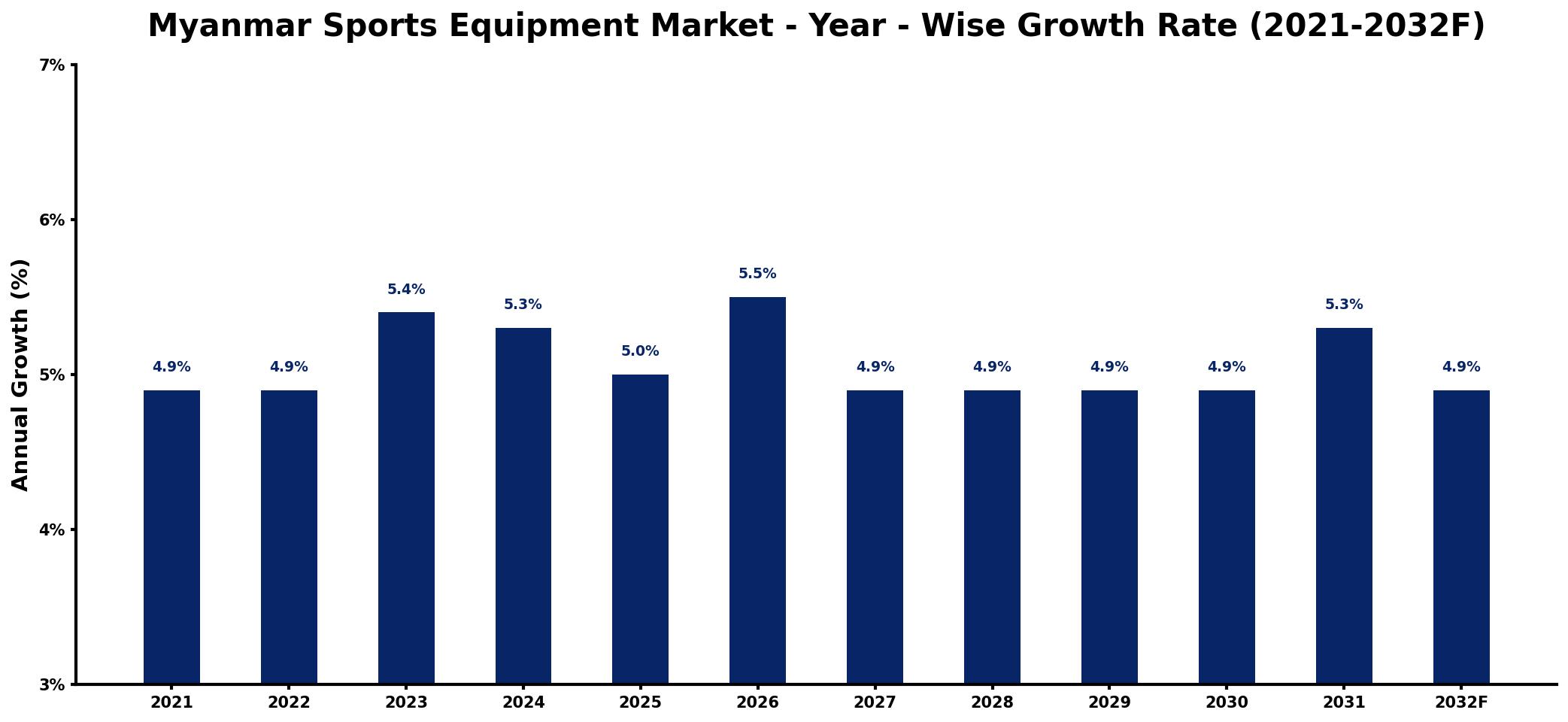
The table below presents the year‑wise growth rates along with the key drivers influencing the market
| Year | Growth Rate | Major Drivers |
| 2021 | 4.9% | Rising youth participation rates |
| 2022 | 4.9% | Increased health consciousness trends |
| 2023 | 5.4% | Expansion of retail distribution channels |
| 2024 | 5.3% | Growing urban fitness facilities |
| 2025 | 5.0% | Government investments in recreation |
| 2026 | 5.5% | Emergence of fitness technology solutions |
| 2027 | 4.9% | Boost in local manufacturing capabilities |
| 2028 | 4.9% | Surge in online purchasing options |
| 2029 | 4.9% | increased overall sector activity |
| 2030 | 4.9% | Enhancement of public recreational spaces |
| 2031 | 5.3% | Increased sponsorship of events |
| 2032 | 4.9% | Strengthening of local brand presence |
Note: Market size estimations and growth projections presented in this report are based on 6Wresearch's proprietary forecasting methodology, utilizing the latest available industry data, government publications, and primary research inputs.
Myanmar Sports Equipment Market Synopsis
The Myanmar sports equipment market has gained momentum recently, reflecting the population's growing interest in physical activities and wellness. As the market matures, there is a significant opportunity for both local and international brands to meet the increasing demand for premium sports gear.
Looking ahead, the market is poised for further growth, supported by the rise in health awareness and active lifestyles. The increasing penetration of e-commerce is also likely to enhance accessibility, thus encouraging more consumers to engage with various sports and fitness activities.
Myanmar Sports Equipment Market Key Takeaways
- The market is projected to grow steadily, driven by increasing health consciousness and sports participation.
- International brands are gaining traction, reflecting a shift towards performance-oriented sports equipment.
- E-commerce is reshaping the distribution landscape, enabling wider access to sports products.
- Innovation in sports equipment, including sustainable options, is emerging as a key consumer preference.
- Government initiatives to promote sports are enhancing market potential and supporting growth.
Evaluation of Restraints in Myanmar Sports Equipment Market
Despite the positive outlook, the Myanmar sports equipment market grapples with significant challenges that could inhibit its growth. Limited consumer purchasing power remains a primary constraint, as economic conditions can restrict demand for premium products. Additionally, the existing infrastructure for sports facilities is inadequate, which hinders participation rates. High import tariffs and restrictions on sports equipment also pose barriers to entry for international brands. Moreover, the prevalence of counterfeit products compromises the integrity of the market, making it essential for authentic brands to navigate these complexities strategically.
Myanmar Sports Equipment Market Trends
As the market evolves, several trends are shaping its landscape. There is an observable shift towards high-quality, performance-focused sports equipment among consumers, particularly in urban areas. The increasing popularity of e-commerce is facilitating a more diverse product offering, while consumers are also showing interest in sustainable and eco-friendly options. Furthermore, the adoption of innovative technologies in sports gear is increasingly valued, aligning with the broader global trend towards enhanced athletic performance and user experience.
Myanmar Sports Equipment Market Opportunities
The burgeoning interest in sports and fitness creates a fertile ground for investment in the Myanmar sports equipment market. Opportunities lie in expanding distribution networks and retail channels, particularly through e-commerce platforms tailored to local consumers. Collaborative ventures with local manufacturers can also facilitate market entry for international brands. Additionally, aligning product offerings with government initiatives aimed at promoting physical activity can enhance visibility and market penetration, further capitalizing on the growing health and wellness trend.
Government Initiatives in the Myanmar Sports Equipment Market
The Myanmar government plays a crucial role in fostering the growth of the sports equipment market through various initiatives. Policies designed to incentivize local manufacturing and provide tax breaks are aimed at enhancing domestic production capabilities. Regulatory measures are in place to ensure the quality and safety of sports products, with ongoing monitoring to uphold standards. Furthermore, public investment in sports facilities and programs is focused on increasing participation in sports and physical activities, significantly contributing to market growth.
Future Insights of the Myanmar Sports Equipment Market
Looking towards 2026-2032, the Myanmar sports equipment market is expected to experience sustained growth, fueled by rising disposable incomes, urbanization, and an emphasis on health and wellness. As the economy progresses, more consumers are likely to invest in sports gear, broadening the market's potential. The expanding role of e-commerce will make sports equipment more accessible, particularly in less urbanized areas. Overall, the combination of economic development and a cultural shift towards active lifestyles presents a promising future for this market.
Myanmar Sports Equipment Market Latest Developments (2025 - 2026)
Recent developments in the Myanmar sports equipment market highlight a growing focus on innovation and sustainability. Local manufacturers are increasingly adopting eco-friendly practices in their production processes, reflecting consumer demand for sustainable options. Additionally, collaborations between domestic and international brands are on the rise, enhancing product variety and availability across the country. The surge in e-commerce usage continues to reshape how consumers access sports equipment, with many players investing in online platforms to reach a broader audience.
Myanmar Sports Equipment Market - Key Attractiveness of the Report
- 10 Years of Market Numbers
- Historical Data Starting from 2022 to 2025
- Base Year: 2025
- Forecast Data until 2032
- Key Performance Indicators Impacting the Market
- Major Upcoming Developments and Projects
Key Highlights of the Report:
- Myanmar Sports Equipment Market Outlook
- Market Size of Myanmar Sports Equipment Market, 2025
- Forecast of Myanmar Sports Equipment Market, 2032
- Historical Data and Forecast of Myanmar Sports Equipment Revenues & Volume for the Period 2022-2032F
- Myanmar Sports Equipment Market Trend Evolution
- Myanmar Sports Equipment Market Drivers and Challenges
- Myanmar Sports Equipment Price Trends
- Myanmar Sports Equipment Porter's Five Forces
- Myanmar Sports Equipment Industry Life Cycle
- Historical Data and Forecast of Myanmar Sports Equipment Market Revenues & Volume By Product for the Period 2022-2032F
- Historical Data and Forecast of Myanmar Sports Equipment Market Revenues & Volume By Ball over net games for the Period 2022-2032F
- Historical Data and Forecast of Myanmar Sports Equipment Market Revenues & Volume By Ball games for the Period 2022-2032F
- Historical Data and Forecast of Myanmar Sports Equipment Market Revenues & Volume By Fitness/Strength equipment for the Period 2022-2032F
- Historical Data and Forecast of Myanmar Sports Equipment Market Revenues & Volume By Athletic training equipment for the Period 2022-2032F
- Historical Data and Forecast of Myanmar Sports Equipment Market Revenues & Volume By Others for the Period 2022-2032F
- Historical Data and Forecast of Myanmar Sports Equipment Market Revenues & Volume By Distribution Channel for the Period 2022-2032F
- Historical Data and Forecast of Myanmar Sports Equipment Market Revenues & Volume By Online retail for the Period 2022-2032F
- Historical Data and Forecast of Myanmar Sports Equipment Market Revenues & Volume By Specialty & sports shops for the Period 2022-2032F
- Historical Data and Forecast of Myanmar Sports Equipment Market Revenues & Volume By Department & discount stores for the Period 2022-2032F
- Myanmar Sports Equipment Import Export Trade Statistics
- Market Opportunity Assessment By Product
- Market Opportunity Assessment By Distribution Channel
- Myanmar Sports Equipment Top Companies Market Share
- Myanmar Sports Equipment Competitive Benchmarking By Technical and Operational Parameters
- Myanmar Sports Equipment Company Profiles
- Myanmar Sports Equipment Key Strategic Recommendations






































