Myanmar Threat Intelligence Market Size & Growth Rate (2026-2032)
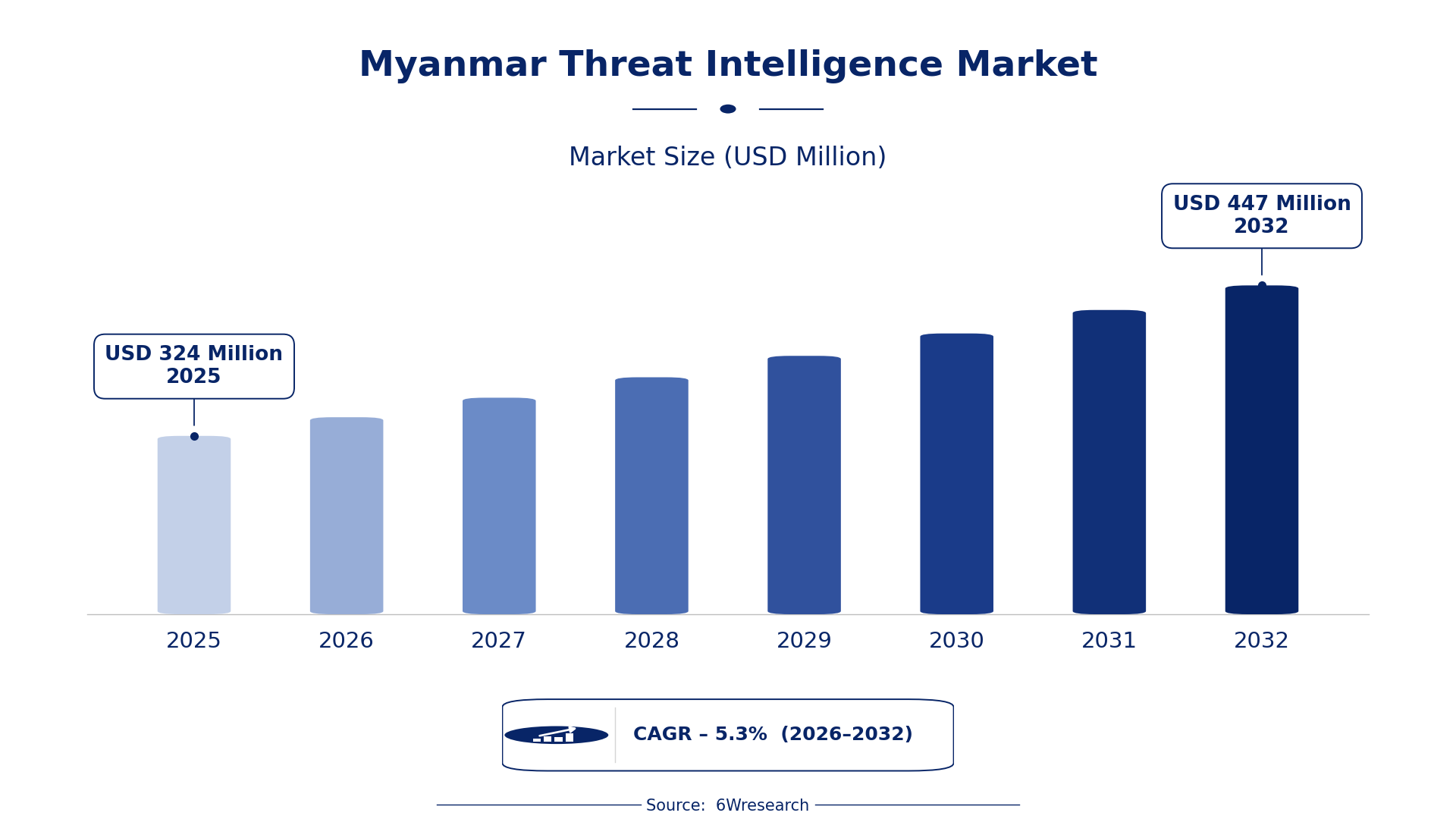
The Myanmar Threat Intelligence Market was estimated at USD 324 Million in 2025 and is projected to reach USD 447 Million by 2032, growing at a CAGR of 5.3% from 2026 to 2032.
Myanmar Threat Intelligence Market Synopsis
A surge in cyber threats is the most powerful force shaping the Myanmar Threat Intelligence Market today. As organizations across sectors such as finance, healthcare, and government increasingly digitize their operations, the need for robust cybersecurity solutions has intensified. Companies are investing heavily in threat intelligence solutions to bolster their defenses against sophisticated attacks.
Threat intelligence services have become essential for proactive risk management. Organizations are now more aware of the necessity for incident response and security analytics, which helps them identify vulnerabilities before they can be exploited. This growing awareness and demand are set to fuel the market's expansion in the coming years.
Myanmar Threat Intelligence Market Year-wise Growth Rate and Key Drivers
This graph illustrates the annual growth rates of the Myanmar Threat Intelligence Market from 2021 to 2032, highlighting a steady upward trajectory and projected expansion over the forecast period.
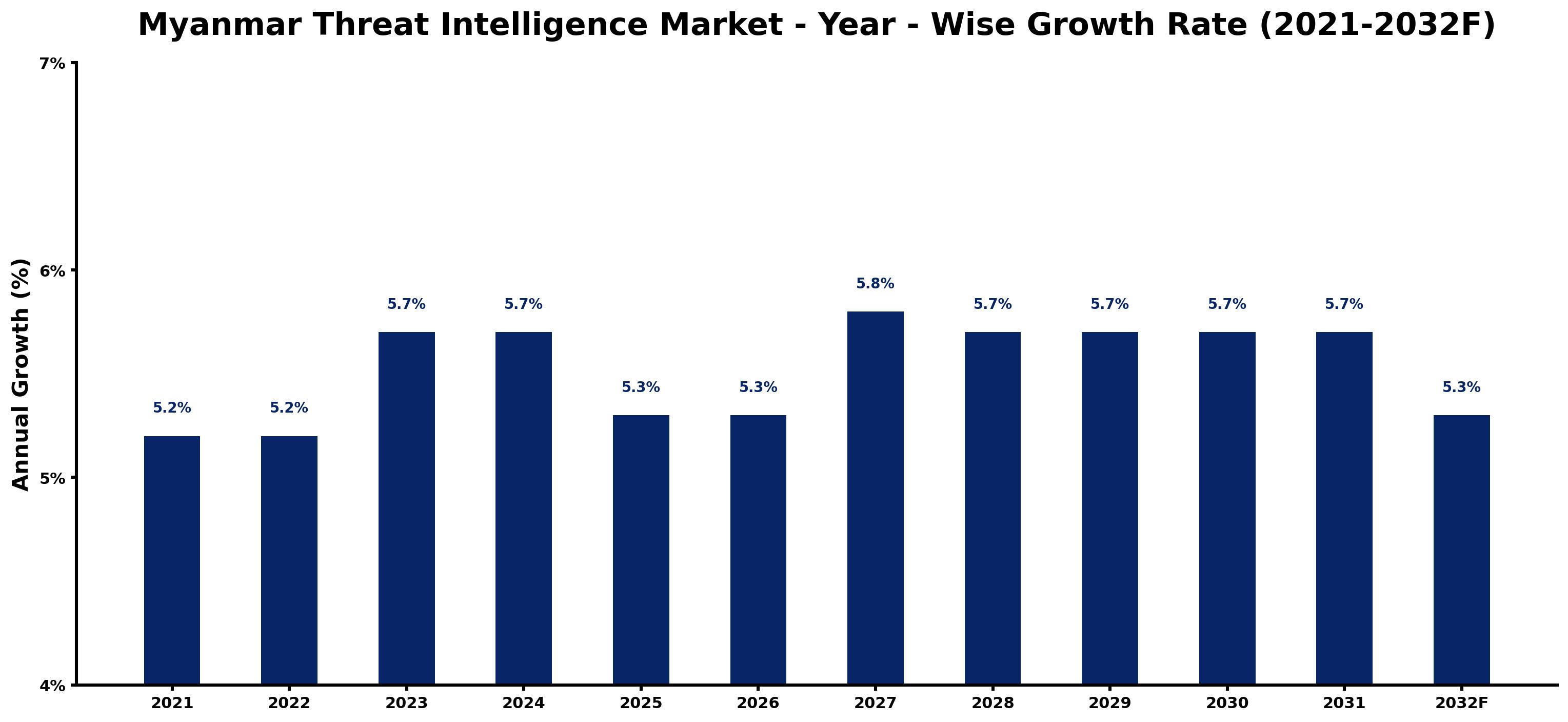
The table below presents the year‑wise growth rates along with the key drivers influencing the market
| Year | Growth Rate | Major Drivers |
| 2021 | 5.2% | Increased cyber attacks on government institutions driving need. |
| 2022 | 5.2% | Burmese military's digital surveillance initiatives heightening security demands. |
| 2023 | 5.7% | Growing awareness of data privacy laws boosting threat intelligence. |
| 2024 | 5.7% | Local enterprises investing in cybersecurity training programs extensively. |
| 2025 | 5.3% | Surge in mobile app usage increasing vulnerability awareness. |
| 2026 | 5.3% | Myanmar's economic recovery fostering greater security investments. |
| 2027 | 5.8% | International partnerships enhancing threat intelligence capabilities significantly. |
| 2028 | 5.7% | Rising foreign investment necessitating robust cybersecurity measures. |
| 2029 | 5.7% | Increased risks from geopolitical tensions driving protective technologies. |
| 2030 | 5.7% | Adoption of cloud services spurring demand for security solutions. |
| 2031 | 5.7% | Local NGOs promoting cybersecurity awareness and readiness initiatives. |
| 2032 | 5.3% | Integration of IoT devices escalating cyber threat complexities. |
Note: Market size estimations and growth projections presented in this report are based on 6Wresearch's proprietary forecasting methodology, utilizing the latest available industry data, government publications, and primary research inputs.
Myanmar Threat Intelligence Market Key Takeaways
Below are some of the specific key takeaways from the market, including:
- The increasing digitization of businesses is amplifying the demand for threat intelligence solutions.
- Cloud-based threat intelligence platforms are gaining traction for their scalability and flexibility.
- The use of artificial intelligence and machine learning is becoming common for advanced threat detection.
- There is a growing emphasis on collaboration and information sharing among organizations to enhance cybersecurity efforts.
- Regulatory compliance requirements are shaping the market dynamics and service offerings.
Evaluation of Restraints in Myanmar Threat Intelligence Market
One of the most pressing limitations in the Myanmar Threat Intelligence Market is the scarcity of skilled cybersecurity professionals. This shortage significantly hampers the ability of organizations to develop and implement effective threat intelligence solutions. Limited access to cutting-edge technology and inadequate funding for cybersecurity initiatives further exacerbate the situation. With cyber threats evolving rapidly, organizations must continuously adapt their strategies to stay ahead, which remains a challenge amidst these constraints.
Myanmar Threat Intelligence Market Trends
A noticeable trend in the Myanmar Threat Intelligence Market is the shift towards cloud-based solutions. These platforms offer organizations the agility they need to scale their operations while reducing overhead costs. Additionally, the integration of artificial intelligence and machine learning technologies is becoming more prevalent. Such technologies facilitate quicker and more accurate threat detection, allowing for a more proactive approach to security. Collaborative frameworks for threat intelligence sharing are also on the rise, aimed at uniting organizations to fortify defenses against cyber threats.
Myanmar Threat Intelligence Market Opportunities
Amidst increasing digitization, the Myanmar Threat Intelligence Market holds substantial growth and investment prospects. The demand for sophisticated threat detection and incident response services is surging. Investing in local cybersecurity firms that offer innovative threat intelligence platforms presents a significant opportunity. Additionally, training programs aimed at equipping organizations with necessary skills in cybersecurity can create a viable investment avenue, fostering a more resilient cybersecurity environment in Myanmar.
Government Initiatives in the Myanmar Threat Intelligence Market
Government policy is a crucial determinant of the Myanmar Threat Intelligence Market's direction. The authorities have established a regulatory framework aimed at balancing innovation in threat intelligence with national security interests. Strict licensing and reporting requirements are enforced to ensure compliance with data protection laws, and collaboration with government agencies is mandatory for threat intelligence providers. Such initiatives are essential to enhance the overall cybersecurity posture of the nation.
- A regulatory framework launched in early 2023 mandates compliance with data protection laws for organizations dealing with threat intelligence.
- A national cybersecurity awareness program is currently underway, aimed at educating businesses about potential cyber threats and best practices.
- A planned initiative focusing on public-private partnerships aims to improve national cybersecurity infrastructure by 2026.
- Recent efforts have introduced licensing requirements for threat intelligence vendors, implemented in late 2023 to ensure compliance with national security interests.
Future Insights of the Myanmar Threat Intelligence Market
Looking ahead to 2026-2032, the Myanmar Threat Intelligence Market is set to experience remarkable growth. As awareness around cybersecurity continues to rise, coupled with increasing digitization across sectors, the demand for threat intelligence solutions will escalate. Enhanced regulatory measures aimed at improving cybersecurity standards will also play a pivotal role in market expansion. Organizations that invest wisely in threat intelligence will not only safeguard their operations but also set a benchmark for resilience in the face of evolving cyber threats.
Myanmar Threat Intelligence Market Latest Developments
Recent months have shown a flurry of activity in the Myanmar Threat Intelligence Market. Organizations are increasingly focusing on developing innovative solutions to combat rising cyber threats. Investment in cybersecurity initiatives is growing, with firms looking to enhance their offerings and technologies to meet emerging challenges.
- A partnership established in Q3 2023 between local firms aims to enhance threat intelligence sharing protocols across industries, currently ongoing.
- A new AI-based threat detection tool was launched in early 2023, receiving positive feedback for its advanced capabilities in real-time monitoring.
- An initiative to train cybersecurity personnel began in mid-2023, with a goal to develop local talent and reduce skill shortages.
- Plans for a nationwide cybersecurity assessment are in place, expected to start in late 2024 to evaluate current threats and vulnerabilities.
Myanmar Threat Intelligence Market - Key Attractiveness of the Report
- 10 Years of Market Numbers
- Historical Data Starting from 2022 to 2025
- Base Year: 2025
- Forecast Data until 2032
- Key Performance Indicators Impacting the Market
- Major Upcoming Developments and Projects
Key Highlights of the Report:
- Myanmar Threat Intelligence Market Outlook
- Market Size of Myanmar Threat Intelligence Market, 2025
- Forecast of Myanmar Threat Intelligence Market, 2032
- Historical Data and Forecast of Myanmar Threat Intelligence Revenues & Volume for the Period 2022-2032F
- Myanmar Threat Intelligence Market Trend Evolution
- Myanmar Threat Intelligence Market Drivers and Challenges
- Myanmar Threat Intelligence Price Trends
- Myanmar Threat Intelligence Porter's Five Forces
- Myanmar Threat Intelligence Industry Life Cycle
- Historical Data and Forecast of Myanmar Threat Intelligence Market Revenues & Volume By Component for the Period 2022-2032F
- Historical Data and Forecast of Myanmar Threat Intelligence Market Revenues & Volume By Solutions for the Period 2022-2032F
- Historical Data and Forecast of Myanmar Threat Intelligence Market Revenues & Volume By Services for the Period 2022-2032F
- Historical Data and Forecast of Myanmar Threat Intelligence Market Revenues & Volume By Vertical for the Period 2022-2032F
- Historical Data and Forecast of Myanmar Threat Intelligence Market Revenues & Volume By BFSI for the Period 2022-2032F
- Historical Data and Forecast of Myanmar Threat Intelligence Market Revenues & Volume By IT for the Period 2022-2032F
- Historical Data and Forecast of Myanmar Threat Intelligence Market Revenues & Volume By ITeS for the Period 2022-2032F
- Historical Data and Forecast of Myanmar Threat Intelligence Market Revenues & Volume By Retail for the Period 2022-2032F
- Historical Data and Forecast of Myanmar Threat Intelligence Market Revenues & Volume By Healthcare for the Period 2022-2032F
- Historical Data and Forecast of Myanmar Threat Intelligence Market Revenues & Volume By Life Sciences for the Period 2022-2032F
- Historical Data and Forecast of Myanmar Threat Intelligence Market Revenues & Volume By Organization Size for the Period 2022-2032F
- Historical Data and Forecast of Myanmar Threat Intelligence Market Revenues & Volume By Large Enterprises for the Period 2022-2032F
- Historical Data and Forecast of Myanmar Threat Intelligence Market Revenues & Volume By SMEs for the Period 2022-2032F
- Historical Data and Forecast of Myanmar Threat Intelligence Market Revenues & Volume By Application for the Period 2022-2032F
- Historical Data and Forecast of Myanmar Threat Intelligence Market Revenues & Volume By Security Information and Event Management for the Period 2022-2032F
- Historical Data and Forecast of Myanmar Threat Intelligence Market Revenues & Volume By Government, Risk, and Compliance for the Period 2022-2032F
- Historical Data and Forecast of Myanmar Threat Intelligence Market Revenues & Volume By Business Continuity Planning and Management for the Period 2022-2032F
- Historical Data and Forecast of Myanmar Threat Intelligence Market Revenues & Volume By Deployment Mode for the Period 2022-2032F
- Historical Data and Forecast of Myanmar Threat Intelligence Market Revenues & Volume By Cloud for the Period 2022-2032F
- Historical Data and Forecast of Myanmar Threat Intelligence Market Revenues & Volume By On-premises for the Period 2022-2032F
- Myanmar Threat Intelligence Import Export Trade Statistics
- Market Opportunity Assessment By Component
- Market Opportunity Assessment By Vertical
- Market Opportunity Assessment By Organization Size
- Market Opportunity Assessment By Application
- Market Opportunity Assessment By Deployment Mode
- Myanmar Threat Intelligence Top Companies Market Share
- Myanmar Threat Intelligence Competitive Benchmarking By Technical and Operational Parameters
- Myanmar Threat Intelligence Company Profiles
- Myanmar Threat Intelligence Key Strategic Recommendations






































