Myanmar Trolley Market Size, Share & Growth Rate
The Myanmar Trolley Market was estimated at USD 393 Million in 2025 and is projected to reach USD 551 Million by 2032, growing at a CAGR of 4.9% from 2026 to 2032. This growth trajectory is driven by a surge in urbanization and industrial expansion, which are heightening the demand for effective material handling solutions across various sectors. Additionally, government initiatives to bolster public transportation infrastructure further augment the market's upward momentum.
Myanmar Trolley Market Year-wise Growth Rate and Key Drivers
This graph highlights how the Myanmar Trolley Market has steadily grown over the years, supported by major growth factors.
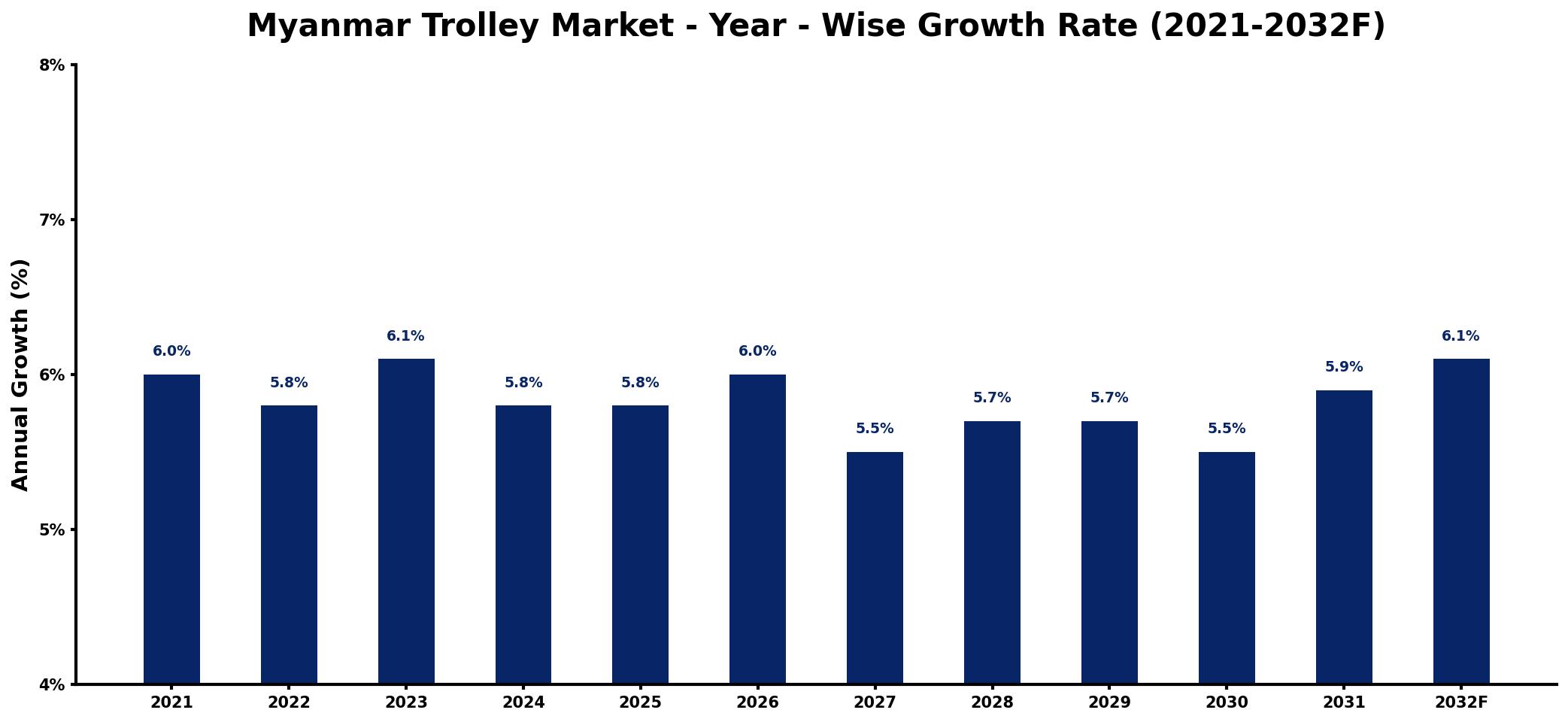
The table below presents the year‑wise growth rates along with the key drivers influencing the market
| Year | Growth Rate | Major Drivers |
| 2021 | 6.0% | Rising urban population demand |
| 2022 | 5.8% | Increased logistics and transportation needs |
| 2023 | 6.1% | Expansion of retail sector investments |
| 2024 | 5.8% | Growing e-commerce market growth |
| 2025 | 5.8% | Enhanced infrastructure development projects |
| 2026 | 6.0% | Boost in small business startups |
| 2027 | 5.5% | Surge in tourism sector activities |
| 2028 | 5.7% | Increase in environmental sustainability focus |
| 2029 | 5.7% | Growing demand for affordable mobility |
| 2030 | 5.5% | rising procurement volume requirements |
| 2031 | 5.9% | Technological advancements in logistics |
| 2032 | 6.1% | Rise in consumer purchasing power |
Note: Market size estimations and growth projections presented in this report are based on 6Wresearch's proprietary forecasting methodology, utilizing the latest available industry data, government publications, and primary research inputs.
Myanmar Trolley Market Synopsis
In Myanmar, the trolley market is experiencing a transformation, especially in urban centers where logistics and retail activities are on the rise. Trolleys are becoming increasingly vital for ensuring efficient movement of goods, catering not only to commercial needs but also contributing to improved public transport systems.
As demand escalates for ergonomically designed material handling tools, various industries are investing in advanced trolley solutions. The governments focus on sustainable transportation solutions and smart city initiatives is also fostering an environment ripe for growth in this sector.
Myanmar Trolley Market Key Takeaways
- Strong urbanization and industrial growth are crucial drivers of the trolley market.
- Government initiatives support advancements in public transport systems and trolley technology.
- Competitive pricing remains a critical factor affecting consumer choices in the market.
- Adoption of electric trolley technologies is gaining traction as sustainability becomes a priority.
- The market is evolving to meet the diverse needs of logistics, retail, and manufacturing sectors.
Evaluation of Restraints in Myanmar Trolley Market
Despite the potential for growth, the Myanmar Trolley Market faces certain limitations. A notable challenge is the fluctuating consumer demand, which is often influenced by economic conditions. Furthermore, competition from alternative transportation solutions, such as motorized vehicles, can detract from trolley adoption. Price sensitivity among consumers, particularly in rural areas, also limits market expansion, making it essential for providers to offer cost-effective options that deliver value.
Myanmar Trolley Market Trends
Several trends are shaping the future of the Myanmar Trolley Market. The push for sustainability is encouraging the development of eco-friendly trolley designs and electric-powered options. Additionally, the integration of technology in trolley manufacturing is leading to smarter, more efficient systems that streamline operations for businesses. Ergonomic designs are also gaining popularity, as they enhance user experience and reduce the risk of workplace injuries.
Myanmar Trolley Market Opportunities
Opportunities abound in the Myanmar Trolley Market, particularly in the realms of product innovation and infrastructure development. As urban areas expand, the need for modern, versatile trolley systems that cater to various industries will grow. Investments in electric trolley technologies and sustainable practices present avenues for market players to differentiate themselves. Collaborations with governmental bodies on public transportation projects can also yield substantial business opportunities.
Government Initiatives in the Myanmar Trolley Market
The Myanmar government is actively working to enhance urban mobility through various policies that support the trolley market. This includes funding for the development of modern trolley systems, setting regulatory standards aimed at ensuring safety and efficiency, and promoting the adoption of sustainable trolley technologies. Such initiatives are designed to foster a robust public transportation network that benefits both the economy and the environment.
Future Insights of the Myanmar Trolley Market
Looking ahead to 2026-2032, the Myanmar Trolley Market is poised for significant evolution. The anticipated growth in urban areas will catalyze demand for advanced trolley solutions, fueled by an increasingly mobile population and shifting industrial needs. As government investments continue, and as technology integration becomes more prevalent, the trolley market will likely transform, offering enhanced solutions that prioritize efficiency, safety, and sustainability.
Myanmar Trolley Market Latest Developments (2025 - 2026)
Recent developments in the Myanmar Trolley Market indicate a growing focus on electric trolley systems, aligning with global sustainability trends. The government has initiated collaborations with private sectors to explore innovative solutions in public transport systems, enhancing efficiency and user experience. Additionally, the ongoing modernization of urban infrastructure is set to impact trolley adoption positively, making it an exciting period for stakeholders within the market.
Myanmar Trolley Market - Key Attractiveness of the Report
- 10 Years of Market Numbers
- Historical Data Starting from 2022 to 2025
- Base Year: 2025
- Forecast Data until 2032
- Key Performance Indicators Impacting the Market
- Major Upcoming Developments and Projects
Key Highlights of the Report:
- Myanmar Trolley Market Outlook
- Market Size of Myanmar Trolley Market, 2025
- Forecast of Myanmar Trolley Market, 2032
- Historical Data and Forecast of Myanmar Trolley Revenues & Volume for the Period 2022-2032F
- Myanmar Trolley Market Trend Evolution
- Myanmar Trolley Market Drivers and Challenges
- Myanmar Trolley Price Trends
- Myanmar Trolley Porter's Five Forces
- Myanmar Trolley Industry Life Cycle
- Historical Data and Forecast of Myanmar Trolley Market Revenues & Volume By Product for the Period 2022-2032F
- Historical Data and Forecast of Myanmar Trolley Market Revenues & Volume By Manual for the Period 2022-2032F
- Historical Data and Forecast of Myanmar Trolley Market Revenues & Volume By Electric for the Period 2022-2032F
- Historical Data and Forecast of Myanmar Trolley Market Revenues & Volume By Application for the Period 2022-2032F
- Historical Data and Forecast of Myanmar Trolley Market Revenues & Volume By Commercial for the Period 2022-2032F
- Historical Data and Forecast of Myanmar Trolley Market Revenues & Volume By Non-commercial for the Period 2022-2032F
- Historical Data and Forecast of Myanmar Trolley Market Revenues & Volume By Distribution for the Period 2022-2032F
- Historical Data and Forecast of Myanmar Trolley Market Revenues & Volume By Offline for the Period 2022-2032F
- Historical Data and Forecast of Myanmar Trolley Market Revenues & Volume By Online for the Period 2022-2032F
- Myanmar Trolley Import Export Trade Statistics
- Market Opportunity Assessment By Product
- Market Opportunity Assessment By Application
- Market Opportunity Assessment By Distribution
- Myanmar Trolley Top Companies Market Share
- Myanmar Trolley Competitive Benchmarking By Technical and Operational Parameters
- Myanmar Trolley Company Profiles
- Myanmar Trolley Key Strategic Recommendations






































