Myanmar Vending machines Market Summary
The myanmar vending machines market was estimated at USD 485 Million in 2025 and is projected to reach USD 655 Million by 2032, growing at a CAGR of 5.4% from 2026 to 2032.
Myanmar Vending machines Market Year-wise Growth Rate and Key Drivers
This graph highlights how the Myanmar Vending machines Market has steadily grown over the past five years, supported by major growth factors.
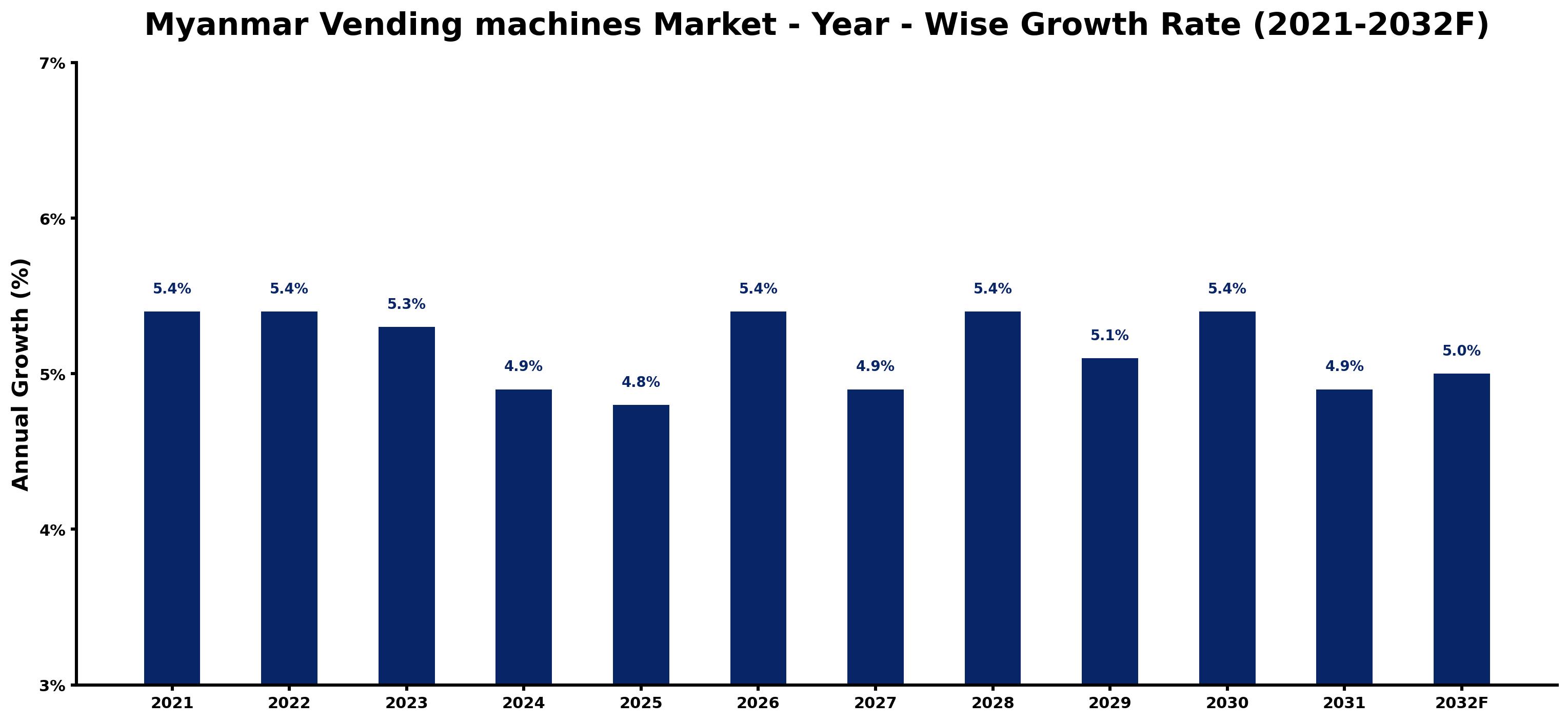
The table below presents the year wise growth rates along with the key drivers influencing the market
| Year | Growth Rate | Major Drivers |
| 2021 | 5.4% | Initial market penetration of vending machines revealed significant urban consumer interest. |
| 2022 | 5.4% | Emerging middle class in urban areas begins to prioritize convenience-driven purchases. |
| 2023 | 5.3% | Influx of international brands introduces innovative vending solutions to local markets. |
| 2024 | 4.9% | Urbanization trends boost foot traffic in high-density locations like shopping malls. |
| 2025 | 4.8% | Technological advancements enable cashless payment options, enhancing transaction efficiency. |
| 2026 | 5.4% | Corporate partnerships emerge, placing vending machines in workplaces and educational institutions. |
| 2027 | 4.9% | Local entrepreneurs begin to explore unique product offerings tailored to regional tastes. |
| 2028 | 5.4% | Increased investment in infrastructure supports strategic placement near transit hubs. |
| 2029 | 5.1% | The popularity of healthy snacks prompts vending machine diversification in offerings. |
| 2030 | 5.4% | Smart vending machines integrate IoT technology, improving inventory management and service. |
| 2031 | 4.9% | Consumer behavior shifts favorably towards 24/7 access to on-demand food and beverages. |
| 2032 | 5.0% | Sustainable practices become a priority, with eco-friendly machines gaining market traction. |
Note - Market size estimations and growth projections presented in this report are based on 6Wresearch's advanced forecasting approach, validated with industry datasets as of June 2026.
Myanmar Vending machines Market Synopsis
The Myanmar Vending machines Market is projected to reach 5.4% and witness significant growth during the forecast period (2026-2032). This market is evolving rapidly as consumer preferences shift towards convenience and automation in retail solutions. Vending machines are becoming increasingly prevalent in various settings, including public spaces, offices, and educational institutions, reflecting the growing demand for quick access to snacks, beverages, and other essential products.
Myanmar Vending machines Market Growth Drivers
The expansion of the Myanmar Vending machines Market can be attributed to several key drivers:
- Increasing consumer demand for automation and convenience is significantly fueling the market. As lifestyles become busier, consumers are seeking more efficient ways to purchase products without the need for traditional retail interactions.
- Technological advancements have improved vending machine functionality, allowing for enhanced customer experiences. Features such as touchless payment options and real-time inventory tracking are becoming standard, driving further market adoption.
- The shift towards cashless transactions is reshaping the vending landscape. More consumers prefer using digital payment methods, prompting vending machine operators to incorporate cashless systems, which improves transaction speed and customer satisfaction.
- The growing trend of healthy eating is reflected in the availability of diverse product offerings within vending machines. Operators are now providing healthier options, catering to the evolving preferences of health-conscious consumers.
- The increasing number of public events and gatherings further propels the demand for vending machines as a means of providing quick service and enhancing consumer access to food and beverages.
Myanmar Vending machines Market Challenges and Restraints
Despite the promising growth prospects of the Myanmar Vending machines Market, it faces several challenges:
- Intense competition from traditional retail channels poses a significant threat. Many consumers still prefer visiting stores where they can inspect products and receive personalized service, which can hinder vending machine adoption.
- Maintenance and servicing of vending machines require consistent effort and investment. Operators need to ensure that machines are well-stocked and functioning correctly to avoid losing customers due to malfunctions or empty machines.
- Vandalism and theft remain persistent risks in the industry. The presence of unsecured machines in public spaces can deter operators from installing them, impacting market growth.
- Consumer preferences for cashless transactions necessitate the adaptation of vending solutions. However, this transition may alienate demographics that still rely on cash payments, affecting sales.
- Concerns regarding product freshness and the quality of goods dispensed through vending machines can affect consumer trust. Operators must implement stringent quality control measures to ensure product integrity.
Myanmar Vending machines Market Government Investment and Initiatives
The government of Myanmar plays a pivotal role in fostering the development of the vending machines market through various supportive initiatives:
- Promoting the adoption of automated retail technologies is a priority for the government, fostering a conducive environment for market growth.
- Financial incentives are being offered for the installation of vending machines in both public and private sectors, encouraging more businesses to explore automated retail solutions.
- Support for research and development into advanced vending technologies is crucial, ensuring that local companies can innovate and adopt the latest trends in vending machine solutions.
- The government's emphasis on improving consumer convenience and access to goods complements the evolving landscape of the retail market, aligning with consumer expectations.
- Public spending initiatives on infrastructure improvement enhance locations suitable for vending machine placement, increasing their visibility and accessibility to the general public.
Myanmar Vending machines Market Latest Developments (May 2025 - June 2026)
In the period from May 2025 to June 2026, the Myanmar Vending machines Market witnessed several noteworthy developments:
- The introduction of contactless payment solutions became more widespread, making vending machines more appealing to consumers during a post-pandemic era.
- Innovative vending machine designs featuring interactive screens and personalized content began to emerge, enhancing user engagement and experience.
- There was a noticeable increase in partnerships between technology providers and vending machine operators, aimed at integrating advanced technologies into machines for improved functionality.
- Events that showcased automated retail solutions contributed to raising awareness and interest in vending machines among potential investors and consumers alike.
- The government's continued support for research initiatives aimed at optimizing vending machine operations led to improved strategies for inventory management and customer service.
Myanmar Vending machines Market - Key Attractiveness of the Report
- 10 Years of Market Numbers
- Historical Data Starting from 2022 to 2025
- Base Year: 2025
- Forecast Data until 2032
- Key Performance Indicators Impacting the Market
- Major Upcoming Developments and Projects
Key Highlights of the Report:
- Myanmar Vending machines Market Outlook
- Market Size of Myanmar Vending machines Market, 2025
- Forecast of Myanmar Vending machines Market, 2032
- Historical Data and Forecast of Myanmar Vending machines Revenues & Volume for the Period 2022-2032F
- Myanmar Vending machines Market Trend Evolution
- Myanmar Vending machines Market Drivers and Challenges
- Myanmar Vending machines Price Trends
- Myanmar Vending machines Porter's Five Forces
- Myanmar Vending machines Industry Life Cycle
- Historical Data and Forecast of Myanmar Vending machines Market Revenues & Volume By Applications for the Period 2022-2032F
- Historical Data and Forecast of Myanmar Vending machines Market Revenues & Volume By Commercial Places for the Period 2022-2032F
- Historical Data and Forecast of Myanmar Vending machines Market Revenues & Volume By Offices for the Period 2022-2032F
- Historical Data and Forecast of Myanmar Vending machines Market Revenues & Volume By Public Places for the Period 2022-2032F
- Historical Data and Forecast of Myanmar Vending machines Market Revenues & Volume By Others for the Period 2022-2032F
- Historical Data and Forecast of Myanmar Vending machines Market Revenues & Volume By Payment Mode for the Period 2022-2032F
- Historical Data and Forecast of Myanmar Vending machines Market Revenues & Volume By Cash for the Period 2022-2032F
- Historical Data and Forecast of Myanmar Vending machines Market Revenues & Volume By Cashless for the Period 2022-2032F
- Myanmar Vending machines Import Export Trade Statistics
- Market Opportunity Assessment By Applications
- Market Opportunity Assessment By Payment Mode
- Myanmar Vending machines Top Companies Market Share
- Myanmar Vending machines Competitive Benchmarking By Technical and Operational Parameters
- Myanmar Vending machines Company Profiles
- Myanmar Vending machines Key Strategic Recommendations






































