Myanmar Virtual Private Cloud Market Size & Growth Rate (2026-2032)
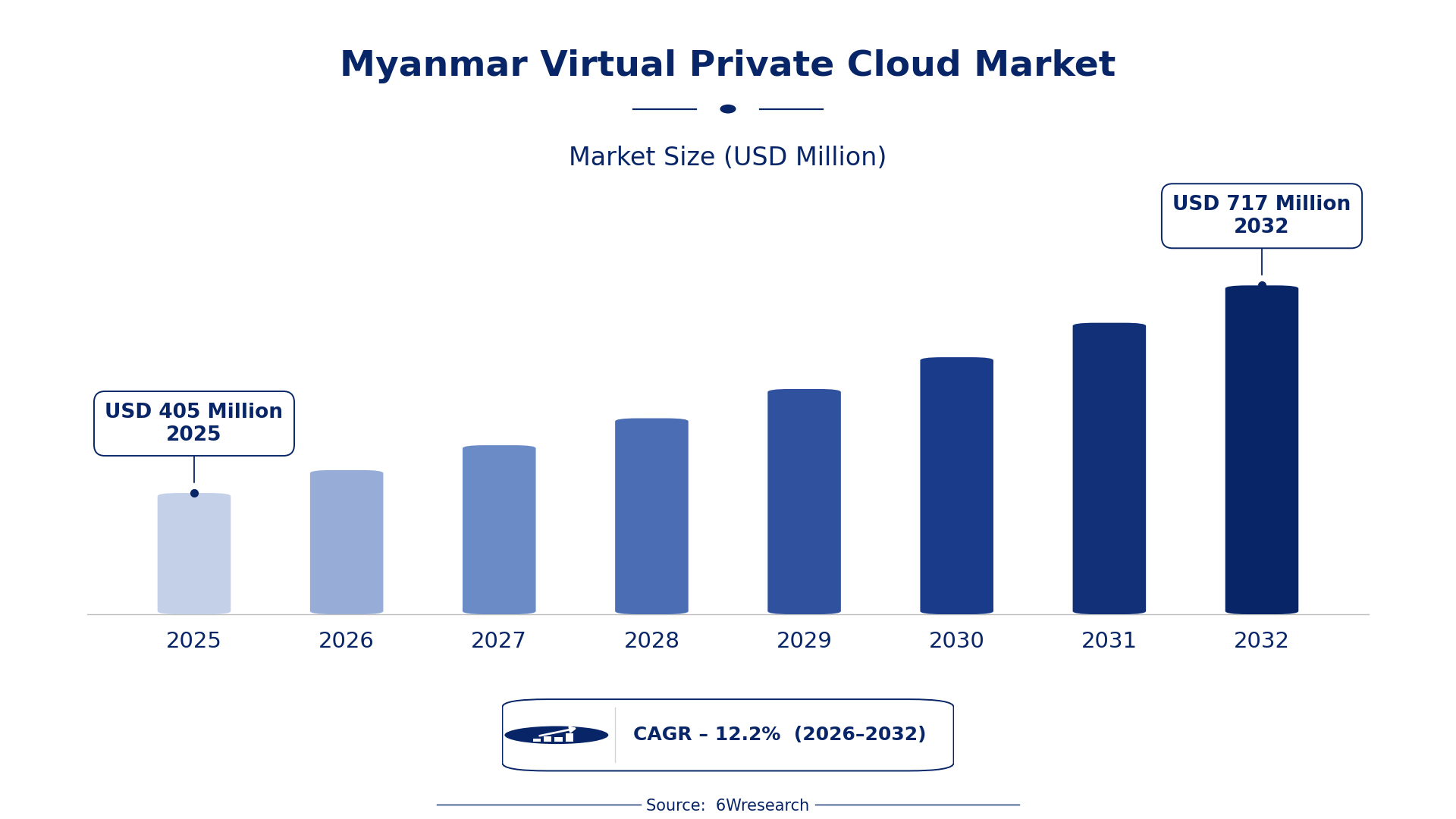
The Myanmar Virtual Private Cloud Market was estimated at USD 405 Million in 2025 and is projected to reach USD 717 Million by 2032, growing at a CAGR of 12.2% from 2026 to 2032.
Myanmar Virtual Private Cloud Market Synopsis
Businesses in Myanmar are increasingly turning to virtual private cloud (VPC) solutions to meet their growing data management needs. The unique combination of flexibility and security offered by VPCs aligns well with the demands of local enterprises looking to enhance operational efficiency while ensuring compliance with data protection regulations.
As Myanmar's digital economy continues to mature, the virtual private cloud market is positioned for substantial growth. The convergence of technological advancements and a rising awareness of cloud benefits is driving this shift, prompting businesses across various sectors to embrace virtual private clouds as a strategic asset.
Myanmar Virtual Private Cloud Market Year-wise Growth Rate and Key Drivers
This graph illustrates the annual growth rates of the Myanmar Virtual Private Cloud Market from 2021 to 2032, highlighting a steady upward trajectory and projected expansion over the forecast period.
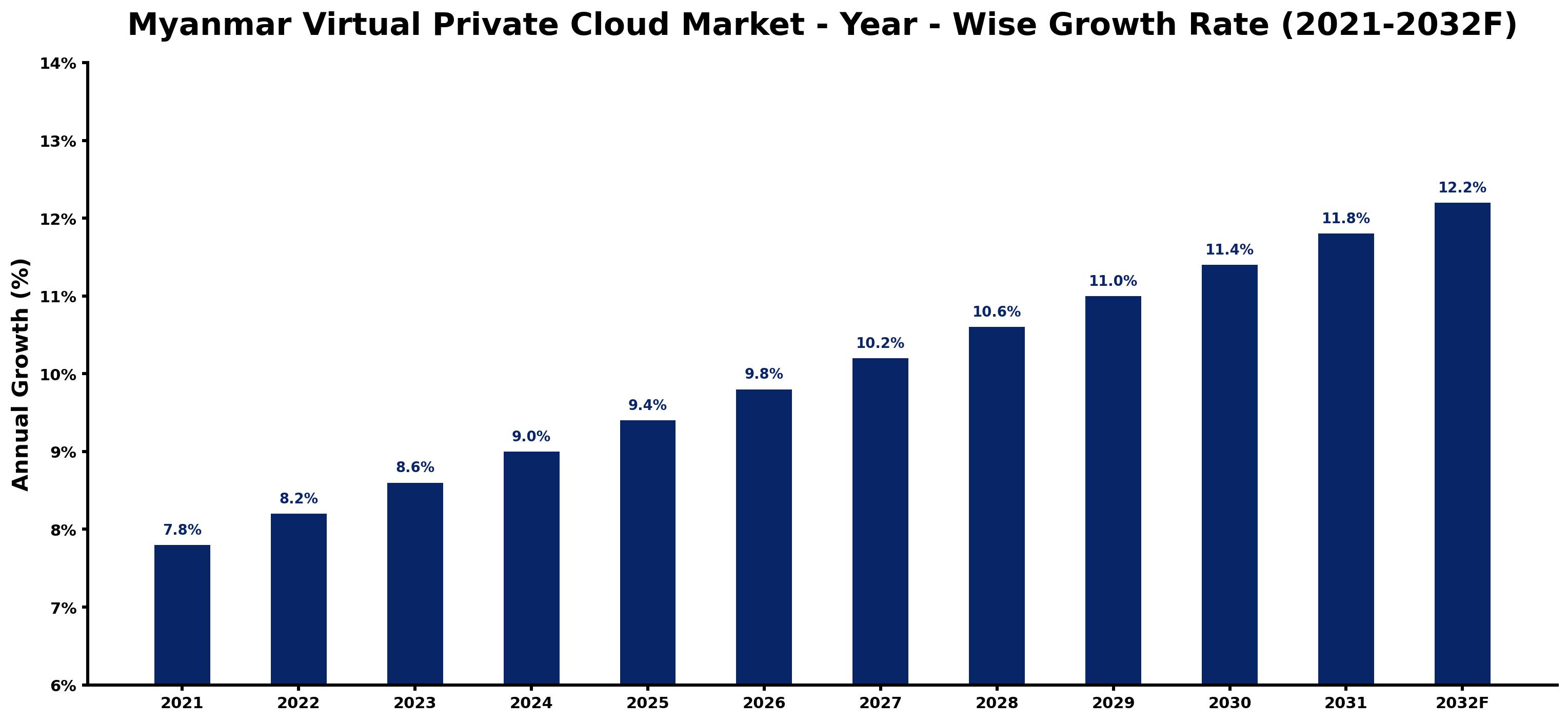
The table below presents the year‑wise growth rates along with the key drivers influencing the market
| Year | Growth Rate | Major Drivers |
| 2021 | 7.8% | Government’s Digital Economy Policy promotes cloud adoption. |
| 2022 | 8.2% | Local startups integrating cloud solutions for business growth. |
| 2023 | 8.6% | Increased internet penetration driving demand for virtual private services. |
| 2024 | 9.0% | Investment in fintech sector requiring robust virtual infrastructure. |
| 2025 | 9.4% | Telecommunications improvements enhancing cloud accessibility in urban areas. |
| 2026 | 9.8% | Rising cybersecurity awareness fueling demand for private cloud services. |
| 2027 | 10.2% | SMEs transitioning to digital platforms needing scalable cloud solutions. |
| 2028 | 10.6% | Growing number of online educational services adopting cloud technologies. |
| 2029 | 11.0% | E-government initiatives driving demand for secure cloud applications. |
| 2030 | 11.4% | Increased investments in IoT driving need for cloud connectivity. |
| 2031 | 11.8% | Rural digital initiatives expanding cloud service reach. |
| 2032 | 12.2% | Rising data privacy regulations enhancing demand for private clouds. |
Note: Market size estimations and growth projections presented in this report are based on 6Wresearch's proprietary forecasting methodology, utilizing the latest available industry data, government publications, and primary research inputs.
Myanmar Virtual Private Cloud Market Key Takeaways
Below are some of the specific key takeaways from the market, including:
- The market's growth is fueled by the increasing demand for secure data management solutions.
- Advancements in cloud technology are facilitating wider adoption of virtual private clouds.
- Cost concerns and data privacy issues remain primary challenges for businesses.
- Government initiatives are enhancing the market's potential for growth and development.
- Rising digital transformation efforts across industries are driving investments in VPC solutions.
Evaluation of Restraints in Myanmar Virtual Private Cloud Market
High costs associated with implementing virtual private cloud solutions are a significant barrier for many businesses in Myanmar. While the benefits are clear, the initial investment can be daunting for small to medium enterprises. Additionally, concerns about data security and privacy continue to be a topic of discussion, particularly in a region where regulatory frameworks are still evolving. There is also a pervasive lack of awareness about the advantages of private cloud infrastructure, which stunts market growth. Regulatory hurdles related to data storage and transmission further complicate the landscape, creating an environment where many companies hesitate to transition to cloud-based solutions.
Myanmar Virtual Private Cloud Market Trends
The trend towards hybrid cloud environments is gaining traction, as businesses seek to balance flexibility with security. Many organizations are exploring VPC options to complement their existing public cloud solutions, allowing for more tailored and controlled data environments. Another emerging trend is the increasing demand for compliance with local and international data protection regulations, which is pushing companies to adopt more secure cloud infrastructures.
The rise of remote working and digital services has further accelerated the push for cloud solutions. As organizations adapt to a more digital-first approach, the need for reliable and scalable cloud services has never been more pressing. The focus on enhancing operational efficiency is driving businesses to invest in technologies that support their growth strategies, with VPCs playing a crucial role.
Myanmar Virtual Private Cloud Market Opportunities
There are significant opportunities for growth in Myanmar's virtual private cloud market. The increasing digital transformation initiatives across various industries open up avenues for cloud service providers to tailor offerings to specific business needs. Sectors such as finance, healthcare, and e-commerce are particularly ripe for cloud adoption, given their stringent data security requirements. Collaborations between local enterprises and international cloud service providers can enhance capabilities and knowledge sharing, paving the way for more sophisticated cloud solutions.
on top of that, as the government continues to promote digital infrastructure improvements, businesses will benefit from financial incentives and regulatory support, making it an ideal time to invest in VPC technologies.
Government Initiatives in the Myanmar Virtual Private Cloud Market
The Myanmar government has recognized the importance of virtual private cloud solutions in enhancing the country’s digital economy. By fostering a supportive regulatory environment, authorities are encouraging businesses to adopt secure and scalable cloud solutions. This proactive approach includes various initiatives aimed at improving data security and promoting collaboration between local companies and international cloud service providers.
- A national digital infrastructure upgrade programme recently completed in late 2025 aims to enhance cloud service accessibility across the country.
- A current initiative focuses on establishing regulatory standards for data security and privacy, which is crucial for building trust in cloud services.
- Plans are underway for a public-private partnership expected to bolster the local cloud service ecosystem by 2027.
- The government is offering financial incentives for businesses that adopt virtual private cloud services, supporting digital transformation efforts.
- Ongoing workshops and seminars are designed to raise awareness about the benefits of cloud computing among local businesses, aimed at enhancing overall market knowledge.
Future Insights of the Myanmar Virtual Private Cloud Market
Looking ahead to 2026-2032, the Myanmar virtual private cloud market is set for transformative growth. As more businesses recognize the benefits of VPCs in terms of scalability and security, adoption rates are expected to rise significantly. Continuous advancements in cloud technology will facilitate new service offerings and improve user experiences. Additionally, as the government solidifies its support for digital initiatives, the infrastructure supporting VPCs will become increasingly sophisticated, enabling businesses to thrive in a competitive landscape.
Myanmar Virtual Private Cloud Market Latest Developments
Recent activity in the Myanmar virtual private cloud market reflects a dynamic push towards modernization and enhanced security. Over the past year, various initiatives have emerged, indicating a clear trend towards greater cloud adoption among local businesses. These developments highlight an evolving market ready to embrace cloud technologies.
- A major technology vendor launched a new VPC service in early 2025, focusing on sectors like finance and healthcare to address specific compliance needs.
- Partnerships between local ISPs and international cloud providers are currently ongoing, aimed at improving infrastructure reliability and service quality.
- Research and development efforts are underway, targeting innovations in cloud security features to safeguard sensitive business data, expected to roll out by late 2026.
- Upcoming initiatives are planned to establish training programs for IT professionals, focusing on cloud management skills by mid-2026.
- An ongoing pilot program is testing the integration of AI-driven analytics into VPC services, with potential full-scale implementation anticipated by early 2027.
Myanmar Virtual Private Cloud Market - Key Attractiveness of the Report
- 10 Years of Market Numbers
- Historical Data Starting from 2022 to 2025
- Base Year: 2025
- Forecast Data until 2032
- Key Performance Indicators Impacting the Market
- Major Upcoming Developments and Projects
Key Highlights of the Report:
- Myanmar Virtual Private Cloud Market Outlook
- Market Size of Myanmar Virtual Private Cloud Market, 2025
- Forecast of Myanmar Virtual Private Cloud Market, 2032
- Historical Data and Forecast of Myanmar Virtual Private Cloud Revenues & Volume for the Period 2022-2032F
- Myanmar Virtual Private Cloud Market Trend Evolution
- Myanmar Virtual Private Cloud Market Drivers and Challenges
- Myanmar Virtual Private Cloud Price Trends
- Myanmar Virtual Private Cloud Porter's Five Forces
- Myanmar Virtual Private Cloud Industry Life Cycle
- Historical Data and Forecast of Myanmar Virtual Private Cloud Market Revenues & Volume By Component for the Period 2022-2032F
- Historical Data and Forecast of Myanmar Virtual Private Cloud Market Revenues & Volume By Software for the Period 2022-2032F
- Historical Data and Forecast of Myanmar Virtual Private Cloud Market Revenues & Volume By Services for the Period 2022-2032F
- Historical Data and Forecast of Myanmar Virtual Private Cloud Market Revenues & Volume By Vertical for the Period 2022-2032F
- Historical Data and Forecast of Myanmar Virtual Private Cloud Market Revenues & Volume By Banking, Financial Services, and Insurance for the Period 2022-2032F
- Historical Data and Forecast of Myanmar Virtual Private Cloud Market Revenues & Volume By IT and Telecom for the Period 2022-2032F
- Historical Data and Forecast of Myanmar Virtual Private Cloud Market Revenues & Volume By Government and Defense for the Period 2022-2032F
- Historical Data and Forecast of Myanmar Virtual Private Cloud Market Revenues & Volume By Healthcare for the Period 2022-2032F
- Historical Data and Forecast of Myanmar Virtual Private Cloud Market Revenues & Volume By Media and Entertainment for the Period 2022-2032F
- Historical Data and Forecast of Myanmar Virtual Private Cloud Market Revenues & Volume By Retail for the Period 2022-2032F
- Historical Data and Forecast of Myanmar Virtual Private Cloud Market Revenues & Volume By Manufacturing for the Period 2022-2032F
- Historical Data and Forecast of Myanmar Virtual Private Cloud Market Revenues & Volume By Others for the Period 2022-2032F
- Historical Data and Forecast of Myanmar Virtual Private Cloud Market Revenues & Volume By Service for the Period 2022-2032F
- Historical Data and Forecast of Myanmar Virtual Private Cloud Market Revenues & Volume By Training for the Period 2022-2032F
- Historical Data and Forecast of Myanmar Virtual Private Cloud Market Revenues & Volume By Consulting for the Period 2022-2032F
- Historical Data and Forecast of Myanmar Virtual Private Cloud Market Revenues & Volume By Integration for the Period 2022-2032F
- Historical Data and Forecast of Myanmar Virtual Private Cloud Market Revenues & Volume By Deployment for the Period 2022-2032F
- Historical Data and Forecast of Myanmar Virtual Private Cloud Market Revenues & Volume By Support for the Period 2022-2032F
- Historical Data and Forecast of Myanmar Virtual Private Cloud Market Revenues & Volume By Maintenance for the Period 2022-2032F
- Historical Data and Forecast of Myanmar Virtual Private Cloud Market Revenues & Volume By Managed Services for the Period 2022-2032F
- Historical Data and Forecast of Myanmar Virtual Private Cloud Market Revenues & Volume By Organization Size for the Period 2022-2032F
- Historical Data and Forecast of Myanmar Virtual Private Cloud Market Revenues & Volume By Small and Medium-Sized Enterprises for the Period 2022-2032F
- Historical Data and Forecast of Myanmar Virtual Private Cloud Market Revenues & Volume By Large Enterprises for the Period 2022-2032F
- Myanmar Virtual Private Cloud Import Export Trade Statistics
- Market Opportunity Assessment By Component
- Market Opportunity Assessment By Vertical
- Market Opportunity Assessment By Service
- Market Opportunity Assessment By Organization Size
- Myanmar Virtual Private Cloud Top Companies Market Share
- Myanmar Virtual Private Cloud Competitive Benchmarking By Technical and Operational Parameters
- Myanmar Virtual Private Cloud Company Profiles
- Myanmar Virtual Private Cloud Key Strategic Recommendations






































