Myanmar Vitamin K Market Size, Share & Growth Rate
The Myanmar Vitamin K Market was estimated at USD 274 Million in 2025 and is projected to reach USD 375 Million by 2032, growing at a CAGR of 4.6% from 2026 to 2032. This growth trajectory is largely fueled by rising consumer awareness regarding the critical role Vitamin K plays in blood clotting and bone health. Moreover, the increasing demand for dietary supplements and fortified food products is reinforcing the market's positive outlook.
Myanmar Vitamin K Market Year-wise Growth Rate and Key Drivers
This graph highlights how the Myanmar Vitamin K Market has steadily grown over the years, supported by major growth factors.
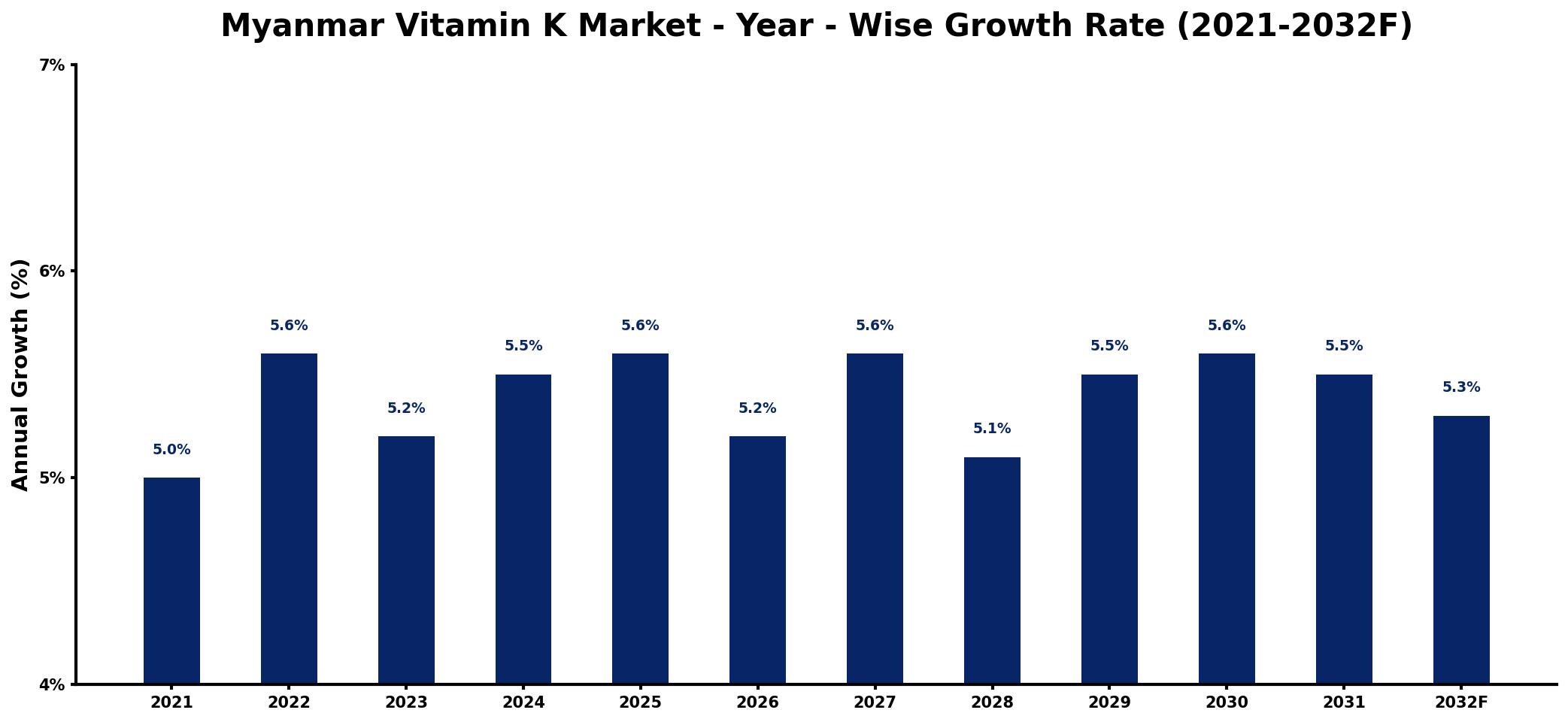
The table below presents the year‑wise growth rates along with the key drivers influencing the market
| Year | Growth Rate | Major Drivers |
| 2021 | 5.0% | Rising health awareness initiatives |
| 2022 | 5.6% | Increased dietary supplement consumption |
| 2023 | 5.2% | Growing demand for natural ingredients |
| 2024 | 5.5% | Expansion of health food retail |
| 2025 | 5.6% | Innovations in food fortification methods |
| 2026 | 5.2% | Surge in preventive healthcare trends |
| 2027 | 5.6% | Higher consumer spending on wellness |
| 2028 | 5.1% | Increased focus on nutrition education |
| 2029 | 5.5% | Growth in online health platforms |
| 2030 | 5.6% | Rising popularity of organic products |
| 2031 | 5.5% | rising procurement volume requirements |
| 2032 | 5.3% | Increased investments in research initiatives |
Note: Market size estimations and growth projections presented in this report are based on 6Wresearch's proprietary forecasting methodology, utilizing the latest available industry data, government publications, and primary research inputs.
Myanmar Vitamin K Market Synopsis
Recently, the Myanmar Vitamin K market has experienced a surge in demand, driven by a burgeoning interest in nutritional health among consumers. However, as the market matures, it is expected to navigate challenges such as high production costs and limited raw material availability.
Looking ahead, the market's growth will be shaped by government initiatives aimed at promoting Vitamin K consumption. These efforts are likely to enhance consumer awareness and drive the integration of Vitamin K into more food products, thereby paving the way for sustained market expansion.
Myanmar Vitamin K Market Key Takeaways
- The market is witnessing a significant uptick in consumer demand driven by health awareness.
- Government policies are supportive, offering subsidies and funding for research.
- The sector faces challenges, including high production costs and raw material scarcity.
- There is a noticeable lack of consumer knowledge regarding Vitamin K's benefits.
- The market is forecasted to grow steadily, reflecting an expanding health-conscious demographic.
Evaluation of Restraints in Myanmar Vitamin K Market
The Myanmar Vitamin K market is confronted with several constraints that may impede its growth. High production costs are a pressing concern, limiting manufacturers' ability to competitively price their products. Furthermore, the availability of raw materials is inconsistent, which can disrupt supply chains and impact product offerings. Another significant barrier is the competition posed by alternative vitamin supplements, which may divert potential customers away from Vitamin K products. Additionally, the overall lack of consumer awareness about the advantages of Vitamin K supplementation remains a critical hurdle that the industry must address to maximize market potential.
Myanmar Vitamin K Market Trends
Several trends are currently shaping the Myanmar Vitamin K market. First, there is a noticeable shift towards organic and natural supplements, as consumers become more health-conscious. Additionally, the rise of e-commerce is transforming the way Vitamin K products are marketed and sold, making them more accessible to a broader audience. Technological advancements in fortifying foods with Vitamin K are also emerging, enhancing product offerings and nutritional profiles. Furthermore, collaborations among health organizations and nutritional experts are fostering greater awareness of Vitamin K, potentially leading to increased consumption.
Myanmar Vitamin K Market Opportunities
Genuine growth opportunities lie in the enhancement of consumer education programs aimed at highlighting the health benefits of Vitamin K. Additionally, the expansion of fortified food products provides a significant avenue for market players to explore. As the government continues to support nutrition initiatives, companies that align their strategies with public health goals are poised to benefit. Moreover, the increasing integration of Vitamin K into various dietary supplements creates room for innovation and market diversification.
Government Initiatives in the Myanmar Vitamin K Market
The Myanmar government has recognized the importance of Vitamin K in promoting public health and is taking steps to bolster its market presence. Initiatives include subsidies aimed at encouraging the production of Vitamin K supplements and funding for research into its health benefits. Furthermore, the government actively promotes the fortification of staple foods with Vitamin K, seeking to improve overall nutritional outcomes for the population.
Future Insights of the Myanmar Vitamin K Market
From 2026 to 2032, the Myanmar Vitamin K market is expected to continue on its growth path, driven by a combination of rising health consciousness and supportive government policies. As consumer awareness increases, the demand for Vitamin K supplements and fortified foods is likely to surge. The strategic push towards educating the public about the benefits of Vitamin K, coupled with technological advancements in food fortification, will further enhance the market landscape. Overall, the next few years will be critical as the sector adapts to evolving consumer preferences and market dynamics.
Myanmar Vitamin K Market Latest Developments (2025 - 2026)
In the recent months, the Myanmar Vitamin K market has seen a surge in new product launches that emphasize both the health benefits of Vitamin K and its role in preventive healthcare. Industry stakeholders are increasingly collaborating with health professionals to create awareness campaigns that target health-conscious consumers. Additionally, the government has ramped up its efforts in promoting dietary supplements as part of national health initiatives, further strengthening the market's foundation.
Myanmar Vitamin K Market - Key Attractiveness of the Report
- 10 Years of Market Numbers
- Historical Data Starting from 2022 to 2025
- Base Year: 2025
- Forecast Data until 2032
- Key Performance Indicators Impacting the Market
- Major Upcoming Developments and Projects
Key Highlights of the Report:
- Myanmar Vitamin K Market Outlook
- Market Size of Myanmar Vitamin K Market, 2025
- Forecast of Myanmar Vitamin K Market, 2032
- Historical Data and Forecast of Myanmar Vitamin K Revenues & Volume for the Period 2022-2032F
- Myanmar Vitamin K Market Trend Evolution
- Myanmar Vitamin K Market Drivers and Challenges
- Myanmar Vitamin K Price Trends
- Myanmar Vitamin K Porter's Five Forces
- Myanmar Vitamin K Industry Life Cycle
- Historical Data and Forecast of Myanmar Vitamin K Market Revenues & Volume By Type for the Period 2022-2032F
- Historical Data and Forecast of Myanmar Vitamin K Market Revenues & Volume By Vitamin K1 for the Period 2022-2032F
- Historical Data and Forecast of Myanmar Vitamin K Market Revenues & Volume By Vitamin K2 for the Period 2022-2032F
- Historical Data and Forecast of Myanmar Vitamin K Market Revenues & Volume By Application for the Period 2022-2032F
- Historical Data and Forecast of Myanmar Vitamin K Market Revenues & Volume By Osteoporosis for the Period 2022-2032F
- Historical Data and Forecast of Myanmar Vitamin K Market Revenues & Volume By Vitamin-K Dependent Clotting Factor Deficiency for the Period 2022-2032F
- Historical Data and Forecast of Myanmar Vitamin K Market Revenues & Volume By Prothrombin Deficiency for the Period 2022-2032F
- Historical Data and Forecast of Myanmar Vitamin K Market Revenues & Volume By Vitamin K Deficiency Bleeding for the Period 2022-2032F
- Historical Data and Forecast of Myanmar Vitamin K Market Revenues & Volume By Dermal Applications for the Period 2022-2032F
- Historical Data and Forecast of Myanmar Vitamin K Market Revenues & Volume By Route of Administration for the Period 2022-2032F
- Historical Data and Forecast of Myanmar Vitamin K Market Revenues & Volume By Oral for the Period 2022-2032F
- Historical Data and Forecast of Myanmar Vitamin K Market Revenues & Volume By Parenteral for the Period 2022-2032F
- Historical Data and Forecast of Myanmar Vitamin K Market Revenues & Volume By Topical for the Period 2022-2032F
- Myanmar Vitamin K Import Export Trade Statistics
- Market Opportunity Assessment By Type
- Market Opportunity Assessment By Application
- Market Opportunity Assessment By Route of Administration
- Myanmar Vitamin K Top Companies Market Share
- Myanmar Vitamin K Competitive Benchmarking By Technical and Operational Parameters
- Myanmar Vitamin K Company Profiles
- Myanmar Vitamin K Key Strategic Recommendations






































