Myanmar Water Purifier Market Size, Share & Growth Rate
The Myanmar Water Purifier Market was estimated at USD 281 Million in 2025 and is projected to reach USD 372 Million by 2032, growing at a CAGR of 4.1% from 2026 to 2032. This growth is primarily fueled by increasing awareness around health and hygiene, which has led consumers to seek reliable water purification solutions. Moreover, advancements in purification technologies such as reverse osmosis and UV filtration systems are making these products more effective and accessible.
Myanmar Water Purifier Market Year-wise Growth Rate and Key Drivers
This graph highlights how the Myanmar Water Purifier Market has steadily grown over the years, supported by major growth factors.
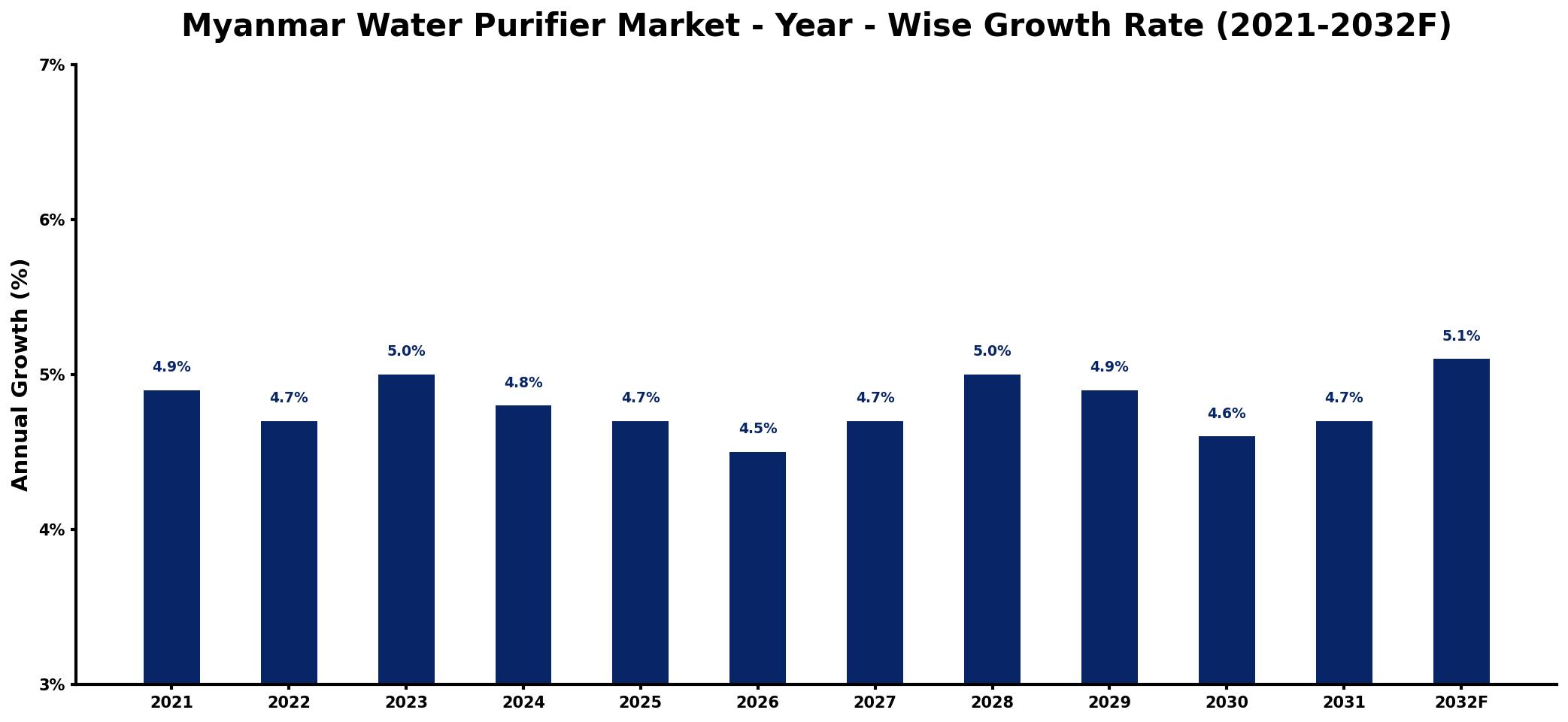
The table below presents the year‑wise growth rates along with the key drivers influencing the market
| Year | Growth Rate | Major Drivers |
| 2021 | 4.9% | Increased consumer health awareness |
| 2022 | 4.7% | Growing urban population demand |
| 2023 | 5.0% | Expansion of distribution networks |
| 2024 | 4.8% | Rising government health initiatives |
| 2025 | 4.7% | Higher disposable income levels |
| 2026 | 4.5% | More stringent health regulations |
| 2027 | 4.7% | Increased environmental sustainability focus |
| 2028 | 5.0% | Technological advancements in filtration |
| 2029 | 4.9% | Enhanced public awareness campaigns |
| 2030 | 4.6% | Investment in rural infrastructure |
| 2031 | 4.7% | Growth in tourism sector |
| 2032 | 5.1% | Emerging middle class expansion |
Note: Market size estimations and growth projections presented in this report are based on 6Wresearch's proprietary forecasting methodology, utilizing the latest available industry data, government publications, and primary research inputs.
Myanmar Water Purifier Market Synopsis
The Myanmar Water Purifier Market has recently experienced an uptick in demand, driven by a growing recognition of the importance of clean drinking water. However, despite this momentum, the market is poised for further expansion as government policies and consumer awareness initiatives are set to enhance the adoption of purification systems in homes and businesses alike.
As the market evolves, emerging trends, such as a shift toward eco-friendly purification technologies and an increased focus on health, are reshaping consumer preferences. The path ahead promises not only growth but also a vital transformation in how Myanmar addresses its clean water needs.
Myanmar Water Purifier Market Key Takeaways
- The market is set to grow from USD 281 Million in 2025 to USD 372 Million by 2032.
- Increased public awareness about health and hygiene is a significant growth driver.
- Technological advancements in purification methods are enhancing product efficiency and accessibility.
- Government initiatives play a crucial role in promoting clean water access and subsidies for water purifiers.
- Challenges such as high import tariffs and limited consumer education remain key issues to address.
Evaluation of Restraints in Myanmar Water Purifier Market
Despite the positive trajectory, the Myanmar Water Purifier Market faces several restraints that could impede growth. High import tariffs on purification systems increase costs, making them less accessible to the average consumer. Additionally, there is a lack of widespread consumer knowledge regarding the benefits of water purifiers, which limits market penetration. Furthermore, inadequate infrastructure for distribution poses challenges, especially in rural areas where clean drinking water access is essential.
Myanmar Water Purifier Market Trends
Several key trends are shaping the Myanmar Water Purifier Market. The shift toward environmentally sustainable technologies is gaining traction, as consumers increasingly prefer products that are both effective and eco-friendly. Additionally, the integration of smart technology in water purifiers is becoming more popular, allowing users to monitor water quality and usage through connected devices. These trends indicate a move toward more sophisticated, user-friendly solutions in the water purification sector.
Myanmar Water Purifier Market Opportunities
The growth prospects in the Myanmar Water Purifier Market are robust, driven by opportunities in both urban and rural settings. There is significant potential for expanding distribution networks to reach underserved communities. Additionally, partnerships with local organizations focused on health education can help raise awareness and foster a culture of water purification. With increasing urbanization, demand for home purification systems is likely to rise, presenting a viable investment avenue.
Government Initiatives in the Myanmar Water Purifier Market
The Myanmar government is actively promoting initiatives to ensure access to clean and safe drinking water for its citizens. This includes offering subsidies for both the production and purchase of water purifiers, which can make these essential technologies more affordable. Additionally, government funding for research into innovative purification technologies reflects a commitment to improving public health and supporting local industries, while awareness campaigns are designed to educate the populace about the importance of clean water.
Future Insights of the Myanmar Water Purifier Market
Looking forward to 2026-2032, the Myanmar Water Purifier Market is set to evolve significantly. As public awareness about health continues to grow, so too will the demand for advanced purification technologies. Innovations in product design and efficacy will further drive market interest. Government support and infrastructure improvements are expected to enhance market accessibility, ensuring that clean drinking water becomes a standard expectation rather than a luxury.
Myanmar Water Purifier Market Latest Developments (2025 - 2026)
In recent months, the Myanmar Water Purifier Market has seen notable developments as companies ramp up production capabilities to meet rising demand. New product launches featuring advanced purification technologies reflect the competitive landscape, while collaborations with local NGOs aim to expand awareness and adoption. Additionally, policy updates have encouraged more investments in water purification initiatives, signaling a robust commitment from both the government and private sectors.
Myanmar Water Purifier Market - Key Attractiveness of the Report
- 10 Years of Market Numbers
- Historical Data Starting from 2022 to 2025
- Base Year: 2025
- Forecast Data until 2032
- Key Performance Indicators Impacting the Market
- Major Upcoming Developments and Projects
Key Highlights of the Report:
- Myanmar Water Purifier Market Outlook
- Market Size of Myanmar Water Purifier Market, 2025
- Forecast of Myanmar Water Purifier Market, 2032
- Historical Data and Forecast of Myanmar Water Purifier Revenues & Volume for the Period 2022-2032F
- Myanmar Water Purifier Market Trend Evolution
- Myanmar Water Purifier Market Drivers and Challenges
- Myanmar Water Purifier Price Trends
- Myanmar Water Purifier Porter's Five Forces
- Myanmar Water Purifier Industry Life Cycle
- Historical Data and Forecast of Myanmar Water Purifier Market Revenues & Volume By Type for the Period 2022-2032F
- Historical Data and Forecast of Myanmar Water Purifier Market Revenues & Volume By Point-of-use Filters for the Period 2022-2032F
- Historical Data and Forecast of Myanmar Water Purifier Market Revenues & Volume By Under The Counter Filters for the Period 2022-2032F
- Historical Data and Forecast of Myanmar Water Purifier Market Revenues & Volume By Counter Top Filters for the Period 2022-2032F
- Historical Data and Forecast of Myanmar Water Purifier Market Revenues & Volume By Pitcher Filters for the Period 2022-2032F
- Historical Data and Forecast of Myanmar Water Purifier Market Revenues & Volume By Faucet-mounted Filters for the Period 2022-2032F
- Historical Data and Forecast of Myanmar Water Purifier Market Revenues & Volume By Others for the Period 2022-2032F
- Historical Data and Forecast of Myanmar Water Purifier Market Revenues & Volume By Point-of-entry Filters for the Period 2022-2032F
- Historical Data and Forecast of Myanmar Water Purifier Market Revenues & Volume By Category for the Period 2022-2032F
- Historical Data and Forecast of Myanmar Water Purifier Market Revenues & Volume By Ro Filters for the Period 2022-2032F
- Historical Data and Forecast of Myanmar Water Purifier Market Revenues & Volume By Uv Filters for the Period 2022-2032F
- Historical Data and Forecast of Myanmar Water Purifier Market Revenues & Volume By Gravity Filters for the Period 2022-2032F
- Historical Data and Forecast of Myanmar Water Purifier Market Revenues & Volume By Others for the Period 2022-2032F
- Historical Data and Forecast of Myanmar Water Purifier Market Revenues & Volume By Application for the Period 2022-2032F
- Historical Data and Forecast of Myanmar Water Purifier Market Revenues & Volume By Residential for the Period 2022-2032F
- Historical Data and Forecast of Myanmar Water Purifier Market Revenues & Volume By Light Commercial for the Period 2022-2032F
- Myanmar Water Purifier Import Export Trade Statistics
- Market Opportunity Assessment By Type
- Market Opportunity Assessment By Category
- Market Opportunity Assessment By Application
- Myanmar Water Purifier Top Companies Market Share
- Myanmar Water Purifier Competitive Benchmarking By Technical and Operational Parameters
- Myanmar Water Purifier Company Profiles
- Myanmar Water Purifier Key Strategic Recommendations






































