Myanmar Water Treatment Market Summary
The myanmar water treatment market was estimated at USD 434 Million in 2025 and is projected to reach USD 579 Million by 2032, growing at a CAGR of 4.7% from 2026 to 2032.
Myanmar Water Treatment Market Year-wise Growth Rate and Key Drivers
This graph highlights how the Myanmar Water Treatment Market has steadily grown over the past five years, supported by major growth factors.
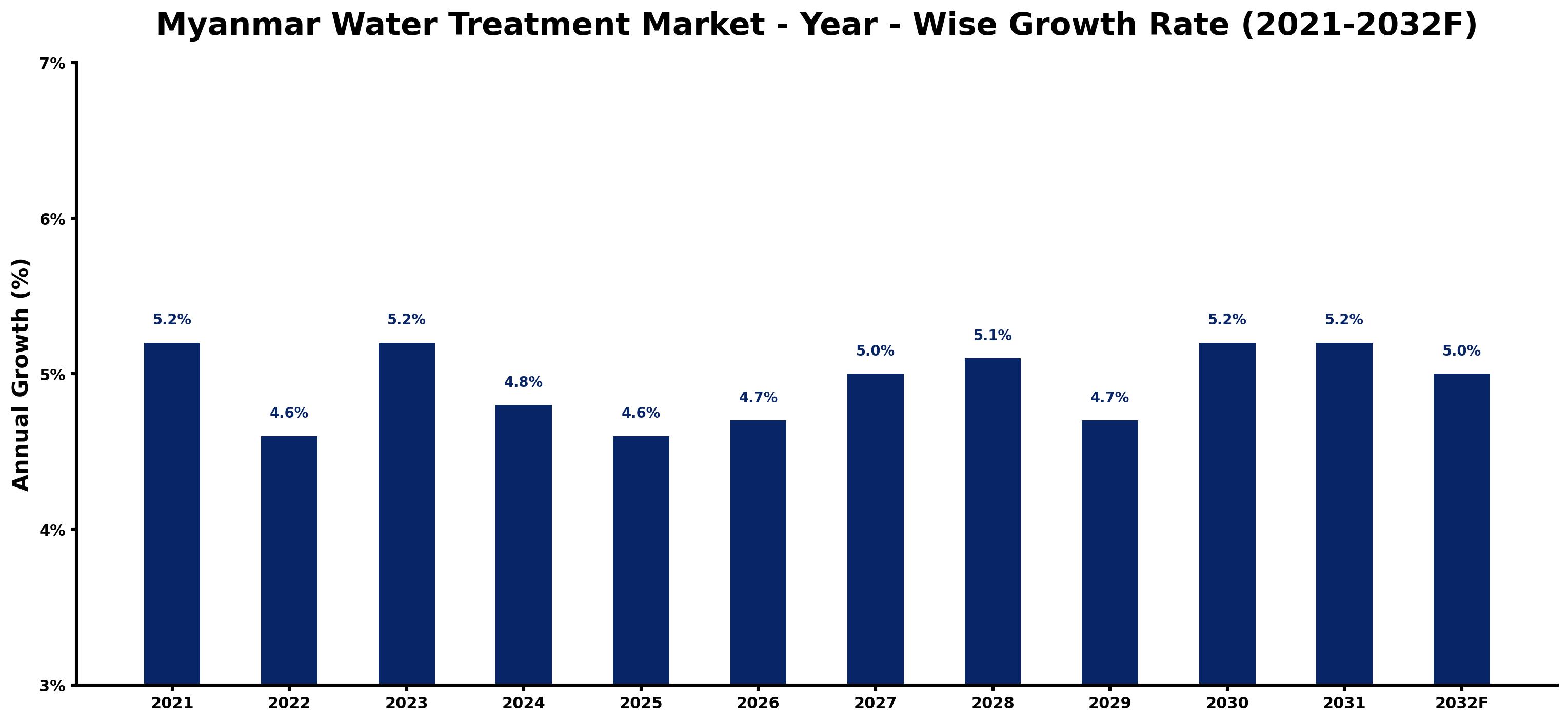
The table below presents the year wise growth rates along with the key drivers influencing the market
| Year | Growth Rate | Major Drivers |
| 2021 | 5.2% | Investment in infrastructure upgrades enhances water treatment capabilities and efficiency. |
| 2022 | 4.6% | Rural electrification programs increase access to clean water solutions for communities. |
| 2023 | 5.2% | Local partnerships boost technology transfer for advanced water purification techniques. |
| 2024 | 4.8% | Increased awareness of health impacts drives demand for reliable water treatment solutions. |
| 2025 | 4.6% | Climate change pressures promote sustainable practices within water management sectors. |
| 2026 | 4.7% | Technological innovations reduce operational costs associated with water treatment facilities. |
| 2027 | 5.0% | Emerging industries, including tourism, require enhanced water quality for sustainability. |
| 2028 | 5.1% | Government collaborations initiate long-term projects for improved water infrastructure. |
| 2029 | 4.7% | Urbanization trends lead to higher demands for efficient wastewater management systems. |
| 2030 | 5.2% | International investments encourage development of advanced filtration technologies in Myanmar. |
| 2031 | 5.2% | Public-private partnerships enhance resource allocation for water treatment initiatives. |
| 2032 | 5.0% | Enhanced regulatory frameworks ensure compliance and drive market growth for treatment services. |
Note - Market size estimations and growth projections presented in this report are based on 6Wresearch's advanced forecasting approach, validated with industry datasets as of June 2026.
Myanmar Water Treatment Market Synopsis
The Myanmar Water Treatment Market is projected to reach 4.7% and witness significant growth during the forecast period (2026-2032). This expansion is driven by an array of factors including the increasing urban population, which demands greater access to clean drinking water, and substantial investments in infrastructure aimed at enhancing water treatment capabilities. Furthermore, the government's commitment to Sustainable Development Goal 6 (SDG 6), focusing on ensuring availability and sustainable management of water and sanitation for all, underscores a vital initiative that supports the sector's growth. As concerns surrounding climate change continue to mount, there is a notable shift towards the adoption of innovative technologies utilizing renewable energy for wastewater treatment, raising the bar for environmental sustainability.
Myanmar Water Treatment Market Growth Drivers
Several key factors contribute to the growth of the Myanmar water treatment market. Firstly, increased urbanization signifies a rising population in cities, amplifying the demand for potable water solutions. Secondly, government initiatives promoting public health and sanitation improvement pave the way for enhanced water treatment facilities. Thirdly, ongoing industrialization necessitates adherence to stringent regulatory standards on wastewater management, thereby bolstering the market. Fourthly, escalating investment in infrastructure development, including rehabilitation of existing facilities and construction of new plants, directly supports market dynamics. Lastly, the rising awareness among the populace about the importance of clean water for health drives market demand.
Myanmar Water Treatment Market Trends and Opportunities
The Myanmar water treatment market is witnessing several trends that present significant opportunities. The emphasis on technological advancements in water purification methods, particularly those leveraging renewable energy, marks a pivotal shift towards sustainable practices. Additionally, the integration of smart water management systems is becoming increasingly prevalent, enhancing efficiency and monitoring capabilities in water distribution. Furthermore, the rise in public-private partnerships provides avenues for collaborative investments in infrastructure projects. The focus on environmentally friendly treatment options is also gaining traction, appealing to both consumers and regulatory bodies alike. Lastly, the exploration of various funding mechanisms, including international aid and investments, serves to support infrastructure development efforts in the region.
Myanmar Water Treatment Market Challenges and Restraints
Despite positive growth prospects, the Myanmar water treatment market faces several challenges. Access to information technology systems remains limited, hindering efficient data management and operational optimization. Additionally, inadequate access to capital can restrict the capabilities of local firms to adopt advanced technologies essential for modern water treatment processes. Furthermore, underdeveloped infrastructure leads to an unreliable supply chain, particularly in rural areas, complicating the distribution of treated water. The market also grapples with a lack of skilled professionals trained in modern water treatment techniques, which can impede technological advancement. Finally, socio-political factors may affect investment flows and project implementations, adding layers of complexity to market dynamics.
Myanmar Water Treatment Market Government Investment and Initiatives
The Myanmar government has recognized the critical importance of water treatment and sanitation in enhancing public health and economic viability. As part of its commitment to achieving SDG 6, the government actively promotes initiatives that seek to improve infrastructure and service delivery across the water treatment sector. Public spending has been directed towards constructing new facilities, upgrading existing ones, and fostering collaborations with international development agencies. With a focus on sustainable practices, government policies are increasingly steering investments towards technologies that minimize environmental impact. Moreover, incentives for private sector participation in water infrastructure projects are being developed, aimed at attracting capital to bolster the sector's capacity to meet the growing demand for clean water.
Myanmar Water Treatment Market Latest Developments (May 2025 - June 2026)
Recent developments in the Myanmar water treatment market have highlighted a strong trend towards embracing innovative technologies. During this period, several initiatives have emerged, aiming to enhance the efficiency of water treatment processes and expand access to potable water. Additionally, collaborations between governmental bodies and non-governmental organizations have been instrumental in launching various projects focused on rural water infrastructure improvements. The need for sustainable practices has led to increased investments in renewable energy-powered treatment plants. Furthermore, efforts to improve public awareness regarding water conservation and treatment technologies have gained traction, emphasizing the significance of community engagement in achieving national water goals.
Myanmar Water Treatment Market - Key Attractiveness of the Report
- 10 Years of Market Numbers
- Historical Data Starting from 2022 to 2025
- Base Year: 2025
- Forecast Data until 2032
- Key Performance Indicators Impacting the Market
- Major Upcoming Developments and Projects
Key Highlights of the Report:
- Myanmar Water Treatment Market Outlook
- Market Size of Myanmar Water Treatment Market, 2025
- Forecast of Myanmar Water Treatment Market, 2032F
- Historical Data and Forecast of Myanmar Water Treatment Revenues & Volume for the Period 2022-2032F
- Myanmar Water Treatment Market Trend Evolution
- Myanmar Water Treatment Market Drivers and Challenges
- Myanmar Water Treatment Price Trends
- Myanmar Water Treatment Porter's Five Forces
- Myanmar Water Treatment Industry Life Cycle
- Historical Data and Forecast of Myanmar Water Treatment Market Revenues & Volume By Types for the Period 2022-2032F
- Historical Data and Forecast of Myanmar Water Treatment Market Revenues & Volume By Distillation? for the Period 2022-2032F
- Historical Data and Forecast of Myanmar Water Treatment Market Revenues & Volume By Filtration? for the Period 2022-2032F
- Historical Data and Forecast of Myanmar Water Treatment Market Revenues & Volume By Disinfection for the Period 2022-2032F
- Historical Data and Forecast of Myanmar Water Treatment Market Revenues & Volume By Reverse Osmosis for the Period 2022-2032F
- Historical Data and Forecast of Myanmar Water Treatment Market Revenues & Volume By Applications for the Period 2022-2032F
- Historical Data and Forecast of Myanmar Water Treatment Market Revenues & Volume By Residential? for the Period 2022-2032F
- Historical Data and Forecast of Myanmar Water Treatment Market Revenues & Volume By Non-Residential? for the Period 2022-2032F
- Historical Data and Forecast of Myanmar Water Treatment Market Revenues & Volume By Installations for the Period 2022-2032F
- Historical Data and Forecast of Myanmar Water Treatment Market Revenues & Volume By Point Of Use for the Period 2022-2032F
- Historical Data and Forecast of Myanmar Water Treatment Market Revenues & Volume By Point Of Entry for the Period 2022-2032F
- Myanmar Water Treatment Import Export Trade Statistics
- Market Opportunity Assessment By Types
- Market Opportunity Assessment By Applications
- Market Opportunity Assessment By Installations
- Myanmar Water Treatment Top Companies Market Share
- Myanmar Water Treatment Competitive Benchmarking By Technical and Operational Parameters
- Myanmar Water Treatment Company Profiles
- Myanmar Water Treatment Key Strategic Recommendations






































