Myanmar Website Builder Market Size, Share & Growth Rate
The Myanmar Website Builder Market was estimated at USD 259 Million in 2025 and is projected to reach USD 367 Million by 2032, growing at a CAGR of 5.1% from 2026 to 2032. This upward trajectory is primarily driven by the surge in digital entrepreneurship and the growing recognition among small and medium-sized enterprises of the vital need for an online presence. Coupled with a rise in digital marketing initiatives, the demand for accessible website-building solutions is poised to escalate in the coming years.
Myanmar Website Builder Market Year-wise Growth Rate and Key Drivers
This graph highlights how the Myanmar Website Builder Market has steadily grown over the years, supported by major growth factors.
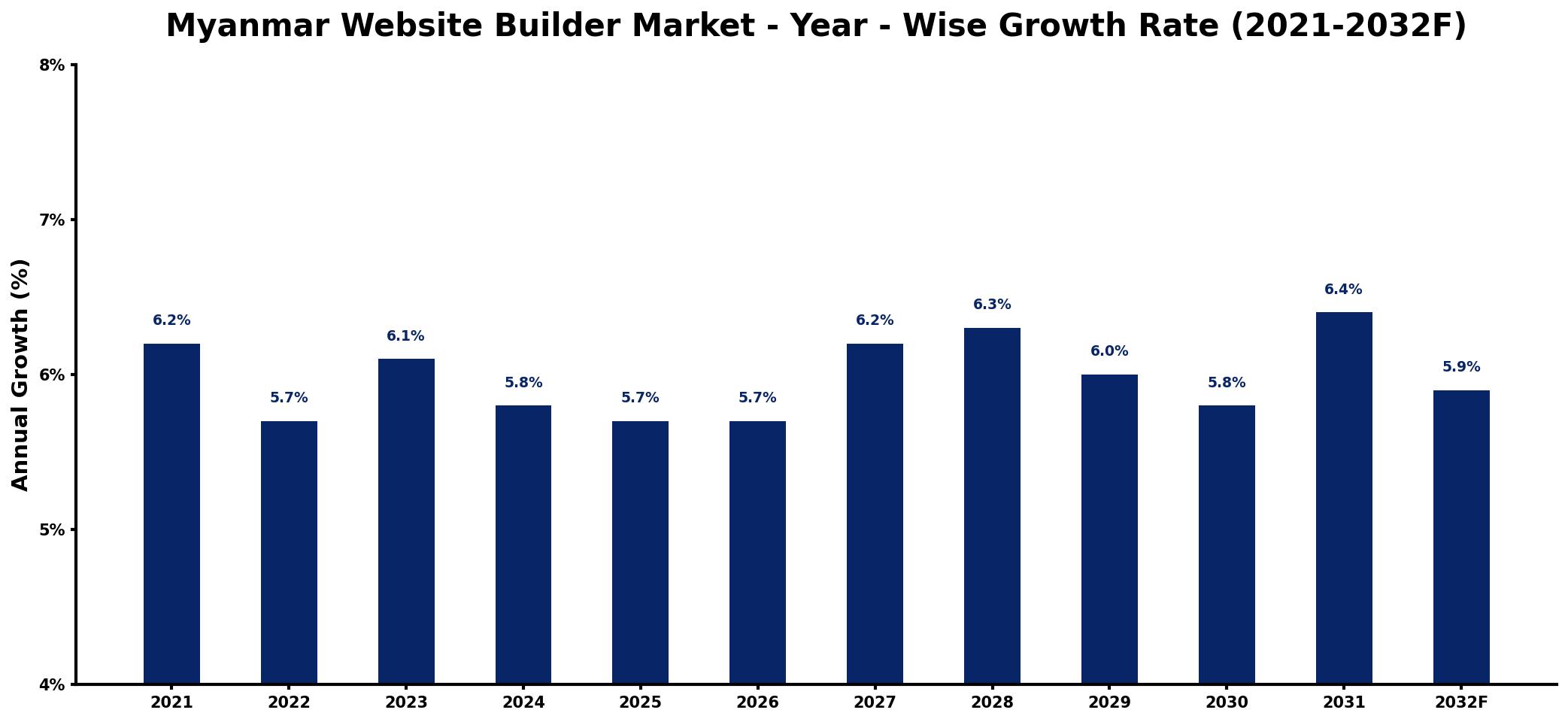
The table below presents the year‑wise growth rates along with the key drivers influencing the market
| Year | Growth Rate | Major Drivers |
| 2021 | 6.2% | Increased digital marketing investments |
| 2022 | 5.7% | Rising e-commerce platform adoption |
| 2023 | 6.1% | Growing demand for online presence |
| 2024 | 5.8% | Expansion of mobile internet access |
| 2025 | 5.7% | Surge in small business startups |
| 2026 | 5.7% | Increase in freelance digital services |
| 2027 | 6.2% | Growing interest in local content |
| 2028 | 6.3% | Enhanced social media engagement strategies |
| 2029 | 6.0% | Rise in mobile app development |
| 2030 | 5.8% | Growth of online educational platforms |
| 2031 | 6.4% | Increased focus on user experience |
| 2032 | 5.9% | increased overall sector activity |
Note: Market size estimations and growth projections presented in this report are based on 6Wresearch's proprietary forecasting methodology, utilizing the latest available industry data, government publications, and primary research inputs.
Myanmar Website Builder Market Synopsis
In Myanmar, the website builder market is experiencing significant transformation, fueled by an increasing number of SMEs seeking to establish their digital footprint. This drive for online visibility is becoming crucial as businesses aim to tap into the digital economy and enhance their competitive edge.
Furthermore, the advent of user-friendly platforms is making it easier for individuals and businesses without coding skills to create attractive websites. With affordable solutions becoming widely available, the market is positioned for robust growth, aligning with global digital trends.
Myanmar Website Builder Market Key Takeaways
- The market is driven by the rising need for SMEs to create an online presence and leverage digital marketing.
- User-friendly, low-cost website builders are essential for supporting local entrepreneurs and businesses.
- Government policies are encouraging the adoption of online platforms among businesses and individuals.
- Challenges such as low digital literacy remain, potentially hindering growth opportunities.
- The market is expected to witness continued growth, fueled by increasing digital adoption across various sectors.
Evaluation of Restraints in Myanmar Website Builder Market
Despite promising growth prospects, the Myanmar Website Builder Market faces significant restraints, particularly concerning digital literacy. A considerable portion of the population remains unaware of the advantages of having an online presence, which stunts demand for website-building services. Additionally, limited access to affordable and user-friendly tools tailored to local requirements hampers widespread adoption. Addressing these issues is crucial for unlocking the markets full potential.
Myanmar Website Builder Market Trends
A notable trend in the Myanmar Website Builder Market is the increasing integration of artificial intelligence (AI) and automation features within website-building platforms. These advancements allow users to create personalized websites more efficiently. Moreover, the emphasis on mobile optimization is growing, as more consumers engage with businesses through their mobile devices. Enhanced customization features are becoming a standard expectation, catering to the diverse needs of the local market.
Myanmar Website Builder Market Opportunities
The growing number of start-ups and small businesses presents substantial opportunities for website builders in Myanmar. By focusing on local needs and developing tools that enhance usability, companies can capture this expanding segment. Moreover, the rise of digital marketing and e-commerce initiatives creates an additional avenue for growth, as businesses increasingly seek integrated solutions for their online activities.
Government Initiatives in the Myanmar Website Builder Market
The government of Myanmar is actively promoting initiatives that support the establishment of an online presence among SMEs and individuals. Programs include the provision of low-cost resources and subsidies for website-building tools, as well as training programs aimed at enhancing digital skills. Additionally, partnerships between website builder platforms and local entrepreneurs are being facilitated to increase accessibility and usability for potential users.
Future Insights of the Myanmar Website Builder Market
Looking ahead to 2026-2032, the Myanmar Website Builder Market is poised for steady expansion. As digital literacy improves and more businesses embrace the necessity of online platforms, demand for website-building solutions will likely accelerate. Moreover, the continuous development of advanced features within website builders could lead to increased market competition, further enhancing user experiences and driving innovation in the sector.
Myanmar Website Builder Market Latest Developments (2025 - 2026)
In recent months, the Myanmar website builder landscape has seen a flurry of activity aimed at addressing local needs. Many platforms are launching tailored packages designed for SMEs, emphasizing affordability and ease of use. Additionally, initiatives to collaborate with educational institutions are on the rise, aiming to bolster digital skills among the workforce, thereby expanding the potential user base for website-building tools.
Myanmar Website Builder Market - Key Attractiveness of the Report
- 10 Years of Market Numbers
- Historical Data Starting from 2022 to 2025
- Base Year: 2025
- Forecast Data until 2032
- Key Performance Indicators Impacting the Market
- Major Upcoming Developments and Projects
Key Highlights of the Report:
- Myanmar Website Builder Market Outlook
- Market Size of Myanmar Website Builder Market, 2025
- Forecast of Myanmar Website Builder Market, 2032
- Historical Data and Forecast of Myanmar Website Builder Revenues & Volume for the Period 2022-2032F
- Myanmar Website Builder Market Trend Evolution
- Myanmar Website Builder Market Drivers and Challenges
- Myanmar Website Builder Price Trends
- Myanmar Website Builder Porter's Five Forces
- Myanmar Website Builder Industry Life Cycle
- Historical Data and Forecast of Myanmar Website Builder Market Revenues & Volume By Deployment Type for the Period 2022-2032F
- Historical Data and Forecast of Myanmar Website Builder Market Revenues & Volume By Cloud-Based for the Period 2022-2032F
- Historical Data and Forecast of Myanmar Website Builder Market Revenues & Volume By On-Premise for the Period 2022-2032F
- Historical Data and Forecast of Myanmar Website Builder Market Revenues & Volume By Type for the Period 2022-2032F
- Historical Data and Forecast of Myanmar Website Builder Market Revenues & Volume By Mobile Website Builders for the Period 2022-2032F
- Historical Data and Forecast of Myanmar Website Builder Market Revenues & Volume By PC Website Builders for the Period 2022-2032F
- Historical Data and Forecast of Myanmar Website Builder Market Revenues & Volume By End Users for the Period 2022-2032F
- Historical Data and Forecast of Myanmar Website Builder Market Revenues & Volume By Individuals for the Period 2022-2032F
- Historical Data and Forecast of Myanmar Website Builder Market Revenues & Volume By SMEs for the Period 2022-2032F
- Historical Data and Forecast of Myanmar Website Builder Market Revenues & Volume By Large Enterprises for the Period 2022-2032F
- Myanmar Website Builder Import Export Trade Statistics
- Market Opportunity Assessment By Deployment Type
- Market Opportunity Assessment By Type
- Market Opportunity Assessment By End Users
- Myanmar Website Builder Top Companies Market Share
- Myanmar Website Builder Competitive Benchmarking By Technical and Operational Parameters
- Myanmar Website Builder Company Profiles
- Myanmar Website Builder Key Strategic Recommendations






































