Myanmar Welding Consumables Market Size, Share & Growth Rate
The Myanmar Welding Consumables Market was estimated at USD 360 Million in 2025 and is projected to reach USD 509 Million by 2032, growing at a CAGR of 5.1% from 2026 to 2032. This growth trajectory is largely propelled by the expanding construction, manufacturing, and automotive sectors, which are increasingly prioritizing high-quality welding consumables to enhance the reliability and efficiency of their operations. Additionally, the ongoing infrastructural developments and investments in industrial capabilities further bolster demand for welding materials.
Myanmar Welding Consumables Market Year-wise Growth Rate and Key Drivers
This graph highlights how the Myanmar Welding Consumables Market has steadily grown over the years, supported by major growth factors.
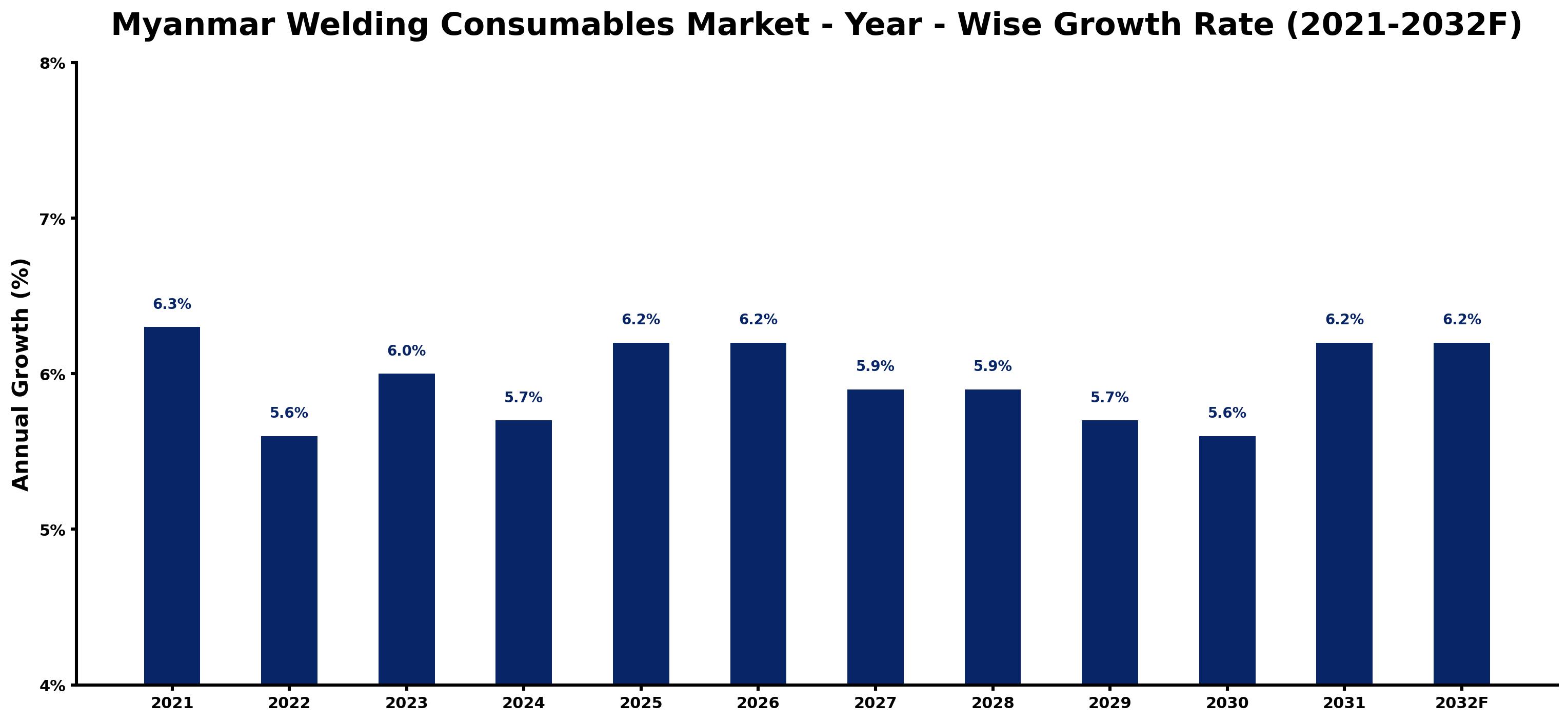
The table below presents the year‑wise growth rates along with the key drivers influencing the market
| Year | Growth Rate | Major Drivers |
| 2021 | 6.3% | Increasing smart city development projects |
| 2022 | 5.6% | Expansion of commercial construction activities |
| 2023 | 6.0% | Government infrastructure modernization initiatives |
| 2024 | 5.7% | Rapid growth in telecom and data center sectors |
| 2025 | 6.2% | Growing urbanization and commercial development |
| 2026 | 6.2% | Growing urbanization and commercial development |
| 2027 | 5.9% | Expansion of transportation and logistics networks |
| 2028 | 5.9% | Increasing industrial automation investments |
| 2029 | 5.7% | Increasing adoption of advanced technologies |
| 2030 | 5.6% | Government infrastructure modernization initiatives |
| 2031 | 6.2% | Increasing smart city development projects |
| 2032 | 6.2% | Government infrastructure modernization initiatives |
Note - Market size estimations and growth projections presented in this report are based on 6Wresearch's advanced forecasting approach, validated with industry datasets as of June 2026.
Myanmar Welding Consumables Market Synopsis
Recently, the Myanmar Welding Consumables Market has shown a strong upward momentum, benefiting from the robust growth of key industries. However, as it transitions towards 2032, the market faces challenges related to quality control and supply chain reliability, which will need to be addressed to sustain growth.
As the market evolves, consumers are increasingly seeking materials that offer not just strength and conductivity, but also enhanced corrosion resistance and thermal stability. The demand for welding consumables is poised to rise significantly, emphasizing the need for standardized and high-quality products in this growing landscape.
Myanmar Welding Consumables Market Key Takeaways
- The market is projected to grow at a CAGR of 5.1% from 2026 to 2032.
- Strong growth is driven by the construction, manufacturing, and automotive sectors.
- The reliance on imports presents challenges regarding quality and availability.
- Government initiatives are enhancing manufacturing capabilities and training programs.
- Emerging trends focus on higher standards of quality and performance in welding materials.
Evaluation of Restraints in Myanmar Welding Consumables Market
The Myanmar Welding Consumables Market is currently restrained by several critical factors. One prominent issue is the heavy reliance on imports, which can lead to supply chain disruptions and expose the market to volatile international pricing. Moreover, the lack of standardization and quality control among locally produced consumables undermines operational reliability. These issues hinder the potential for local manufacturers to meet the increasing demand for quality materials, ultimately affecting overall market performance.
Myanmar Welding Consumables Market Trends
There are notable trends shaping the Myanmar Welding Consumables Market. Increasingly, manufacturers are focusing on developing welding consumables with improved properties, such as enhanced corrosion resistance and thermal stability. Additionally, advancements in technology are allowing for more efficient welding processes, which in turn drives the demand for high-quality materials. The emphasis on sustainability and eco-friendly practices is also emerging, pushing the market towards innovative solutions that align with global environmental standards.
Myanmar Welding Consumables Market Opportunities
The market presents several genuine growth and investment opportunities. There is significant potential for local manufacturers to expand their product lines by incorporating advanced materials and technologies that meet international standards. Additionally, as the construction and automotive sectors continue to expand, there will be increasing demand for specialized welding applications, creating new niches for innovation. Investment in vocational training and skill development programs can further enhance the workforce's capabilities, driving productivity in this sector.
Government Initiatives in the Myanmar Welding Consumables Market
The Myanmar government is actively promoting the Welding Consumables Market through various initiatives. There are financial incentives in place aimed at enhancing the manufacturing sector's capabilities, ensuring that producers can deliver high-quality consumables. The government is also establishing regulatory standards for material composition and performance, which are crucial for improving reliability in welding processes. Moreover, vocational training programs are being supported to enhance the skills of the workforce, aligning with the industry's needs for higher quality and efficiency.
Future Insights of the Myanmar Welding Consumables Market
Looking forward to the years 2026-2032, the Myanmar Welding Consumables Market is set to evolve significantly. As the construction, automotive, and manufacturing sectors grow, the demand for sophisticated and reliable welding materials will only intensify. Emphasis on quality and standardization is expected to drive manufacturers to innovate, ensuring they meet both local and international standards. With the government's support and a focus on skill development, the market is well-positioned for sustainable growth in the coming years.
Myanmar Welding Consumables Market Latest Developments (May 2025 - June 2026)
Recent developments in the Myanmar Welding Consumables Market indicate a shift towards greater quality control and standardization in locally produced materials. Initiatives focused on enhancing the capabilities of local manufacturers are gaining traction, with more emphasis placed on adopting international quality standards. Furthermore, there is a notable increase in collaboration between government entities and educational institutions to bolster vocational training programs aimed at addressing the skills gap within the industry. These changes signal a positive direction for the market's future.
Myanmar Welding Consumables Market - Key Attractiveness of the Report
- 10 Years of Market Numbers
- Historical Data Starting from 2022 to 2025
- Base Year: 2025
- Forecast Data until 2032
- Key Performance Indicators Impacting the Market
- Major Upcoming Developments and Projects
Key Highlights of the Report:
- Myanmar Welding Consumables Market Outlook
- Market Size of Myanmar Welding Consumables Market, 2025
- Forecast of Myanmar Welding Consumables Market, 2032
- Historical Data and Forecast of Myanmar Welding Consumables Revenues & Volume for the Period 2022-2032F
- Myanmar Welding Consumables Market Trend Evolution
- Myanmar Welding Consumables Market Drivers and Challenges
- Myanmar Welding Consumables Price Trends
- Myanmar Welding Consumables Porter's Five Forces
- Myanmar Welding Consumables Industry Life Cycle
- Historical Data and Forecast of Myanmar Welding Consumables Market Revenues & Volume By Type for the Period 2022-2032F
- Historical Data and Forecast of Myanmar Welding Consumables Market Revenues & Volume By Stick Electrodes for the Period 2022-2032F
- Historical Data and Forecast of Myanmar Welding Consumables Market Revenues & Volume By Solid Wires for the Period 2022-2032F
- Historical Data and Forecast of Myanmar Welding Consumables Market Revenues & Volume By Flux Cored Wires for the Period 2022-2032F
- Historical Data and Forecast of Myanmar Welding Consumables Market Revenues & Volume By SAW Wires & Fluxes for the Period 2022-2032F
- Historical Data and Forecast of Myanmar Welding Consumables Market Revenues & Volume By End-user Industry for the Period 2022-2032F
- Historical Data and Forecast of Myanmar Welding Consumables Market Revenues & Volume By Aerospace & Defense for the Period 2022-2032F
- Historical Data and Forecast of Myanmar Welding Consumables Market Revenues & Volume By Automotive & Transportation for the Period 2022-2032F
- Historical Data and Forecast of Myanmar Welding Consumables Market Revenues & Volume By Construction for the Period 2022-2032F
- Historical Data and Forecast of Myanmar Welding Consumables Market Revenues & Volume By Energy for the Period 2022-2032F
- Historical Data and Forecast of Myanmar Welding Consumables Market Revenues & Volume By Heavy Machinery for the Period 2022-2032F
- Historical Data and Forecast of Myanmar Welding Consumables Market Revenues & Volume By Shipbuilding for the Period 2022-2032F
- Historical Data and Forecast of Myanmar Welding Consumables Market Revenues & Volume By Process & Others for the Period 2022-2032F
- Historical Data and Forecast of Myanmar Welding Consumables Market Revenues & Volume By Welding Technique for the Period 2022-2032F
- Historical Data and Forecast of Myanmar Welding Consumables Market Revenues & Volume By Arc Welding for the Period 2022-2032F
- Historical Data and Forecast of Myanmar Welding Consumables Market Revenues & Volume By Resistance Welding for the Period 2022-2032F
- Historical Data and Forecast of Myanmar Welding Consumables Market Revenues & Volume By Oxy-fuel Welding for the Period 2022-2032F
- Historical Data and Forecast of Myanmar Welding Consumables Market Revenues & Volume By Laser-beam Welding for the Period 2022-2032F
- Historical Data and Forecast of Myanmar Welding Consumables Market Revenues & Volume By Others for the Period 2022-2032F
- Myanmar Welding Consumables Import Export Trade Statistics
- Market Opportunity Assessment By Type
- Market Opportunity Assessment By End-user Industry
- Market Opportunity Assessment By Welding Technique
- Myanmar Welding Consumables Top Companies Market Share
- Myanmar Welding Consumables Competitive Benchmarking By Technical and Operational Parameters
- Myanmar Welding Consumables Company Profiles
- Myanmar Welding Consumables Key Strategic Recommendations






































