Myanmar Wheat Bran Market Size, Share & Growth Rate
The Myanmar Wheat Bran Market was estimated at USD 233 Million in 2025 and is projected to reach USD 320 Million by 2032, growing at a CAGR of 4.6% from 2026 to 2032. This growth trajectory is primarily fueled by the rising demand for dietary fiber and health-conscious food products among consumers. Additionally, the expansion of the livestock sector plays a crucial role in driving wheat bran consumption as an essential ingredient in animal feed.
Myanmar Wheat Bran Market Year-wise Growth Rate and Key Drivers
This graph highlights how the Myanmar Wheat Bran Market has steadily grown over the years, supported by major growth factors.
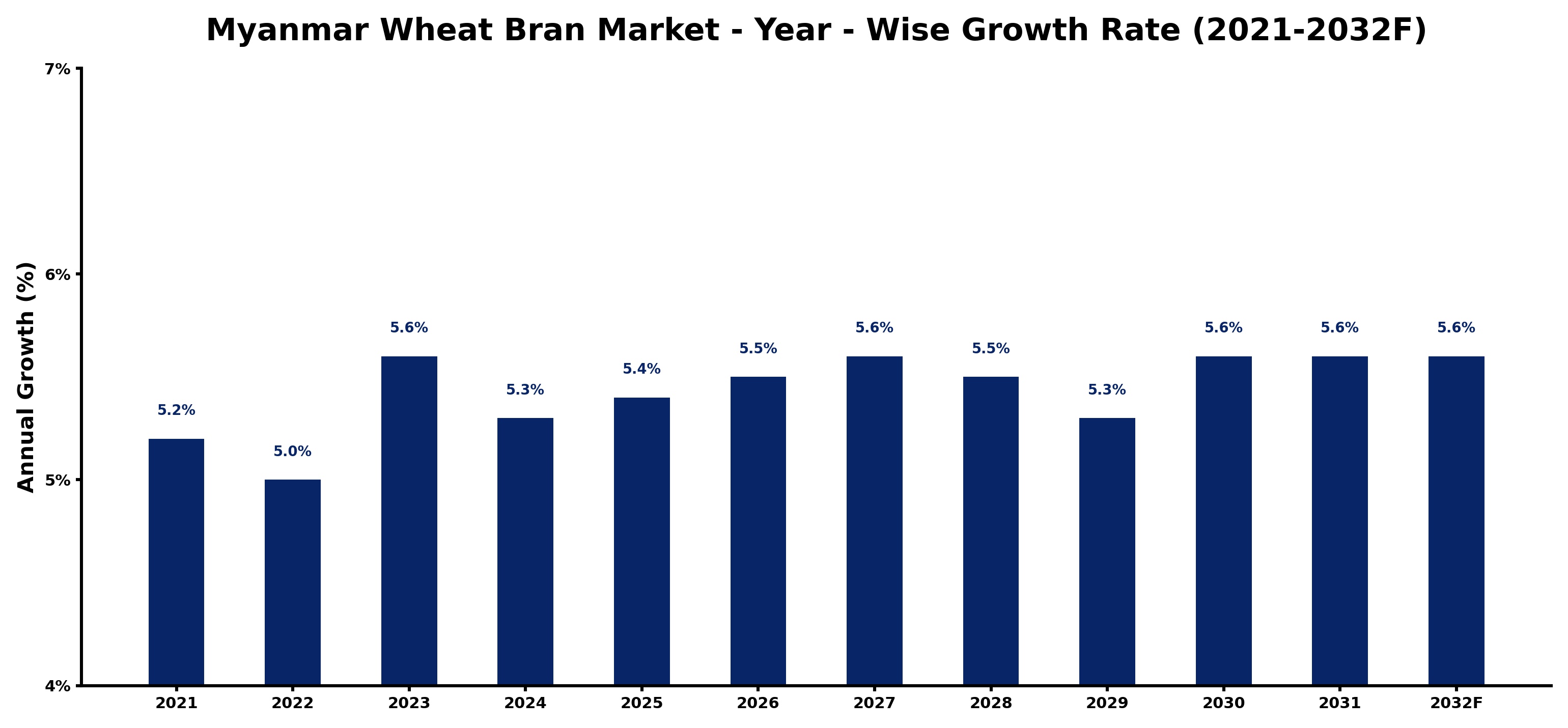
The table below presents the year‑wise growth rates along with the key drivers influencing the market
| Year | Growth Rate | Major Drivers |
| 2021 | 5.2% | Health awareness drove consumption growth |
| 2022 | 5.0% | Increased demand for nutritious options |
| 2023 | 5.6% | Rising bakery production expanded market |
| 2024 | 5.3% | Local sourcing improved supply chain |
| 2025 | 5.4% | Export opportunities enhanced market reach |
| 2026 | 5.5% | Food processing innovation attracted investment |
| 2027 | 5.6% | Consumer preference for fiber-rich diets |
| 2028 | 5.5% | Sustainable farming practices gained traction |
| 2029 | 5.3% | Collaboration with local farmers increased |
| 2030 | 5.6% | E-commerce growth expanded customer base |
| 2031 | 5.6% | Nutritional education boosted product awareness |
| 2032 | 5.6% | Diversified product offerings attracted consumers |
Note - Market size estimations and growth projections presented in this report are based on 6Wresearch’s advanced forecasting approach, validated with industry datasets as of June 2026.
Myanmar Wheat Bran Market Synopsis
In recent years, the Myanmar Wheat Bran Market has experienced a notable uptick in demand, particularly within the health food segment. Consumers are increasingly recognizing the benefits of incorporating wheat bran into their diets, thanks to its rich fiber content and nutritional value.
Moreover, as the livestock industry flourishes, wheat bran is becoming an indispensable component of animal feed formulations. This dual demand from both health-conscious consumers and livestock producers establishes a robust foundation for market growth.
Myanmar Wheat Bran Market Key Takeaways
- The market is bolstered by rising consumer awareness of health and wellness.
- Wheat bran is gaining traction as a nutrient-rich ingredient in both food products and animal feed.
- Quality control and processing improvements are essential for maintaining nutritional value.
- Government policies favoring agricultural growth enhance market prospects.
- Import dependency for raw materials highlights a potential vulnerability in the market.
Evaluation of Restraints in Myanmar Wheat Bran Market
Despite the promising growth potential, the Myanmar Wheat Bran Market faces several challenges that could impede its progress. A significant constraint is the limited availability of quality raw materials, which often forces producers to rely on imports. This dependency can lead to price fluctuations, impacting profitability and market stability. Furthermore, the lack of advanced processing and storage facilities poses a threat to preserving the nutritional quality of wheat bran, ultimately affecting consumer trust and demand.
Myanmar Wheat Bran Market Trends
Several current trends are shaping the Myanmar Wheat Bran Market. Notably, there's a rising inclination towards organic and health-oriented food products, prompting food manufacturers to incorporate wheat bran as a natural source of fiber. The increasing popularity of plant-based diets is further amplifying the demand for wheat bran in both human consumption and livestock feed. Additionally, innovative processing technologies are emerging, aimed at enhancing the quality and shelf life of wheat bran, making it more appealing to consumers and producers alike.
Myanmar Wheat Bran Market Opportunities
Opportunities for investment and growth abound in the Myanmar Wheat Bran Market. The ongoing expansion of the livestock sector presents a significant avenue for increased consumption of wheat bran in animal feed formulations. Additionally, the health and wellness trend offers a lucrative opportunity for new product development that incorporates wheat bran into cereals, snacks, and health supplements. This is complemented by rising consumer demand for clean-label products, which can be leveraged by manufacturers focusing on the quality and sourcing of their ingredients.
Government Initiatives in the Myanmar Wheat Bran Market
The Myanmar government actively supports the agricultural sector, which includes initiatives to promote wheat bran production. Policies are designed to ensure food security, provide subsidies for wheat bran producers, and facilitate access to agricultural inputs for farmers. Additionally, the government is implementing quality control measures to uphold product standards, aiming to bolster consumer confidence in locally produced wheat bran.
Future Insights of the Myanmar Wheat Bran Market
Looking ahead to the period from 2026 to 2032, the Myanmar Wheat Bran Market is expected to thrive as awareness of health and wellness continues to grow. The convergence of increasing dietary fiber demand and the expanding livestock industry positions wheat bran as a critical commodity. Furthermore, ongoing government support will likely enhance production capabilities, while consumer preferences for nutritious and sustainable food options will drive innovation and diversification within the market.
Myanmar Wheat Bran Market Latest Developments (May 2025 - June 2026)
In recent months, the Myanmar Wheat Bran Market has witnessed several strategic initiatives aimed at improving production efficiency and market reach. Industry stakeholders are focusing on enhancing processing technologies to better preserve the nutritional value of wheat bran. Additionally, partnerships between local farmers and agricultural organizations are emerging to bolster the supply chain, ensuring that producers can meet the increasing demand for wheat bran both domestically and in regional markets.
Myanmar Wheat Bran Market - Key Attractiveness of the Report
- 10 Years of Market Numbers
- Historical Data Starting from 2022 to 2025
- Base Year: 2025
- Forecast Data until 2032
- Key Performance Indicators Impacting the Market
- Major Upcoming Developments and Projects
Key Highlights of the Report:
- Myanmar Wheat Bran Market Outlook
- Market Size of Myanmar Wheat Bran Market, 2025
- Forecast of Myanmar Wheat Bran Market, 2032
- Historical Data and Forecast of Myanmar Wheat Bran Revenues & Volume for the Period 2022-2032F
- Myanmar Wheat Bran Market Trend Evolution
- Myanmar Wheat Bran Market Drivers and Challenges
- Myanmar Wheat Bran Price Trends
- Myanmar Wheat Bran Porter's Five Forces
- Myanmar Wheat Bran Industry Life Cycle
- Historical Data and Forecast of Myanmar Wheat Bran Market Revenues & Volume By Product Type for the Period 2022-2032F
- Historical Data and Forecast of Myanmar Wheat Bran Market Revenues & Volume By Animal Feed Grade for the Period 2022-2032F
- Historical Data and Forecast of Myanmar Wheat Bran Market Revenues & Volume By Medical Use Grade for the Period 2022-2032F
- Historical Data and Forecast of Myanmar Wheat Bran Market Revenues & Volume By Others for the Period 2022-2032F
- Historical Data and Forecast of Myanmar Wheat Bran Market Revenues & Volume By Application for the Period 2022-2032F
- Historical Data and Forecast of Myanmar Wheat Bran Market Revenues & Volume By Food Products for the Period 2022-2032F
- Historical Data and Forecast of Myanmar Wheat Bran Market Revenues & Volume By Animal Feed for the Period 2022-2032F
- Historical Data and Forecast of Myanmar Wheat Bran Market Revenues & Volume By Pharmacuticals for the Period 2022-2032F
- Historical Data and Forecast of Myanmar Wheat Bran Market Revenues & Volume By Cosmetics for the Period 2022-2032F
- Historical Data and Forecast of Myanmar Wheat Bran Market Revenues & Volume By Others for the Period 2022-2032F
- Myanmar Wheat Bran Import Export Trade Statistics
- Market Opportunity Assessment By Product Type
- Market Opportunity Assessment By Application
- Myanmar Wheat Bran Top Companies Market Share
- Myanmar Wheat Bran Competitive Benchmarking By Technical and Operational Parameters
- Myanmar Wheat Bran Company Profiles
- Myanmar Wheat Bran Key Strategic Recommendations






































