Myanmar Winding Wire Market Size, Share & Growth Rate
The Myanmar Winding Wire Market was estimated at USD 316 Million in 2025 and is projected to reach USD 443 Million by 2032, growing at a CAGR of 4.9% from 2026 to 2032. This growth trajectory is primarily driven by the country's rapid urbanization, substantial infrastructure initiatives, and a marked increase in energy consumption across various sectors. As construction and manufacturing activities ramp up, the demand for high-quality winding wires, particularly copper for its efficiency, is expected to sustain this market momentum.
Myanmar Winding Wire Market Growth Rate Analysis (2021-2032)
The Myanmar winding wire market has shown stable growth, with a projected annual increase of 5.6% in 2021, followed by a similar rate in 2022. Demand is expected to pick up slightly in 2023 with a growth of 6.1%, driven by expanding infrastructural projects and the energy transition initiatives within the country. This trend continues, with 5.6% growth in 2024 and a rebound to 6.1% in 2025, reflecting increasing investments in renewable energy and rising consumer demand for efficient electrical products. Fluctuations from 2026 to 2032, where growth averages between 5.5% and 6.1%, indicate a market that is responding well to technological advancements and stable policy frameworks, fostering a conducive environment for future expansions.
Myanmar Winding Wire Market Year-wise Growth Rate and Key Drivers
This graph highlights how the Myanmar Winding Wire Market has steadily grown over the past five years, supported by major growth factors.
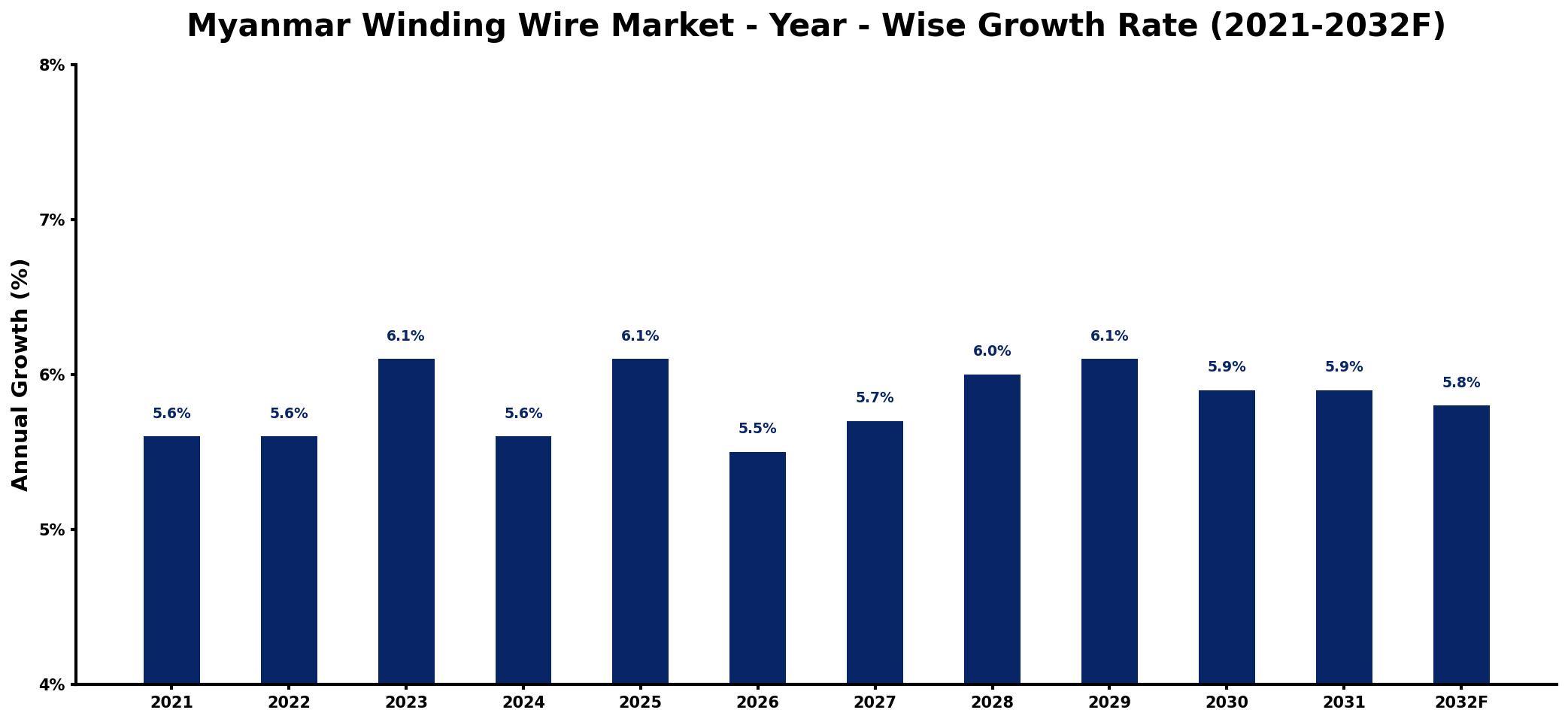
The table below presents the year‑wise growth rates along with the key drivers influencing the market
| Year | Growth Rate | Major Drivers |
| 2021 | 5.6% | Rising electrical infrastructure investments |
| 2022 | 5.6% | Growing renewable energy projects |
| 2023 | 6.1% | Increased manufacturing sector demand |
| 2024 | 5.6% | Expansion of telecommunications networks |
| 2025 | 6.1% | Surge in construction activities |
| 2026 | 5.5% | Boost in automotive production output |
| 2027 | 5.7% | Enhancement of industrial automation |
| 2028 | 6.0% | Growth in consumer electronics sales |
| 2029 | 6.1% | Development of smart grid solutions |
| 2030 | 5.9% | Increase in energy efficiency initiatives |
| 2031 | 5.9% | increased overall sector activity |
| 2032 | 5.8% | Rise in technological advancements |
Note: Market size estimations and growth projections presented in this report are based on 6Wresearch's proprietary forecasting methodology, utilizing the latest available industry data, government publications, and primary research inputs.
Myanmar Winding Wire Market Synopsis
In recent years, the Myanmar winding wire market has witnessed significant momentum, largely fueled by an expanding industrial sector and government-backed infrastructure projects. However, as the market evolves, a shift towards specialty winding wires, driven by a need for efficiency and sustainability, is anticipated to reshape industry dynamics.
As urbanization accelerates, manufacturers are increasingly investing in innovative solutions to meet the changing demands of industries such as automotive and electronics. This evolution reflects a broader trend in Myanmar's economy, which is embracing modernization while navigating challenges inherent to its growth.
Myanmar Winding Wire Market Key Takeaways
- The market is experiencing robust growth, attributed to urbanization and increased energy demands.
- Copper winding wire remains the dominant choice, although aluminum options are gaining popularity due to cost benefits.
- Investment in renewable energy projects is driving demand for specialty winding wires.
- Challenges such as quality inconsistencies and regulatory uncertainties persist in the market landscape.
- Government initiatives are aiming to bolster local manufacturing and establish quality standards.
Evaluation of Restraints in Myanmar Winding Wire Market
The Myanmar winding wire market faces several key constraints, notably the inconsistent quality of raw materials, which can hinder production efficiency and product reliability. Limited technological advancement in manufacturing processes often results in lower overall efficiency. Additionally, logistical challenges related to infrastructure can impact distribution and accessibility of winding wire products. The lack of standardized regulations and certifications creates further complications, especially when competing with imported alternatives. Lastly, fluctuating currency exchange rates coupled with ongoing political uncertainties introduce volatility, potentially disrupting market stability.
Myanmar Winding Wire Market Trends
Currently, there is a notable trend toward the adoption of high-quality winding wires, particularly in sectors that prioritize energy efficiency and durability. The shift towards copper wires is largely due to their superior conductivity, with manufacturers actively enhancing thermal and electrical properties to meet end-user specifications. Moreover, the growing emphasis on sustainable production practices is prompting companies to innovate, leading to the development of specialty winding wires tailored for specific applications, particularly in the renewable energy sector.
Myanmar Winding Wire Market Opportunities
As Myanmars industrial landscape expands, significant investment opportunities are emerging within the winding wire market. The government's commitment to developing electrical infrastructure and attracting foreign investments indicates a favorable environment for local manufacturers and distributors. Furthermore, there is substantial potential for introducing advanced manufacturing technologies that emphasize efficiency and sustainability, positioning companies to gain a competitive edge as demand for reliable electrical equipment continues to rise.
Government Initiatives in the Myanmar Winding Wire Market
Government policies regarding the winding wire market include measures aimed at enhancing quality standards, implementing import/export regulations, and ensuring environmental compliance. These initiatives are designed to safeguard consumer interests while promoting a competitive marketplace. By fostering local production and establishing clear guidelines, the government is actively working to encourage growth within the sector and attract both domestic and international investments.
Future Insights of the Myanmar Winding Wire Market
Looking ahead, the Myanmar winding wire market is set to experience moderate to strong growth through 2032, driven by ongoing investments in infrastructure development, industrialization, and the transition to renewable energy sources. The demand for winding wire is likely to increase as modernization efforts in electrical infrastructure expand. However, stakeholders must remain vigilant regarding potential risks, including raw material price fluctuations and evolving regulatory landscapes. Overall, the market presents a landscape rich with opportunities for strategic growth and innovation.
Myanmar Winding Wire Market Latest Developments (2025 - 2026)
Recent developments in the Myanmar winding wire market indicate a strong focus on sustainability and innovation. Manufacturers are increasingly exploring advanced materials and production techniques to enhance the efficiency of winding wires. Additionally, there is a notable increase in collaborative efforts among industry players to set quality benchmarks and improve manufacturing standards, responding to both domestic and international market demands. These initiatives reflect a broader trend towards modernization and competitiveness in the sector.
Myanmar Winding Wire Market - Key Attractiveness of the Report
- 10 Years of Market Numbers
- Historical Data Starting from 2022 to 2025
- Base Year: 2025
- Forecast Data until 2032
- Key Performance Indicators Impacting the Market
- Major Upcoming Developments and Projects
Key Highlights of the Report:
- Myanmar Winding Wire Market Outlook
- Market Size of Myanmar Winding Wire Market, 2025
- Forecast of Myanmar Winding Wire Market, 2032
- Historical Data and Forecast of Myanmar Winding Wire Revenues & Volume for the Period 2022-2032F
- Myanmar Winding Wire Market Trend Evolution
- Myanmar Winding Wire Market Drivers and Challenges
- Myanmar Winding Wire Price Trends
- Myanmar Winding Wire Porter's Five Forces
- Myanmar Winding Wire Industry Life Cycle
- Historical Data and Forecast of Myanmar Winding Wire Market Revenues & Volume By Product for the Period 2022-2032F
- Historical Data and Forecast of Myanmar Winding Wire Market Revenues & Volume By Copper Winding Wire for the Period 2022-2032F
- Historical Data and Forecast of Myanmar Winding Wire Market Revenues & Volume By Aluminum Winding Wire for the Period 2022-2032F
- Myanmar Winding Wire Import Export Trade Statistics
- Market Opportunity Assessment By Product
- Myanmar Winding Wire Top Companies Market Share
- Myanmar Winding Wire Competitive Benchmarking By Technical and Operational Parameters
- Myanmar Winding Wire Company Profiles
- Myanmar Winding Wire Key Strategic Recommendations






































