Myanmar Wood Charcoal Market Size, Share & Growth Rate
The Myanmar Wood Charcoal Market was estimated at USD 397 Million in 2025 and is projected to reach USD 486 Million by 2032, growing at a CAGR of 2.9% from 2026 to 2032. This growth trajectory is significantly influenced by the increasing domestic demand for high-quality charcoal, particularly in cooking and heating applications. Additionally, the burgeoning hospitality and food service sectors are further stimulating market expansion, reinforcing the importance of sustainable and eco-friendly fuel sources.
Myanmar Wood Charcoal Market Growth Rate Analysis (2021-2032)
The Myanmar wood charcoal market has experienced a steady decline, with growth rates gradually decreasing from 5.1% in 2021 to an anticipated 1.8% by 2032. This downturn can be attributed to increasing pressures from sustainable energy transitions and a shift towards alternative fuel sources, driven by evolving consumer demand for cleaner energy options. Moreover, technological advancements in both industrial processes and cleaner energy alternatives have shifted focuses away from traditional charcoal production. The government’s regulatory policies aimed at curbing deforestation further contribute to this contraction. As the market adjusts, stakeholders must navigate these challenges while exploring innovative solutions to align with global sustainability trends.
Myanmar Wood Charcoal Market Year-wise Growth Rate and Key Drivers
This graph highlights how the Myanmar Wood Charcoal Market has steadily grown over the past five years, supported by major growth factors.
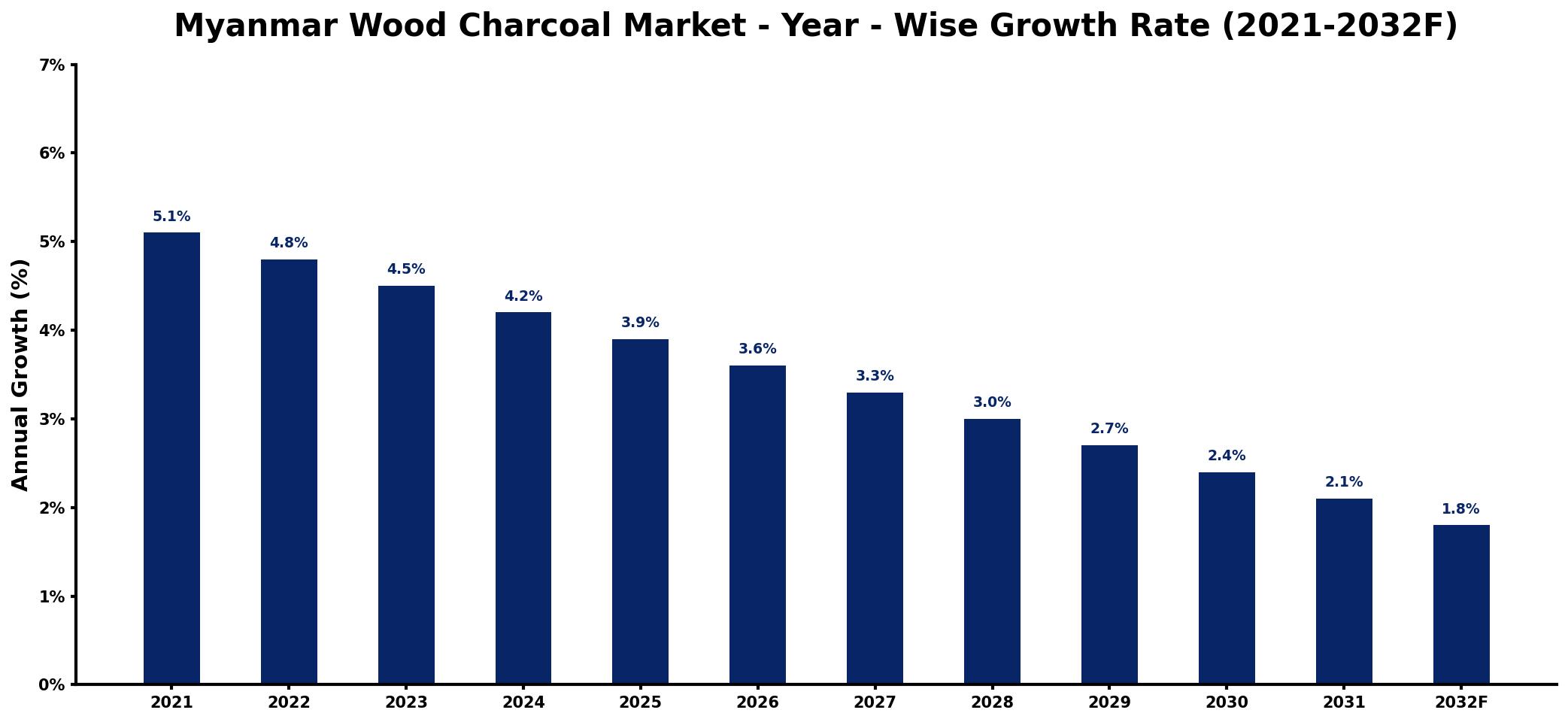
The table below presents the year‑wise growth rates along with the key drivers influencing the market
| Year | Growth Rate | Major Drivers |
| 2021 | 5.1% | Rising demand for eco-friendly fuel |
| 2022 | 4.8% | Increased investment in sustainable energy |
| 2023 | 4.5% | Growing popularity of outdoor grilling |
| 2024 | 4.2% | Expansion of rural cooking solutions |
| 2025 | 3.9% | Higher exports to neighboring countries |
| 2026 | 3.6% | Emerging market for bioenergy products |
| 2027 | 3.3% | Strengthening local production capabilities |
| 2028 | 3.0% | Diversification into renewable energy sources |
| 2029 | 2.7% | Surge in urban cooking preferences |
| 2030 | 2.4% | Enhanced distribution network efficiency |
| 2031 | 2.1% | growing automotive sector requirements |
| 2032 | 1.8% | Growing interest in carbon offsetting |
Note: Market size estimations and growth projections presented in this report are based on 6Wresearch's proprietary forecasting methodology, utilizing the latest available industry data, government publications, and primary research inputs.
Myanmar Wood Charcoal Market Synopsis
The most substantial force currently shaping the Myanmar Wood Charcoal Market is the rising consumer preference for sustainable and eco-friendly fuel options. As awareness of environmental issues grows, more consumers are turning to wood charcoal as a cleaner alternative to fossil fuels and other sources of energy.
Furthermore, traditional charcoal-making practices rooted in Myanmar's culture continue to thrive, ensuring a consistent supply of wood charcoal. This cultural significance, combined with the nation's abundant forestry resources, positions the market for steady growth, catering to both local consumption and export needs.
Myanmar Wood Charcoal Market Key Takeaways
- The market is driven by increasing demand for high-quality wood charcoal in various applications.
- Emerging trends favoring sustainable energy sources are reshaping consumer behavior in Myanmar.
- The hospitality and food service sectors are significant contributors to market growth.
- Government policies promote sustainable practices in charcoal production, enhancing market viability.
- Raw material availability and competition from alternative fuels remain critical factors to watch.
Evaluation of Restraints in Myanmar Wood Charcoal Market
Despite the promising outlook, the Myanmar Wood Charcoal Market faces several challenges that could hinder its growth. One of the primary restraints is the fluctuating availability and cost of high-quality raw materials needed for charcoal production. Furthermore, the emergence of alternative fuel sources presents competitive pressures, which may divert consumer interest away from wood charcoal. Regulatory compliance, while necessary for sustainability, often imposes constraints on production capabilities and operational efficiencies.
Myanmar Wood Charcoal Market Trends
Current trends in the Myanmar Wood Charcoal Market indicate a notable shift towards eco-friendly charcoal products, such as those derived from sustainably managed forests. Furthermore, technological advancements in charcoal production, particularly in the areas of pyrolysis and carbonization, are enhancing efficiency and product quality. The growing popularity of barbecue culture is also driving demand for specialized charcoal products tailored to culinary applications.
Myanmar Wood Charcoal Market Opportunities
Opportunities for growth in the Myanmar Wood Charcoal Market lie significantly in the export sector. With increasing global demand for sustainable fuel sources, Myanmar can capitalize on its rich forestry resources and traditional production methods. Additionally, innovations in production technologies and collaborations with environmental organizations can pave the way for enhanced market presence and sustainability.
Government Initiatives in the Myanmar Wood Charcoal Market
The Myanmar government plays a pivotal role in shaping the Wood Charcoal Market through regulations aimed at promoting sustainable practices. Policies include issuing licenses for charcoal production, enforcing strict harvesting quotas to combat deforestation, and implementing measures to reduce environmental pollution. Such initiatives not only support responsible resource management but also enhance the market's credibility on both domestic and international fronts.
Future Insights of the Myanmar Wood Charcoal Market
Looking ahead to the period between 2026 and 2032, the Myanmar Wood Charcoal Market is poised for continued development driven by increasing awareness of sustainability and environmental stewardship. The interplay of consumer preferences for high-quality charcoal products and governmental support for sustainable forestry practices will likely yield a robust market landscape. Additionally, evolving consumption patterns and potential new export opportunities could further reinforce growth, positioning Myanmar as a significant player in the global wood charcoal arena.
Myanmar Wood Charcoal Market Latest Developments (2025 - 2026)
In the recent months, the Myanmar Wood Charcoal Market has seen a surge in interest from both local producers and international buyers, particularly as sustainability becomes a top priority globally. Discussions surrounding enhanced production technologies and collaborations focused on sustainable practices have gained momentum. Moreover, local industries are increasingly adopting eco-friendly standards, which may lead to a transformative shift in how wood charcoal is produced and marketed in the coming years.
Myanmar Wood Charcoal Market - Key Attractiveness of the Report
- 10 Years of Market Numbers
- Historical Data Starting from 2022 to 2025
- Base Year: 2025
- Forecast Data until 2032
- Key Performance Indicators Impacting the Market
- Major Upcoming Developments and Projects
Key Highlights of the Report:
- Myanmar Wood Charcoal Market Outlook
- Market Size of Myanmar Wood Charcoal Market, 2025
- Forecast of Myanmar Wood Charcoal Market, 2032
- Historical Data and Forecast of Myanmar Wood Charcoal Revenues & Volume for the Period 2022-2032F
- Myanmar Wood Charcoal Market Trend Evolution
- Myanmar Wood Charcoal Market Drivers and Challenges
- Myanmar Wood Charcoal Price Trends
- Myanmar Wood Charcoal Porter's Five Forces
- Myanmar Wood Charcoal Industry Life Cycle
- Historical Data and Forecast of Myanmar Wood Charcoal Market Revenues & Volume By Product for the Period 2022-2032F
- Historical Data and Forecast of Myanmar Wood Charcoal Market Revenues & Volume By Charcoal Lumps for the Period 2022-2032F
- Historical Data and Forecast of Myanmar Wood Charcoal Market Revenues & Volume By Charcoal Briquettes for the Period 2022-2032F
- Historical Data and Forecast of Myanmar Wood Charcoal Market Revenues & Volume By Charcoal Powder for the Period 2022-2032F
- Historical Data and Forecast of Myanmar Wood Charcoal Market Revenues & Volume By Wood for the Period 2022-2032F
- Historical Data and Forecast of Myanmar Wood Charcoal Market Revenues & Volume By Softwood for the Period 2022-2032F
- Historical Data and Forecast of Myanmar Wood Charcoal Market Revenues & Volume By Hardwood for the Period 2022-2032F
- Historical Data and Forecast of Myanmar Wood Charcoal Market Revenues & Volume By Application for the Period 2022-2032F
- Historical Data and Forecast of Myanmar Wood Charcoal Market Revenues & Volume By Fuel Feedstock for the Period 2022-2032F
- Historical Data and Forecast of Myanmar Wood Charcoal Market Revenues & Volume By Reducing Agent for the Period 2022-2032F
- Historical Data and Forecast of Myanmar Wood Charcoal Market Revenues & Volume By Filtration Agent & Gas Masking for the Period 2022-2032F
- Historical Data and Forecast of Myanmar Wood Charcoal Market Revenues & Volume By Decolorizing Agent for the Period 2022-2032F
- Historical Data and Forecast of Myanmar Wood Charcoal Market Revenues & Volume By Gastric Medicine for the Period 2022-2032F
- Historical Data and Forecast of Myanmar Wood Charcoal Market Revenues & Volume By Sketches & Paints for the Period 2022-2032F
- Historical Data and Forecast of Myanmar Wood Charcoal Market Revenues & Volume By Soil Conditioning for the Period 2022-2032F
- Historical Data and Forecast of Myanmar Wood Charcoal Market Revenues & Volume By Others for the Period 2022-2032F
- Historical Data and Forecast of Myanmar Wood Charcoal Market Revenues & Volume By End Use for the Period 2022-2032F
- Historical Data and Forecast of Myanmar Wood Charcoal Market Revenues & Volume By Residential for the Period 2022-2032F
- Historical Data and Forecast of Myanmar Wood Charcoal Market Revenues & Volume By Cooking Fuel for the Period 2022-2032F
- Historical Data and Forecast of Myanmar Wood Charcoal Market Revenues & Volume By Gardening for the Period 2022-2032F
- Historical Data and Forecast of Myanmar Wood Charcoal Market Revenues & Volume By Commercial Paints & Sketches for the Period 2022-2032F
- Historical Data and Forecast of Myanmar Wood Charcoal Market Revenues & Volume By Water Treatment for the Period 2022-2032F
- Historical Data and Forecast of Myanmar Wood Charcoal Market Revenues & Volume By Industrial for the Period 2022-2032F
- Myanmar Wood Charcoal Import Export Trade Statistics
- Market Opportunity Assessment By Product
- Market Opportunity Assessment By Wood
- Market Opportunity Assessment By Application
- Market Opportunity Assessment By End Use
- Myanmar Wood Charcoal Top Companies Market Share
- Myanmar Wood Charcoal Competitive Benchmarking By Technical and Operational Parameters
- Myanmar Wood Charcoal Company Profiles
- Myanmar Wood Charcoal Key Strategic Recommendations






































